A procurement team at a mid-sized manufacturer releases an $80,000 payment in USD to a supplier in Vietnam. The buyer expects the money to arrive within two business days, but the supplier sees a smaller amount, the invoice remains open in the accounting system, and nobody can immediately explain whether the delay came from compliance review, foreign exchange, an intermediary bank, or local clearing.
That situation captures the core challenge of B2B cross-border payments. The payment instruction is only the visible starting point. Behind it sit currency decisions, banking relationships, screening rules, settlement calendars, data handoffs, and treasury controls. A reliable operating model maps every stage instead of treating an international payment as a larger domestic transfer.
Table of Contents
Why B2B Cross Border Payments Are Harder Than They Look
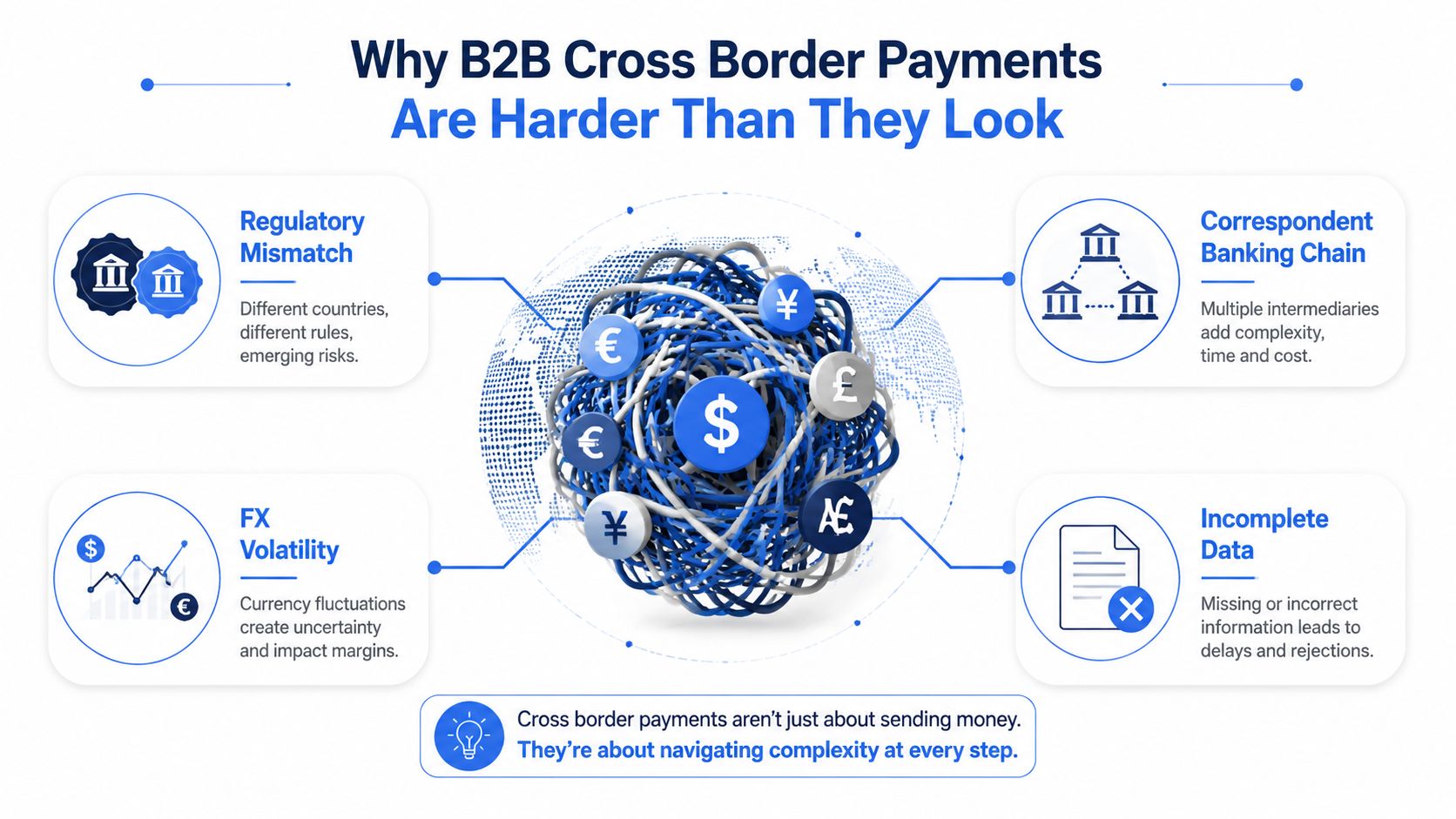
The finance team may see a confirmation screen that says “payment submitted.” The supplier's bank sees a message that must be validated, screened, routed, converted, and credited. Those are different events, and the gap between them creates most of the confusion.
Before release, accounts payable still needs to confirm that the invoice matches the purchase order, that the beneficiary details are current, and that the payment currency follows the commercial agreement. The treasury team may also need to decide whether to buy currency immediately or fund the transaction later. A rate can move between approval and execution, even when the invoice amount never changes.
The payment then enters a network that may include the originating bank, one or more correspondent banks, a local clearing system, and the beneficiary bank. Each participant can apply its own validation, cut-off, screening, or fee process. A payment may arrive with deductions because intermediary charges were taken from the amount in transit, while a missing purpose code or incomplete beneficiary address can send it into manual review.
Practical rule: Treat the payment record, the settlement event, and the reconciliation event as separate milestones.
The scale makes these details more important. The global B2B cross-border payments market was estimated at $31.6 trillion in 2024 and projected to reach $50.0 trillion by 2032, representing 58% growth over the period and a 5.9% CAGR, according to FXC Intelligence's B2B cross-border payments market analysis. This isn't a niche flow. It supports procurement, trade, payroll, treasury, and supplier relationships across the global economy.
The right mental model is a multi-stage operational workflow. Teams that understand each stage can prevent avoidable failures, assign ownership, and explain delays to suppliers with evidence instead of guesses.
How a B2B Cross Border Payment Moves
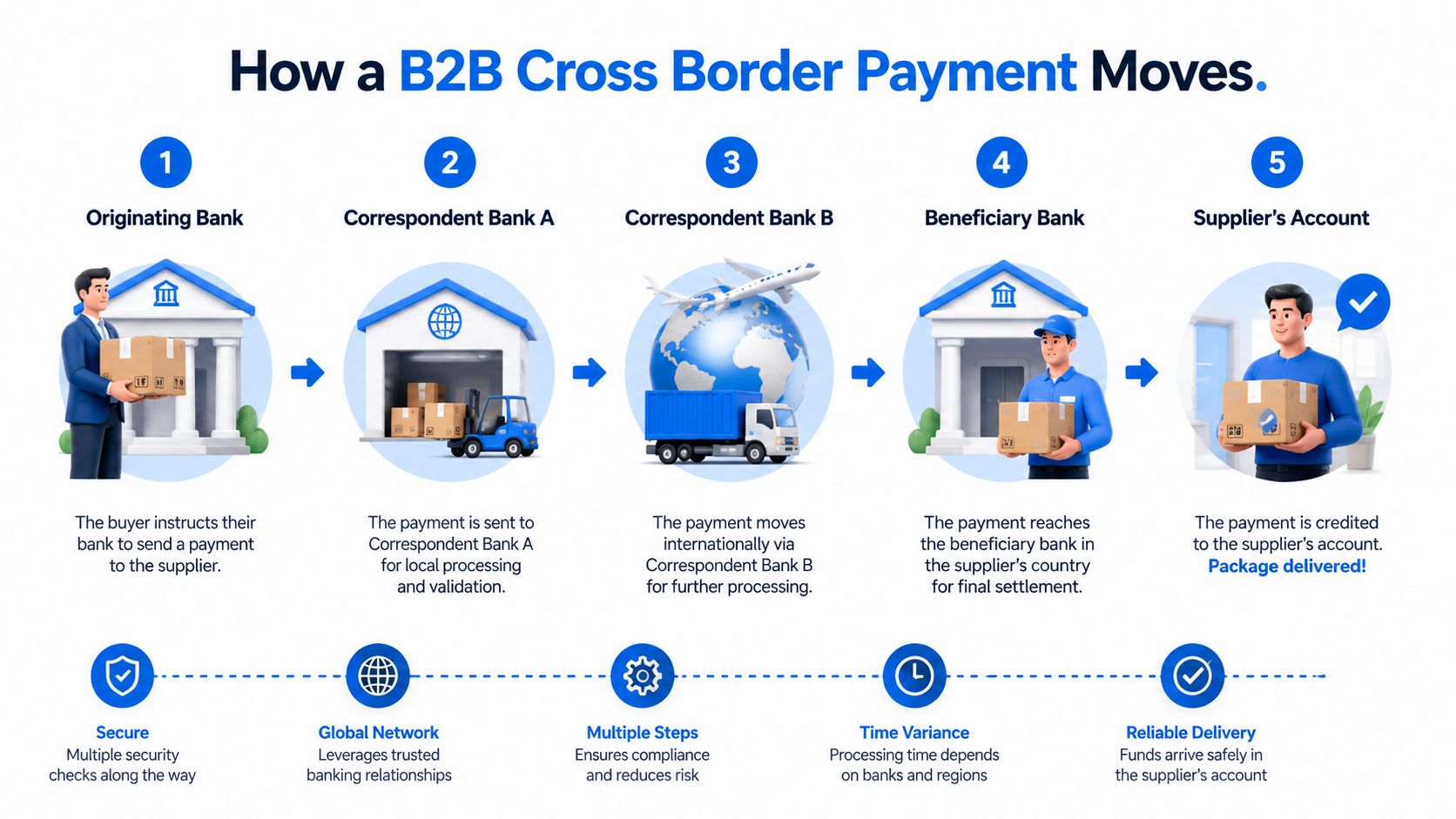
Think of an international payment as a package moving through several courier hubs. The sender hands over the package, each hub checks the label and routing information, and the final courier delivers it to the recipient. A payment message travels in a similar way, although the “package” includes money, account information, currency instructions, and compliance data.
The participants and handoffs
The accounts payable team validates the invoice, purchase order, beneficiary record, currency, amount, and requested value date. A maker may prepare the payment while a separate approver authorizes it.
The originating bank or payment provider checks the sender's account, formats the instruction, applies initial screening, and sends a payment message. Depending on the route, that message may use a SWIFT MT103 format or structured ISO 20022 data.
Correspondent banks provide access where the originating institution and beneficiary bank don't hold a direct relationship. They route the transaction through established accounts and may perform additional screening or deduct charges.
The local clearing system moves the payment through the destination country's domestic infrastructure. Its operating hours, currency rules, purpose codes, and beneficiary requirements can differ from those in the sender's market.
The beneficiary bank and supplier finance team receive the funds, apply any local deductions, post the credit, and match the remittance information to the open invoice.
A useful payment record should carry more than the account number. It may include an invoice reference, purchase-order reference, purpose code, beneficiary legal name, address, tax information, and remittance detail. Structured data matters because the receiving finance team needs to identify the payment without opening an investigation.
The BIS bulletin on the G20 cross-border payments roadmap describes the policy focus on improving speed, transparency, access, and cost by the end of 2027. Its progress reporting found that 35% of global cross-border retail payments and 55% of wholesale and remittance payments were credited within one hour of initiation, below the 75% target. For B2B operators, the lesson is simple: a payment marked as sent isn't proof of same-hour receipt.
Common exception points include rejected fields, an invalid beneficiary identifier, a compliance hold, a missed FX cut-off, and a payment that arrives without enough remittance information to match the invoice. The team that maps these handoffs can define escalation paths before the supplier starts asking for updates.
Choosing the Right Payment Rail
No single rail fits every corridor. A local clearing route may work well for a recurring supplier payment where both parties hold accounts in the same currency zone, while a SWIFT wire may remain the practical option for a high-value payment to a bank with limited local connectivity. Card settlement can suit smaller operational purchases, but it usually needs different controls from invoice-based treasury payments.
| Rail | Typical Use Case | Settlement Window | Fee Model | Best Fit |
|---|---|---|---|---|
| Domestic ACH | Recurring payments within a domestic currency system | Depends on scheme processing and cut-offs | Fixed or tiered transaction pricing | Scheduled supplier, contractor, and operating payments |
| Domestic instant rail | Time-sensitive domestic payments where the corridor supports immediate processing | Often near real time within the domestic scheme | Transaction fee or account pricing | Urgent local payouts and responsive vendor operations |
| SEPA or SEPA Instant | Euro payments within participating European markets | Standard or near real time, depending on the scheme and participant | Usually transparent scheme or provider pricing | Euro-denominated supplier and payroll flows |
| Faster Payments | Sterling payments within the UK | Near real time within supported domestic use cases | Provider or account-based fee | UK operating payments and urgent sterling transfers |
| International wire through SWIFT | High-value or less-supported international corridors | Depends on banks, intermediaries, cut-offs, and compliance checks | Wire fee, FX spread, and possible intermediary deductions | Large invoices, established bank relationships, and broad reach |
| Card-based settlement | Smaller purchases, travel, subscriptions, and recurring operating spend | Authorization is quick, while final posting follows the card process | Merchant pricing, card fees, and possible FX costs | Controlled employee or vendor spend |
| Crypto-compatible settlement | Corridors where digital-asset movement is acceptable and counterparties can receive or convert it | Depends on the asset, network, provider, compliance checks, and payout route | Network, conversion, custody, and payout costs | Web3 operations and selected time-sensitive flows |
Bank rails continue to dominate high-value B2B activity. Industry analysis cited in the BIS roadmap progress material expected wire transfers to represent 80% of B2B cross-border transaction value by 2026, compared with 70% in 2021. That doesn't make wires universally better. It shows that bank connectivity, acceptance, accounting familiarity, and regulatory infrastructure still matter.
Digital-asset settlement introduces a different set of questions. The sender must verify the network, asset, wallet, conversion route, sanctions controls, custody responsibilities, and fiat payout process. A fast blockchain confirmation doesn't automatically mean the supplier has usable local currency in its bank account.
Most mature teams run a portfolio of rails. They choose by corridor, invoice currency, urgency, amount, counterparty preference, data requirements, and fallback availability. Rail selection is an operating decision, not a one-time platform decision.
Understanding FX and Currency Settlement
Foreign exchange begins before anyone clicks “send.” The commercial team and supplier first decide which currency appears on the invoice. Treasury then determines how much currency to buy, when to quote the rate, where to hold the funds, and which party absorbs the conversion cost.
Suppose a supplier issues an invoice for $100,000. That number alone doesn't tell treasury the final economic cost. The result depends on whether the buyer funds USD directly, converts from another currency, uses a contractually agreed rate, accepts the provider's quoted spread, or asks the supplier to receive its local currency. The recipient may also receive less after intermediary charges, payout fees, or rounding.
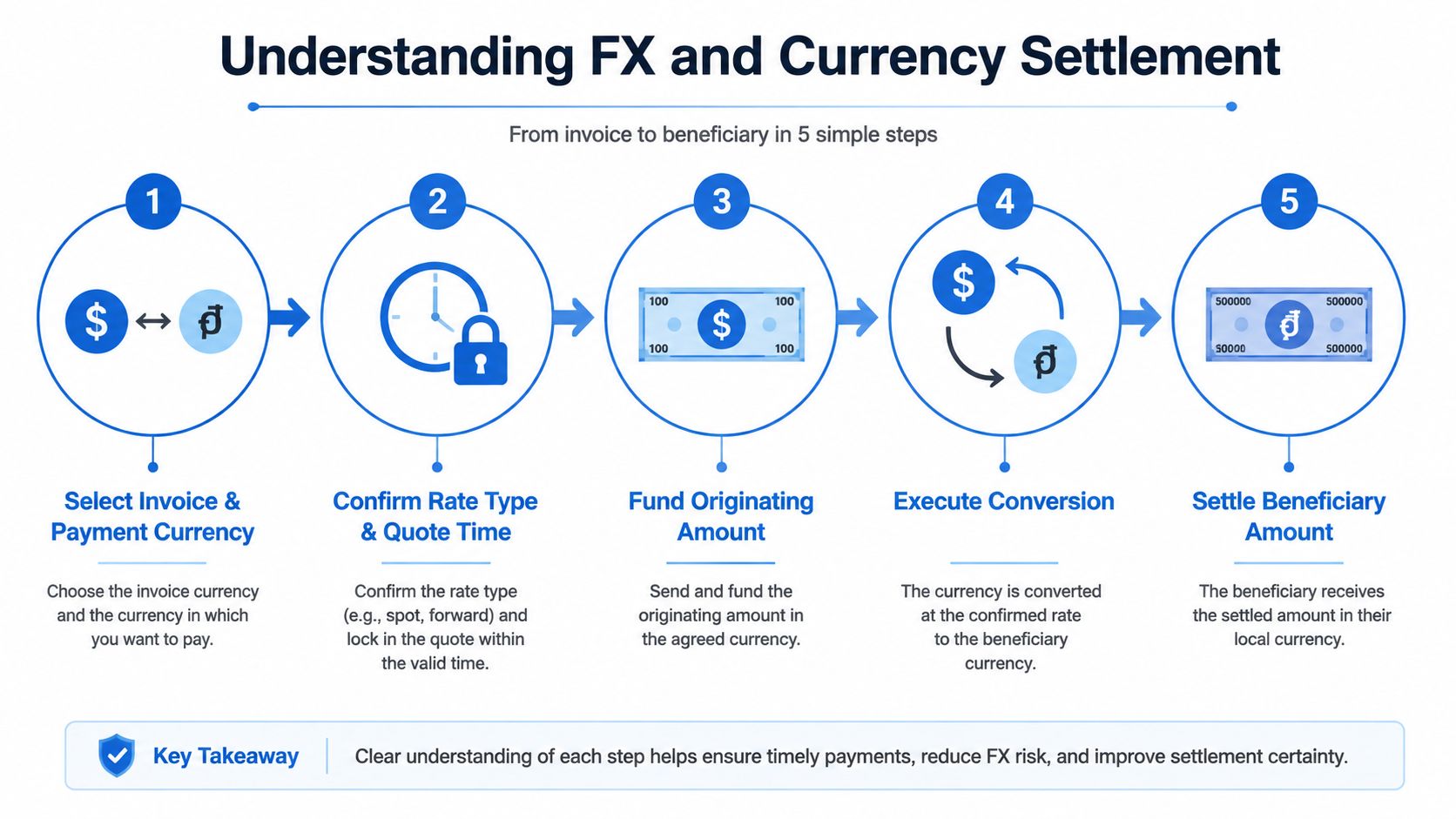
The FX lifecycle
- Select the invoice and payment currency. Confirm whether the contract requires USD, the supplier's local currency, or another agreed currency.
- Confirm the quote type and time. Identify whether the rate is indicative, executable, or locked, and record when the quote expires.
- Fund the originating amount. Treasury supplies the currency needed for the conversion or payment.
- Execute the conversion. A bank, FX provider, correspondent route, or digital-asset conversion path exchanges the funds.
- Settle the beneficiary amount. The destination bank or payout provider credits the agreed account after applicable deductions.
A rate lock protects a quoted exchange rate for a defined process, but it doesn't erase every downstream variable. The beneficiary amount can still differ if the route applies fees, if another institution deducts a charge, or if the payment uses a different value date. Likewise, a message that moves quickly doesn't prove that the FX conversion or final bank credit happened at the same speed.
Treasury should record five fields for every material conversion: the quoting currency, reference amount, beneficiary amount, rate and spread, and value date. Those fields let the team explain differences between the invoice, the amount debited, and the amount received.
Spot conversion suits immediate needs. A forward can support a known future obligation, while a limit order may help a team wait for a chosen rate. Net settlement can reduce the number of gross transfers between related entities, but it requires strong intercompany records and approval controls.
For businesses managing several currencies, a multi-currency business account can provide a place to hold balances and organize currency-specific payment activity. The team still needs to assess the account structure, conversion terms, partner institutions, and corridor coverage independently.
The FSB progress report on cross-border payments found that B2B transactions averaged 1.4% in total cost in 2025, with average fees of 0.2% and most of the remaining cost driven by the FX spread. That distinction changes the conversation. Reducing the visible transfer fee may have less effect than comparing the delivered exchange rate against a transparent reference rate.
Managing Compliance and Treasury Risk
A payment should pass through a control environment, not arrive at compliance as a last-minute obstacle. The first control point is counterparty onboarding. The business needs verified legal identity, ownership information, bank details, expected activity, and a documented reason for the relationship.
The next layer covers transaction-specific checks. Accounts payable should match the invoice to the purchase order, verify the beneficiary against an approved record, and confirm required tax or purpose documentation. Compliance should screen the parties, relevant addresses, and transaction context under the rules that apply to the entities and jurisdictions involved.
Assign owners before release
A practical workflow separates preparation from authorization. One employee creates the payment, another approves it, and the system preserves the evidence. A whitelist can restrict payments to verified beneficiaries, while a maker-checker process reduces the chance that one compromised account can change a bank record and release funds.
Teams should also define what happens after submission. Sanctions lists and risk signals can change, a bank can request additional documents, and a payment can enter manual review. The owner of each exception should know whether to contact the bank, procurement, the supplier, legal counsel, or the compliance team.
The Polytreasury guide to KYC rules offers useful background for teams documenting customer and counterparty verification procedures. Requirements still vary by jurisdiction, provider, transaction type, and business model, so legal and compliance professionals should validate the operating design before launch.
| Risk Area | Required Control | Primary Owner | Evidence |
|---|---|---|---|
| Counterparty identity | KYB, ownership review, and approved vendor record | Compliance and procurement | Onboarding file and approval history |
| Sanctions and financial crime | Screening at onboarding and payment release | Compliance | Screening result and escalation record |
| Beneficiary fraud | Verified bank details, change controls, and callback procedures | Accounts payable | Bank-detail verification log |
| Invoice integrity | Invoice, purchase-order, and goods or service matching | Accounts payable | Matching record and exception note |
| Payment authority | Dual approval, role separation, and defined limits | Finance leadership | Approval trail |
| Liquidity and currency | Currency forecasts, balance thresholds, and exposure review | Treasury | Forecast, position report, and funding record |
| Settlement exposure | Review of banks, providers, custodians, and fallback routes | Treasury and risk | Counterparty assessment |
| Reconciliation | Matching by invoice, batch, currency, and value date | Finance operations | Reconciliation report and unapplied-cash log |
Treasury risk extends beyond FX. A company can concentrate liquidity with one provider, hold currency that it can't deploy easily, or depend on a settlement bank with no practical alternative. The global treasury management framework should therefore connect cash visibility, authority segregation, counterparty limits, and reconciliation rather than treating each as a separate project.
Calculating Cost Timing and Working Capital
The advertised transfer fee is only one line in the payment economics. A useful calculation starts with the invoice amount and adds every cost required to deliver the expected beneficiary amount.
| Cost Component | Bank Transfer | Local Clearing | Digital-Asset or Hybrid |
|---|---|---|---|
| Originating debit | Bank account debit and possible service charge | Local account debit and scheme charge | Fiat or digital-asset funding cost |
| FX | Bank or correspondent spread | Local conversion spread where currency changes | Conversion spread between fiat and digital asset |
| Intermediary deductions | Possible correspondent and beneficiary-bank charges | Usually fewer cross-border intermediaries | Provider, custody, network, and payout charges |
| Network or scheme cost | Wire or messaging-related pricing | Domestic scheme or provider pricing | Blockchain network and service pricing |
| Liquidity cost | Cash tied up during routing and value-date uncertainty | Lower when local balances are available | Depends on prefunding, conversion, and payout timing |
| Operational effort | Repairs, tracking, and manual reconciliation | Simpler when data is standardized | Wallet, asset, compliance, and fiat-payout controls |
Use a simple decision model:
All-in cost = amount debited + FX cost + transfer and intermediary charges + funding cost + operational effort cost.
Then compare it with four outputs: net beneficiary receipt, all-in home-currency cost, expected settlement time, and exception workload. A low-fee route that creates repeated repairs may be more expensive than a transparent route that posts cleanly to the ledger.
Timing belongs in the calculation because cash can remain unavailable while a payment moves through cut-offs, weekends, local holidays, document repair, compliance review, or an intermediary currency. The 2025 SME cross-border settlement research reported that each day of settlement delay costs SMEs 0.6% to 2.1% of transaction value, and noted that some firms lost contracts when funds arrived late. The same source reported that, in Brazil, 80% of cross-border payments took more than four days, one in five took more than ten days, and a $250 transfer could face average fees of 23.3%, depending on destination.
For a low-value urgent payment, a local or hybrid route may justify its added conversion work. A high-value invoice may favor a bank rail with stronger documentation and established counterparty acceptance. Recurring supplier payments need templates, predictable cut-offs, and automated reconciliation. Digital-asset settlement can fit a web3 counterparty, but only after the team prices conversion, custody, sanctions screening, and fiat payout.
Measure more than price and speed. Track payment exceptions, unapplied cash, quoted-versus-executed FX, forecast variance, failed instructions, and manual handling time. Those measures reveal whether a rail is helping the whole workflow.
Using OneSafe for Unified Global Payments
A unified operating model places multi-currency accounts, payment workflows, APIs, and crypto-compatible settlement in one treasury interface. Finance teams can then evaluate a supplier invoice against several possible routes without maintaining separate operational records across unrelated portals.
OneSafe's business account for international payments can sit within that type of workflow for companies that need fiat and digital-asset payment activity organized together. Its role should be understood precisely: the platform provides the interface, workflow, analytics, and ledger layer, while regulated banking, custody, FX, and payment services are delivered through licensed partners.
Separate platform functions from regulated execution
| Capability | Provided by OneSafe Platform | Delivered by Licensed Partners |
|---|---|---|
| Account and payment workflow | User interface, payment instructions, roles, and approval routing | Banking account services and payment execution |
| Multi-currency operations | Balance visibility, transaction organization, and reference data | Currency accounts, local connectivity, and settlement |
| Fiat transfers | Workflow for ACH, domestic wires, international wires, and SWIFT activity | Licensed banks and payment institutions |
| Crypto-compatible activity | Digital-asset workflow, conversion visibility, and transaction records | Custody, exchange, network access, and regulated payout services |
| Compliance operations | Data collection, workflow controls, and audit records | KYB, sanctions, transaction monitoring, and jurisdiction-specific obligations |
| Reconciliation | Shared references, transaction history, and matching workflows | Bank and partner settlement files |
Treasury can choose traditional settlement for one invoice and a stablecoin-compatible path for another, but the approval record should explain why. The team should review the licensed partner, geographic coverage, custody model, sanctions controls, service-level terms, supported currencies, and fallback route before production use.
ISO 20022 is especially relevant to the unified-ledger concept. SWIFT confirmed that the MT and ISO 20022 coexistence period ended on 22 November 2025, and explained that richer structured data supports straight-through processing and reduces exceptions through better information quality in its ISO 20022 migration guidance. For finance teams, the practical value is cleaner screening and more dependable invoice-to-payment matching, not merely a newer message format.
Implementing a Resilient Payment Workflow
Start with evidence, not a platform demo. Export recent payment records and map currencies, corridors, beneficiaries, settlement routes, exceptions, unapplied cash, and manual interventions. The aim is to identify where the current process breaks before choosing a replacement or adding a new rail.
A staged rollout
- Map current volumes and exceptions. Separate recurring supplier payments from urgent, high-value, unusual, and digital-asset activity.
- Standardize vendor records. Create required fields for legal name, address, bank details, invoice currency, purpose, tax documents, and approved contacts.
- Create payment templates. Predefine corridor, currency, beneficiary, remittance, cut-off, and fallback information.
- Define approval matrices. Assign preparation, approval, compliance escalation, treasury funding, and reconciliation responsibilities.
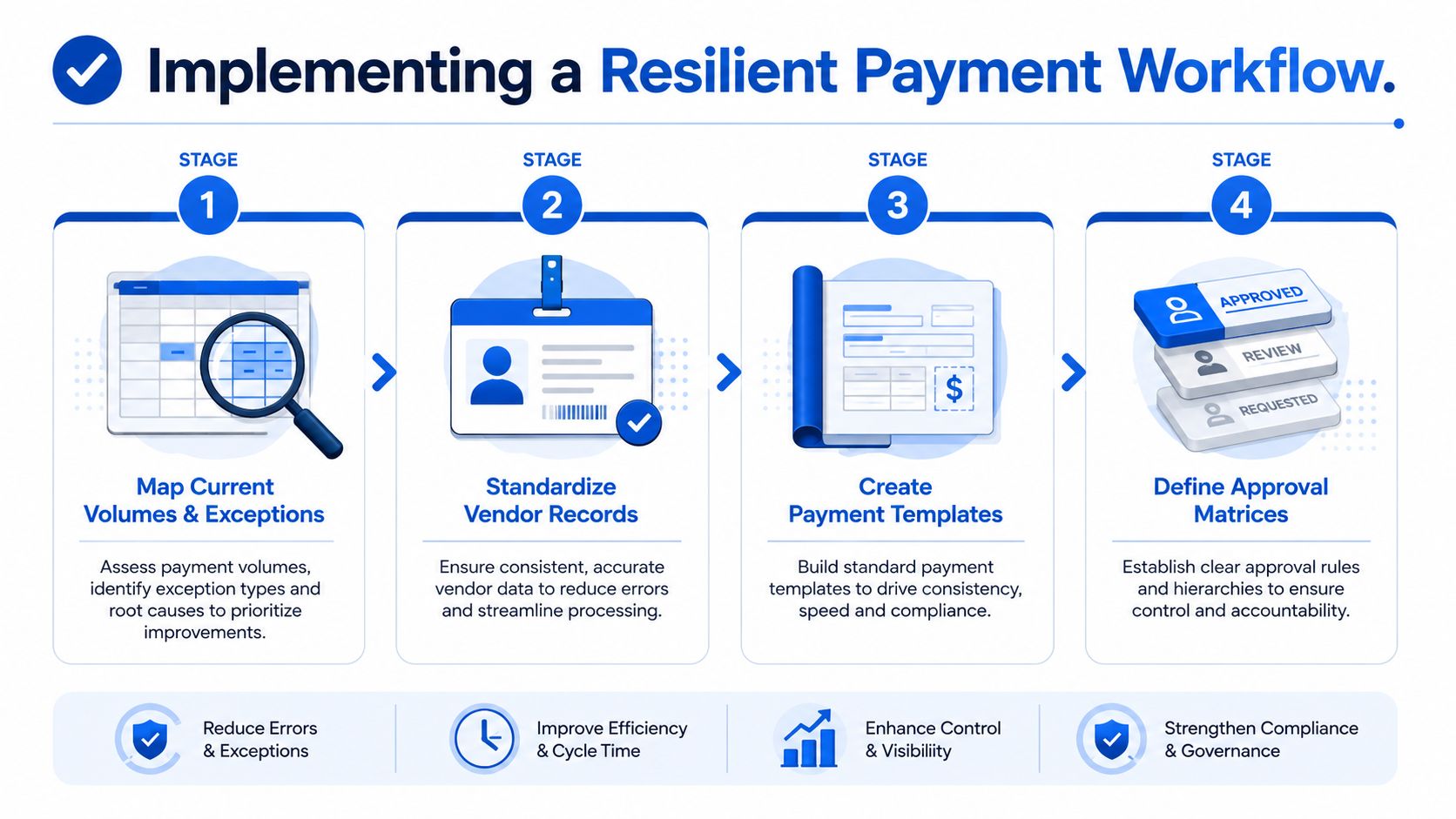
After the controlled rollout, automate reconciliation against invoice, batch, currency, and value date. Review performance using day-one settlement rate, FX slippage against the quoted rate, exception rate by rail, and manual intervention time. These measures don't guarantee an outcome, but they show whether the workflow is becoming more predictable.
Review policies when corridors change, sanctions requirements evolve, providers alter their terms, or the business adds digital-asset activity. Select banks and payment partners based on fee transparency, data quality, integration depth, regulatory standing, service terms, and resilience when one route becomes unavailable.
OneSafe provides a unified platform for multi-currency business accounts, fiat payment workflows, crypto-compatible settlement, approvals, and reconciliation. Visit OneSafe to assess whether its combined operating model fits your company's B2B cross-border payment corridors and treasury controls.