Meta description: Chainalysis breach forced KYT and address screening offline, exposing DeFi compliance risks. Learn to diversify analytics and build resilience.
Chainalysis Breach: What It Means for DeFi Compliance
On November 9, 2026, Chainalysis took its Know Your Transaction (KYT) and Address Screening tools offline after a security incident. By the time services were restored later that day, every user had been forced to reset credentials and restrict access to predefined IP addresses — a stark reminder for DeFi projects that their defi compliance programs can depend entirely on a handful of centralized providers whose own security is rarely questioned.
Table of Contents
- What Happened
- Why This Matters for DeFi Compliance
- The Centralization Paradox
- What Forward‑Thinking Businesses Are Doing Differently
- What to Watch Next
- Why does DeFi create compliance challenges?
- What is DeFi compliance and how does it work in practice?
- How does the Chainalysis breach affect the security of DeFi compliance programs?
- What immediate actions should a DeFi business take when a key compliance tool is compromised?
- How can DeFi startups and DAOs build a more resilient compliance stack?
- What role does an integrated neo‑banking platform play in managing DeFi compliance and custody risk?
- Key Takeaways
What Happened
According to The Defiant, Chainalysis temporarily shut down KYT and Address Screening after detecting unauthorized access. The scope remains undisclosed, but the remediation tells the story. Access was restored in phases only after every customer completed mandatory credential and API-key resets and configured IP allowlists — an extreme containment step that signals a threat capable of enabling broad, unattributed queries (The Defiant). Compliance teams spent November 9 scrambling to re‑authenticate systems that underpin real‑time transaction screening.
Why This Matters for DeFi Compliance
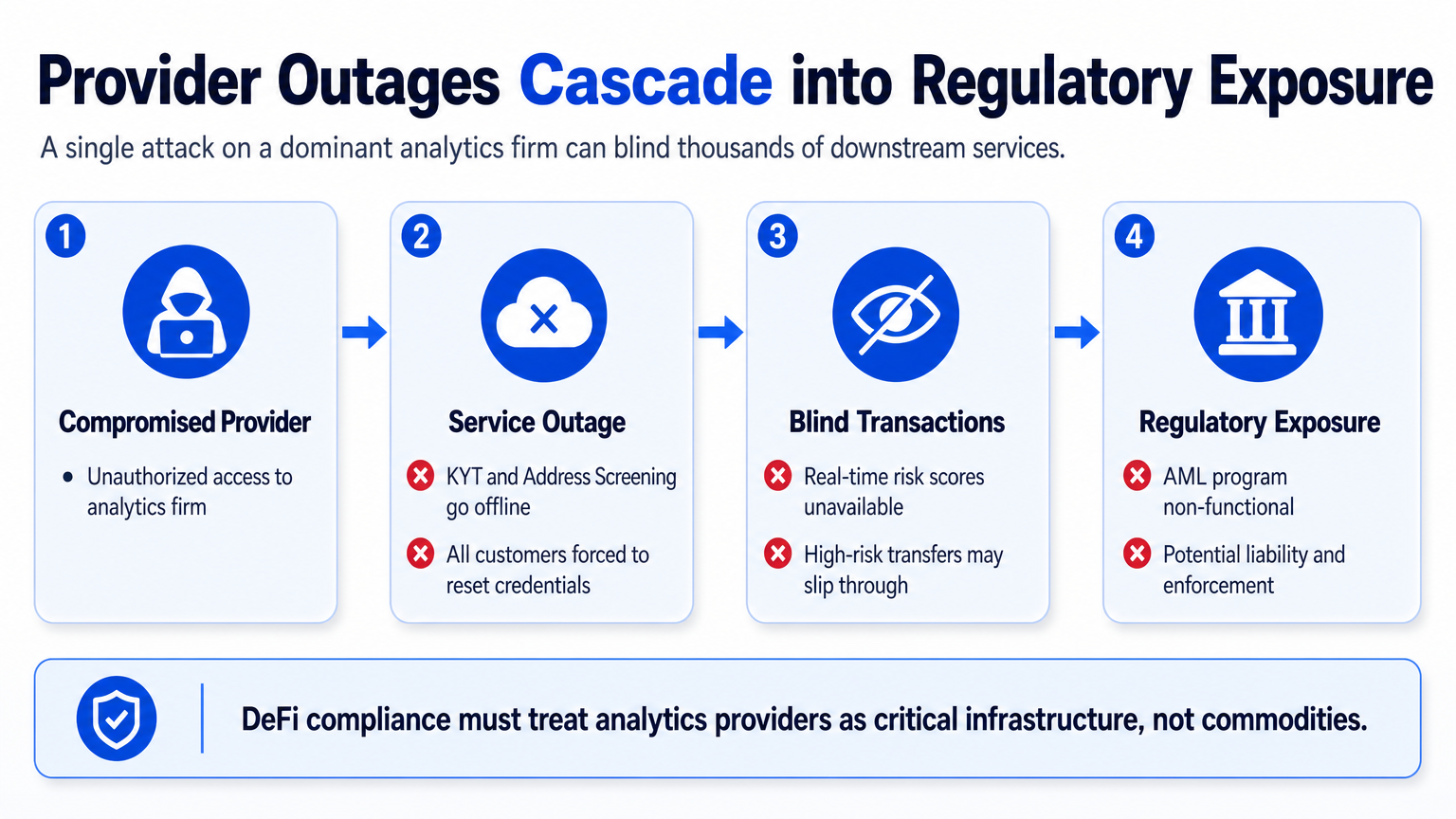
DeFi protocols rely on blockchain analytics APIs to screen wallet addresses and transactions against known illicit entities and sanctions lists. Tools like Chainalysis KYT provide real‑time risk scores; Address Screening checks counterparty wallets. For most projects, this integration is the entirety of their AML program. When the analytics provider goes dark, screening stops — creating immediate regulatory exposure.
The incident shows that centralized compliance infrastructure introduces systemic risk. A single successful attack on a dominant provider can cascade across thousands of downstream services. The US Treasury’s 2023 Illicit Finance Risk Assessment of Decentralized Finance flagged concentration risk among blockchain analytics firms as a vulnerability that could be exploited by sophisticated threat actors (Treasury DeFi Risk Assessment). If a malicious actor accesses a provider’s internal query logs, they could map monitored addresses or manipulate screening results. The Chainalysis incident makes these scenarios impossible to ignore.
The Centralization Paradox
Over the past five years, compliance frameworks like the FATF Travel Rule and MiCA have pushed DeFi projects toward off‑the‑shelf screening solutions. The path of least resistance was to plug into a single market‑leading API, making a few firms the compliance backbone for much of the ecosystem. A 2023 working paper notes that this dependency often goes unexamined (Regulating DeFi Platforms). The trade‑off was convenience over resilience. The November 9 breach revealed how fragile that choice is: when a provider imposes IP allowlists overnight, a protocol’s screening may be offline for hours while DevOps updates firewall rules. In that window, a high‑risk transaction could slip through, creating a liability no insurance policy clearly covers.
What Forward‑Thinking Businesses Are Doing Differently

Proactive organizations are moving away from a mono‑vendor model. They pair a primary analytics provider with a secondary one on standby, with automated health checks that fail over if the primary’s API becomes unavailable. Some teams also develop in‑house blockchain indexing and heuristic detection for known laundering patterns, so a basic level of screening continues even when all external tools are down. The goal isn’t to replace external analytics, but to avoid a “lights‑out” scenario. This kind of diversification in crypto compliance tools is quickly becoming a baseline expectation.
An integrated platform like OneSafe further reduces the blast radius by combining fiat and crypto operations with built‑in security. It provides digital asset custody secured by Fireblocks custody security — multi‑party computation (MPC) technology that prevents any single compromised key from draining funds — and enforces mandatory MFA. Segregated global accounts ensure that a compliance gap on one asset pool doesn’t automatically contaminate others. While these safeguards don’t replace blockchain analytics, they embed resilience at the transaction layer, buying time until the analytics feed is restored. For DAOs managing payroll and operational expenses, such platforms also simplify crypto payroll and vendor payments with corporate cards and multi‑currency accounts.
Immediate steps for startups and DAOs
The table below outlines a practical action sequence for any DeFi business.
| Action | Description | Timing | Priority |
|---|---|---|---|
| Force credential rotation | Reset all API keys and passwords for the breached provider, restrict IP access per vendor instructions. | Within 1 hour of vendor notice | Immediate |
| Activate secondary screening | If a standby analytics provider is configured, redirect transaction screening to that service. | Within 2 hours | High |
| Pause high‑risk flows | If no alternative is ready, halt transactions above a risk threshold or to unverified counterparties. | Within 2 hours | High |
| Audit provisioned access | Inventory every system that uses the compromised tool; revoke any unused or overly permissive tokens. | Day 1 | High |
| Notify banking partners | Inform fiat banking providers of the incident and steps taken; this preempts account freezes from unusual activity flags. | Day 1 | Medium |
| Review logs for the outage window | After restoration, examine all transactions that occurred during the screening gap for any high‑risk indicators. | Day 2–3 | Medium |
| Document for regulators | Create a contemporaneous memo of the incident, response, and any suspicious activity found; this aids any future reporting obligations. | Within 1 week | Medium |
For startups, this mirrors the incident‑response cadence traditional financial institutions follow. Banking partners that support DAO banking compliance — especially those that understand the unique demands of startup crypto banking — increasingly expect a documented playbook.
What to Watch Next
The Chainalysis breach will attract regulatory attention. Guidelines on operational resilience already signal that concentration risk in critical third‑party services must be managed. Forthcoming DeFi regulation may require a secondary analytics provider on standby or regular penetration testing of compliance tooling integrations. Regulators may also demand real‑time attestations that screening is functional, pushing architectures where fallback isn’t optional.
Longer‑term, self‑sovereign identity and zero‑knowledge proofs could allow users to prove a wallet is not on a sanctions list without relying on a single analytics firm’s real‑time API. Research from the Centre for International Governance Innovation argues that programmable compliance — rules embedded in smart contracts and verified cryptographically — could reduce the operational need for external screening in many low‑risk activities (Regulating Compliance in a World of Decentralized Finance). The breach gives these approaches new urgency.
Open questions remain over liability when a compliance‑tool breach enables illicit activity. Most analytics providers disclaim consequential damages, and cyber insurance rarely covers regulatory fines from a vendor’s security flaw. The DeFi compliance after Tether’s $344M USDT freeze already illustrated how quickly a single event can shift enforcement expectations; the Chainalysis incident adds another layer. For teams looking to keep their own blog updated with daily compliance insights, Joyrise plans, writes and publishes illustrated SEO articles to your Webflow blog every day — and you can read your first article before paying.
Why does DeFi create compliance challenges?
DeFi protocols operate without traditional intermediaries, using pseudonymous wallet addresses and permissionless smart contracts. This structure makes it difficult to identify counterparties, enforce know‑your‑customer (KYC) rules, and monitor transactions for money laundering or sanctions evasion. Mixers, cross‑chain bridges, and privacy‑enhancing technologies further obscure the flow of funds. As a result, compliance must rely on on‑chain heuristics and third‑party analytics rather than the institution‑based controls used in traditional finance.
What is DeFi compliance and how does it work in practice?
DeFi compliance is the set of policies and technical measures a decentralized application adopts to meet AML, counter‑terrorist financing, and sanctions obligations. In practice, it works by integrating blockchain analytics APIs (like Chainalysis KYT) that assign risk scores to wallet addresses and transactions in real time. When a user interacts with a protocol, the front‑end or smart contract queries the analytics service to check if the address is linked to illicit activity. If flagged, the transaction can be blocked or escalated for manual review. Additional layers may include geoblocking, on‑chain identity verification, and reporting to authorities under the Travel Rule.
How does the Chainalysis breach affect the security of DeFi compliance programs?
The breach undermines the trust model that treats a single analytics provider as a secure, always‑available source of truth. If an attacker can compromise a provider’s systems, they could potentially alter screening results, exfiltrate sensitive monitoring data, or simply disable the service — leaving protocols blind. The mandatory credential resets and IP allowlists forced by Chainalysis on November 9, 2026, illustrate the operational chaos: even with no confirmed tampering of risk scores, the response itself created periods where screening was non‑functional. This demonstrates that security of the compliance tool itself must be part of the compliance program’s threat model, not something assumed.
What immediate actions should a DeFi business take when a key compliance tool is compromised?
The table in the “Immediate steps for startups and DAOs” section above provides a concise action plan. In summary: force credential rotation, switch to a backup screening service if available, pause high‑risk transaction flows, audit access, notify banking partners, and review logs after restoration. The priority is to prevent any unchecked risk exposure during the outage window while maintaining operational continuity where possible.
How can DeFi startups and DAOs build a more resilient compliance stack?
Start by mapping all dependencies on a single vendor — not just the primary analytics API, but also any front‑end libraries, alerting pipelines, and reporting modules that tie into it. Then, contract with at least one secondary provider and implement automated failover logic that redirects queries when the primary fails or returns errors. For DAOs, incorporate redundancy requirements into governance proposals so that funding for a second provider is approved before an incident occurs. On the custody and banking side, use platforms that offer secure custody via Fireblocks and mandatory MFA, such that even if screening falters, transactional controls remain in place. Finally, pressure analytics vendors for incident‑response SLAs and transparency reports; if the market demands resilience, providers will build it.
What role does an integrated neo‑banking platform play in managing DeFi compliance and custody risk?
An integrated neo‑banking platform like OneSafe consolidates fiat and crypto operations with security measures that directly reduce compliance risk exposure. By holding digital assets in Fireblocks MPC‑based custody and enforcing mandatory MFA, the platform limits the damage from any single compromised credential — whether it originates from a compliance tool breach or an internal failure. Furthermore, segregated global accounts and corporate cards with spend limits create a clear audit trail for treasury movements, which is invaluable when regulators ask how a business maintained controls during a compliance‑tool outage. For startups and DAOs that must reconcile fiat payroll, vendor payments, and crypto treasury, such a platform provides a single, secure interface that bridges the gaps left by fragmented banking relationships — all while helping to maintain the operational resilience that incidents like the Chainalysis breach demand. In the context of PTNC stablecoin pilots reshaping crypto banking, having a unified financial operating system is no longer a luxury but a necessity for scalable compliance.
Key Takeaways
- The November 9, 2026, Chainalysis breach forced credential resets and IP allowlists, exposing fragilities in single‑vendor compliance dependencies.
- DeFi compliance programs must treat analytics providers as critical infrastructure — not a black‑box commodity.
- Immediate incident response: rotate credentials, fail over to a secondary provider, and communicate with banking partners.
- Resilience demands diversified blockchain analytics vendors, fallback screening, and integrated custody platforms that secure transaction layers.
- Regulators will scrutinize concentration risk, and decentralized identity technologies may reduce reliance on centralized providers.
- Start securing your DeFi operations with a platform that combines multi‑currency accounts, Fireblocks‑secured custody, and mandatory MFA — open a OneSafe account today.