You're trying to pay a contractor in Warsaw, clear a vendor invoice in PLN, or move treasury funds before the rate shifts again. On paper, the math looks simple, just convert USD to zloty and send the money. In practice, the recipient often gets less than the headline rate suggests, and the difference usually comes from spread, transfer fees, settlement timing, and the rate you picked for accounting.
Table of Contents
- Why Converting USD to Zloty Costs More Than You Think
- Mid-market rate versus quoted rate
- Why the recent range matters
- What usually breaks at bank level
- Where exchanges tend to help
- Why fintech platforms are getting attention
Why Converting USD to Zloty Costs More Than You Think
A web3 startup in New York can see this problem fast. The team approves a payout to Polish contractors, checks a converter, and thinks the transfer should be straightforward. Then the funds land in PLN, and the recipient's amount is thinner than expected because the company relied on the headline rate alone.
The trap is usually hidden in plain sight. Two providers can quote nearly the same FX rate, but one charges more in wire fees, another widens the spread, and a third slows settlement enough that the market moves before execution. That is why the important question isn't just what the rate says, but what lands in the account.
Practical rule: compare the final PLN received, not the rate advertised on the landing page.
For a cross-border business, that distinction matters every time cash is routed across currencies. The total cost of conversion includes the exchange spread, any transfer fee, and the value lost to delay if the rate moves while the payment sits in flight. I've seen teams focus on the quote and ignore the operational drag, then spend hours reconciling why the books and the bank statement don't line up cleanly.
A useful mindset shift is to treat USD-to-PLN as a treasury decision, not a simple calculator problem. If you're also dealing with imported goods, cross-border logistics, or vehicle purchases, it helps to review adjacent cost drivers too, like ile kosztuje import auta z USA, because the same mistake shows up there, too, a visible price hides several invisible layers underneath it.
When businesses convert at scale, the smallest leak becomes expensive. A slightly worse spread on a large payroll run, or a slow transfer that misses a favorable intraday window, can change margins without ever looking dramatic in isolation. That's why the rest of the process has to start with landed value, not just the rate on the screen.
Understanding the USD to PLN Exchange Rate Situation
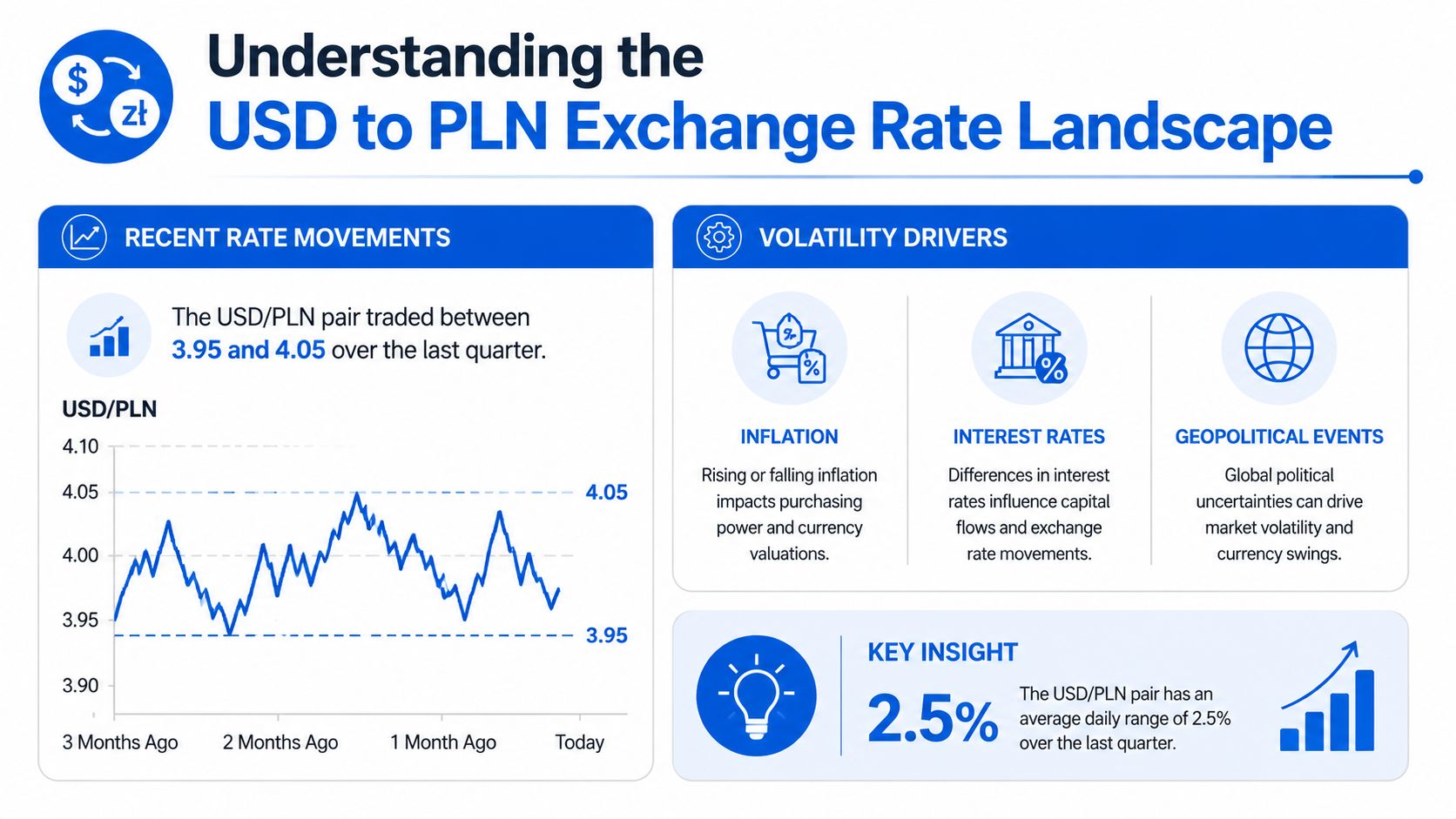
A USD-to-PLN conversion rarely comes down to a single “good rate.” The outcome depends on the spread, any transfer fee, how fast the payment settles, and whether the rate moves before the funds arrive. For a treasury team, that means the question is what lands in PLN, not the number printed at the top of the quote.
USD/PLN has recently hovered in the 3.6 to 3.8 PLN per USD range, which means a $1,000 transfer typically converts to about 3,600 to 3,800 PLN depending on the day, according to the market snapshots in the brief OFX USD/PLN history. That range is wide enough to affect payroll, vendor invoices, and internal cash planning, because the same notional amount can produce a different receipt value depending on timing and provider pricing.
Mid-market rate versus quoted rate
The mid-market rate is the clean benchmark shown on search results or currency tools. It sits between bid and ask, so it works as a reference point, but it is rarely the rate your provider gives you. Recent independent quotes cluster around 1 USD ≈ 3.72 to 3.74 PLN in the brief, including Xe at 3.72038895, Wise at 3.740, and Investing.com bid and ask at 3.7272 / 3.7294, while the National Bank of Poland's published average rate was 3.7058 PLN per USD on its Table A as cited in the brief.
That gap is the spread. It is often the first place value leaks out of a conversion, even before transfer charges or timing risk enter the picture. Treasury teams should use the mid-market or reference rate as a baseline, then compare the live quote against it to see how much is being lost before the payment even starts.
Why the recent range matters
The recent history shows that USD/PLN does not sit still. OFX lists an average of 3.69754 across its selected history, with 3.631529 on May 31, 2026, 3.702521 on June 30, 2026, 3.780555 on July 31, 2026, and 3.73835 on August 5, 2026 OFX history. Daily closes in the brief also move around enough to change timing outcomes, with quotes near 3.6508 on June 17, 2026, 3.6416 on June 2, 2026, and 3.6298 on May 31, 2026.
A rate that looks close on screen can still alter the final PLN amount once volume is large enough. That is why the better control point is the landed value, not the quote alone.
For teams comparing execution options, a practical check is to run the same amount through a dedicated currency converter and compare the final PLN after spreads and fees. That is also where operational teams in currency expansion payments jobs spend their time, because they have to care about the rate, the payout rail, and the amount that settles.
Comparing Banks, Exchanges, and Fintech Platforms
A treasury team can quote the same USD amount three different ways and still end up with three different PLN results. The spread, transfer fee, settlement speed, and tax treatment all shape the total cost, so the headline rate is only one part of the decision. What matters is the amount that clears, settles, and stays defensible in reconciliation.
OneSafe's international business payments sit in this comparison as one fintech option that combines payments and FX in a single workflow. In practice, the right choice depends on what the payment needs most, cost certainty, faster settlement, or more flexibility around rails and controls.
| Provider Type | Typical Spread | Transfer Fees | Settlement Time | Crypto Support |
|---|---|---|---|---|
| Traditional bank | Often opaque, usually wider | Can include SWIFT or card-related charges | Often slower, especially on cross-border wires | Limited |
| Currency exchange | Often tighter than banks | May charge transfer or service fees | Can vary by rail and cutoff | Usually limited |
| Fintech platform | Can be competitive and more transparent | Depends on product and rail | Often faster for supported flows | More likely to support crypto-adjacent workflows |
What usually breaks at bank level
Traditional banks are familiar, but familiarity does not always reduce cost. A quoted FX rate can look acceptable until intermediary charges, wire fees, or correspondent bank deductions reduce the final PLN amount, and the full cost only shows up after reconciliation. For teams handling recurring contractor payments, that gap becomes an ongoing operational burden.
Taxes and documentation can add another layer. If the conversion or the resulting payment needs a clearer audit trail, bank workflows may require extra review, and that can slow approval or create mismatches between treasury, accounting, and the recipient's expectation of what should land.
Where exchanges tend to help
Dedicated exchanges often give better visibility into spreads. Their strength is usually clearer conversion pricing and a more direct trade flow, which helps when the team wants to compare a live quote against the mid-market reference and separate spread from transfer charges. That said, a tighter spread does not automatically make the route cheaper if the platform adds service fees or if the settlement timing misses the payment window.
Exchanges are less helpful when the operating need goes beyond FX alone. If the treasury team also needs integrated controls, payment rails, or a process that can sit alongside currency expansion payments jobs, the exchange route can feel narrow. It may solve the conversion, but not the broader payout workflow.
Why fintech platforms are getting attention
Fintech platforms are getting attention because they can put FX, payments, and account control in one place. That matters for companies that want to move from USD liquidity into PLN spending power without stitching together separate tools for treasury, payment release, and reconciliation. The practical trade-off is that a platform needs to be judged on the whole outcome, not just the rate on screen.
For cross-border teams, the appeal is usually operational, not cosmetic. They get one place to review pricing, see how the rail affects timing, and compare the landed result against a bank or exchange before approving the transfer.
Executing a USD to PLN Conversion on OneSafe
A clean workflow starts before anyone clicks convert. With OneSafe's multi-currency business accounts, companies can keep USD balances, cross-border payments, and account control in one place instead of piecing together a bank login and a separate crypto workflow. For treasury teams that move between fiat and digital assets, that reduces manual work and makes the full conversion path easier to reconcile.
Start with account readiness
The first step is onboarding and KYB. For startups and web3 businesses, that usually means getting entity documents, ownership details, and operating information ready before the account is approved. The brief notes that initial completion is typically within about a week, which can matter when a vendor payment cannot wait for a long compliance queue.
Move funds, then convert
Once the account is live, fund it in USD and choose the conversion route inside the platform. OneSafe publishes 0.25% FX pricing in the publisher details, which gives treasury teams a clear starting point for landed-cost modeling before they send money. That matters because the total cost is the spread, the service fee, and the timing of settlement, not just the number on the quote screen.
If the business already holds stablecoins, the workflow can be simpler. OneSafe supports USDC deposits and withdrawals at no cost in the publisher details, which helps teams that move between crypto treasury and fiat spending without managing multiple silos. That is especially relevant for DAOs and contractor-heavy startups that need operational conversions without extra handoffs.
The cleanest conversion flow is the one finance can reconcile without a spreadsheet rescue mission.
For day-to-day spending, corporate cards can sit inside the same process. A vendor invoice in PLN does not need a separate rail if the team can fund the account, convert, and spend from the same control layer. If you want a wider view of how that setup fits into account structure, OneSafe's multi-currency business accounts show the account side of the workflow.
For a practical parallel on cashing out across currencies, Coiner Blog's guide to cashing out is useful because it makes the same point treasury teams run into every day, the public conversion rate is only one part of the final result.
Navigating Compliance and Tax Treatment for Cross-Border Conversions
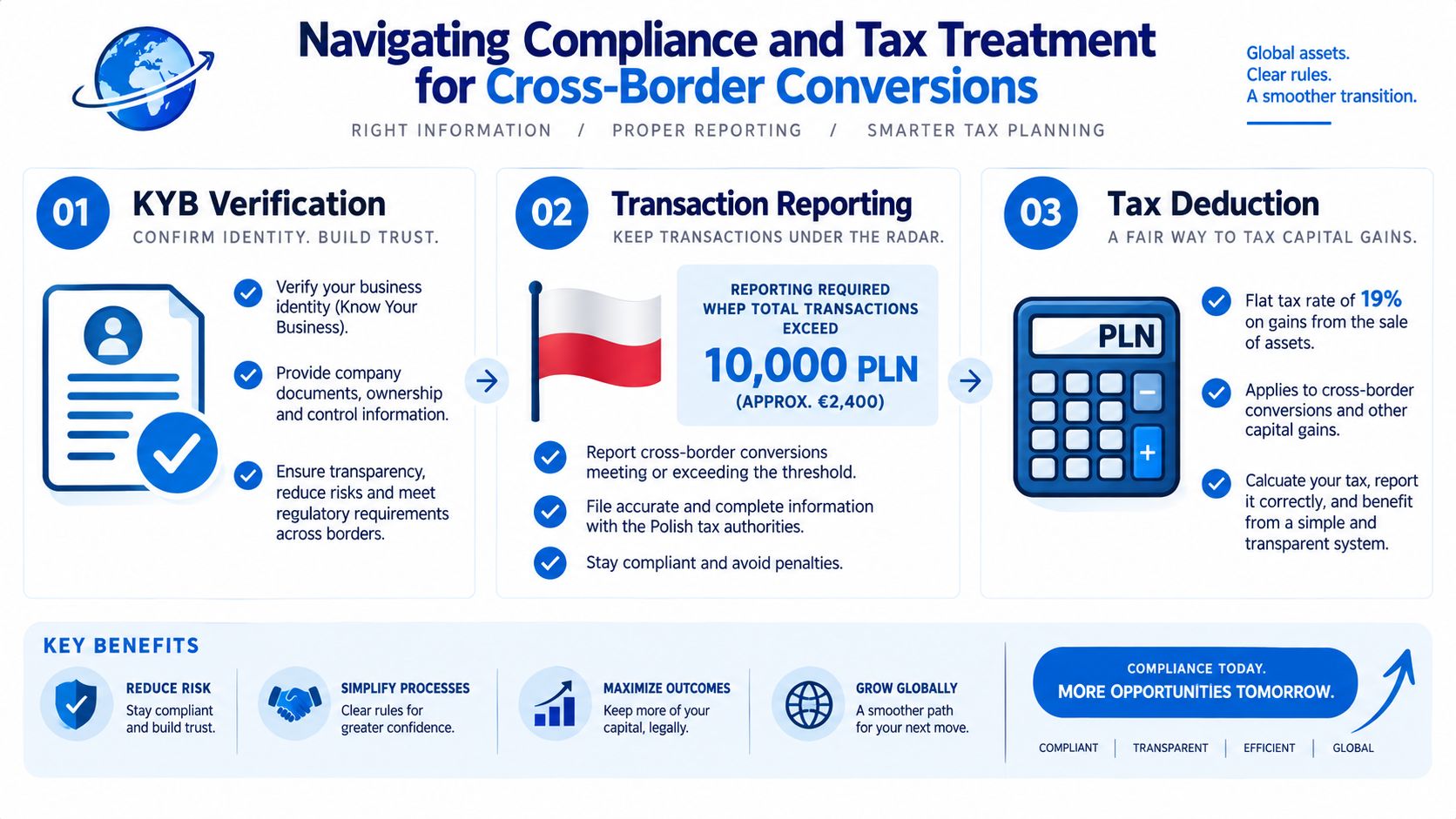
Compliance starts with identity and ownership checks. KYB is not just onboarding friction, it's the layer that lets a payment provider know who is moving funds, why the account exists, and whether the flow fits regulatory expectations. For businesses operating across borders, that's especially important when the same company might pay contractors, hold digital assets, and settle invoices in more than one currency.
The rate used for books can differ from the live quote
Poland's tax authority provides a currency calculator that lets users select the conversion date, which shows that the applicable PLN value can depend on the transaction date rather than a single live market rate Poland tax calculator. That matters for invoices, expense reimbursement, bookkeeping, and tax filings, because the amount you record may not match the rate you saw when you initiated payment.
Many generic converter pages fall short. They explain the arithmetic, but they don't solve the reporting question. A finance team needs to know which rate belongs to revenue recognition, which one applies to deductible expenses, and where foreign-exchange gains or losses show up when the reporting date and the payment date don't match.
Why payment controls matter for compliance
For businesses subject to U.S. sanctions screening and similar controls, payment routing has to stay within the platform's supported geography and policy scope. That's not a theoretical detail, it's part of how a company avoids operational blocks during onboarding or settlement. Tools such as OneSafe structure onboarding around KYB, which helps align the account setup with business use rather than personal-style consumer banking.
Tax treatment and reporting discipline also affect the end result of a conversion. The same USD amount can produce different accounting entries depending on when the transaction is booked, and that can change the way a treasury team measures gains or losses. For cross-border operators, the right workflow is to document the date, the applied rate, and the settlement record together, not after the fact.
Strategies to Minimize Cost and Timing Risk
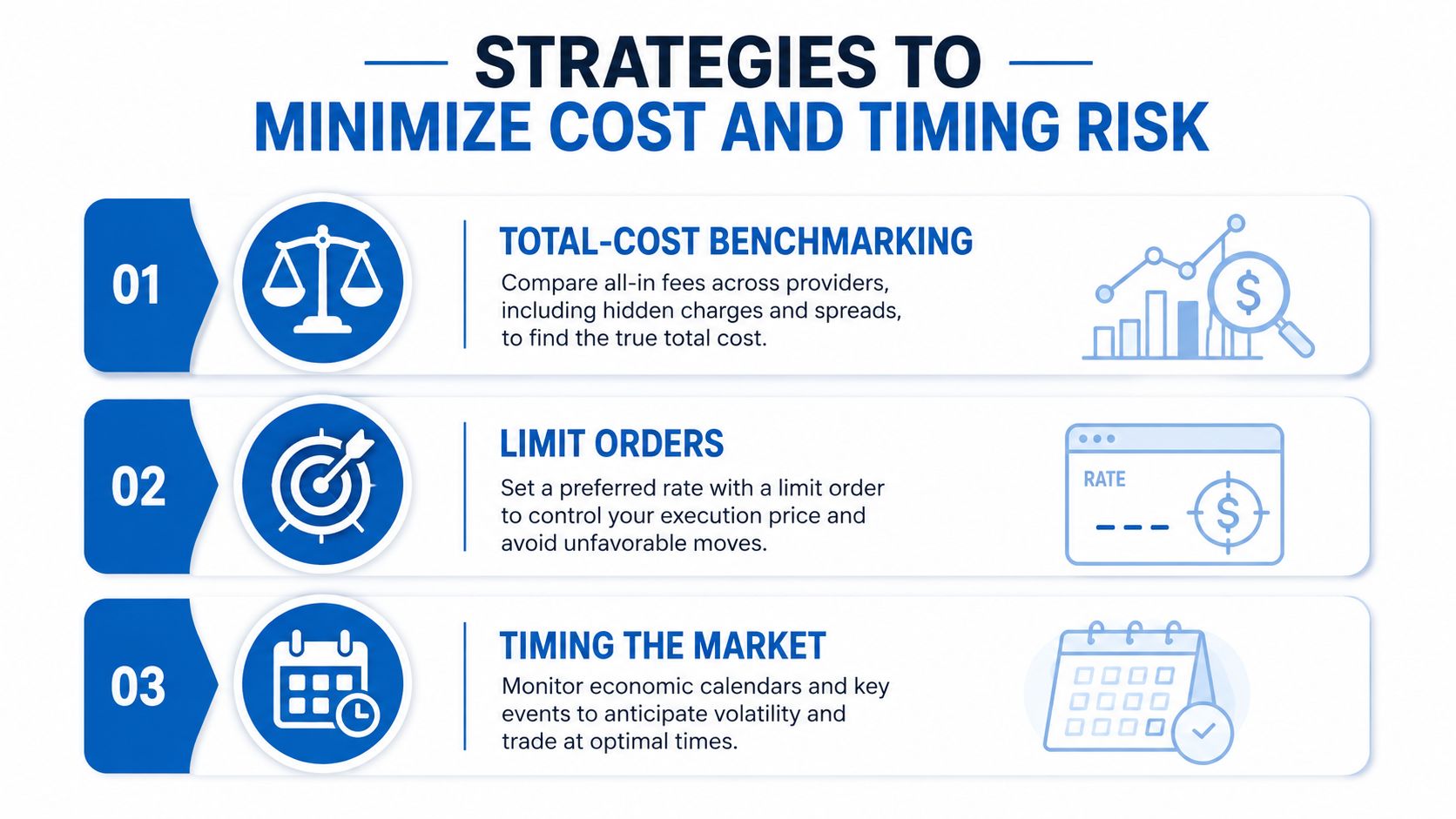
The cheapest conversion is not the one with the prettiest headline rate. Treasury teams should compare the same USD notional across providers at the same timestamp, then measure the PLN delivered after spread, fees, and settlement timing are all included. That catches the false savings that look attractive on a quote screen but disappear in reconciliation.
Use a landed-value comparison
A provider can show a slightly better rate and still end up more expensive once transfer fees, correspondent charges, and timing delays are factored in. Another provider may quote a wider spread but settle faster or with fewer deductions. The quote alone does not settle the question.
The landed-value method does. It forces the team to compare the final PLN outcome on equal terms, which is the only way to see what lands in the recipient account.
Time the conversion with the risk in mind
Short-term USD/PLN moves can matter. Historical samples show that the pair has moved through a wide recent band, with meaningful changes across weeks and months exchange-rate history. If the payment is not urgent, waiting for a better market window can reduce cost. If the transfer is time-sensitive, accepting a slightly worse rate may be the cleaner trade-off because it removes execution risk.
A practical treasury habit is to separate recurring payments into two buckets. Urgent operating payables should move on reliability and speed. Discretionary treasury conversions can be planned with target rates, provider alerts, or scheduled execution. Rate alerts and limit orders are standard tools in FX operations.
Don't ignore delivery speed
Delivery speed changes the value of the transfer, even when the quoted rate looks strong. Standard bank transfers often take 1 to 2 business days, priority SWIFT can reach same day before cutoff, and local rails can take 1 business day where available, according to CurrencyTransfer's transfer guide CurrencyTransfer. For a payroll run or an invoice deadline, that timing difference can matter as much as the FX spread.
If you cannot name the all-in cost and the delivery window, you do not really know what the conversion costs.
The safest operating rule is simple. Convert immediately when certainty matters more than price, wait when the payment is flexible, and document the chosen rate, fee layer, and booking date so finance can reconcile the outcome cleanly.
If you need a cleaner way to move from USD into PLN, manage the payment, and keep the books straight, OneSafe gives you a single place to handle multi-currency balances, FX conversion, and business payments. It is a practical fit for teams that care about landed cost, settlement speed, and accounting discipline, not just the number on the quote screen.