A small company can have three payments queued on the same afternoon: a contractor in Europe paid through a local bank rail, a Canadian vendor expecting a wire, and a treasury team converting USDC into fiat for payroll. Inside each country, those actions may feel routine. Across borders, they become separate workflows with different account details, cut-off times, foreign-exchange rules, compliance reviews, and tracking screens.
That fragmentation explains why a cross-border payments platform matters. The platform isn't a faster version of online banking. It connects payment rails, currencies, compliance checks, settlement processes, and internal approvals so finance teams can manage international money movement as one operating system.
The scale is enormous. The International Monetary Fund estimates that the global cross-border payments market approached about US$1 quadrillion in 2024, when traditional payments, wholesale flows, and crypto-related activity are combined, as described in its analysis of cross-border payment activity. Yet the experience remains uneven because local payment innovation often stops at the border.
This guide starts with the mechanics, then examines the features that matter, the structural reasons for delays, and the hidden layers inside pricing. It also connects those issues to practical workflows for SMEs, DAOs, web3 startups, and teams paying international contractors. The central question is not whether a provider advertises fast transfers. It's whether the provider can route reliably across fragmented domestic rails while controlling FX, compliance, and settlement together.
Table of Contents
- Introduction Why Cross Border Payments Still Feel Broken
- The handoffs behind the interface
- Platform versus bank
- Accounts establish the operating base
- Payment rails determine the route
- FX connects currencies to obligations
- Cards and crypto extend the workflow
Introduction Why Cross Border Payments Still Feel Broken
A finance lead might begin the week by approving a European contractor invoice in euros. The same team could then send a Canadian supplier a dollar wire and move USDC from a treasury wallet into a fiat account. The business has one obligation, paying people and vendors, but the money travels through several unrelated systems.
The contractor may need local account details. The Canadian payment may require a wire form and intermediary-bank information. The USDC conversion introduces a digital-asset custody and compliance workflow. Each system may show a different balance, status, fee, and settlement expectation. A payment can be approved internally while still waiting for a bank window, a screening decision, or a correspondent handoff.
That difference between local simplicity and international fragmentation is the problem. A domestic payment usually stays within one currency environment, one regulatory framework, and one set of operating conventions. A cross-border transfer has to coordinate at least the sender's system, the recipient's system, currency conversion, compliance controls, and a settlement path between them.
The policy response became a formal global agenda in 2020, when the G20 endorsed a roadmap focused on faster, cheaper, more transparent, and more accessible payments. Progress hasn't been uniform. The Financial Stability Board reported that in 2024 only 50.6% of wholesale cross-border payments credited funds within one hour, although 92% settled within one business day, according to its 2024 progress report.
Practical rule: Treat “fast” as a corridor-specific claim, not a universal product attribute.
The rest of the evaluation follows the payment's actual path. First, identify what the platform abstracts. Next, inspect the account, rail, FX, card, crypto, and control features that support the workflow. Then calculate the full cost, including the layers that don't appear in the headline transfer fee. Finally, test whether the provider covers your corridors, legal entities, currencies, and compliance requirements.
What a Cross Border Payments Platform Actually Does
Start with a domestic payment. A business sends money through a local rail such as ACH or a domestic wire. The sender and recipient operate inside a shared banking environment, and the institutions understand the same currency, settlement rules, identity conventions, and regulatory expectations.
A cross-border payment resembles a highway trip that reaches a border crossing. The highway represents the sender's local rail. At the border, customs checks, currency conversion, operating hours, and routing decisions enter the journey. The recipient's local rail is another highway, but it follows its own rules. Intermediaries help connect the two.
The handoffs behind the interface
Correspondent banks and payment institutions may pass instructions and funds between the sender and recipient. A SWIFT message, for example, communicates payment instructions across financial institutions, but the message itself isn't the same thing as final settlement. Each participant may apply screening, validate data, or wait for a processing window.
A platform gives the finance team one interface for tasks that would otherwise sit in separate tools:
- Accounts: Create and manage business accounts in supported currencies.
- Payments: Initiate ACH, domestic wire, international wire, or SWIFT transfers.
- FX: Convert balances or settle an invoice in the currency the recipient needs.
- Tracking: Monitor payment status, exceptions, and completion.
- Controls: Apply user roles, approval policies, limits, and authentication.
Platform versus bank
A cross-border payments platform isn't automatically a bank. It may provide the technology, user interface, orchestration, and operational workflows while regulated partner institutions deliver the banking services. That distinction affects safeguarding, account ownership, supported countries, dispute processes, and the documentation a business must provide.
The reusable mental model is simple:
A platform is a routing and control layer over financial rails.
When evaluating any provider, ask which rails it can access, who holds or settles funds, where FX occurs, how compliance exceptions are handled, and whether the interface shows the complete payment path. A polished dashboard is useful, but interoperability determines whether money can cross the border without falling back into manual work.
Core Features That Make Global Money Movement Work
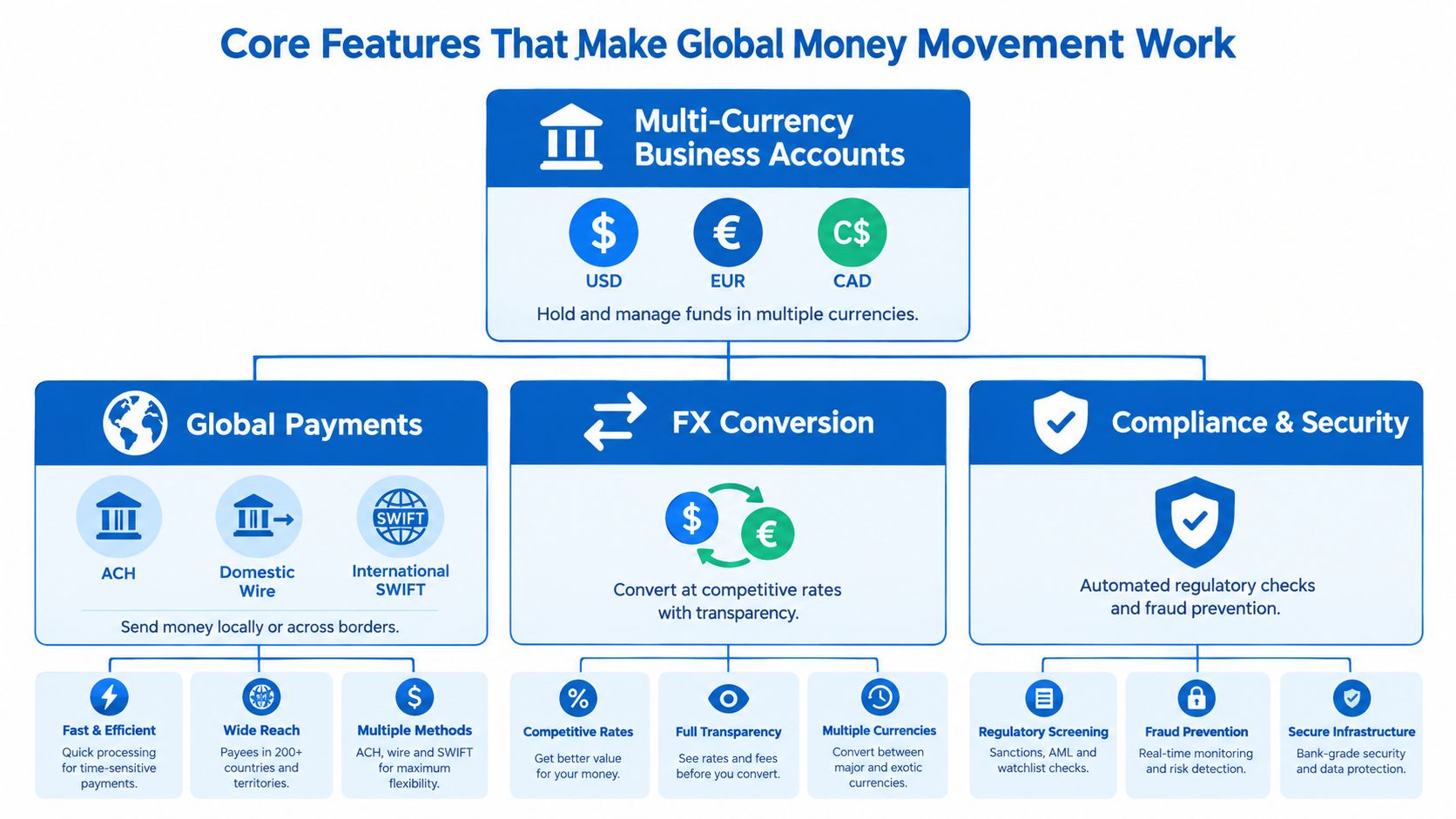
The right feature set follows the payment lifecycle. A business first needs somewhere to receive or hold funds. It then needs a suitable rail to send money, an FX process when currencies differ, and controls that keep employees, vendors, and digital assets within policy.
Accounts establish the operating base
Multi-currency business accounts let a company hold balances in currencies such as USD, EUR, and CAD instead of converting every receipt immediately. That can simplify reconciliation when customers pay in one currency and suppliers invoice in another. It also gives treasury teams a clearer choice: convert now, hold the balance, or settle directly from the matching currency account.
For a finance team, the account isn't just a balance display. It supplies the payment instructions, recipient details, transaction history, and reconciliation records needed for the next action. OneSafe describes this workflow through its multi-currency business accounts, which connect account management with international operating needs.
Payment rails determine the route
ACH can suit an eligible local payment. A domestic wire may fit a time-sensitive supplier settlement within the same banking market. SWIFT can reach international bank accounts where local connectivity isn't available, but the route may involve additional institutions and instructions.
The useful question isn't “Does the provider support international payments?” Ask instead: Which rail will it use for this currency, destination, beneficiary type, and urgency? A platform that chooses an appropriate local route can avoid unnecessary intermediary steps. A platform that defaults to a generic international wire may add cost and delay even when a more direct option exists.
FX connects currencies to obligations
Foreign exchange should appear as a distinct decision, not disappear inside a transfer total. A finance team needs to know the conversion rate, the stated fee or markup, the timing of conversion, and whether the recipient receives the intended amount.
Multi-currency settlement can reduce unnecessary conversions. If a customer pays in euros and a European supplier invoices in euros, retaining that balance may be cleaner than converting to dollars and later converting back.
Cards and crypto extend the workflow
Corporate cards handle recurring operational spend when a bank transfer isn't practical. Spend limits, merchant controls, roles, and approval policies help separate legitimate team purchases from unapproved activity.
Crypto-compatible workflows serve a different job. USDC deposits or withdrawals, crypto-to-fiat conversion, fiat-to-crypto conversion, and web3 invoicing can connect a digital-asset treasury to ordinary business obligations. Security controls still matter. Fireblocks-based custody and mandatory MFA address custody and account-access risks, while KYB and transaction monitoring support the compliance layer.
Why Payments Are Still Slow and Expensive
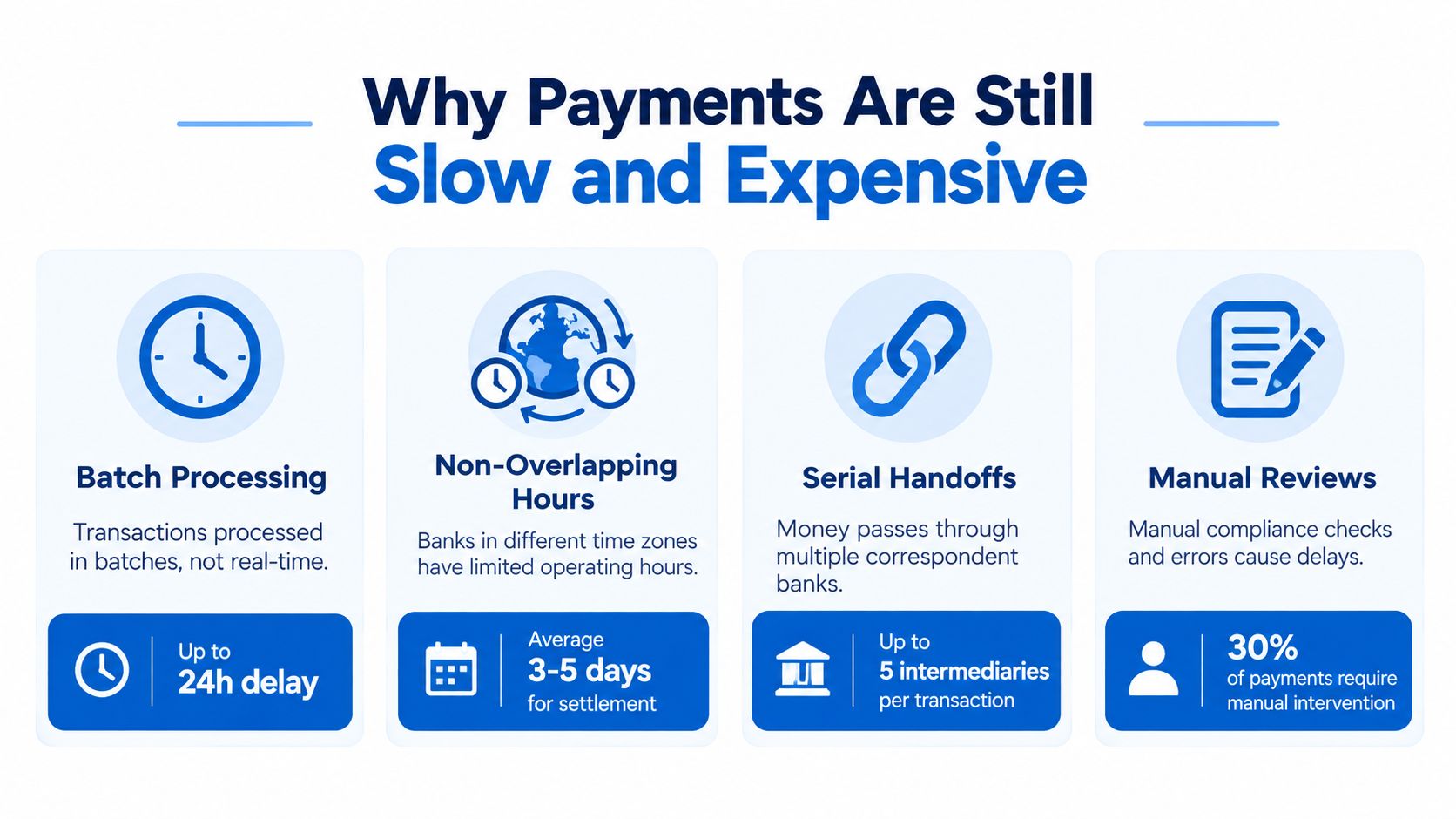
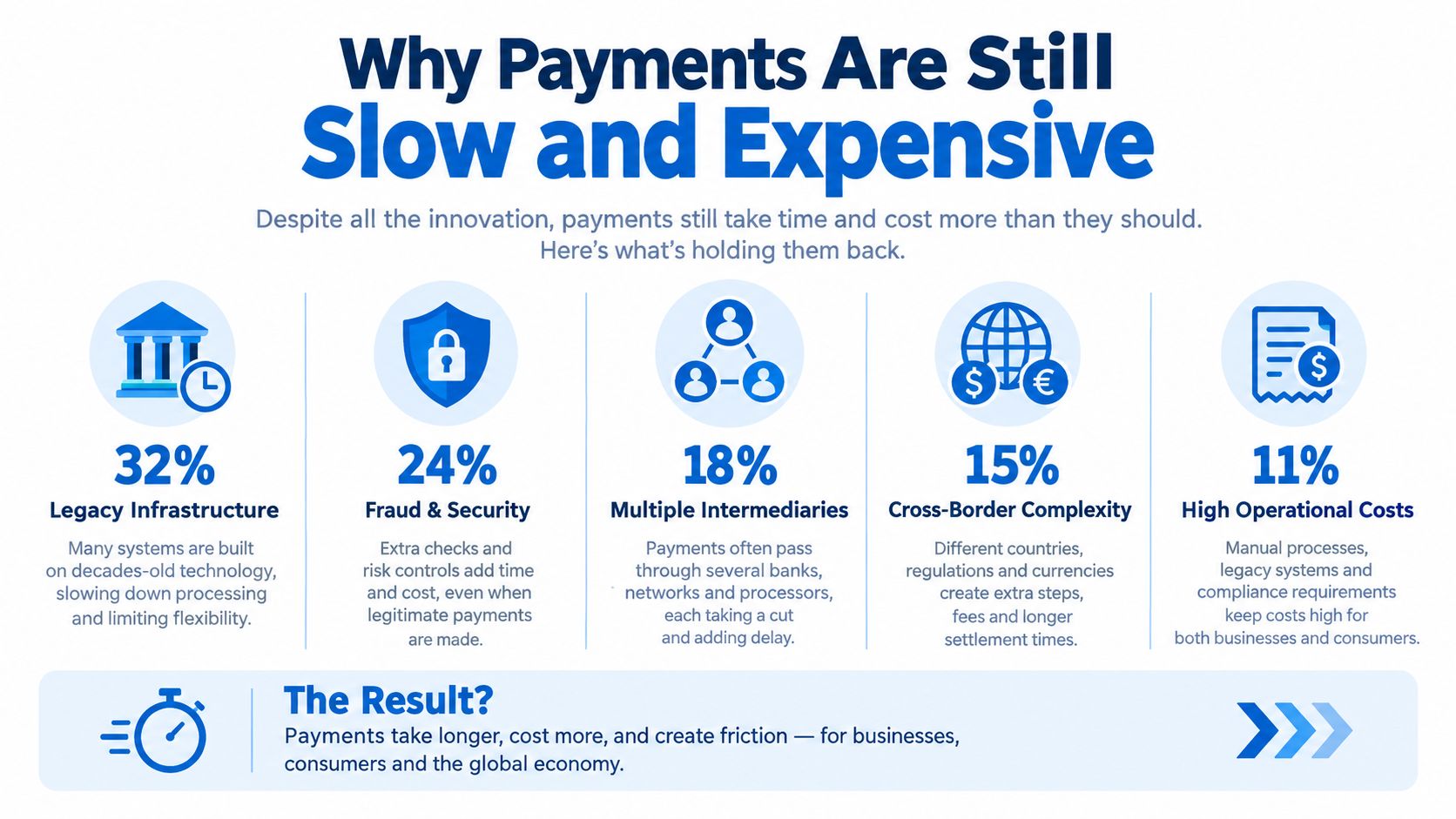
Software can improve the interface without removing the underlying bottleneck. A payment may still move through batch systems, non-overlapping bank hours, serial intermediary handoffs, and manual exception queues.
The Bank for International Settlements explains that processing can exceed 12 hours when legacy batch platforms, limited operating-hour overlap, and serial handoffs force incoming payments to wait for the next processing window. Its technical background report on enhancing cross-border payments points toward three practical remedies: collapse sequential steps, extend operating-hour overlap, and use richer standardized messages such as ISO 20022 and API protocols.
Four structural causes
Batch processing means the receiving institution doesn't necessarily act when the sending institution submits the instruction. The payment waits for a scheduled window, even if the sender's screen shows a completed submission.
Non-overlapping operating hours create a calendar problem. A transfer submitted near the end of one market's working day may reach another institution when its relevant team or clearing system isn't operating.
Serial handoffs multiply dependencies. Each intermediary can introduce data validation, sanctions screening, reconciliation, fees, or a new waiting point. The more steps a route requires, the more opportunities exist for an exception.
Manual reviews appear when payment data is incomplete, inconsistent, or difficult for an automated system to interpret. A human analyst may need to verify the beneficiary, purpose, origin of funds, or supporting documents before release.
The interoperability gap
Local payment systems can be highly effective inside their own markets and still fail to connect cleanly across borders. That is why “instant locally” doesn't guarantee “instant internationally.” A 2026 industry release on cross-border interoperability described a gap where local innovation has advanced while international connectivity remains unresolved.
Cost has the same layered structure. The total effective price can include FX conversion, distribution-network charges, intermediary fees, and compliance or screening overhead. The World Bank reports a global average remittance sending cost of 6.36%, while its data shows an average cost of 6.4% for a US$200 transfer in 2023 Q4, as recorded in its Remittance Prices Worldwide data. The wider policy target is 3% by 2030 and 1% by 2027, so the gap remains material.
Pricing Models and How to Calculate Total Cost
Finance teams shouldn't compare platforms using the transfer fee alone. They should calculate what leaves the company and what arrives with the beneficiary.
A subscription model may combine a free plan or a paid plan with transaction charges. A transfer model may show a fixed fee while recovering revenue through an FX spread. A card model may apply a foreign-exchange fee when employees spend in another currency. These are different pricing mechanisms, so they need a common comparison method.
The effective-cost formula
For each payment, record:
- Funding cost, such as a wire deposit or fiat deposit fee.
- Transfer cost, such as ACH, domestic wire, international wire, or SWIFT.
- FX cost, including the stated fee or difference between the provider's rate and a reference rate.
- Withdrawal cost, if the beneficiary or treasury account requires a separate withdrawal.
- Platform allocation, meaning the relevant share of a subscription fee.
- Exception cost, including manual work, failed payments, and reconciliation effort.
A simple formula is:
Total effective cost = funding fee + transfer fee + FX cost + withdrawal fee + platform allocation + operational cost
The formula matters because a low visible transfer fee can still produce an expensive payment if the route requires multiple funding and withdrawal steps.
A scenario comparison
The table below uses OneSafe's illustrative published fee schedule from the publisher brief. It isn't a quote for every corridor, and it excludes any fee not specified in the scenario.
| Payment Scenario | Fee Components | Illustrative Total Cost |
|---|---|---|
| US$10,000 vendor payment funded by wire and sent through SWIFT, with no separate FX charge modeled | Wire deposit, SWIFT fee | US$10,060 |
| US$10,000 vendor payment funded by wire and sent through SWIFT, with stated FX pricing modeled at 0.25% | Wire deposit, SWIFT fee, 0.25% FX charge | US$10,085 |
| Recurring contractor payment through ACH, with no additional fee supplied | ACH fee, any applicable plan or FX charge must be verified | Not calculable from the supplied fee schedule |
| Card purchase in a foreign currency | Card FX fee | 3% of the foreign-currency transaction value |
The illustrative SWIFT calculation uses a US$10 wire deposit fee and a SWIFT charge of 0.35% plus US$50, based on the publisher's stated pricing. The separate FX example uses the stated 0.25% or FX rate pricing, but the applicable rate depends on the transaction.
For a deeper comparison of bank and crypto transfer economics, review this Bank of America wire transfer fees versus crypto costs analysis. The operator's task is to model the exact corridor, then confirm who pays intermediary charges and whether the recipient receives the gross or net amount.
Real World Use Cases for SMEs DAOs and Global Teams
A platform earns its place in the stack when it removes a recurring handoff from a real workflow. The same account can support supplier payments, treasury movements, contractor payouts, and card spend, but each job requires different controls and routing decisions.

International SMEs
An international SME may receive customer funds in one currency, hold another for supplier invoices, and use local rails for eligible payments. Centralizing ACH, domestic wires, international wires, and SWIFT can reduce the need to maintain separate banking portals and manual spreadsheets.
The workflow should begin with a beneficiary record, continue through approval, apply the chosen FX instruction, and end with a reconciliation entry. Finance leaders should measure time to settle, FX cost per payout, and the percentage of payments that follow the required approval policy.
DAOs and web3 startups
A DAO or web3 startup often has obligations in both fiat and digital assets. Treasury staff may need to convert USDC into fiat for a vendor, receive crypto for an invoice, or keep operational balances separate from long-term treasury holdings.
The important control is not merely conversion speed. The team needs custody boundaries, MFA, approval roles, transaction records, and a clear path from wallet activity to accounting. Web3 invoicing can also give counterparties a choice between crypto and fiat settlement without forcing the finance team to operate two unrelated systems.
The video below provides a visual introduction to global digital payment workflows.
Teams paying contractors
A technology company with international contractors needs repeatability more than one-off transfer speed. The process should cover contractor onboarding, beneficiary verification, payout approval, currency selection, and evidence for reconciliation. Corporate cards can handle approved software and business expenses when team members need controlled purchasing access.
Teams can review international contractor payment workflows while building their own checklist. Track settlement time, FX cost per payout, rejected or returned payments, and approval compliance rather than relying on a provider's broad delivery promise.
Availability is also a compliance question. OneSafe states worldwide availability with exclusions for OFAC-sanctioned countries and certain U.S. states, so every organization must verify eligibility for its own entity, users, beneficiaries, and corridors before implementation.
How to Choose the Right Cross Border Payments Platform
Choose the platform by mapping your payment routes, not by choosing the most attractive speed claim. A provider that supports one corridor well may not support another with the same rail, settlement window, or compliance process.
Use this checklist during evaluation:
- Routing coverage: Ask which local and international rails serve each destination, currency, and beneficiary type.
- Interoperability: Confirm whether the provider can reduce intermediary hops and support standardized APIs or ISO 20022-compatible data.
- FX transparency: Request the conversion rate, markup or stated fee, and the exact amount the recipient receives.
- Compliance model: Review KYB, sanctions screening, transaction monitoring, escalation procedures, and documentation requirements.
- Custody and access: For crypto workflows, verify custody arrangements, MFA, wallet controls, and approval permissions.
- Team governance: Test roles, spending limits, merchant controls, dual approvals, and audit records.
- Settlement visibility: Check whether the dashboard shows pending, released, rejected, returned, and completed states.
- Support quality: Read the FAQ, help center, and documentation before signing. A support process matters most when a payment is stuck.
- Partner structure: Understand whether the service is a bank, a regulated payment institution, or a technology layer working with partner institutions.
Decision test: Give the provider your actual payment mix and ask it to show the route, total cost, expected settlement window, and exception path for each payment.
Start by listing your corridors and separating recurring payouts from treasury conversions and card spend. Use the cost table to model complete flows, run onboarding for the relevant legal entity, and verify routing coverage before moving volume. OneSafe is one option to assess for businesses that need multi-currency accounts, fiat payment rails, corporate controls, and crypto-compatible workflows through a unified interface.
OneSafe brings multi-currency business accounts, ACH, wire and SWIFT payments, corporate cards, and crypto-compatible treasury workflows into one interface, with regulated services delivered through partner institutions. Visit OneSafe to review the available account, payment, compliance, and pricing options for your cross-border payment mix.