On October 23, 2026, Israeli Prime Minister Benjamin Netanyahu announced he had directed his government to develop a plan using cryptocurrency and blockchain networks to bypass possible international banking sanctions. Speaking on Israel’s Channel10 just days before a national election, he framed it as preparation for an alternative economy—one that might need to function without “tens of billions of dollars in American assistance” or access to the traditional financial system (Yahoo). The announcement is a vivid, state-level turn in the story of crypto banking, carrying direct implications for businesses that depend on fiat-crypto bridge services in an era of fast-moving sanctions and compliance pressure.
Table of Contents
- What Just Happened: Netanyahu’s Crypto Banking Play
- Why This Crypto Banking Pivot Matters for Your Business Right Now
- Crypto Banking in 2026: What Every Operator Needs to Understand
- Actionable Steps: Future-Proofing Your Company’s Banking Stack
- What to Watch Next: Crypto Banking on a Geopolitical Knife-Edge
- What just happened with Israel and crypto banking?
- Why would a country use cryptocurrency to avoid banking sanctions?
- How can my business protect itself from similar banking disruptions?
- What is a crypto bank, and how does it differ from a traditional bank?
- What should I look for in a crypto banking partner for my business?
- How do crypto banking platforms handle compliance when sanctions risk rises?
- A Compliance Checklist for Sanctions-Ready Crypto Banking
- Key Takeaways
What Just Happened: Netanyahu’s Crypto Banking Play
The October 23 announcement and its timing ahead of Israel’s election
Netanyahu’s remarks, four days before Israel’s October 27 election, came with a stark assessment: “There could be sanctions, including banking sanctions,” and “you have to prepare an alternative economy and think about currencies that can get around those restrictions. I am working on that as well.” The substance—a sitting prime minister publicly directing work on a state-sponsored blockchain-based evasive payments infrastructure—sent a signal far beyond Israel. For a deeper analysis, see Netanyahus Crypto Banking Plan: What It Means for Business.
What the plan says: blockchain-based alternative currencies to bypass sanctions
Details remain scarce, but the mention of “cryptocurrency” and “blockchain” in connection with sanctions evasion suggests the Israeli government is considering digital assets that operate outside the correspondent banking network, potentially using permissionless blockchains or privacy-preserving designs to move value without SWIFT or dollar clearing. This would be the most high-profile instance of blockchain sanctions evasion by a sovereign state since Russia’s pivot toward crypto for cross-border trade in 2025.
Why this isn’t theoretical—the history of sanctions on banking channels
Iran, North Korea, and Venezuela have all experimented with state-backed digital currencies. Russia’s 2025 legislative changes legalizing crypto for trade follow the same logic. The European Union keeps a growing list of restrictive measures. What makes Netanyahu’s statement different is its transparency: a U.S. ally openly signaling it may decouple from dollar-denominated banking, using crypto as the bridge.
Why This Crypto Banking Pivot Matters for Your Business Right Now
The new risk of financial deplatforming even for non-sanctioned entities
When a country like Israel contemplates a crypto-based workaround, the immediate effect is a tightening of the compliance apparatus. Banks and payment providers over-screen for any connection to geographies that appear in headlines. A Web3 startup or DAO operating legally may find its business crypto account frozen or wires delayed as intermediaries fear secondary sanctions. Financial deplatforming no longer requires being named on a sanctions list.
How a crypto-friendly neobank changes the resilience equation
A neo-bank crypto platform that natively supports fiat and stablecoin rails gives a business an operational off-ramp. Instead of relying on a single correspondent bank that can cut access overnight, operators can hold multi-currency crypto accounts, convert to USDC or other stablecoins, and move value across jurisdictions without passing through legacy infrastructure every time. This doesn’t mean sanctions avoidance—compliant platforms still screen transactions—but it provides redundancy and speed when traditional channels become politicized.
The gap between political headlines and your treasury workflows
Treasury teams need a sober action plan. The question isn’t whether Israel will launch a digital shekel next month; it’s whether your banking stack can survive a sudden compliance chill. Assess your banking partners’ exposure to geopolitical pressure, stablecoin on/off-ramp costs, and whether custody and screening protocols are up to the new reality.
Crypto Banking in 2026: What Every Operator Needs to Understand

The core model: fiat accounts, stablecoin rails, and compliance under one roof
A modern crypto banking platform combines traditional features (ACH, wires, IBANs, corporate cards) with digital asset services (custody, on-chain payments, fiat-stablecoin conversion) under strict compliance frameworks. These are technology firms that partner with regulated banks—not licensed banks themselves. This model lets businesses manage multi-currency crypto accounts in USD, Euro, CAD, and others, with the ability to accept or send stablecoins. Compliance is woven into the fabric, often using tools like Chainalysis for real-time OFAC screening.
What the FDIC guidance really says and what it doesn’t cover
The OCC’s 2026 stablecoin rule (Crypto Banking Gets a Clarity Milestone with New OCC Stabelcoin Rule) provides a framework for national banks to hold stablecoin reserves and participate in permissioned networks, but it reinforces AML and sanctions compliance. It doesn’t address state-level evasion scenarios. The gap: a business can now open a regulated, FDIC-insured account that integrates crypto, yet that account remains exposed to de-risking if compliance officers get skittish about sanctions chatter.
Where platforms like FV Bank, Anchorage, and OneSafe actually differ
FV Bank and Anchorage are federally regulated digital asset banks (Anchorage holds a national trust charter); Sygnum is another example of a regulated digital asset bank (Sygnum Bank | Regulated Digital Asset Banking). OneSafe is a neo-banking layer—a technology company that aggregates partner bank accounts and blockchain infrastructure into a single interface for businesses, including DAOs. Ramp’s trust charter bid (Ramp’s Trust Charter Bid Tests Crypto Banking) shows the push to bridge these models. The distinction matters for onboarding speed (roughly a week for OneSafe versus longer KYC for chartered institutions) and fee structures. The trade-off is specialized functionality versus direct deposit insurance.
Actionable Steps: Future-Proofing Your Company’s Banking Stack
Diversifying banking relationships beyond a single jurisdiction
Do not keep all fiat and crypto treasury with one provider. Maintain a separate stablecoin wallet with a qualified custodian and a secondary fiat account in a different jurisdiction. If your primary partner faces pressure to sever ties, you can quickly route payments through the backup rail.
Evaluating custodial security (Fireblocks, MFA) and OFAC screening as buying criteria
Custodial infrastructure separates a resilient setup from a catastrophic loss. Look for platforms that use qualified custodian technology (e.g., Fireblocks MPC), enforce mandatory multi-factor authentication, and perform real-time OFAC/sanctions screening on both fiat and crypto transactions—not just at onboarding.
How to assess crypto on/off-ramp fees and FX costs with real numbers from OneSafe
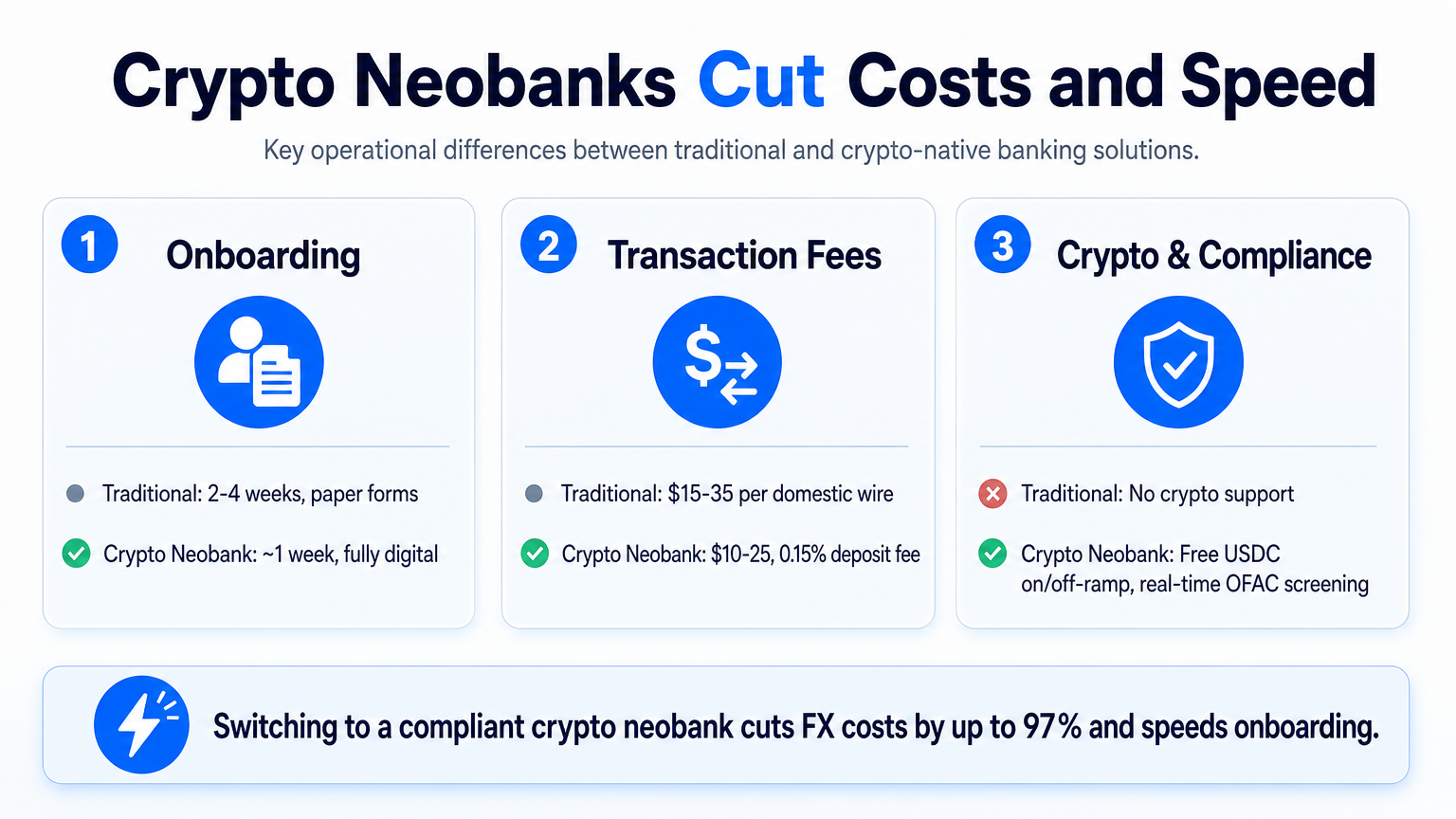
Fees eat into treasury margins, especially during frequent conversions. The table below compares a traditional business bank with a crypto-native neobank on the cost levers that matter most.
| Feature | Traditional Business Bank | Crypto-Native Neobank (e.g., OneSafe) |
|---|---|---|
| Account opening | 2–4 weeks, paper-heavy | ≈1 week, fully digital |
| Fiat deposit/withdrawal fee | Typically free domestic, higher for wire | 0.15% |
| Domestic wire | $15–$35 | $10 deposit / $25 withdrawal |
| SWIFT | $25–$50 + FX margin | $50 + 0.35% |
| FX rate / markup | 1–3% on corporate cards | 0.25% rate (3% on cards) |
| Crypto deposit/withdrawal (USDC) | Not available or high spreads | Free |
| On/off-ramp delay | N/A or 1–3 days | Near-instant conversion |
| Sanctions screening | Relies on bank correspondents | Real-time, integrated |
Numbers reflect OneSafe’s publicly available fee schedule as of October 2026. A crypto on-off ramp with near-instant conversion and transparent pricing cuts FX risk and operational costs.
What to Watch Next: Crypto Banking on a Geopolitical Knife-Edge
How the U.S., EU, and FATF are likely to respond to state-level crypto evasion
Expect two tracks. First, a regulatory clampdown on service providers that facilitate evasion, with the U.S. Treasury already announcing record enforcement actions in 2026. Second, stablecoin issuers and on-ramp platforms will face pressure to enforce geography-based restrictions at the token level. The FATF will almost certainly update virtual asset guidance to address state-actor evasion, tightening crypto regulations for any business that holds or transfers stablecoins.
The next wave of institutional stablecoin adoption and its effect on business banking
Institutional stablecoin adoption is already widening—18% of enterprises are now using stablecoins for payments in production. As national banking sanctions become a live risk, that number will accelerate. The GENIUS Act (Stablecoin Regulation: GENIUS Act Clarifies Interest Rewards) will permit interest-bearing stablecoin accounts within a regulated perimeter, embedding stablecoins deeper into business banking.
Open questions: Can a DAO or startup stay truly sanctions-proof?
No. Sanctions follow the assets, not the legal wrapper. On-chain screening tools can identify and block DAO addresses, and members can face liability. However, a DAO banking setup with customizable roles, multi-sig, and automated workflows can maintain operations while proving no sanctioned entity controls the funds. The goal is resilience, not evasion.
What just happened with Israel and crypto banking?
On October 23, 2026, Netanyahu announced he had requested a plan to use cryptocurrency and blockchain networks to circumvent possible banking sanctions, framing it as preparation for an alternative economy. The statement was made during a pre-election interview and reported by Yahoo.
Why would a country use cryptocurrency to avoid banking sanctions?
Cryptocurrency, especially on public blockchains with stablecoins, allows value to move peer-to-peer without passing through the dollar-clearing system. A country facing sanctions can hold reserves in digital assets, settle trade with stablecoins, or issue its own blockchain-based instrument outside of SWIFT. Israel’s open consideration signals that even U.S. allies now see crypto banking as a necessary resilience tool.
How can my business protect itself from similar banking disruptions?
Diversify banking relationships across jurisdictions and provider types. Move a portion of operating liquidity into stablecoins held in a secure, compliant crypto account that allows instant fiat conversion. Pre-screen counterparties and ensure alternative payment routing. Vetting every crypto banking partner for real-time OFAC screening and custodial security is non-negotiable.
What is a crypto bank, and how does it differ from a traditional bank?
A crypto bank is a financial technology platform that integrates traditional banking services (fiat accounts, wires, cards) with digital asset services (custody, on-chain payments, stablecoin conversion). Unlike a traditional bank that typically walls off crypto activity, it provides native fiat-crypto interoperability. Most are not licensed banks themselves—a design that can speed up onboarding and lower costs but means they don’t directly provide FDIC insurance on deposits. (Crypto Bank and Crypto Banking 101)
What should I look for in a crypto banking partner for my business?
Prioritize five criteria: custodial security (Fireblocks-grade technology with mandatory MFA), real-time sanctions screening covering fiat and crypto transactions, transparent fee schedules for crypto on-off ramp and FX, global multi-currency crypto account availability, and DAO/Web3 readiness with customizable roles and multi-sig.
How do crypto banking platforms handle compliance when sanctions risk rises?
Compliant platforms use multi-layered screening—integrating blocklists from OFAC, EU, and UN—geofence services to exclude sanctioned regions, and run on-chain forensics. When risk escalates, they tighten internal risk scores, may pause specific corridors, and request additional KYB documentation. Compliance must be built into the transaction flow, not bolted on.
A Compliance Checklist for Sanctions-Ready Crypto Banking
- ☐ Onboarding: under 2 weeks
- ☐ Custody: qualified custodian (e.g., Fireblocks) and mandatory MFA
- ☐ Sanctions screening: real-time, OFAC-sanctioned countries restricted
- ☐ Jurisdictional diversification: multiple currency accounts and stablecoin sub-accounts
- ☐ Fee transparency: clear crypto deposit/withdrawal, wire, and FX markups
- ☐ DAO features: customizable permissions, multi-sig, automated payments
- ☐ Continuity plan: instant stablecoin-to-fiat conversion and external wire capability
Key Takeaways
- Netanyahu’s call for a blockchain-based sanctions workaround heightens the risk of cascading de-risking for any business that relies on unified crypto-fiat accounts.
- A diversified banking stack with stablecoin rails is now a resilience essential, not a luxury.
- A reliable crypto banking partner must deliver real-time OFAC screening, Fireblocks-grade custody, transparent fees, and DAO-ready governance controls.
- Proactive counterparty mapping, backup fiat and stablecoin accounts, and compliant neo-bank crypto platforms keep operations running when geopolitics disrupt legacy channels.
- Regulatory pressure will accelerate institutional stablecoin adoption, making platform selection a strategic decision today.
Future-proof your business’s banking stack with OneSafe’s multi-currency and stablecoin accounts.