You've built the company, passed investor diligence, and set up treasury workflows that make sense on-chain. Then your bank sends a closure notice, or a payment provider freezes a euro transfer because the recipient is connected to a stablecoin issuer. Your team can still see the assets, but payroll, contractors, card spend, and vendor invoices are suddenly at risk.
This isn't usually bad luck or a single analyst's mistake. Correspondent banks and downstream providers often manage crypto exposure through broad risk policies rather than a detailed review of every transaction. A crypto business bank account therefore isn't just an account you open once. It's an ongoing operating relationship that depends on how you structure treasury, document activity, and communicate with the provider as the business grows.
Table of Contents
- The Moment Every Crypto Founder Recognizes
- What belongs inside the account
- What deliberately stays outside
The Moment Every Crypto Founder Recognizes
A payments lead at a Series A exchange usually discovers the problem during an otherwise ordinary week. One provider gives the company a notice that its account will close within a month. At the same time, a European fintech pauses euro wires because the destination counterparty is associated with stablecoin activity. No one on the finance team has suddenly changed the business model. The institution has changed its tolerance for the business model.
That pattern appears because crypto exposure travels through banking layers. Your direct provider may understand your exchange, custody, or payments activity, but its correspondent bank may apply a more restrictive policy. The direct provider then has limited room to defend the relationship, even when your company has strong controls and a clean transaction history.
The operational damage arrives quickly:
- Payroll becomes a treasury emergency: Finance has to move funds through unfamiliar rails instead of following the approved payment run.
- Vendor settlement slows down: Suppliers wait while the team explains why a transfer is pending.
- Audit trails fragment: Staff export records from wallets, exchanges, card systems, and temporary accounts.
- Compliance work becomes reactive: Analysts request documents after a review starts, not before the transaction occurs.
Practical rule: Treat the account as infrastructure with a maintenance plan, not as a checkbox on the incorporation list.
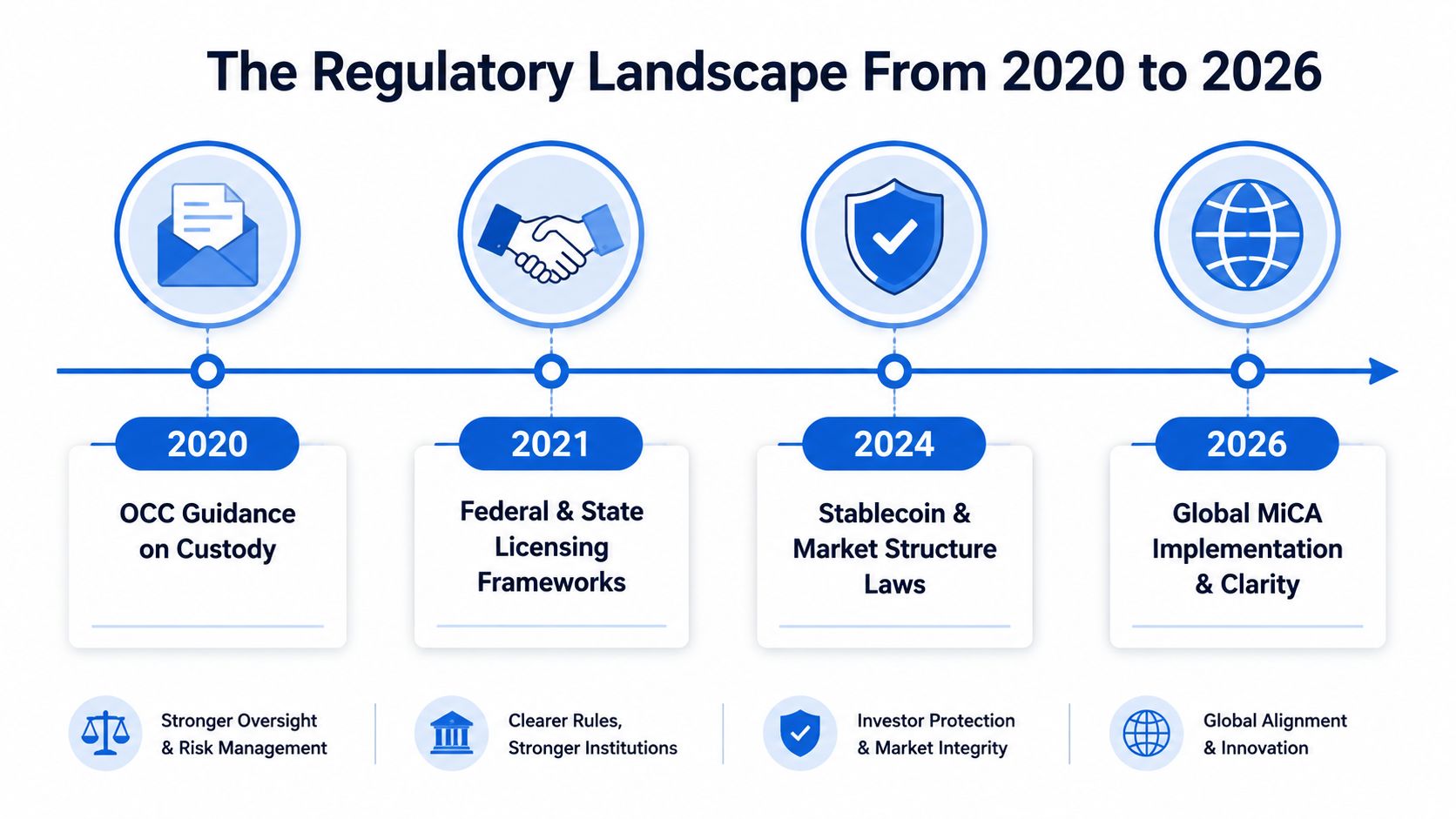
The regulatory environment has moved crypto activity closer to formal financial policy. The OCC's July 22, 2020 interpretive letter addressed national bank custody of crypto assets, and its January 4, 2021 letter clarified the use of distributed ledger technology and stablecoins for payments-related activities, as documented in this timeline of bank and crypto regulatory activity. Yet formal recognition doesn't remove operating risk. It makes your documentation, monitoring, and treasury design more important.
Founders who separate compliance, treasury, and tooling into unrelated projects usually rebuild all three under pressure. The durable approach is to choose a provider that understands the full flow, then make that flow easy to explain.
What a Crypto Business Bank Account Is
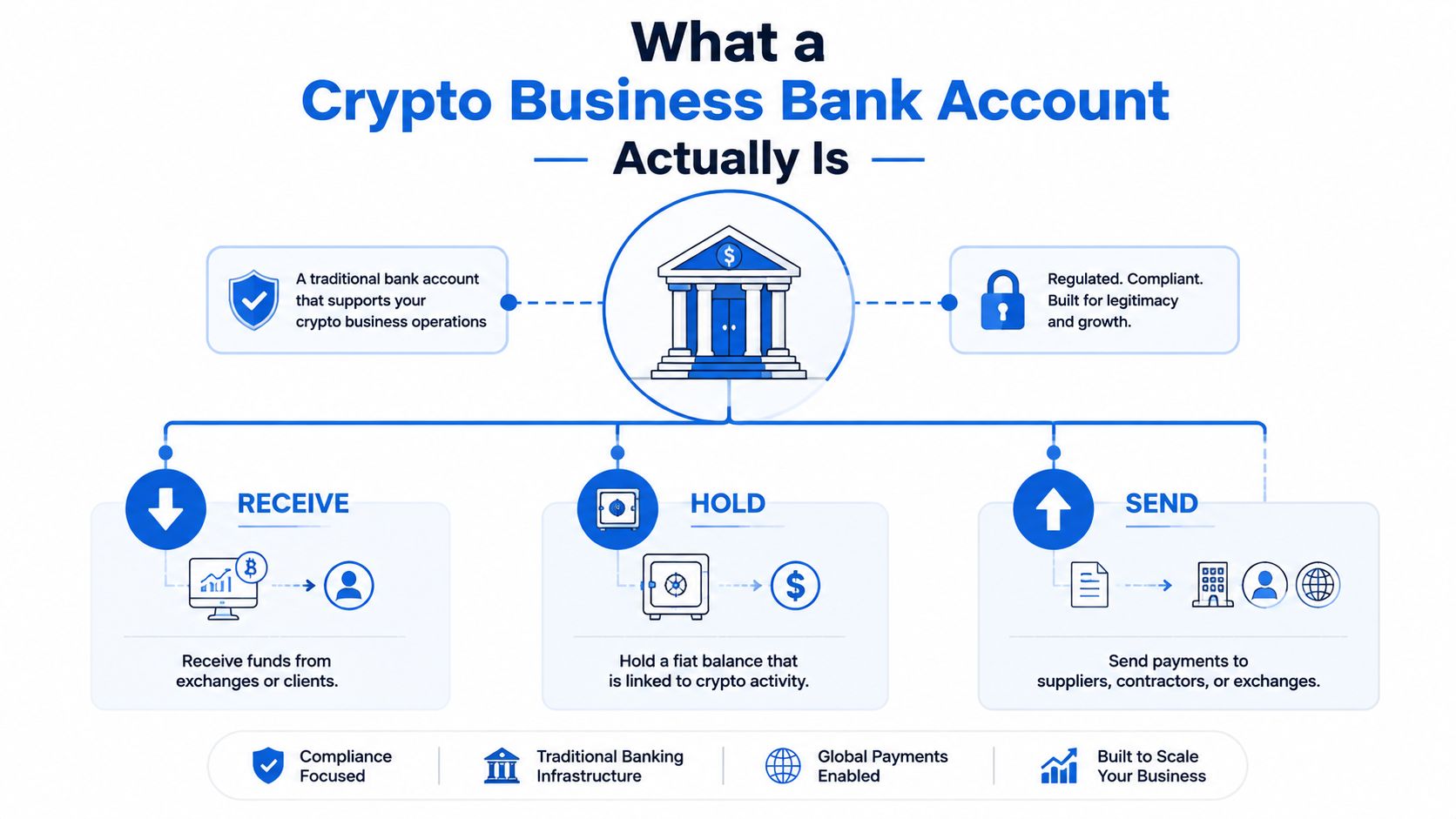
A crypto business bank account is a fiat account for receiving, holding, and sending money connected to digital asset activity. The account usually holds fiat, while digital assets remain in wallets or with a qualified custodian. It supports operating expenses, payroll, vendor invoices, and fiat settlement, as explained in this guide to business banking for crypto operations.
It functions as a treasury control panel. Your finance team should be able to see incoming and outgoing fiat, currency balances, card spend, conversion activity, accounting exports, and the connection between operating funds and reserve wallets. A provider that shows balances but cannot produce usable records will create work during reconciliation and reviews.
What belongs inside the account
The provider should connect the account to a named legal entity that has completed KYB verification. The institution should know the business identity, directors, authorized signers, ownership or control structure, and expected activity.
Day to day, the account should support:
- Receiving funds: Fiat transfers from customers, exchanges, payment processors, or counterparties.
- Holding working capital: Fiat reserved for payroll, suppliers, tax, and operating expenses.
- Sending payments: Contractor payouts, vendor invoices, exchange settlements, and treasury transfers.
- Controlling spend: Corporate cards, approval permissions, merchant restrictions, and team-level limits.
- Producing evidence: Statements, transaction records, reconciliation data, and accounting exports.
The account must show which funds belong to the company and which belong to customers. Customer assets should not share the company's operational pool. Clear segregation and regular reconciliation reduce commingling concerns and make account reviews easier.
What deliberately stays outside
Private keys, signing authority, on-chain execution, and token-swap logic belong in wallets, custody systems, or specialist execution venues. A bank account does not replace wallet governance or blockchain monitoring.
Before signing, map the complete flow. Identify where a stablecoin arrives, who converts it, where fiat lands, which account pays the contractor, and where the accounting record is created. Manual transfers across several personal or corporate accounts signal a fragile setup. Use this crypto integration guide for business accounts to review how the banking and crypto functions connect. A clear flow also gives your provider a defensible explanation of activity as the relationship develops.
The Regulatory Timeline From 2020 to 2026
A bank assessing your crypto company will turn published rules into onboarding questions, transaction limits, monitoring scenarios, and escalation procedures. Founders who understand those signals can design treasury and compliance processes that remain explainable months after approval.
The first major shift came from the OCC. Its July 22, 2020 interpretive letter allowed U.S. national banks to provide crypto-asset custody services. The OCC's January 4, 2021 letter then clarified that banks could use distributed ledger technology and stablecoins for payments-related activities, according to the regulatory chronology cited earlier.
Those letters gave banks a clearer basis for serving crypto businesses, while keeping risk controls in place. In practice, expect deeper KYB, source-of-funds questions, wallet and counterparty screening, and ongoing transaction monitoring. Your account setup should support those reviews instead of forcing the provider to reconstruct activity from disconnected transfers.
Capital treatment changes the product menu
In December 2022, the Basel Committee stated that banks' cryptoasset exposure shouldn't exceed 2% of Tier 1 capital and should generally remain below 1%, with implementation targeted for January 1, 2025, as recorded in the earlier regulatory timeline. The operational signal is straightforward. A bank may support crypto businesses while keeping its own exposure narrow, especially around assets and activities it considers harder to price, custody, or monitor.
The BIS has also described average bank exposure to cryptoassets as less than 0.02% of risk-weighted assets, showing that crypto's balance-sheet footprint has remained limited even as related infrastructure develops, according to the BIS working paper. A provider can therefore be crypto-compatible without accepting concentrated exposure to your treasury or counterparties.
What the 2025 clarification means
The FDIC clarified in March 2025 that supervised institutions may engage in permissible crypto-related activities without prior approval, as described in its statement on crypto-related activities. Banks still apply risk-based review. They will examine your licensing position, customer base, transaction corridors, sanctions controls, and source of funds.
For teams operating in the Gulf, a regional view can clarify how local rules affect banking conversations. The crypto compliance timeline UAE 2026 provides that jurisdictional context.
The policy foundation is clearer, but your company still must prove that its controls work in practice. Banks retain discretion over which crypto businesses they serve, and weak monitoring or unclear fund flows can still lead to tighter limits or account closure.
KYB and Compliance Expectations for Crypto Companies
A bank reviewing a crypto company is testing one operating question: Can this business identify its counterparties, explain where money comes from, and document what happens after funds arrive? Founders should prepare for that review before submitting an application.
Gather formation documents, a current ownership or control chart, UBO declarations, government identification for relevant people, business-model details, AML and KYC procedures, expected transaction activity, and evidence of registration or licensing where applicable. Crypto businesses often face a higher compliance bar because the bank must understand both bank transfers and blockchain-linked flows, as explained in this crypto business bank account compliance guide.
| Document Requested | What the Bank Is Checking | Founder Prep Tip |
|---|---|---|
| Certificate of incorporation and constitutional documents | Whether the entity exists, operates lawfully, and has authority to enter the relationship | Keep certified copies and an updated register ready |
| UBO declaration and ownership chart | Who ultimately owns or controls the business | Include control rights, not only share ownership |
| Director and signer identification | Whether the people giving instructions are verified and authorized | Match names and roles across every document |
| AML and KYC policy | Whether the company can identify customers and manage risk | Show ownership, review cadence, escalation, and recordkeeping |
| Source-of-funds and source-of-wealth evidence | Whether incoming capital and treasury can be explained | Map investor funds, revenue, grants, and on-chain transfers |
| Licensing or VASP registration | Whether regulated activity is permitted in the relevant jurisdiction | Explain pending applications and the exact activity scope |
| Transaction profile | Whether expected payments match the business model | Describe corridors, counterparties, currencies, and purpose |
| Monitoring evidence | Whether controls operate beyond policy documents | Prepare sample alerts, case decisions, and reconciliation records |
Build for the second review
KYB continues after account approval. Providers may revisit your structure when volumes, jurisdictions, products, or counterparties change. Maintain a controlled compliance folder with dated organization charts, licenses, policies, wallet addresses, key counterparties, and board or governance approvals. This record gives the bank a clear audit trail when its review team asks how your business has changed.
DAOs and unincorporated associations need extra preparation. A shareholder register may not identify the people who control a multisig or approve treasury spending. Provide signer attestations, governance rules, wallet ownership evidence, voting records, and a plain-language explanation of how decisions become payment instructions.
Use these AML and KYC procedures as an operating control, not a document stored for onboarding. A focused policy your team follows consistently produces better compliance outcomes than a detailed one that generates no usable monitoring records. Tie each control to evidence: customer reviews, wallet screening results, alert decisions, escalation records, and reconciliations. That evidence is what supports the relationship when the provider reviews your account months after approval.
Two Operating Models for Crypto Banking
Crypto companies usually choose between modularity and integration. Neither model is automatically safer. The correct choice depends on how much separation your governance, finance team, and counterparties require.
Model A uses separate specialists
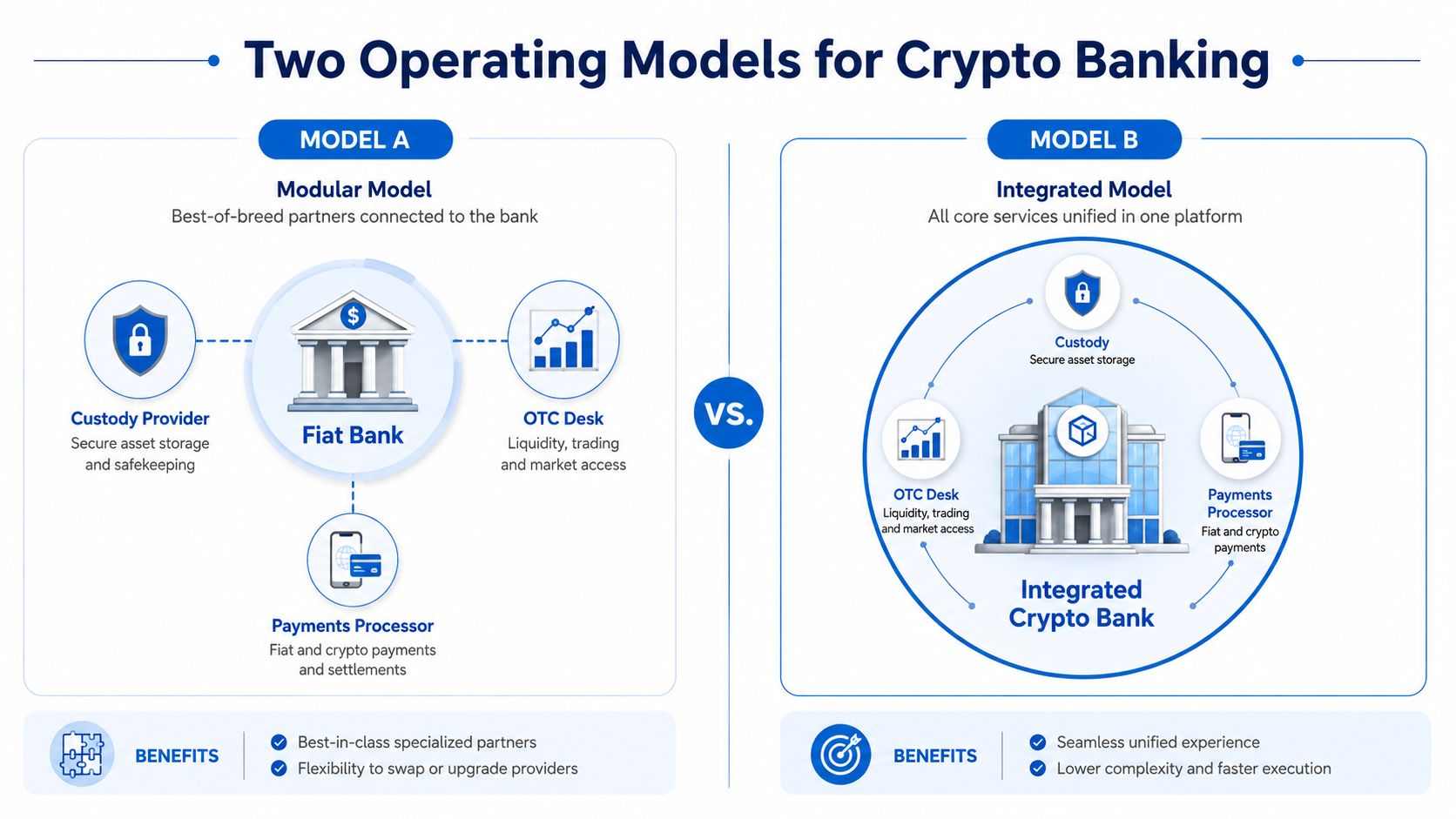
The modular setup pairs a traditional or specialist fiat bank with a custody provider, an OTC desk, and a payments processor. The bank holds fiat, the custodian protects digital assets, the OTC desk executes conversions, and the processor handles selected payouts or card services.
This design gives you separation of duties. A treasury operator can't necessarily move assets, approve fiat payments, and change card limits through one login. Auditors may also find the responsibilities easier to isolate.
The cost is reconciliation. Your team has to align bank statements, custody reports, OTC confirmations, processor records, and wallet activity. Every transfer needs a clear reference, and every conversion needs a record showing the asset sold, fiat received, fees charged, and business purpose.
Model B consolidates the workflow
An integrated platform combines fiat accounts, stablecoin rails, custody or custody partnerships, conversion, cards, and payments under one compliance perimeter. That can reduce handoffs and give finance a single operational view.
The advantage is speed and reporting consistency. The risk is concentration. If the provider changes its policy, experiences an outage, or restricts an activity, more of your treasury workflow may be affected at once.
| Decision Area | Modular Model | Integrated Model |
|---|---|---|
| Control separation | Stronger separation across providers | More authority concentrated in one platform |
| Reconciliation | More ledgers and handoffs | One operating view can simplify close |
| Operational speed | Transfers between providers add friction | Conversion and payout workflows can be faster |
| Counterparty exposure | Spread across several institutions | Concentrated in one regulated entity |
| Audit design | Clear functional boundaries | Fewer systems, but broader provider dependency |
Use Model A when your regulated activity, treasury size, or audit requirements demand strict separation. Use Model B when your main problem is fragmented execution, especially stablecoin-funded operating expenses and global payouts. In both cases, maintain a secondary route for critical payments. An account that works only when every provider remains available isn't resilient.
Features That Matter When You Compare Providers
Provider marketing highlights supported currencies and “crypto-friendly” language. Your finance team needs clearer answers about payment rails, controls, records, and failure handling. Evaluate the account as an operating relationship, because weak processes can trigger restrictions months after onboarding.
Start with the payment path
Ask whether the provider supports the currencies and rails your counterparties use. Confirm which connections are native and which rely on partners. For every route, check cutoffs, beneficiary screening, payment references, returned-payment handling, and the evidence supplied after settlement.
Transparent FX matters more than a headline conversion rate. Ask whether the spread appears before execution, how rate changes enter reports, and whether card purchases follow different pricing from treasury conversions.
Test the controls with a real workflow
A feature list proves little. Give the provider a scenario, such as a contractor payout funded by a stablecoin conversion. Require a clear explanation of every approval, ledger entry, exception path, and report.
| Feature | What to Ask | Why It Matters |
|---|---|---|
| Multi-currency accounts | Which currencies, local rails, and international routes are available? | Reduces unnecessary conversions and intermediary transfers |
| FX pricing | Is the spread disclosed before execution and shown in reports? | Lets finance reconcile the exact cost |
| Corporate cards | Can you set roles, merchant controls, approval rules, and limits? | Prevents uncontrolled team spending |
| Custody | Is custody native or partnered, and who holds signing authority? | Clarifies asset-control and counterparty risk |
| KYB workflow | Can the provider assess non-US entities, DAOs, and complex ownership? | Prevents unsuitable applications and repeated submissions |
| Reporting | Can you export fiat, stablecoin, card, and conversion activity together? | Supports monthly close, audits, and investor updates |
| API access | Can treasury and accounting systems retrieve balances and transactions? | Reduces manual reconciliation |
| Incident handling | Who contacts you during a review, freeze, or returned payment? | Turns a crisis into a managed process |
Record the operating entity behind each capability. For partnered custody, identify who performs screening, holds assets, handles complaints, and supplies records. The same review should cover payment partners, card issuers, and conversion venues. Your contract and audit file should make those responsibilities easy to verify.
Run a controlled test before moving significant treasury activity. Confirm that approvals leave usable evidence, exports reconcile with bank and wallet records, and support can explain a review without sending your team between entities.
A platform that requires an exchange account for every conversion, a separate card system for every employee, and manual spreadsheets for every reconciliation functions as a collection of services rather than an integrated treasury control panel. Choose the setup your team can operate daily, document clearly, and maintain without hidden workarounds.
Use Cases Across DAOs, Web3 Startups, and Global SMEs
A DAO treasury doesn't need a generic current account. It needs a controlled path from governance approval to vendor payment. A Cayman-registered DAO might receive a stablecoin grant into a multisig, convert the approved operating amount, and pay invoices from a named business account. The critical feature is the paper trail linking the governance decision, wallet transaction, conversion, and bank payment.
A seed-stage Web3 startup has a different problem. The founders may hold treasury on-chain while engineers and contractors expect ordinary payroll or card payments. The account must let finance convert only what's needed, issue cards with clear controls, and reconcile spend against grants or departmental budgets without mixing personal and company funds.
A Singapore-based cross-border SaaS business may bill U.S. customers in dollars while settling suppliers in euros and pounds. Its crypto exposure may sit in treasury rather than revenue. The account's value comes from keeping those balances visible, making conversion decisions explicit, and reducing the number of bank relationships needed for ordinary supplier payments.
A Panama-based exporter needs reliable collection and settlement across multiple regions. Its finance team shouldn't have to maintain separate local accounts because customers pay through different rails. Multi-currency receiving, clear beneficiary records, and controlled conversion can remove that administrative burden.
| Entity Type | Primary Flow | Key Features Used | Friction Removed |
|---|---|---|---|
| DAO treasury | Stablecoin grant to approved vendor payments | Governance evidence, multisig records, conversion, named account | Connects collective approval to auditable settlement |
| Web3 startup | On-chain treasury to contractor and card spend | Stablecoin conversion, cards, permissions, reporting | Separates company operations from wallet administration |
| Global SaaS company | Dollar revenue to European supplier settlement | Multi-currency balances, FX visibility, international payments | Reduces repeated conversion and intermediary steps |
| International exporter | Regional customer receipts to supplier payouts | Local rails, beneficiary controls, reconciliation | Limits dependence on scattered banking arrangements |
DAOs need especially clear signer and governance documentation. A provider must understand who can approve a payment, not just who incorporated the entity. Resources for structuring treasury and operational payments for decentralized organizations are available through financial services for DAOs.
Choosing the Right Account for Your Stage
Start with four filters before comparing providers:
- Entity type: Corporation, LLC, foundation, DAO, or unincorporated association.
- Funding source: Venture capital, revenue, grants, client payments, or on-chain treasury.
- Operating pattern: Fiat-only expenses, stablecoin-funded expenses, or mixed treasury.
- Team geography: One country, several jurisdictions, or a fully distributed workforce.
These filters matter more than a long feature list. A provider that works for a conventional software company may reject a DAO. A bank that suits a licensed exchange may be too slow and rigid for a small Web3 team paying contractors across borders.
Pre-seed and seed
Prioritize onboarding clarity, stablecoin-to-fiat conversion, cards, approvals, and predictable pricing. Keep the account simple. Document every treasury transfer and avoid using personal accounts as a bridge.
Series A and later
Add multi-entity visibility, stronger reporting, role-based treasury permissions, and a documented backup route. Investors and auditors will care less about whether the dashboard looks modern than whether finance can explain every material movement of funds.
Mature regulated operations
A licensed exchange, bank, or custody-led business may benefit from a traditional bank for core fiat balances, paired with a specialist custodian and carefully controlled digital asset venues. The modular model can provide cleaner separation once your internal compliance function is strong enough to manage the additional reconciliation.
For teams that need to compare cash-management structures before choosing a provider, this guide to compare zero balance account types can help frame the tradeoffs.
My recommendation is direct. If stablecoin inflows, cross-border contractor payouts, and digital-asset treasury are central to daily operations, an integrated platform such as OneSafe is usually the more practical fit. If you operate a regulated exchange or already hold a banking license, a traditional bank paired with a custody provider may give you cleaner separation and stronger institutional control.
Use this shortlist before you apply:
- Legal fit: Does the provider support your entity and jurisdictions?
- Compliance fit: Can you explain ownership, wallets, counterparties, and funds?
- Treasury fit: Can the account handle your actual fiat and stablecoin workflow?
- Control fit: Are approvals, cards, limits, and segregation built in?
- Durability: What happens when activity, jurisdictions, or counterparties change?
- Exit plan: Can you move critical payments if the relationship is reviewed?
The 2026 Web3-financial-services market is projected to grow from USD 4.76 billion in 2025 to USD 50.41 billion by 2031, representing a projected 48.19% CAGR, according to the BIS-linked market forecast reference. Growth won't protect a poorly documented business. A durable crypto business bank account comes from matching the provider, controls, and treasury design to the way your company moves money.
OneSafe brings multi-currency business accounts, global payments, corporate cards, and crypto-compatible USDC workflows into one operating interface, with regulated banking services delivered by partner institutions. Review the OneSafe platform and map your current treasury, payout, and compliance workflow before your next provider review.