
Are there any drawbacks to neo banking? The short answer: yes, there are real trade-offs—especially for global companies, DAOs, or crypto-native startups. Most consumer neobank reviews won’t prepare you for the friction that hits when you’re settling a six-figure vendor payment in EUR, converting stables to fiat, or onboarding a multisig treasury. This article cuts through generic pros and cons to examine the specific neobank disadvantages for business that finance leads actually face, using OneSafe’s platform parameters as a reference point.
What Are the Real Drawbacks of Neo Banking?
A neobank can slash onboarding time, eliminate branch visits, and natively handle fiat and crypto—but if your business requires large, frequent international wires, deposit insurance on operating cash above $250,000, or exotic currency pairs, the limitations become acute. Generic lists point to missing branches, narrower product suites, partner-bank deposit insurance, and evolving regulatory oversight. The real question is what happens when you push a neobank harder than a consumer app. Founders with distributed teams care less about tellers and more about multi-currency receipt, FX cost transparency, and whether operating cash is actually safe.
Deposit Protection: The FDIC Fallacy and Your Operating Cash
When a fintech says “your funds are FDIC insured,” it usually means money sits at a partner bank and that bank’s insurance covers you indirectly through pass-through rules. Unit21’s Neobanking Compliance overview notes this creates regulatory ambiguity: the neobank itself isn’t the insured institution. If the fintech fails, you could wait months for a receiver to verify records and return funds, even if the underlying bank remains solvent.
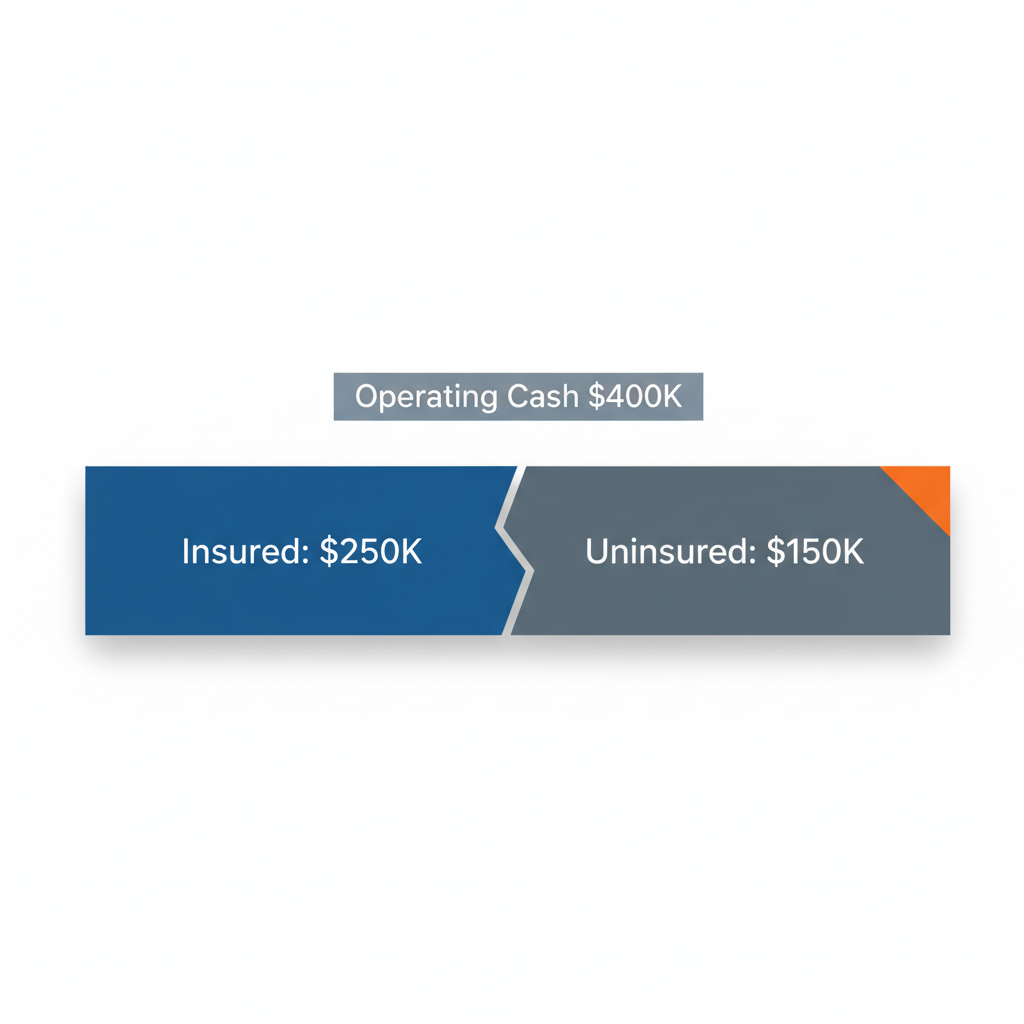
If your business regularly holds $400,000 in operating cash, a partner bank’s $250,000 cap leaves $150,000 uninsured at any given moment. Traditional banks can offer sweep accounts or multiple account titling to extend coverage; most neobank interfaces don’t provide that. OneSafe is a financial technology company, not a bank. Banking services are provided by partners, so fiat funds are held at regulated institutions while the platform itself does not take deposits. It uses state-of-the-art encryption and mandatory Multi-Factor Authentication, while digital assets are held in segregated custody via Fireblocks. That structure isolates operational risk from deposit-taking risk, but finance leads still need to track the platform’s contractual relationships and partner-bank stability.
Cross-Border Complexity Exposes Cracks in Neo Banking
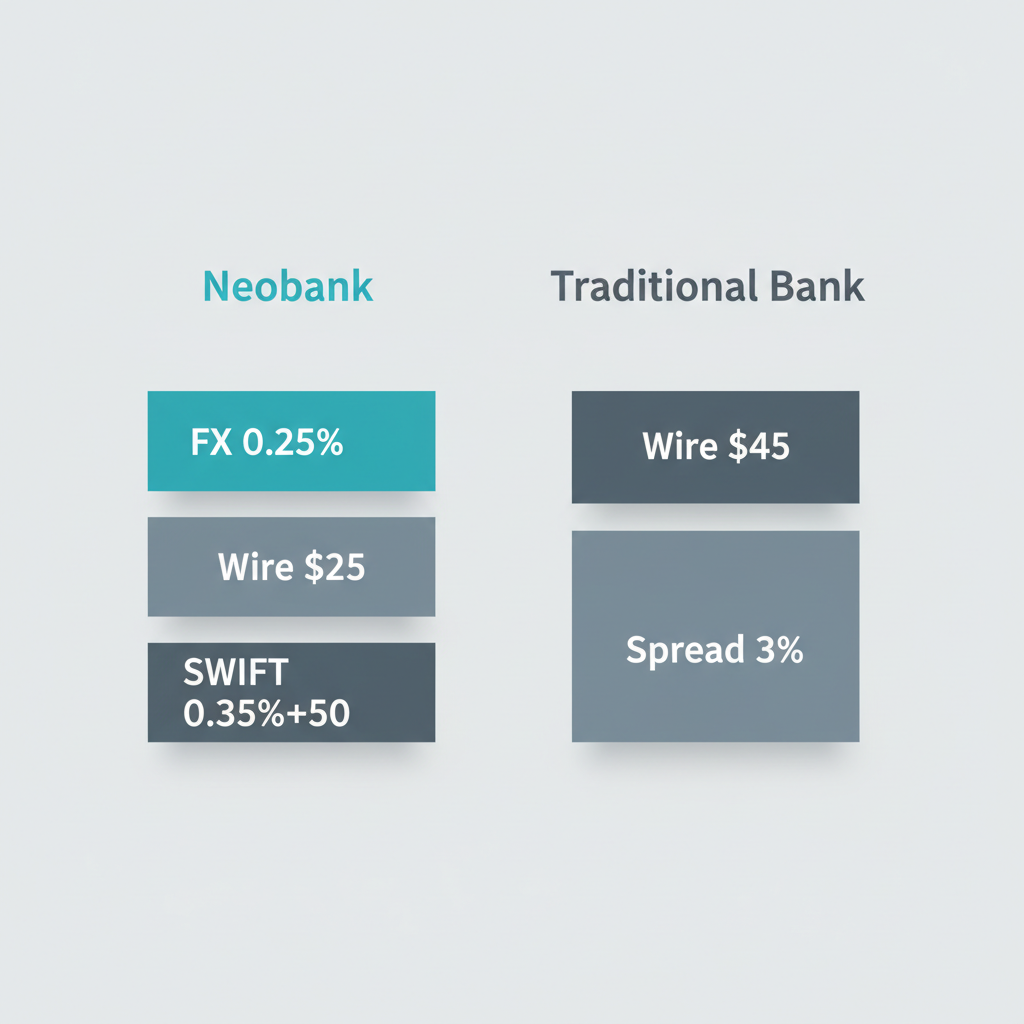
Global businesses often see low sticker prices for wires or FX, then get surprised by intermediary bank fees, hidden spreads, and card network markups. A $25 outgoing wire fee plus a 0.25% FX conversion might look cheap until a 3% corporate card foreign exchange fee and a 0.35% + $50 SWIFT charge appear. On a $20,000 monthly supplier payment, those layers compound fast.
Take a US-registered DAO paying €50,000 to a European development firm and converting $30,000 to CAD. Using OneSafe’s published rates—fiat deposit/withdrawal 0.15%, wire withdrawal $25, SWIFT 0.35% + $50, FX 0.25%—the EUR payment costs roughly 0.35% of €50,000 (€175) plus $50, and the CAD conversion costs $75 plus $25. A traditional US bank might charge $45–$65 for the wire but add a 3%–4% FX spread, often embedding the cost in the rate rather than stating it clearly. For this mid-sized run, the neobank is cheaper. At $2 million a month, the spread matters more than flat wire fees; a traditional bank relationship with negotiated FX tiers below 0.5% may undercut the neobank.
Currency support gaps are another classic multi-currency business account pitfall. OneSafe currently supports USD, Euro, and CAD, with more currencies coming. If you need SGD or MXN tomorrow, you face the full correspondent banking chain: USD conversion, intermediary fees, and possible 3–5-day settlement. Large global banks often handle those pairs directly, reducing cost and delay. OneSafe published a comparison of traditional banks and neo-banking platforms for global business accounts, focusing on multi-currency and crypto capabilities (OneSafe.io blog, 2026-08-13). That comparison confirms many high-volume international companies layer a traditional bank account with a neo-banking platform rather than relying on one provider.
Crypto in a Neo Bank Account: Convenience or Concentration Risk?
When a platform offers a “crypto-friendly business account,” trace the custody path. OneSafe uses Fireblocks for digital asset custody, meaning assets are in institutional-grade segregated wallets with multi-party computation and hardware security modules. That’s far more secure than a hot wallet on a consumer app, but you still trust the platform’s operational security and its custodian contract. For crypto-friendly business account security, ask whether assets are held 1:1, what proof of reserves exists, and what happens if the platform goes offline.
OneSafe offers instant crypto-to-fiat conversions and free USDC stablecoin deposits/withdrawals. If you convert $500,000 of USDC to USD, the rate depends on the liquidity pool OneSafe’s exchange partners access at that moment. A 0.1% deviation is $500. For a DAO managing treasury redemptions, that becomes a reconciliation item. By outsourcing custody to Fireblocks, OneSafe gains institutional-grade security but removes direct on-chain multisig control—an acceptable trade-off for startups without a security team, less so for DAOs accustomed to co-signing a Gnosis Safe. OneSafe published a 2026 guide identifying the most crypto-friendly US banks for businesses, startups, and DAOs—comparing traditional, neo, and stablecoin-native banks (OneSafe.io blog, 2026-08-10). That guide highlights that many crypto-native organizations choose neo-banking platforms precisely because traditional banks won’t serve their needs.
Operational Frictions That Only Show Up at Scale
OneSafe advertises fully digital onboarding typically completed within a week, requiring business formation papers and government-issued ID. That’s fast for a platform handling both fiat and crypto, but finance leads accustomed to consumer-fintech “sign up in minutes” should expect a real KYB process that mirrors what a traditional bank demands—just executed digitally. For DAOs, this gets complicated: verifying beneficial owners with no legal directors or a rotating multisig signer set. These DAO banking challenges are real; you’ll likely need updated formation docs and a governance log to satisfy compliance, even post-onboarding.
OneSafe offers customizable roles and permissions for DAOs, but if your DAO rotates signers via Snapshot, you need a process to update access promptly. Failure can freeze a payment batch. Support is another scaling hazard. A $150,000 SWIFT transfer pending 48 hours because of a name mismatch gets founder attention. Most neobanks, OneSafe included, rely on ticketed email support. There’s no phone number or branch. Resolution means emailing support, document review, and re-queuing—a structural disadvantage versus a direct line to a bank wire desk.
So, Are the Drawbacks Dealbreakers?
Use a neobank as your primary operating account if you routinely transact in supported fiat currencies and stablecoins, need rapid digital onboarding and a unified fiat-crypto dashboard, or run a Web3 startup or DAO that values on/off-ramp fluidity over deposit breadth. Keep a traditional bank relationship if you hold operating cash well above insured limits, require a wide range of currency pairs, trade finance, or credit products, or need named contact support for time-critical large wires.
A practical pattern: use a traditional bank as the vault for large fiat balances, and the neobank as the operational layer for daily payments, multi-currency receipts, and crypto conversion. Before signing up, ask three questions:
- What is the exact pass-through insurance coverage for my fiat balances, and what happens if the fintech goes bankrupt?
- For my three most frequent cross-border corridors, what is the total cost—including spread, intermediary fees, and partner bank charges—on a $50,000 test payment?
- If my signer list changes, what’s the exact process and timeline to update account permissions, and is there a backup method for urgent payments?
Frequently Asked Questions
What are the main drawbacks of neo banking?
The main drawbacks for businesses include limited deposit-insurance coverage structures, fee layers on international payments that can exceed traditional bank spreads at high volumes, narrower currency support, and support escalations without phone or in-person resolution. Neobank disadvantages for business also include reliance on partner banks for core services, creating additional operational risk.
Are neobanks safe for businesses?
Yes, with caveats. Funds held in partner banks may be insured, but the pass-through recovery isn’t instantaneous. Crypto assets in custody via providers like Fireblocks are highly secure, but you shoulder counterparty risk. Robust AML controls are critical; a platform’s security is only as strong as its compliance program. OneSafe includes MFA, encryption, and Fireblocks custody, but it isn’t a bank, so standard deposit guarantees don’t apply directly to the platform.
How does neobanking compare to traditional banking for global businesses?
This is the key neobank vs traditional bank for startups question. Neobanks win on speed, crypto integration, and digital UX. Traditional banks win on currency breadth, deposit-insurance scalability, and credit products. Global businesses often use both: a neobank for daily multi-currency and crypto operations, and a traditional bank for large holdings and complex trade.
When do neobank fees become a disadvantage compared to a traditional bank?
When your monthly FX volume exceeds roughly $500,000 and you need non-USD/EUR/CAD pairs. At that point, a traditional bank’s negotiated spread—often below 0.5%—can beat a flat 0.25% conversion fee plus SWIFT markups. The 3% corporate card FX fee also adds up with frequent international card spend. Model a quarterly payment schedule to find your break-even.
What should a business ask about crypto custody in a neo banking platform?
Ask: “Are digital assets held in segregated accounts? What custodian is used, and what is the insurance coverage? In platform insolvency, do I have a legal claim on those assets, or are they part of the estate?” For OneSafe, custody is via Fireblocks with institutional security, but legal separation depends on the terms of service. Get clarity before depositing significant on-chain assets.
Is a neobank right for your business?
It depends on volume and complexity. If you process less than $1M/month in cross-border payments, operate in major currencies, and need crypto rails, a neobank like OneSafe is likely a better fit than a traditional bank. For higher volumes or exotic corridors, use it as a layer alongside a traditional bank.
This article was last reviewed on August 13, 2026. Fee structures and product parameters are based on publicly available information as of that date and may change. Always consult a platform’s current terms and your legal counsel for decisions affecting your business.