Meta description: Chainlink’s Fulcrum and Remittix’s PayFi testing reshape crypto banking. Learn how cross-chain collateral and instant fiat settlements impact business finance.
The infrastructure for crypto banking is finally catching up — and two coordinated moves this week make that plain. On October 9, 2026, Chainlink unveiled Fulcrum, an initiative to coordinate institutional collateral across blockchains, while Remittix began limited testing of PayFi, a service that turns crypto into bank money for EUR and USD routes, according to TechBullion. For companies that live between on-chain treasuries and fiat obligations, these aren’t distant concept papers. They’re the signal that hybrid finance is leaving beta.
Table of Contents
- What Just Happened: Chainlink and Remittix Push Crypto Banking Forward
- Why This Matters for Business Operators Today
- The Background: Crypto Banking from Niche to Necessity
- Concrete Implications and Recommended Actions
- What to Watch Next and Open Questions
- Key Takeaways
What Just Happened: Chainlink and Remittix Push Crypto Banking Forward
Chainlink Fulcrum targets institutional collateral across chains
Chainlink’s Fulcrum initiative, reported by TechBullion on October 9, 2026, addresses a persistent friction: collateral and financing still operate in silos when assets sit on different networks. Fulcrum aims to let institutions post, move, and coordinate collateral across chains without manually bridging or juggling separate custodians. The goal is to make tokenized assets — whether on Ethereum, Solana, or another layer — usable as backing for loans and treasury strategies without fragmenting the balance sheet. For companies holding multi-chain treasuries, this turns a collection of on-chain assets into a single, financeable pool.
Remittix PayFi enters testing for crypto-to-bank transfers
On the same day, Remittix confirmed it is running invited-holder testing of its PayFi product for EUR and USD crypto-to-bank routes, with the RTX token launch planned for November 24, 2026. The pitch is simple: if institutions and businesses are going to hold and move more assets on-chain, they need a dependable, low-friction way to settle in fiat at the endpoint. PayFi is built to be that off-ramp — a crypto-to-bank conduit that doesn’t require swaps on an exchange or manual conversion steps. For an operational CFO, that means crypto earnings could arrive in a business bank account the same day, without the capital being stranded on an exchange waiting for a batch wire.
The connected trend: infrastructure for hybrid finance
Chainlink’s cross-chain collateral coordination and Remittix’s instant settlement rails are two sides of the same coin. Together they show that the industry is no longer just building trading venues or custody — it’s building the pipes between them. That’s the infrastructure crypto banking for business has always needed: a way to move value across chains and across the fiat boundary without leaving assets exposed or forcing a business to become a manual clearinghouse.
Why This Matters for Business Operators Today
The cost of not bridging fiat and crypto
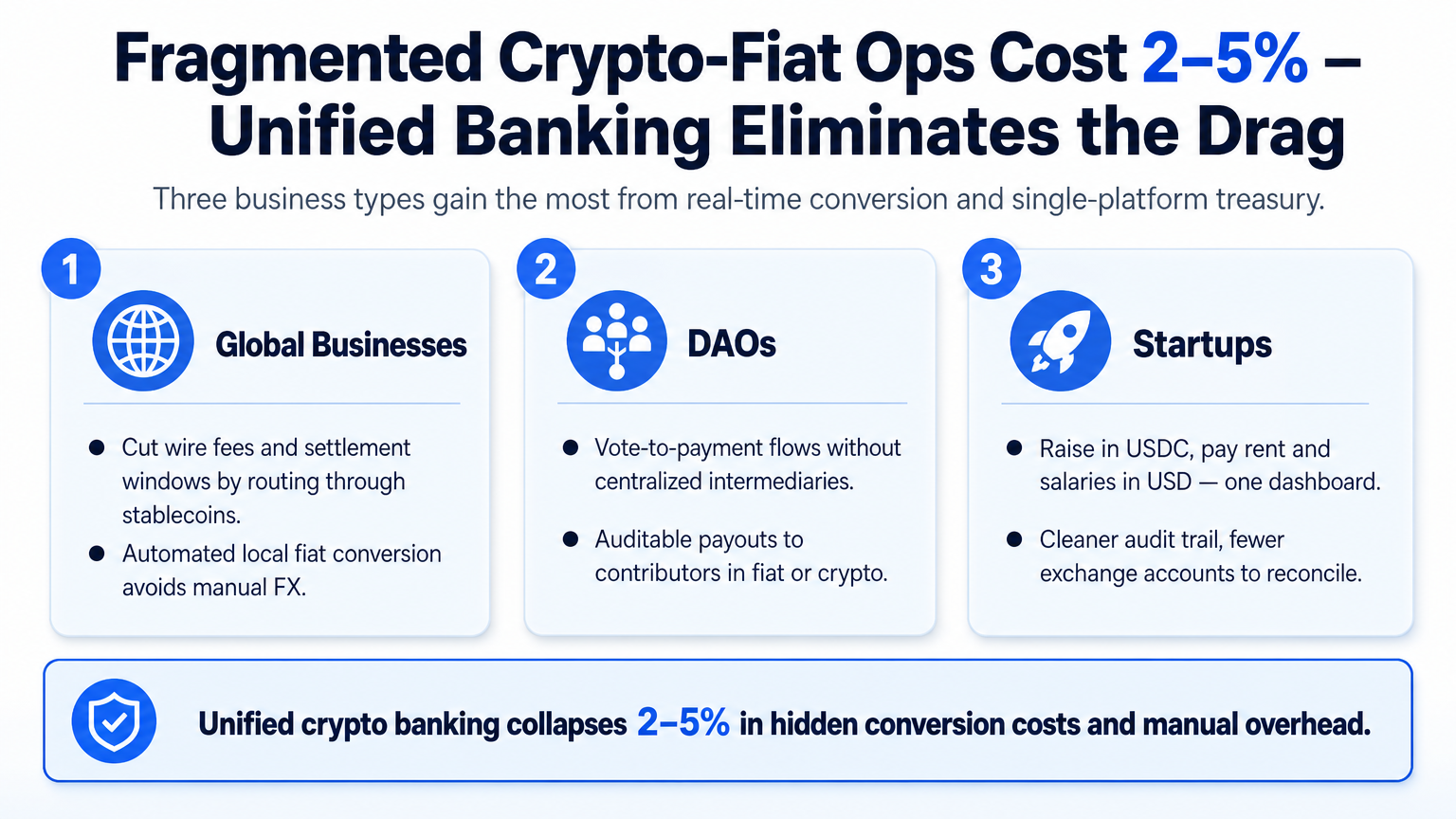
Without integrated crypto banking for business, companies routinely lose 2–5% to conversion spreads, exchange withdrawal fees, and delayed settlement. The typical workflow — swapping stablecoins on an exchange, waiting for the wire to clear, then manually booking the payment — eats time, introduces counterparty risk, and makes treasury forecasting unreliable. Platforms that combine fiat accounts, crypto custody, and direct conversion within a single interface collapse that chain into a few clicks. The alternative is a silent drag on working capital, especially for companies processing regular cross-border payments in multiple currencies.
Who benefits immediately: global businesses, DAOs, startups
- Global businesses: paying international suppliers or receiving revenue in stablecoins can cut wire fees and settlement windows by routing through a crypto banking layer that converts to local fiat automatically.
- DAOs: holding treasuries in tokens while needing to pay contributors and service providers in fiat. A unified platform means fewer steps between a governance vote and a payment landing in someone’s bank account.
- Startups: raising in USDC or ETH and needing to pay rent, salaries, and cloud bills in USD. They avoid running multiple exchange and bank accounts and keep a cleaner audit trail.
The common denominator is a need for real-time crypto-to-fiat conversion embedded in the same place where bills get paid. That’s the shift that Remittix’s PayFi testing and platforms like OneSafe, which supports instant crypto-to-fiat swaps alongside ACH, wires, and bill pay, are bringing to daily operations.
The Background: Crypto Banking from Niche to Necessity
What is crypto banking and how does it differ from traditional banking?
Crypto banking refers to financial platforms that let a business hold, move, and convert between fiat currencies and cryptocurrencies within a single account structure. Unlike a traditional bank, which operates exclusively on fiat rails, a crypto banking platform integrates blockchain-native capabilities — stablecoin payments, on-chain custody, smart contract interaction — alongside conventional payment methods like ACH, SWIFT, and corporate cards.
Most of these platforms are fintech companies that partner with regulated banks for fiat deposit accounts and payment processing while providing crypto services either directly or through custody partnerships. This architecture means a business can send a wire to a supplier in Europe, convert USDC to EUR instantly, and add spend controls to a virtual card — all from one dashboard. It’s the bridge between tokenized finance and everyday treasury operations.
What types of transactions can I perform with a crypto banking platform?
A mature crypto banking platform should handle:
- Crypto to fiat conversion and vice versa, often with near-instant settlement
- ACH and domestic wire transfers in supported fiat currencies
- International wire transfers (SWIFT) to pay suppliers or collect revenue
- Bill payments directly from crypto or fiat balances
- Crypto payments to external wallets for payroll, smart contract interactions, or vendor settlements
- Corporate card spending with limits, often with virtual cards that can be topped up in stablecoins or fiat
- On-ramp and off-ramp flows — buying crypto with fiat or cashing out to a bank account without separate exchange accounts
Platforms like OneSafe, for example, support all the above, including free USDC deposits/withdrawals and fiat deposit fees as low as 0.15%. That kind of integrated suite removes the need to piece together a bank, an exchange, and a card issuer.
Is my money safe with crypto banking?
Security in crypto banking depends on three layers: custody, access controls, and regulatory compliance.
- Custody: Leading platforms use institutional-grade custody technology such as Fireblocks, where digital assets are stored in segregated wallets protected by multi-party computation. This reduces the risk of a single point of failure or exchange-style commingling.
- Access controls: Multi-Factor Authentication (MFA) is now baseline, but the best platforms enforce it automatically at signup and for every sensitive action.
- Regulatory framework: Fiat balances are typically held with partner banks under local deposit protections (though crypto itself isn’t FDIC-insured). The platform itself must run rigorous KYB/AML checks and restrict service in sanctioned jurisdictions.
No system is risk-free — crypto volatility and smart contract risks remain — but the gap between dedicated crypto banking platforms and the exchange-and-bank patchwork is wide. The industry has moved from “don’t keep funds on an exchange” to “keep them on a platform with bank-grade custody and segregated accounts.”
How quickly can I open a crypto banking account?
The best platforms now offer fully digital onboarding that can be started in under 10 minutes and completed within a week. A business typically needs its formation documents, a government-issued ID for the authorized signer, and — for US companies — an EIN. OneSafe, for instance, typically completes account opening within that window while running robust KYB checks. What used to take a month now takes a few days from start to active account.
Key players and architectures
The crypto banking landscape splits roughly into three models:
- Neo-banking platforms for Web3: These combine fiat accounts (via partner banks) with crypto custody, conversion, and payments. Examples include OneSafe, Wirex Business, and Aspire. They serve global businesses and DAOs that need a single platform for hybrid finance.
- Crypto-native banking interfaces: Mercury offers accounts tailored to Web3 startups, while Coinbase Business focuses on custody, trading, and merchant payments but may not integrate full fiat banking rails.
- Hybrid gateways: REAP and Lightspark function more as on/off-ramp layers that plug into existing bank relationships.
The architectural trend is toward unified dashboards — one login, one set of API keys, one compliance check — because the cost of managing multiple relationships is precisely what Web3 business finance was supposed to eliminate.
Security and regulatory considerations
Regulation remains the wildcard. The EU’s Markets in Crypto-Assets (MiCA) framework sets a compliance deadline of 2027, while the US continues to debate the OCC’s authority to charter crypto-focused banks. Businesses should monitor stablecoin regulation closely; a shift in stablecoin rules can quickly reshape the on/off-ramp landscape. Choosing a crypto banking partner means verifying that it operates in jurisdictions that match your corporate structure and that its partner banks are in good standing. The operational risk isn’t just a hack — it’s waking up to a frozen account because a regulator changed a rule.
Concrete Implications and Recommended Actions
For startups: one less integration to build
Startups no longer need to chain together Stripe, a crypto exchange, a bank, and a manual spreadsheet to reconcile. A single crypto banking platform replaces that stack for payments, treasury, and conversion, cutting engineering time and compliance overhead.
For DAOs: treasury ops without banking bottlenecks
DAOs that hold multi-signature wallets and stablecoins can route contributor payouts, grants, and operational expenses through a platform that supports customizable roles and permissions — turning a governance vote into an auditable payment without adding a centralized intermediary. For example, crypto payroll can now include an IBAN path to Euro accounts, merging on-chain governance with off-chain settlement.
Actionable checklist: how to evaluate a crypto banking partner
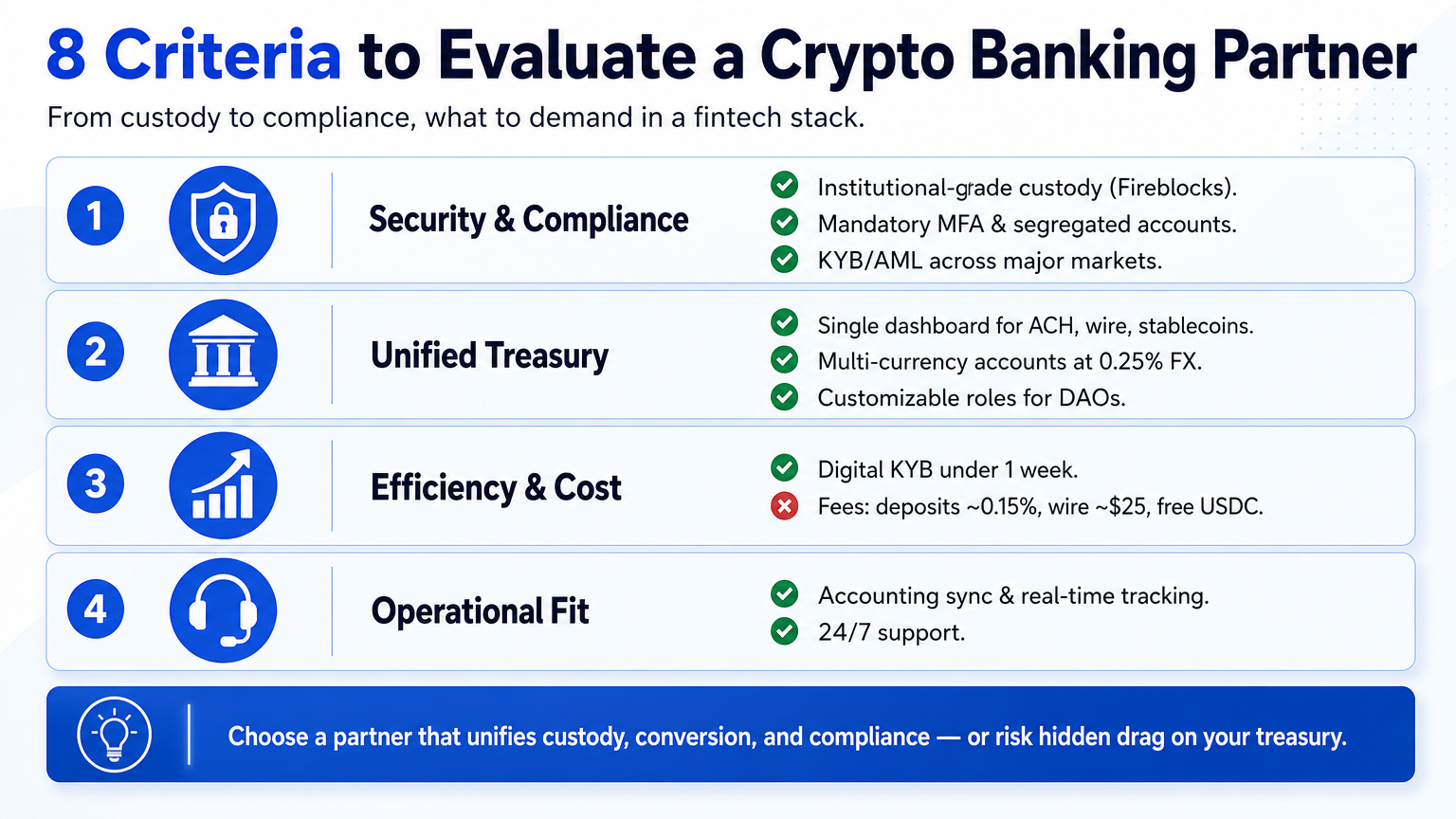
| Evaluation Criterion | What to Look For | Why It Matters |
|---|---|---|
| Custody & security | Institutional-grade custody (Fireblocks or similar), mandatory MFA, segregated accounts | Protects assets from single-point failure and unauthorized access |
| Fiat/crypto integration | Single dashboard for ACH, wire, bill pay, crypto on/off-ramp, stablecoin support | Eliminates the cost and time of manual conversions and separate providers |
| Global multi-currency support | Accounts in USD, EUR, CAD, and other fiat; competitive FX rates (e.g., 0.25% on conversion) | Critical for businesses with international suppliers and customers |
| DAO-friendly features | Customizable roles, permissioned access, and automated payment workflows | Allows decentralized governance without sacrificing financial control |
| Onboarding speed | Digital KYB, account open in under a week; no in-person paperwork | Gets treasury operational fast; reduces administrative friction |
| Fee transparency | Low, predictable fees (deposits ~0.15%, wire withdrawals ~$25, free USDC crypto transactions) | Avoids margin compression from hidden conversion costs |
| Compliance scope | Coverage in major markets; partner banks in good standing; clear AML/KY policy | Reduces regulatory risk and freezes |
| Integrations & support | Accounting software sync, real-time transaction tracking, 24/7 support | Fits into existing ops stack for end-to-end financial management |
What to Watch Next and Open Questions
The Remittix RTX debut (November 2026) and potential impact
If the RTX token launch on November 24, 2026, succeeds in creating a liquid settlement medium, it could push crypto-to-bank transfers from niche to default for Web3 businesses. The question is whether PayFi can scale beyond invited testing to handle serious treasury volumes without slippage or counterparty delays.
Chainlink Fulcrum’s expansion across chains
Fulcrum’s promise is cross-chain collateral portability, but it will need to integrate across multiple networks and DeFi protocols to become a standard. If it does, we could see a new generation of tokenized lending products that don’t care where the collateral originates, only that it’s verifiable and coordinated — a fundamental shift for institutional crypto.
Regulatory developments on the horizon
The EU’s 2027 stablecoin compliance deadline and the US OCC charter battle will define the guardrails for crypto banking. Both could affect the availability of fiat on/off-ramps and the types of assets platforms can custody. Businesses should track Circle’s integration with SAP as a bellwether — when enterprise ERPs begin natively handling stablecoin settlement, regulatory clarity tends to follow.
The risk of new fragmentation if interoperability fails
For all the innovation, Fulcrum and PayFi could become yet another set of middleware that doesn’t talk to each other. If cross-chain collateral and real-time off-ramps evolve as separate ecosystems, businesses will still face a fragmented landscape. The industry’s next test is whether infrastructure builders prioritize shared standards over proprietary moats.
Key Takeaways
- Crypto banking infrastructure is moving from patchwork to purpose-built: Chainlink Fulcrum and Remittix PayFi target the two biggest remaining gaps — multi-chain collateral and instant crypto-to-fiat settlement.
- Businesses that wait lose margin: Fragmented treasury operations can cost 2–5% in conversion and delays; a unified platform collapses that overhead.
- DAOs and global startups stand to benefit most immediately, as they can now manage treasuries and payroll without exchanging platform risk for speed.
- Evaluate crypto banking partners on custody, integration, and compliance: Fireblocks-grade security, seamless fiat/crypto unification, and clear regulatory standing are non-negotiable.
- The next six months will be decisive: Remittix’s token launch and Fulcrum’s chain expansion will either cement a new standard or introduce fresh fragmentation.
Explore how a platform that bridges fiat and crypto can streamline your global payments and treasury — open an account at OneSafe.