
You don't usually get a dramatic rollout moment. You get a normal Tuesday, a customer pays in USDC, the wallet balance updates, and finance suddenly wants to know whether that deposit is revenue, a liability, a temporary hold, or just another line item nobody wants to touch. The awkward part isn't receiving the money, it's deciding what to do with it without creating a reconciliation mess, a tax headache, or a treasury position you never meant to take.
How to accept crypto payments is really a finance-ops question dressed up as a checkout question. The teams that handle it well treat the first incoming payment as the start of a controlled workflow, not the end of one.
Table of Contents
- Holding, converting, or routing through a business account
- Why the first payment changes your operating model
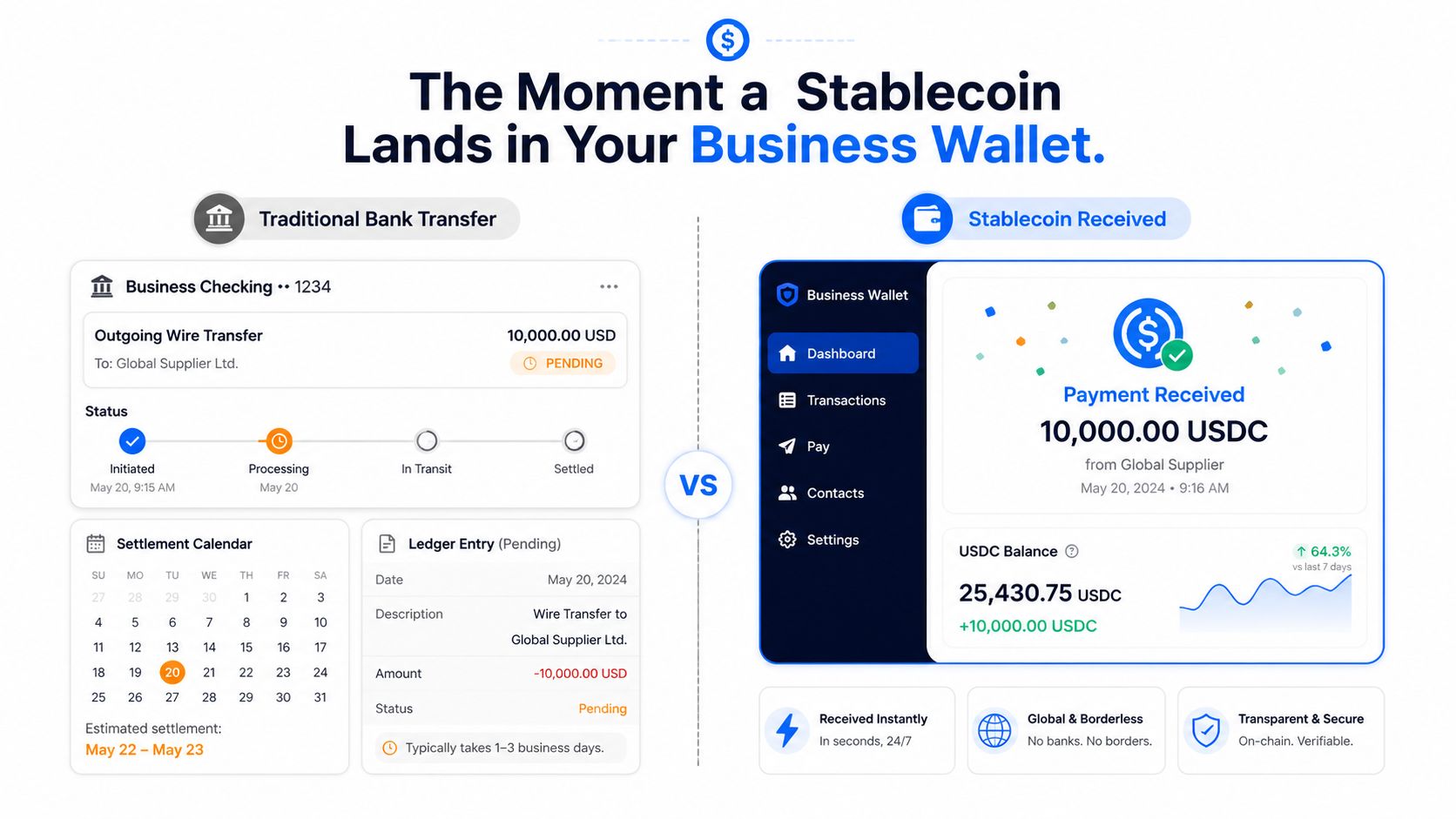
The Moment a Stablecoin Lands in Your Business Wallet
The first time a stablecoin shows up in a business wallet, the reaction is usually triage, not celebration. Someone on the finance side opens the dashboard, sees the balance, and starts asking questions that do not have a clean answer yet. Is this a collected payment, a receivable that cleared, or money that should move somewhere else right away? The answer depends on custody, settlement policy, and how cleanly accounting can tie the transaction back to an invoice.
That first payment also changes the operating model. A stablecoin receipt is no longer just a wallet event, it becomes a finance event, because someone has to decide who owns the balance, when it is recognized, and what happens if the customer asks for a refund.
The market context matters because acceptance is no longer niche behavior. Fiserv's merchant guidance shows that customer use and merchant adoption have both been moving, and that limited acceptance was one of the reasons people held back from using crypto for purchases (Carat by Fiserv). It also notes that retailer adoption rose as customer demand became the main driver. That shift is why the question is not whether the payment arrived, it is what workflow owns it next.
Holding, converting, or routing through a business account
A business has three realistic custody paths. Self-custody with a hardware wallet or multisig gives direct control, but it also puts key-person risk, recovery procedures, and signing discipline squarely on the team. An MPC setup or qualified custodian reduces that burden and usually fits companies that need role-based approvals, audit trails, or programmatic payouts. An exchange-hosted account is easiest for trading-oriented teams, but it can create operational friction if the people handling payments and the people handling treasury are not the same group.
The right choice depends on the kind of risk you want to own. If the business has customer-facing wallets, regular vendor payouts, or a need to move funds between chains and fiat quickly, a managed setup inside a multi-currency business account usually cuts down on chaos. If the founder who originally set up the wallet is still the only person who understands the keys, that is not a system. It is a dependency.
Practical rule: if finance has to ask engineering for the keys every time money moves, the setup is too fragile for live operations.
What changes the calculus is how much the payment rail is expected to do beyond receipt. A business that only wants to collect a one-off payment can tolerate a simple wallet. A business that needs settlement, reconciliation, and vendor payouts starts needing payment controls, exchange access, and approval workflows that look a lot more like normal finance software than a crypto wallet.
Why the first payment changes your operating model
The first real payment creates a new operational surface area. The balance has to be mapped to an invoice, recorded at a specific rate, and handled according to a refund policy that customer support can explain. If those rules are not defined early, they get invented in the middle of a month-end close, which is the worst time to improvise.
That is why a lot of growing web3 companies move away from pure self-custody once volume becomes meaningful. A managed account with USDC support, fiat rails, and internal controls lets the team treat crypto as part of the same treasury workflow as ACH or SWIFT. The wallet still matters, but it stops being the whole story.
A multi-currency business account also closes a gap that most checkout-focused guides ignore. It gives finance one place to see the stablecoin receipt, manage conversion, route funds to fiat, and keep the books moving without forcing every payment to become a special case. That is the operational difference between “we accept crypto” and “we can run the business with it.”
OneSafe's business account model fits that operational pattern because it combines multi-currency accounts, USDC deposits and withdrawals, and Fiat and crypto conversion inside one interface. Its broader stack also includes corporate cards, spend controls, and web3 invoicing, which matters when the job is not “accept a token,” but “close the books without friction” (OneSafe).
Picking the Right Payment Rail for Your Customers
The rail you choose should follow the customer, not the trend. A SaaS company selling globally to crypto-native users cares about checkout speed and low support overhead. A B2B business invoicing in stablecoins cares more about invoice discipline and settlement reliability. A DAO paying contributors across borders cares about chain support, wallet compatibility, and whether the finance team can match payments cleanly afterward.
| Crypto Payment Rails Compared | Best fit | Fiat conversion | Settlement speed | Operational burden |
|---|---|---|---|---|
| Hosted processor | Merchants that want a guided setup | Often built in | Usually faster than direct wallet flows | Lower |
| Crypto payment gateway | Teams that want more control over assets and checkout logic | Optional or processor-led | Depends on asset and network | Medium |
| Direct wallet-to-wallet | Simple invoices, one-off payments, crypto-native counterparties | Not built in | Depends on chain and confirmations | Higher |
Hosted processors are usually the most forgiving starting point because they remove a lot of the friction that breaks first-time implementations. Gateway-style tools can work well when the business wants more control over supported assets, quote windows, or settlement behavior. Direct wallet acceptance is fine when both sides already understand the process, but it's rarely the smoothest option once non-technical finance or support staff get involved.
Operational shortcut: if a payment method creates more support tickets than invoices, it's probably the wrong rail for your customer base.
The decision also depends on who owns the experience after payment. If customer success, finance, and engineering all have to touch the flow, choose the simpler rail and let the processor absorb more complexity. If treasury wants direct control over conversion and settlement, a more configurable gateway may be worth the extra setup.
Building the Checkout and Webhook Flow
A clean checkout only works if the backend can survive real payment behavior. The system creates a payment request with the amount, currency, callback URL, and metadata, then returns either a payment address or a hosted checkout link. The customer signs from their wallet, the transaction broadcasts, and webhook events update order state after the payment confirms. That sounds straightforward until confirmations arrive out of order, retries repeat the same event, and finance refuses to credit one invoice twice.

The core implementation question is idempotency. If the webhook fires twice, the order should stay in the same state instead of being paid twice in the ledger. The safest pattern is a webhook-driven state machine, not a one-off “payment received” flag.
A few controls are worth signing off before the first live invoice goes out:
- Price lock window: keep the quote open for 10 to 15 minutes to reduce slippage and underpayment risk, as recommended in industry guidance (Cobo).
- Exchange-rate metadata: capture the rate at invoice creation so finance can match the receipt back to the original order context (CoinPayPortal).
- Sandbox testing: run the whole path in test mode before live traffic touches it (Cobo).
- Confirmation threshold: don't release goods or digital access until the payment has confirmed according to your policy (CoinPayPortal).
A common oversight is assuming a clean checkout guarantees clean operations. The webhook only helps if the backend, finance tools, and support workflow all agree on what happens next. A payment link can look polished and still leave a mess if the reconciliation logic is weak.
That is why a dedicated invoicing tool earns its keep. A workflow that generates crypto invoices, keeps metadata tied to the order, and hands off to settlement and reconciliation can save a lot of manual cleanup later. OneSafe web3 invoicing is built for that type of handoff, where payment receipt is only one step in a larger finance process.
Settlement, Reconciliation, and the General Ledger
Most guides stop at “payment received.” Finance doesn't. The work is matching the invoice to the payment, recording the rate used, and making sure the blockchain record and the general ledger say the same thing. If those three pieces drift apart, the team ends up doing spreadsheet archaeology at month end.
The cleanest way to think about settlement is in three layers. First, map the payment to the invoice. Second, record the exchange rate or quote used when the invoice was issued. Third, match the on-chain transaction to the ledger entry and confirm that the business account, not just the wallet, reflects the right state. A multi-currency account with stablecoin support collapses a lot of this friction because the same system can receive, convert, and reconcile without forcing finance to jump between tools.
The edge cases are where the process breaks
Partial payments need a status rule, not a guess. Overpayments need a policy for whether the excess is refunded or left as credit. Payments on the wrong network need a human decision and probably a support ticket. Duplicate webhook callbacks should be harmless if your state machine is idempotent, but they become dangerous if anyone is manually editing invoices after the fact.
That's why the back office matters more than the payment button. Recent operational guidance increasingly separates receiving the payment from settlement rules and reconciliation process, which is the right way to think about it. If your finance team can't explain how a crypto receipt lands in the ledger, the checkout page is not the problem.
Finance rule: if a payment can't be tied back to an invoice without manual detective work, it's not settled, it's just parked.
The most useful control is a single source of truth for payment status. That source should tell support, treasury, and accounting the same story. If the wallet says received, the processor says pending, and the general ledger says nothing, then the workflow is incomplete.
A proper reconciliation process also makes audits less painful. The more your system records the invoice metadata, payment network, exchange rate, and settlement outcome in one place, the less time anyone spends defending why three records disagree. OneSafe's accounts payable and audit-focused workflows are relevant here because the operational problem is the same whether the incoming payment was crypto or fiat, the business still needs a verifiable trail (OneSafe audit of accounts payable).
Pricing, Conversions, and the Instant-to-Fiat Question
Accepting crypto and holding crypto are different decisions. For most non-crypto-native companies, the safer default is to accept crypto as a payment method and convert it to fiat quickly. That keeps the customer experience flexible without turning treasury into a volatility desk.
Conversion policy should be a policy, not a mood
The cleanest setup is to define one of three rules. Convert instantly. Convert at end of day. Convert only after a threshold is reached. Each rule changes how much exposure the business takes on, how much FX work finance has to manage, and how predictable cash balance becomes.
Instant conversion is the simplest when the goal is to keep operations boring. End-of-day conversion can make sense if the business wants a little more timing flexibility. Threshold-based conversion works when treasury wants to batch activity, but it also creates more risk between receipt and settlement.
That trade-off is why stablecoins do so much of the heavy lifting in merchant payments. Analysts at Spacepay statistics report that stablecoins make up most crypto payment volume, with USDC and USDT leading merchant flows. The same source says many merchants that accept crypto convert it to fiat right away to cut volatility risk, and that crypto acceptance has grown across merchant networks in recent years.
That is the practical point. Most businesses do not want to speculate on the token they just received. They want to get paid, keep the ledger clean, and spend in the currency they already use.
A multi-currency business account makes that easier because the conversion can happen in the background. The business can price in USD, receive USDC, and still settle vendors in USD, EUR, or CAD without making the finance team run two separate treasury systems. Transparent conversion costs matter here, because the decision to support crypto has to survive a real finance review, not just a product demo.
Compliance, Security, and What Underwriters Actually Ask
Crypto acceptance changes the paperwork. It doesn't eliminate it. The business still needs KYB, sanctions screening, account-level access control, and a refund policy that says whether money goes back in the original token or in fiat. Underwriters care less about whether you support crypto and more about whether you've thought through how money moves, who can move it, and how a bad transaction gets unwound.
The first assumption to challenge is that accepting crypto means holding crypto. It doesn't have to. Instant conversion, role-based approvals, and clear reconciliation make crypto behave like a payment method instead of a treasury bet. That distinction matters for operations, tax, and the people who sign off on risk.
Controls that belong on the ticket before launch
A practical integration ticket should include the following:
- KYB and account ownership: confirm the legal entity and who has authority over payouts.
- Sanctions and AML checks: screen counterparties and monitor inbound flows.
- Mandatory MFA: protect every account that can initiate a payout or change settlement settings.
- Confirmation thresholds: define the point at which goods, services, or access can be released.
- Refund policy: state whether refunds return to the original token or are settled in fiat.
- Access controls: use role-based permissions so finance, ops, and engineering don't all have the same keys.
The security model also needs to reflect custody reality. Fireblocks-style custody, policy-based spend limits, and approvals are useful when the business wants an auditable trail for digital assets. That setup looks less like “crypto management” and more like normal finance controls with a different settlement rail.
The tax side should stay jurisdiction-aware. Crypto can be treated as a payment method in one workflow and still create a taxable event in another, depending on where the entity sits and how the transfer is recorded. That's another reason the finance team should own the process, not just the product team.
Putting It Together with a Unified Multi-Currency Stack

The cleanest crypto setup is the one that stops feeling like a crypto setup. If acceptance, custody, conversion, and reconciliation live in separate systems, teams end up with four tools, two logins, and one person who understands how any of it works. A unified multi-currency stack cuts that fragility down.
The practical stack looks like this. A business issues an invoice, receives USDC, converts it if needed, records the settlement, and pays vendors from the same account environment. Corporate cards with spend controls handle operating expenses, while roles and approvals keep treasury from turning into a free-for-all. For newly incorporated entities in web3-friendly jurisdictions, onboarding speed can matter as much as the product itself, because a delayed account often delays the deal.
That matters more than the checkout page. The team needs a place where the receipt, the conversion decision, the ledger entry, and the payout all sit in the same operating flow, or finance ends up stitching together screenshots, wallet activity, and bank records after the fact.
A unified business account also reduces the number of handoffs during refunds and close. If a customer pays in stablecoins and the company later needs to return value, treasury can follow a rule that is already defined, instead of improvising with whatever rail happens to be convenient that day. That is the part that keeps operations predictable when volume starts to rise.
The best next step is simple. Pick the rail, decide whether you convert instantly, set the price-lock window, define the confirmation threshold, and write the refund rule before the first customer pays. If you want the finance side of crypto acceptance to feel closer to normal operations than to a science project, visit OneSafe and see how a unified business account can handle crypto receipt, settlement, and reconciliation without making your team live in spreadsheets.