On October 24,2026, Prime Minister Benjamin Netanyahu publicly considered a measure that would have been unthinkable a decade ago: using cryptocurrency to shield Israel’s financial system from potential international sanctions. The statement, and the swift institutional pushback that followed, marks an inflection point for crypto banking—not because a government might evade sanctions with digital assets, but because a sovereign leader’s casual mention normalizes crypto as a legitimate state-level treasury instrument. For global businesses, DAOs, and founders operating across borders, that changes the conversation from novelty to necessity.
Table of Contents
- Israel Floats Crypto as Sanctions Shield
- Why This Is a Watershed Moment for Crypto Banking
- Crypto Banking101: A Bridge Between Old and New Finance
- What Geopolitical Moves Mean for Your Business Treasury
- Your Next Move: Practical Considerations
- The Road Ahead: Open Questions and What to Monitor
- Key Takeaways
- Sources
Israel Floats Crypto as Sanctions Shield
Speaking at a cabinet meeting on October 24, 2026, Netanyahu suggested Israel could “use crypto” to circumvent financial restrictions. No legislation followed; the Israel crypto sanctions trial balloon was met with immediate condemnation. The Bank of Israel, opposition figures, and a foreign ministry spokesperson all emphasized the severe reputational and regulatory risks, and the central bank’s governor reinforced that regulated institutions must not facilitate sanctions evasion, as reported by the Israeli central bank rejecting the plan.
Why does a brief, quickly rebuked comment matter? Because it exposes a truth nation-states are internalizing: crypto rails are increasingly impossible to ignore when fiat infrastructure gets weaponized. The discussion—regardless of outcome—signals that the line between policy speculation and operational planning has blurred. A government’s willingness to air the possibility shifts crypto banking from a startup niche to a strategic pillar for any entity that could face frozen accounts or blocked SWIFT messages.
Why This Is a Watershed Moment for Crypto Banking
A global business cannot replicate a sovereign’s sanctions-evasion playbook. But the underlying principle—crypto rails offer an alternative when fiat corridors close—translates into a defensible, compliant strategy: parallel treasury architecture. This means diversifying the operational layer so one political decision doesn’t freeze your ability to pay suppliers or meet payroll. A company can hold a portion of working capital in stablecoins inside a compliant crypto banking platform, continuing to move value when fiat rails become slow or politicized.
The ripple effect is clear: if a G20 leader muses publicly about crypto as a sanctions shield, every multinational treasury will ask if its own banking stack is robust enough. The demand grows for platforms that offer native crypto-to-fiat conversion, multi-currency accounts, and institutional-grade custody under a single compliance framework—what you need to know about crypto in banking often comes down to that integration.
Crypto Banking101: A Bridge Between Old and New Finance
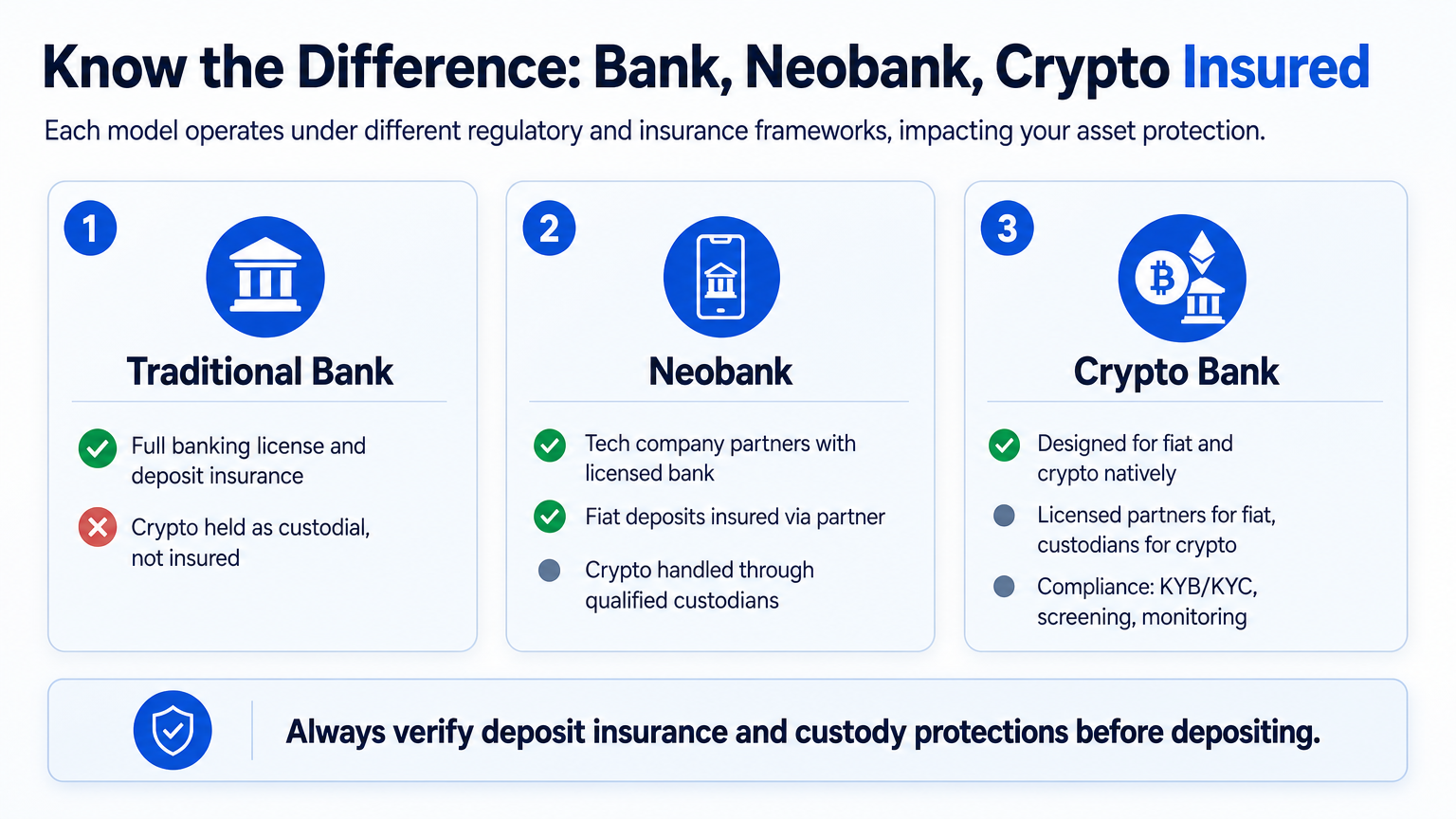
Terminology matters because regulators scrutinize each category differently.
- Traditional bank: A chartered institution with a banking license, capital reserves, deposit insurance, and full prudential regulation. Crypto held through its custodial services is not insured unless explicitly stated.
- Neobank: A technology company providing banking-like services through a partner bank. The partner holds the fiat deposits; the neobank handles the interface. For a neobank for crypto, the model extends to handle digital assets natively, often through qualified custodians.
- Crypto bank / crypto banking platform: Similar to a neobank but explicitly designed for both fiat and crypto. It partners with licensed banks for fiat rails and uses qualified custodians for digital assets. Compliance crypto banking demands robust KYB/KYC, transaction monitoring, and sanctions screening because it sits at the intersection of two regulatory realms.
The intro to cryptocurrencies reminds us that assets on these rails are still new. Verify what is insured and what is custodial. Fiat balances in partner bank accounts may enjoy deposit insurance; crypto assets in custody are protected by the platform’s security and often insured against theft, but not against value loss. A crypto custody for businesses solution must provide transparent architecture (e.g., MPC wallets), segregated accounts, and real-time attestations.
What Geopolitical Moves Mean for Your Business Treasury

Integration is a deliberate layering:
- Map fiat exposure. Identify concentration risk—a single bank in a jurisdiction that could become sanctions-prone.
- Designate a stablecoin working capital tranche. Allocate 10–30% of operating cash (for businesses with cross-border flows) to USDC in a compliant environment that offers real-time fiat conversion.
- Implement transaction-level controls. Use a platform that enforces approval flows, spend limits, role-based permissions (critical for a DAO banking platform), and automated conversion ahead of payments.
- Keep records audit-ready. Every stablecoin movement must sync with accounting software.
The workflows most exposed—supplier payments, revenue collection, contractor payroll—can be held for weeks on politicized fiat rails. Running them through a platform that supports crypto payments and instant settlement reduces single-point-of-failure risk while preserving KYC/AML obligations. The platform’s sanctions screening still applies; the difference is you are no longer reliant on a single correspondent banking chain.
Your Next Move: Practical Considerations
What features should I prioritize in a crypto banking platform today?
- Unified fiat and crypto ledger—a single interface for both balances.
- Instant crypto-to-fiat conversion with competitive rates.
- Multi-currency accounts (USD, Euro, CAD) alongside crypto wallets.
- Institutional-grade custody through a qualified custodian, with MFA and advanced encryption.
- Embedded KYB/KYC and sanctions screening from onboarding to ongoing monitoring.
- DAO-friendly governance: customizable roles, multi-signer controls, automated payment workflows.
- Virtual and physical corporate cards that draw from fiat or crypto balances.
Some platforms also offer yield on deposits, like Crypto.com banking with up to 4% APY, but always verify where yield comes from and how it’s insured. Fragmenting these services across separate providers creates compliance gaps; integrated platforms avoid that.
What are the real costs and time commitments?
Transparent pricing is a differentiator. Below is a representative fee schedule from a provider processing over $800 million across 1,000+ businesses. Use it as a baseline:
| Service | Fee (representative example, 2026) |
|---|---|
| Account opening | Free |
| Monthly fee (premium plan) | $29+/month |
| Fiat deposit / withdrawal | 0.15% |
| Wire withdrawal | $25 |
| Wire deposit | $10 |
| SWIFT deposit / withdrawal | 0.35% + $50 |
| Crypto deposit / withdrawal (USDC) | Free |
| Currency conversion (FX) | 0.25% or prevailing rate |
| Corporate card FX fee | 3% |
| Onboarding time | Typically <1 week |
Onboarding now takes under a week for most entities with digital KYB/KYC, assuming you have formation documents and ID ready. DAOs may need additional documentation of their legal wrapper. Dedicate a few hours to configure permissions and accounting integration—an investment that pays back when geopolitical shocks test your treasury.
The Road Ahead: Open Questions and What to Monitor
The Netanyahu episode surfaces a tension: financial sovereignty versus global oversight. Watch for these signals:
- AML/CFT guidance updates from FATF and national regulators, potentially requiring more granular transaction monitoring for non-custodial wallets.
- Stablecoin regulation that could force issuers to freeze addresses or comply with new reserve requirements, directly affecting stablecoin usability as a treasury asset.
- CBDC developments as state-led alternatives to decentralized rails, potentially reshaping cross-border payments again.
- Global business response: if mid-size enterprises publicly shift treasury portions to crypto-native platforms, that validates the strategic treasury thesis.
The open question: when a country’s leadership publicly considers decentralized rails, can its own regulated institutions credibly claim they cannot build compliant bridges to them? The next enforcement actions will answer.
Key Takeaways
- The Israel crypto sanctions discussion accelerates crypto banking from a startup convenience to a strategic treasury layer for any business exposed to cross-border fiat risk.
- Compliant integration means building a parallel stablecoin rail through a platform that enforces the same sanctions controls as your fiat accounts.
- Crypto banking platforms are not banks; verify deposit insurance for fiat and custody protections for digital assets separately.
- Onboarding a compliant business crypto account now takes under a week, with transparent costs (fiat fees ~0.15%, free USDC transfers, monthly plans from $29).
- The regulatory environment will tighten; businesses that build multi-rail treasuries now position themselves for the next geopolitical shock.
Staying ahead requires not just the right infrastructure but also ongoing education. For teams looking to consistently publish daily updates on crypto banking trends, a service like Joyrise—which plans, writes, and publishes illustrated SEO articles to your Webflow blog every day—can help keep stakeholders informed without adding overhead.
Choose a platform that unifies fiat and crypto operations under one compliance umbrella, and begin stress-testing your treasury architecture today.
Sources
Ready to put this into practice? Get started with onesafe.io.