
Mastercard launched a stablecoin risk intelligence tool on October 21, 2026, moving compliance from a background concern to a real‑time operational factor for businesses that depend on stablecoin rails. Reported by Crowdfund Insider, the tool helps banks evaluate transaction risks before settlement.
Table of Contents
- What Just Happened
- Why This Matters Now for Global Businesses and DAOs
- How We Got Here
- Concrete Implications for Your Payment Operations
- What to Watch Next
- Key Takeaways
What Just Happened
What is Mastercard's new stablecoin risk intelligence tool?
On October 21, 2026, Mastercard introduced an automated scoring tool for stablecoin payments. Per Crowdfund Insider, it uses on‑chain analytics to flag transactions tied to sanctioned addresses, suspicious patterns, or high‑risk counterparties. Every stablecoin payment passing through an adopting bank now gets a real‑time risk score that can block, delay, or let the payment through.
Why a Payments Giant Is Investing in Stablecoin Compliance
Surging stablecoin adoption and tightening regulation drove this move. Visa’s partnership with Mesh (September 2026) extended stablecoin payments to 175 million merchants. Volumes in certain corridors already surpass ACH, and Circle expanded USDC into over 40 markets. Mastercard positions itself as the risk‑management layer that makes stablecoin payments institutionally acceptable—and creates a compliance moat as more money moves on‑chain.
Why This Matters Now for Global Businesses and DAOs

Real‑time monitoring, long standard on card networks, now applies to stablecoin payments. A transaction scored as high‑risk can be delayed, frozen, or trigger extra documentation requests—eroding the speed that makes stablecoins attractive. DAO payrolls, merchant settlements, and cross‑border flows are all in scope. New wallets with short, clean histories may be downgraded simply because they lack a long transaction record.
How does the Mastercard tool affect businesses using stablecoin payments?
If your banking partner adopts Mastercard’s tool, every payment is scored. A risky score—from a counterparty wallet’s past interaction with a mixer or a sanctioned address—can stop a payment in its tracks. The instant settlement promise of stablecoins can turn into a multi‑day hold. Even routine payments can be impacted.
Will stablecoin payments become safer or slower because of this?
Both. The tool adds genuine protection against sanctions evasion and fraud, which encourages larger institutions to adopt stablecoin payments. But marginal risk scores may trigger manual reviews, slowing down cross‑border flows. The net effect depends on bank configuration: if thresholds are set too aggressively, instant stablecoin payments might become a premium service for vetted participants only. The challenge: preserving speed while satisfying regulators.
The Compliance Burden Shifts to Everyday Operators
Before, compliance sat with exchanges and large fintechs. Now a Web3 startup paying a developer in USDC must care about the risk score of the developer’s wallet, the issuer’s history, and the banking partner’s internal policies. Crypto payments compliance becomes part of the finance team’s daily workflow.
Fiat-to-Crypto Bridges Face New Scrutiny
Risk scoring applies at on‑ and off‑ramps, too. A bank can flag a USD‑to‑USDC conversion just like a pure on‑chain payment. If the downstream banking partner hesitates, a routine conversion can be held. Platforms that pre‑screen wallets and embed checks directly into the flow will hold a structural advantage.
How We Got Here
Stablecoin settlement volumes top $1 trillion quarterly, and in some segments they’ve overtaken ACH. The appeal—near‑instant finality, 24/7 availability, low fees—outpaced the compliance tools that traditional finance demands. The GENIUS Act (2026) creates a federal framework for stablecoin issuers and payment systems, while the SEC’s stablecoin regulatory framework mandates transaction monitoring and counterparty risk management. Stablecoin payments must now meet the same AML and sanctions screening as traditional rails.
Circle’s USDC, Stripe’s native acceptance and payouts, and Visa’s USDC settlement on Ethereum built the rails. The Visa‑Mesh deal added 175 million merchant endpoints. Missing was a risk layer that made banks comfortable at scale—Mastercard’s tool fills that gap.
Concrete Implications for Your Payment Operations
Every stablecoin payment gets a dynamic score based on wallet reputation, transaction graph analysis, and exposure to flagged entities. New wallets start with low trust, so onboarding a freelancer or DAO contributor with a fresh wallet may trigger KYC requests. Batch payrolls could stall if one recipient’s wallet shows a tenuous link to a mixer. Cross‑border payments face additional scrutiny involving multiple intermediaries.
Speed‑to‑onboard and settlement‑time guarantees can’t be taken for granted. Finance teams must pre‑vet wallets and maintain a whitelist of trusted addresses.
How does a unified fiat-crypto platform help manage stablecoin compliance?
A platform that handles fiat and crypto natively can absorb complexity by:
- Pre‑scoring wallet addresses with blockchain analytics before they hit the banking layer.
- Maintaining vetted counterparty lists and automatically rejecting high‑risk transactions.
- Applying consistent risk management across the payment lifecycle.
Because such platforms operate through banking partners likely to adopt Mastercard’s tool, they can pre‑align with those partners’ requirements, turning an external constraint into a predictable checkpoint.
What should a finance lead in a Web3 startup or DAO do to prepare?
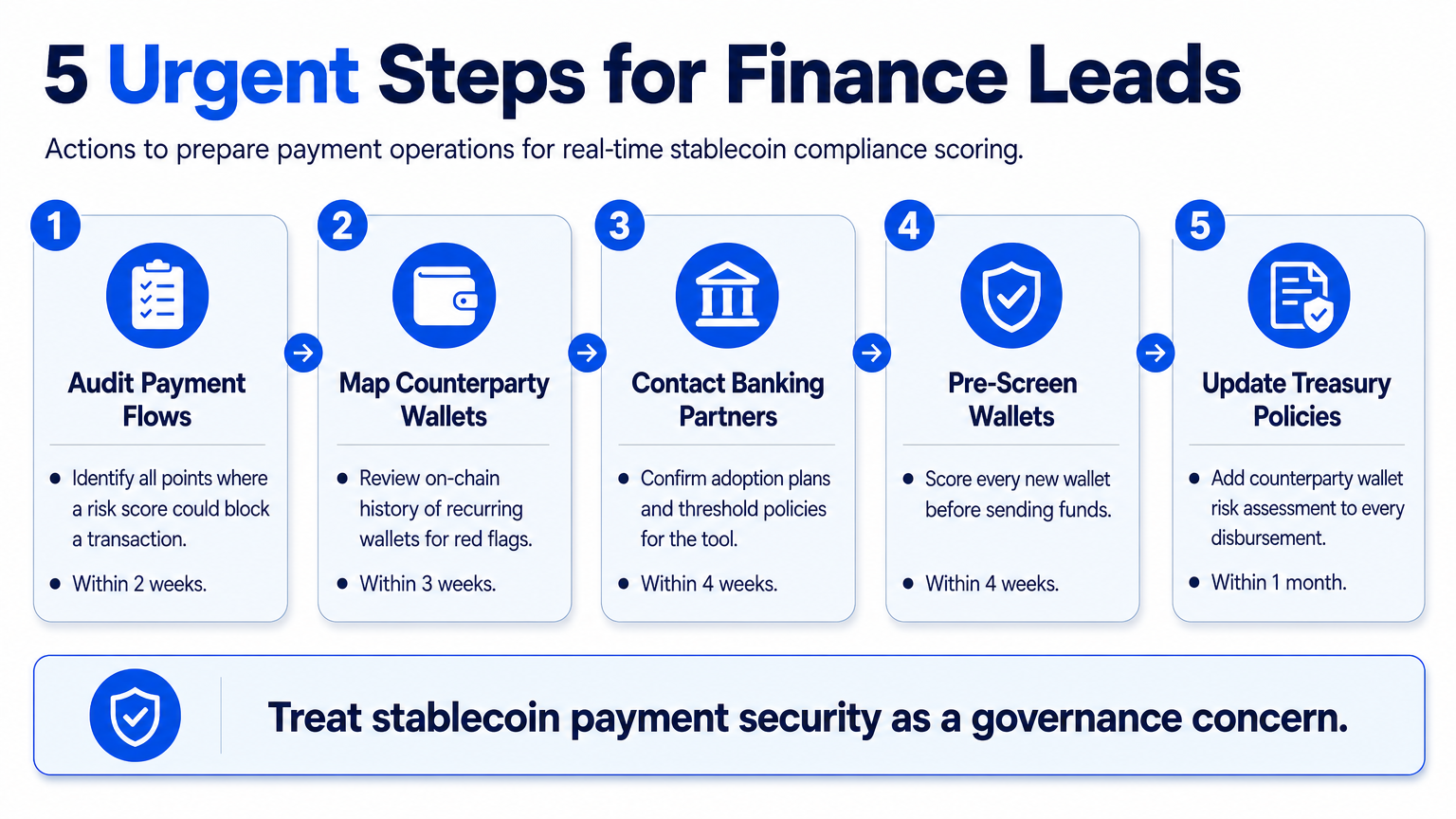
| Action | Why It Matters | Urgency |
|---|---|---|
| Audit every stablecoin payment flow (on‑chain and off‑ramp legs) | Identify all points where a risk score could block a transaction | Within 2 weeks |
| Map all recurring counterparty wallets and review their on‑chain history | Surface any addresses likely to be flagged | Within 3 weeks |
| Contact your banking and payment partners | Confirm adoption plans and threshold policies for Mastercard’s tool | Within 4 weeks |
| Implement a wallet pre‑screening solution (via platform or third‑party API) | Score every new wallet before sending funds | Within 4 weeks |
| Update DAO treasury payment policies | Add a “counterparty wallet risk assessment” step to every disbursement proposal; define escalation paths | Within 1 month |
| Evaluate a unified fiat‑crypto platform with embedded compliance monitoring | Centralize so every transaction goes through one risk‑managed interface | Within 1 quarter |
Treat stablecoin payment security as a governance concern. Train the finance committee on risk scoring, build alerts for high‑risk transactions, and negotiate explicit SLAs with banking partners for how holds are handled.
What to Watch Next
Visa will almost certainly build or buy a similar capability. SWIFT’s tokenized deposit efforts will need an equivalent. Analytics providers already offer stablecoin risk management solutions that banks deploy independently. Mastercard’s move commoditizes this function, making it a baseline expectation.
Stablecoin regulations 2026 set the stage; 2027 will bring enforcement. The GENIUS Act will be fully implemented, the SEC’s framework will be tested, and banking regulators will issue guidance on stablecoin risk management. The Brookings Institution has outlined essential features for a safe payment stablecoin—tools like Mastercard’s will define “reasonable” compliance.
Is this tool relevant for non-US businesses making stablecoin payments?
Yes. Mastercard operates globally, and its partner banks span major financial centers. A business in Singapore or Portugal processing through a bank that uses the tool faces the same scoring logic. Under MiCA and Asian frameworks, non‑US businesses will encounter equivalent national requirements. The tool is not US‑only.
What other stablecoin payment risks should businesses monitor in 2026?
- Depegging events: Even major stablecoins can lose 2% of their value during stress, creating reconciliation issues.
- Legal reclassification: A court ruling that deems a specific stablecoin a security could freeze a payment corridor.
- Smart contract risk: Bridge exploits can strand corporate funds.
- Compliance gaps in crypto banking: Many platforms still have transaction monitoring gaps that expose businesses to sanctioned actors.
Stripe’s guidance on stablecoin risk management strategies underscores the need for a multilayered approach: technical security, legal due diligence, and operational monitoring.
Open Questions on Decentralized Treasury Risk
How will risk scoring models treat decentralized treasuries? A Gnosis Safe controlled by a dozen pseudonymous signers can look high‑risk to a bank algorithm. There’s no standard for proving a multisig is a legitimate corporate treasury. Until analytics firms develop a “proof of treasury legitimacy” standard, DAOs must document governance structures and maintain transparent on‑chain records to reduce false positives.
Key Takeaways
- Mastercard’s tool introduces real‑time scoring that can delay or block stablecoin payments if counterparty wallets are flagged.
- Businesses must pre‑screen every wallet and engage proactively with banking partners.
- A unified fiat‑crypto platform integrates wallet risk checks, reducing surprise holds.
- Finance leads should immediately audit payment flows, implement wallet screening, and update treasury policies.
- The tool is globally relevant; stablecoin payment security and crypto payments compliance will be table stakes by 2027.
For a financial platform that handles fiat and crypto in one place while staying ahead of compliance demands, sign up at OneSafe.



