
Typing your neobank login credentials opens a gateway linking traditional banking to on-chain asset custody. This guide secures that gateway for global businesses with crypto holdings.
Table of Contents
- What Is Neobank Login?
- How Neobank Login Works Under the Hood
- Security Architecture That Protects a Neobank Login Session
- Setting Up a Neobank Login for Your Business: A Concrete Workflow
- Common Neobank Login Mistakes That Put Your Company at Risk
- How to Evaluate a Neobank’s Login Security When Choosing a Platform
- What’s Next for Neobank Login
- Key Takeaways
What Is Neobank Login?
A neobank login is the authentication point that grants an authorized user access to a financial platform offering multi-currency accounts, payments, cards, and often crypto on/off-ramps—without the platform itself being a licensed bank. Unlike a consumer fintech app, a business neobank login supports multiple team members with distinct permissions across a shared financial operating system that may hold fiat in segregated accounts and digital assets in institutional custody. Not all neobank login portals are equal; for example, Neo Financial login shows a typical consumer interface, while business platforms like OneSafe add role-based access and custody integrations.
How does neobank login differ from traditional bank login for businesses?
Traditional business bank portals offer a single-point login with rigid roles—usually “viewer” and “signer”—and no native crypto capability. A secure neobank sign‑in for modern businesses layers on mandatory MFA at enrollment, granular RBAC that can map to DAO governance, custody‑aware session handling (fiat via partner banks, crypto via MPC‑based custodians like Fireblocks), and KYB‑integrated identity binding. Every login is tied to a verified business identity and a specific human.
Why Web3 startups and global teams need a different kind of sign‑in
A Web3 startup might have multiple founders in different time zones, part‑time contributors with treasury authority, and a multisig signer who only needs read access. The neobank login enforces governance: when a DAO contributor authenticates, the platform knows exactly what they can view, initiate, or approve. Customizable roles and permissions for DAOs are not a consumer feature—they’re infrastructure.
How Neobank Login Works Under the Hood
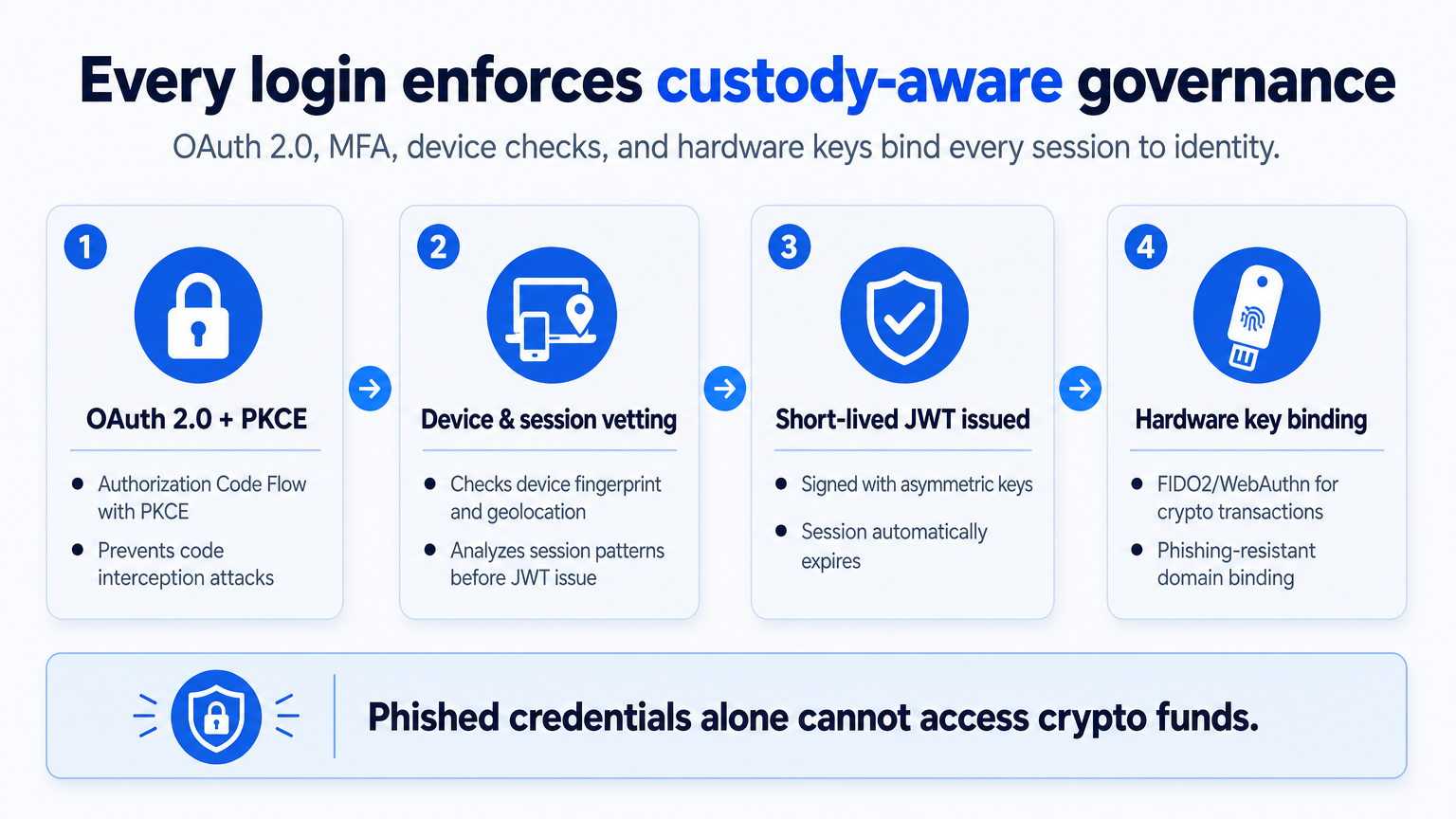
When you open a business neobank app, you trigger OAuth 2.0 Authorization Code Flow with PKCE to prevent code interception attacks. After credential validation, the platform checks device fingerprinting, geolocation, and session patterns before issuing short‑lived JWTs signed with asymmetric keys. For high‑value crypto transactions, hardware security keys (FIDO2/WebAuthn) cryptographically bind the authentication to the domain, blocking phishing.
Multi‑factor authentication (MFA) as the non‑negotiable baseline
Every business platform worth evaluating enforces MFA at enrollment. OneSafe requires at least two factors—a strong password and a TOTP app or hardware key—before you ever see a dashboard. MFA must be enforced per login session, not per device, with automatic timeouts and step‑up re‑authentication for wires or crypto movements.
Onboarding‑KYB‑first‑login sequence in a business neobank
Consumer neobanks onboard with KYC; businesses go through KYB (Know Your Business). The sequence: entity submission (formation docs, EIN, proof of address), beneficial ownership identification, sanctions screening, account approval, then first admin login with mandatory MFA setup. OneSafe’s digital KYB engine typically completes within a week—fast, but never bypassed.
Security Architecture That Protects a Neobank Login Session
Encryption, tokenization, and the custody layer (Fireblocks)
Fiat operations use bank‑grade encryption; partner banks hold segregated accounts. Digital assets are secured in Fireblocks MPC custody—private key material is never assembled in one place. When you initiate a crypto withdrawal, the login session sends an instruction, but execution requires an MPC signing ceremony across distributed key shards. A phished login session cannot unilaterally drain funds.
Role‑based access and custom permissions for DAOs
A DAO banking platform must offer granular permissions: read‑only treasury view, payment initiator with limits, approver with thresholds, full admin. The platform enforces these boundaries on every login session, so no single contributor’s credentials carry unilateral spending power.
Is neobank login safer than a traditional bank’s online portal?
For businesses holding both fiat and crypto, a properly architected neobank login can be safer. Traditional portals often rely on SMS‑based 2FA and flat role structures. A business neobank with mandatory MFA, FIDO2 support, MPC custody separation, and per‑session enforcement reduces the blast radius of a compromised credential. The key difference is that a neobank login is a governance gateway—phishing a password alone never grants direct access to cryptographic key material.
Setting Up a Neobank Login for Your Business: A Concrete Workflow
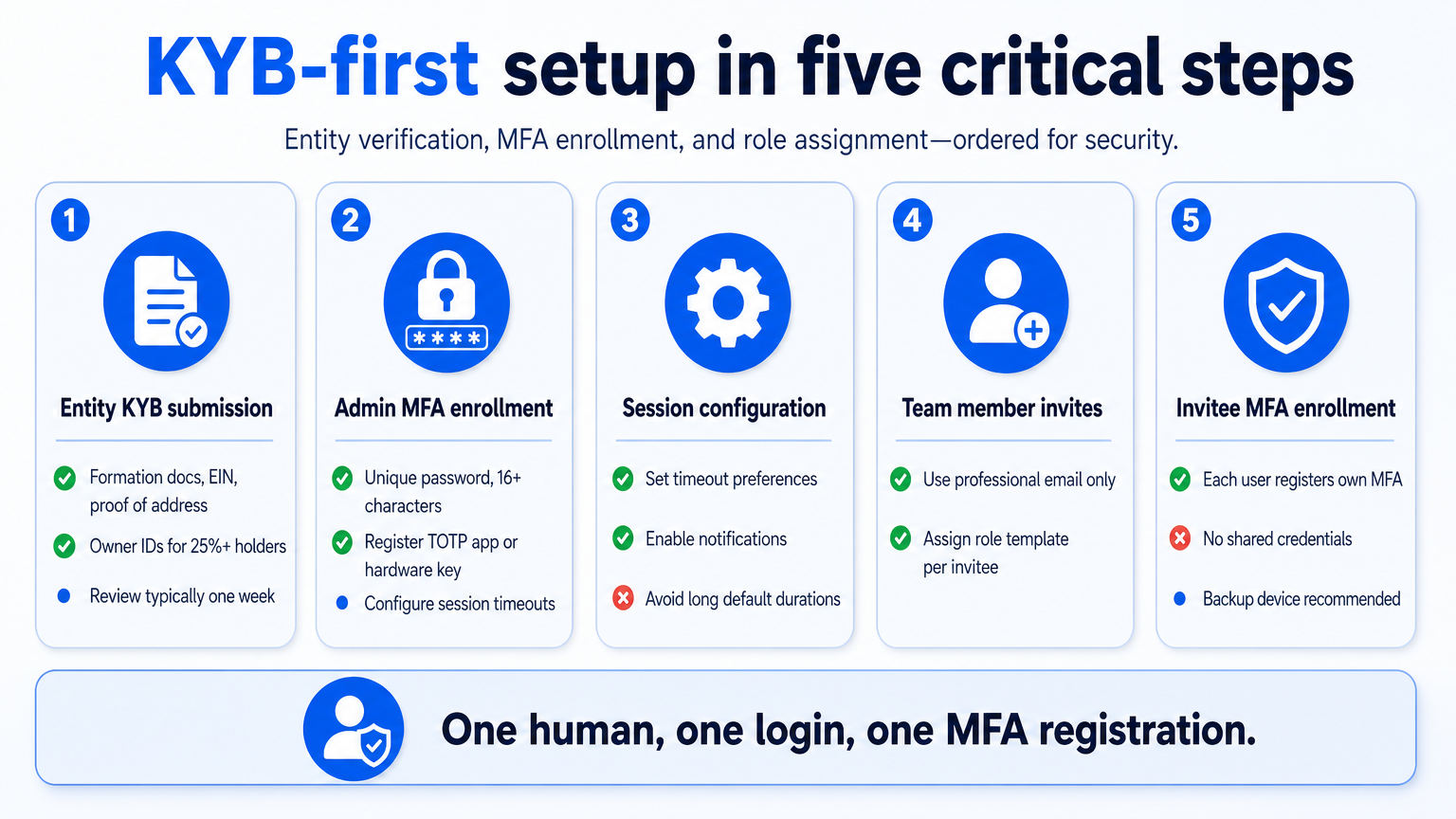
Before anyone logs in, the entity must pass KYB. Gather formation documents, EIN or local tax ID, proof of business address, and government‑issued photo ID for each beneficial owner (25%+ ownership or control). For a DAO, use its legal wrapper (Wyoming DAO LLC, Cayman Foundation Company) or the service provider entity.
First login and mandatory MFA setup
Once approved, the admin receives enrollment credentials. On first login, set a strong, unique password (16+ characters from a password manager), register a TOTP app or hardware key, verify the registration, and then configure session timeout preferences before inviting team members.
Issuing team member invites with limited roles — a walkthrough
Invite members from the admin panel using professional email addresses. For each invitee, assign a role template—e.g., finance contributor (view fiat, initiate domestic wires ≤$10k), treasury approver (approve payments, view crypto), read‑only auditor (export logs). Each invitee completes their own MFA enrollment. No shared credentials. This ensures every login is a distinct, auditable event.
| Setup Step | Required Input | Timeline | Pitfall |
|---|---|---|---|
| Entity KYB submission | Formation docs, EIN, proof of address, owner IDs | Submitted minutes; review ~1 week | Incomplete beneficial ownership |
| Admin enrollment | Platform‑issued credentials | 10–15 min | No backup MFA device |
| Session configuration | Timeout preferences, notifications | 5 min | Leaving default long duration |
| Team invite | Professional email, role template | 5 min/invite | Using consumer email |
| Invitee MFA enrollment | TOTP app or hardware key | 10 min/user | Single device, no backup |
Common Neobank Login Mistakes That Put Your Company at Risk
Shared credentials—one admin login shared over Slack or a vault with multiple people—destroys audit trails and makes revocation impossible. The rule: one human, one login, one MFA registration.
Skipping session hygiene on contractor devices. A contractor’s personal laptop on public WiFi can leak session tokens. Require explicit logout, a dedicated financial‑ops browser profile with no extensions, VPN with DNS filtering, and a fully patched OS.
Treating login like a personal banking app. A business neobank login is an operational control point. Know which role you’re operating under and what transactions you intend to perform before authenticating.
How to Evaluate a Neobank’s Login Security When Choosing a Platform
What should a business look for in a neobank’s login security before opening an account?
Ask these five questions:
- Where are digital assets held, and by which custodian? The answer should name an institutional custodian (e.g., Fireblocks). If the platform can’t name one, dig deeper.
- Is MFA mandatory at enrollment, or can users defer it? Deferrable MFA is a disqualifier for business use.
- What compliance certifications does the platform hold? Look for SOC 2 Type II, ISO 27001, and independent penetration tests. Ask about the custody partner’s certifications.
- How are login sessions terminated? Must enforce idle‑time session expiration (e.g., 15 minutes) and step‑up auth for sensitive operations.
- Can we enforce hardware‑key‑only MFA for treasury roles? Phishing‑resistant MFA matters most for spending authority.
Why login‑first design signals the right platform for mixed fiat‑crypto operations
Platforms that enforce role selection at the gate, MFA without opt‑out, and custody‑aware transaction signing are engineered for institutional risk. During a demo, ask to see what happens when a read‑only user attempts a USDC withdrawal—a clear permission‑denied state demonstrates a proper login‑permission‑custody chain.
What’s Next for Neobank Login
- Passkeys (FIDO2 credentials): Biometric‑bound private keys in device secure enclaves will become primary auth within 12–18 months, combining possession and inherence into a phishing‑resistant ceremony.
- Decentralized identifiers (DIDs) for entity verification: Businesses may present verifiable credentials from their jurisdiction’s registry, enabling real‑time KYB without re‑uploading documents. eIDAS 2.0 and W3C DID standards are converging.
- User‑side MPC wallets: MPC key shards on user devices will make the login ceremony part of the transaction‑signing quorum. Three team members authenticate from different locations, each device contributes a partial signature, and the transaction executes only at threshold—bridging login governance with direct custody.
For teams choosing a platform now, hardware‑backed authentication and role‑based access are the baseline. The login layer you build today should accommodate these standards.
Key Takeaways
- A business neobank login enforces role boundaries, custody separation, and compliance on every session—not just at signup.
- Shared credentials are a critical risk; every team member needs a unique login with independent MFA.
- Mandatory MFA at enrollment is the minimum bar; never accept deferrable MFA for treasury operations.
- Institutional MPC custody (e.g., Fireblocks) means a phished session alone can’t drain digital assets.
- Evaluate a platform by asking about MFA enforceability, session timeouts, step‑up authentication, and the named custodian.
Start your business with a neobank login architecture built for fiat operations and crypto treasury. Open a OneSafe account for your global business or DAO.



