Anchorage Digital’s Routable acquisition merges stablecoin custody with fiat rails, enabling cross-border stablecoin transfers and merchant acceptance.
On October 6, 2026, Anchorage Digital (a federally chartered digital asset bank) acquired payments orchestration platform Routable, directly linking institutional-grade stablecoin custody with high‑volume fiat payout capabilities. The deal creates fiat-to-stablecoin rails that sit “quietly between a company’s ERP and the world’s payment rails,” making stablecoin settlement invisible to end users. Large platforms—streaming services, marketplaces, app stores—can now use stablecoins as the core settlement layer and Routable’s 220‑country fiat payout orchestration for the final mile, delivering near‑instant, compliant cross‑border stablecoin transfers.
Table of Contents
- Why This Merger Matters
- Stablecoin Payments 101
- What This Means for Your Business
- The OneSafe Perspective
- What to Watch Next
- FAQ
- Key Takeaways
- Sources
Why This Merger Matters
Stablecoin volumes have surged, and Visa, Stripe, and others now settle on‑chain. The Anchorage Routable acquisition signals that stablecoin payments are graduation from crypto‑native experiments to mainstream enterprise infrastructure. OneSafe’s analysis of the APAC turning point shows businesses already adopt stablecoins for payroll and vendor payments. Yet the last mile remains fiat; recipients need local currency in their bank account. Routable fills that gap with automated compliance checks and local payout rails. The merger validates the only path to enterprise‑scale stablecoin settlement: integrated custody plus fiat orchestration. This is the model platforms like OneSafe have been building for mid‑market and Web3 businesses.
Stablecoin Payments 101
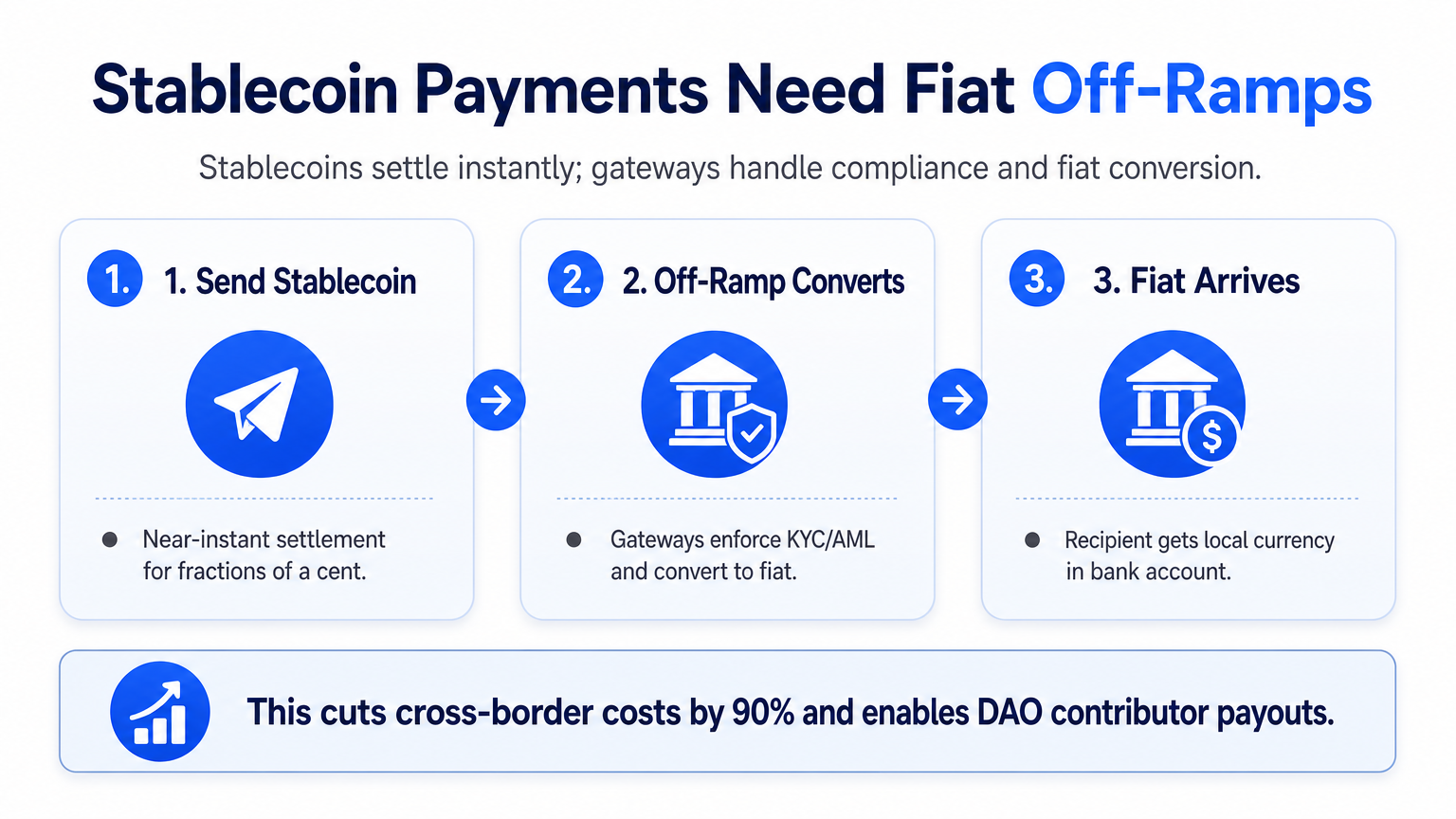 A stablecoin is a blockchain token pegged to a fiat currency (usually USD). Payments settle in seconds for fractions of a cent. The recipient’s challenge is converting stablecoins to local fiat and depositing to a bank account—that’s where payment gateways and off‑ramp services come in. Stripe now supports USDC payments, Visa settles in USDC over Ethereum, and Paxos offers regulated infrastructure. The Federal Reserve has raised stability concerns, but compliance‑focused stablecoin infrastructure is attracting serious investment; McKinsey’s 2026 report notes stablecoins are becoming the dominant tokenized cash. Global businesses save on the typical 3–5% cross‑border cost, and DAOs pay contributors without a centralized bank. Stablecoin merchant acceptance is rising as integrated fiat‑to‑stablecoin rails mature, turning crypto efficiency into everyday B2B and B2C flows.
What This Means for Your Business
 For DAOs and Web3 startups: Regulated custody and fiat payout can now be bundled. OneSafe already delivers crypto‑fiat accounts with multi‑sig governance and automated payments. DAO stablecoin payments move from ad hoc to institutional‑grade.
For global businesses: The line between traditional and digital‑asset treasuries is blurring. Idle stablecoins can earn yield while remaining liquid for payroll and cross‑border settlements. The Anchorage‑Routable model points toward a single treasury using stablecoins for internal liquidity and fiat for final payouts.
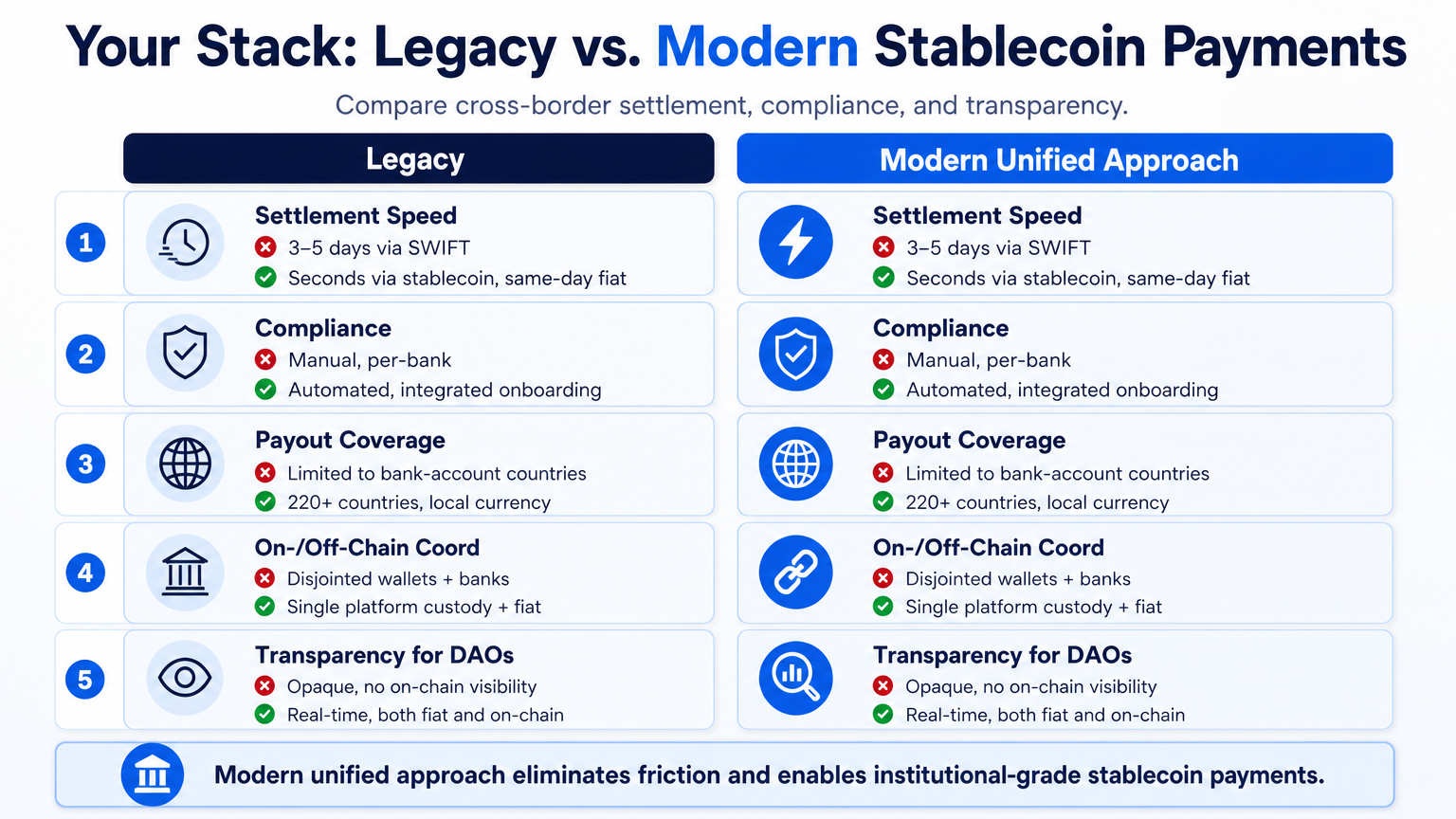
Actionable evaluation: Compare your stack against the emerging standard.
| Capability | Legacy Setup | Modern Unified Approach |
|---|---|---|
| Cross‑border settlement speed | 3–5 days via SWIFT | Seconds via stablecoin, same‑day fiat off‑ramp |
| Compliance / KYC | Manual, per‑bank | Automated, integrated with onboarding |
| Payout coverage | Limited to bank‑account countries | 220+ countries, local currency |
| On‑/off‑chain coordination | Disjointed wallets + separate banks | Single platform for custody + fiat orchestration |
| Transparency for DAOs | Opaque, no on‑chain visibility | Real‑time, both fiat and on‑chain ledger |
The OneSafe Perspective
OneSafe, a financial technology company (not a bank; banking services provided by partners), already operates the unified model: fiat and crypto accounts, on‑/off‑ramps, corporate cards, and cross‑border wires from one dashboard. Over $800 million processed across 30+ countries shows the stack works for Web3 startups, DAOs, and global SMBs. Instant crypto‑to‑fiat conversions with fees as low as 0.15% pass the cost advantage of stablecoins on without sacrificing compliance—digital asset custody is via Fireblocks, and multi‑factor authentication is mandatory. DAO governance aligns with fiat execution through customizable roles and permissions. This is the practical implementation that the Anchorage Routable acquisition points toward for mega‑enterprises.
What to Watch Next
Regulation: As a federally chartered bank, Anchorage operates within a known framework, but comprehensive stablecoin legislation in 2027 would unlock even more enterprise adoption. More tie‑ups: Expect traditional payment processors to acquire fiat payout engines and crypto‑native firms to seek custody partners. Platforms that already bridge fiat and crypto may become strategic targets. DAO support: The deal accelerates institutional‑grade on‑/off‑ramp infrastructure that DAO tooling can build upon. Within 12 months, expect more DAO‑specific integrations from platforms that understand decentralized governance and banking requirements.
FAQ
What infrastructure is needed for stablecoin payments at scale?
A regulated custody solution, a stablecoin API/payment gateway, and a fiat off‑ramp network covering 220+ countries—with embedded KYC/AML/sanctions screening—an integrated stack as recommended by Polygon’s enterprise guide.
How do stablecoin payments integrate with fiat payroll?
A payment platform automatically converts stablecoins to fiat and executes ACH, wire, or local bank transfers. The payer sends a stablecoin instruction; the platform handles conversion and payout. Invoices can be issued in either currency. OneSafe’s automated modules already pay a contractor in Mexico via USDC while they receive MXN.
How do stablecoin payment fees compare to wires?
Blockchain fees are negligible. Total lifecycle cost includes spread on conversion, platform fees, and the fiat payout leg. Compared to international wire fees of $25–$50 plus 3–5% FX margins, a stablecoin‑powered cross‑border transfer can be over 90% cheaper.
What compliance obligations apply?
Entities must meet the same AML/KYC requirements as traditional money transmitters: BSA/AML program, OFAC screening, SARs filing, and potentially a money transmitter license. A regulated custodian or platform that works with banking partners can shoulder much of the burden. Circle’s APIs include built‑in compliance checks, but ultimate responsibility lies with the business. For DAOs without a legal entity, using a platform that provides segregated, compliant fiat accounts is a practical workaround.
Can stablecoin payments be charged back?
Blockchains are immutable, so chargebacks don’t apply in the card‑network sense. Refunds require a new stablecoin transaction from the merchant to the customer. Enterprise payouts rely on orchestration layers (like Routable’s) to handle exceptions and reconciliation.
How do DAOs start using stablecoin payments today?
Choose a platform with multi‑sig custody, on‑/off‑ramps, and fiat accounts. OneSafe supports DAO governance features and FBO accounts; onboarding requires formation papers and government ID and can be completed in under a week. The unified stack eliminates the need to stitch together separate custody, conversion, and banking services.
Key Takeaways
- The Anchorage Routable acquisition proves that integrated stablecoin custody plus fiat payout rails is the new baseline for enterprise cross‑border stablecoin transfers.
- DAOs and global businesses should evaluate their stack against the emerging standard: regulated custody, automated compliance, and local‑currency off‑ramping.
- The unified neobanking model—already in production—bridges fiat, crypto, and stablecoin operations with transparent fees and institutional‑grade security.
- Regulatory clarity is the biggest unknown, but the market is moving faster; integrated fiat‑to‑stablecoin rails are now table stakes for global payments.
Ready to bring stablecoin payments into your operations? Explore OneSafe’s unified account.
Sources
- How Stablecoin Payments Infrastructure Works
- Stablecoin Payments for Enterprise: A Practical Guide
- Stablecoin payments infrastructure - Circle
- Stablecoins payments infrastructure for modern finance
- Stablecoins and the future of onchain finance | Visa
Ready to put this into practice? Get started with onesafe.io.