OCBC and StraitsX pilot invisible stablecoin settlements: corporates get fiat credit, no crypto handling. NTT DOCOMO Asia is first.
On November 23, 2026, Ledger Insights reported that StraitsX and OCBC are piloting corporate stablecoin payments for cross-border settlement. A company receiving stablecoins has the funds automatically credited to its bank account, removing the need to touch crypto. Both firms participate in Singapore’s BLOOM digital money settlement initiative.
This matters because stablecoin payments become invisible to treasury teams. No wallets, no keys, no blockchain interaction — the stablecoin is a transport layer, and the business sees a normal bank credit. That shift could move B2B stablecoin settlement from pilot to default.
Table of Contents
- Key Takeaways
- How the pilot works
- Can stablecoins be used for B2B cross-border payments?
- Are stablecoin payments regulated in Asia?
- Benefits and trade-offs of bank-mediated settlement
- How does this compare to existing fintech stablecoin solutions?
- What should a corporate treasurer do to prepare?
- What this means for your business
- What to watch next
Key Takeaways
The pilot eliminates crypto complexity. A receiving corporate never handles a stablecoin; funds automatically credit its bank account. That skips custody decisions, wallet whitelisting, and transaction signing. The corporate experience stays a bank statement entry.
Auto-settlement links a dedicated wallet to a business account. StraitsX assigns a wallet address linked to the client’s OCBC account. When a payer sends stablecoins, settlement credits the bank account. NTT DOCOMO Asia runs the first flow. The outcome is a familiar fiat credit with no on-chain balance management.
The model prioritizes workflow continuity over technology exposure. Corporates want the benefit — faster, lower-cost cross-border settlement — without changing how they work. StraitsX mirrors tokenized deposit behavior: blockchain complexity is hidden. That “invisible crypto” approach lowers adoption barriers more than any wallet UX improvement.
Cost and speed gains are real, but trade-offs exist. Stablecoin settlement reduces correspondent banking friction and compresses windows. However, the bank-mediated version introduces dependencies: service only through participating banks; crediting may follow bank batches, not pure on-chain finality; and you rely on both the issuer and the bank. As noted in the same report, similar services exist in other jurisdictions — PNC Bank in the US, for instance — so this is not isolated.
Regulatory backing reduces compliance uncertainty. Both parties operate inside Singapore’s BLOOM initiative. A tokenized deposit proof of concept was completed the previous week. The pilot sits in a coordinated, regulator-adjacent framework — not a permissionless experiment. That gives corporate treasurers the compliance wrapper they’ve been waiting for.
Asia and the US move in parallel, signaling globally. PNC Bank’s US service runs the same invisible-crypto model. The market splits: platforms like Circle and Stripe push direct stablecoin interaction (see Stripe’s Stablecoin Payments Explained: A Guide for Businesses), while the StraitsX-OCBC pilot represents a bank-mediated, invisible path. For most traditional corporates, the bank-mediated route is more pragmatic because it preserves existing workflows and relationships.
How the pilot works
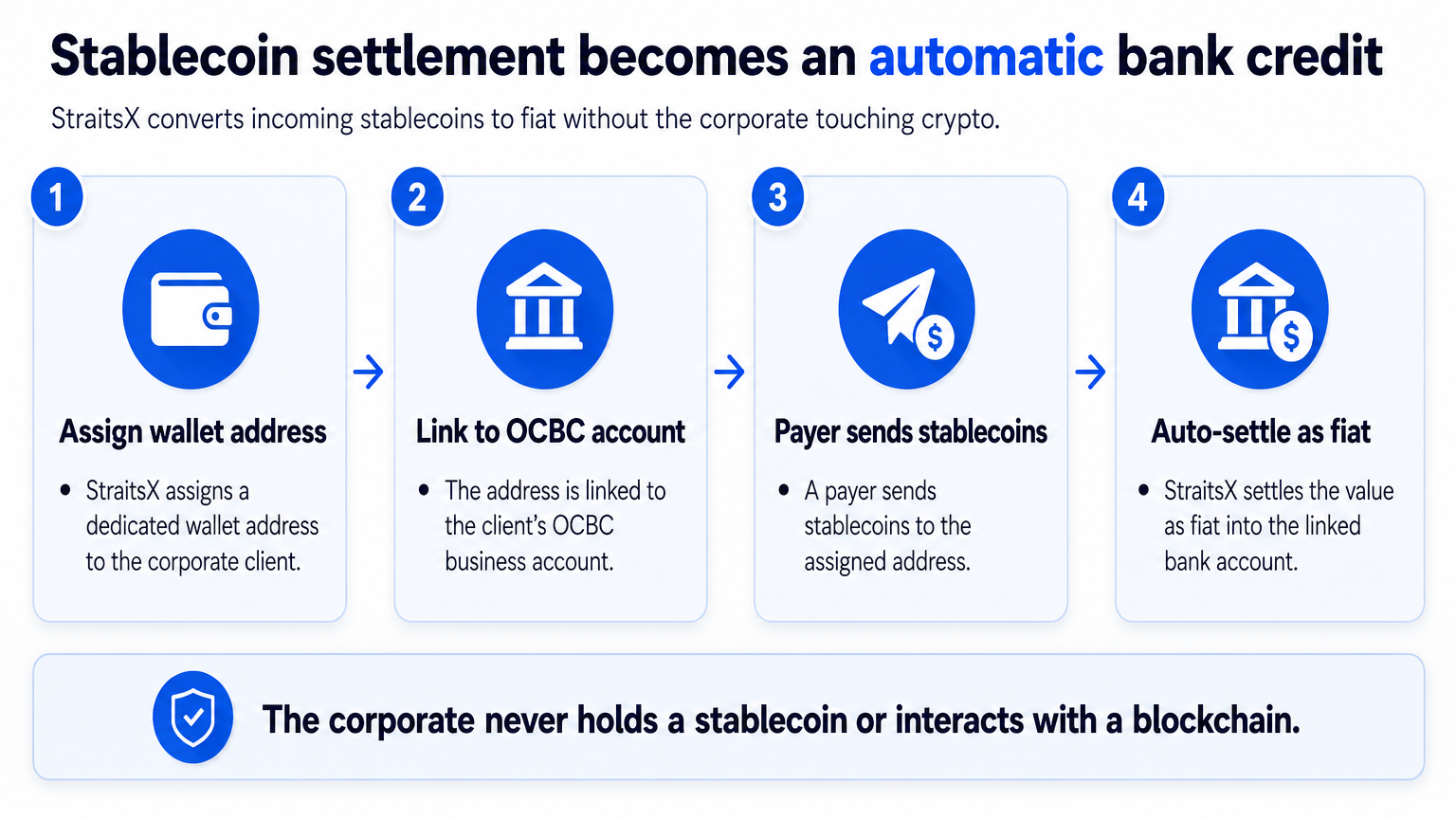
- StraitsX assigns a dedicated stablecoin wallet address to a corporate client.
- That address links to the client’s OCBC business account.
- A payer sends stablecoins to the address.
- StraitsX automatically settles the value as fiat into the linked bank account.
The corporate never holds a stablecoin balance or interacts with a blockchain. The design mirrors tokenized deposit settlement. NTT DOCOMO Asia is the first participant, per Ledger Insights on November 23, 2026.
Can stablecoins be used for B2B cross-border payments?
Yes — this pilot is the latest evidence. The report frames the arrangement as a stablecoin cross-border payments pilot for corporates and notes PNC Bank already supports a similar service. The commercial case is well established: stablecoins can settle faster and at lower cost than traditional correspondent banking (see BitGo’s Stablecoin Payments Explained: A Guide for Merchants and Institutions). The open question was always operational integration; this pilot answers it by making the outcome indistinguishable from a bank transfer.
Are stablecoin payments regulated in Asia?
Regulation varies, but Singapore leads. The pilot sits inside the BLOOM initiative with StraitsX (a regulated stablecoin issuer) and OCBC (a major bank). That configuration provides a compliance wrapper many treasurers have sought. For US-specific context, see Stablecoin Regulation: GENIUS Act Impact on Businesses. Asia-Pacific frameworks remain fragmented, but the direction is toward regulated, bank-linked stablecoin payment infrastructure rather than unregulated on-chain flows.
Benefits and trade-offs of bank-mediated settlement

The model trades control for convenience.
| Factor | Bank-mediated (StraitsX-OCBC) | Direct stablecoin integration |
|---|---|---|
| Corporate crypto handling | None; fiat credit | Wallet or API required |
| Settlement visibility | Bank statement entry | On-chain and dashboard |
| Control over timing/corridors | Limited to bank-supported corridors and batch cycles | Higher; provider-dependent |
| Compliance integration | Embedded in bank relationship | Provider-dependent |
| Speed and cost | Varies by bank and corridor | Varies by network and provider |
| Flexibility for crypto-native ops | Low | High |
Benefit: A corporate can receive cross-border stablecoin payments without building internal crypto capability. Trade-off: Dependence on a specific bank’s infrastructure, and settlement timing may reflect bank processing windows rather than blockchain finality. For a firm with an existing OCBC relationship, the bank-mediated path is low-friction. For a global business needing multi-currency accounts, instant conversion, and automated workflows across fiat and crypto, a direct or hybrid platform remains more useful.
How does this compare to existing fintech stablecoin solutions?
This is the central market conflict. Direct platforms (the Circle/Stripe model) require the business to interact with stablecoins directly. That offers full control and programmability but demands custody and operational changes. The StraitsX-OCBC model removes all that for simplicity. A neo-banking platform like OneSafe occupies a middle position: it unifies fiat and crypto natively — multi-currency accounts, ACH and wire transfers, bill pay, and instant USDC-to-fiat conversion — without waiting for a specific bank pilot. The bank pilot proves the demand; the fintech layer already delivers the capability.
What should a corporate treasurer do to prepare?
- Ask your bank or payment provider whether they offer bank-mediated stablecoin settlement or plan to join an initiative like BLOOM.
- Map your cross-border corridors. Identify which currency pairs and settlement windows cause the most cost and delay.
- If your bank isn’t there yet, evaluate a neo-banking platform that supports stablecoin-to-fiat conversion and multi-currency accounts. Confirm KYB, custody, and supported currencies before onboarding.
- Run a low-value pilot with a dedicated treasury wallet or settlement account. Reconcile daily against bank statements to catch timing or FX discrepancies early.
- Confirm accounting treatment and sanctions screening for stablecoin flows. Weekend and cross-border settlement can create reconciliation gaps — see Crypto Treasury Management Ends Weekend Cash Drag.
What this means for your business
Three questions to ask your current payment provider
- Do you offer automated stablecoin settlement that credits my existing business account, or will I need to manage a wallet myself?
- Which currencies and corridors are covered, and what are the actual settlement times and fees?
- How do you handle audit trails, sanctions screening, and reporting for cross-border stablecoin transactions?
These separate genuine bank-mediated settlement from marketing. If the first answer isn’t “credits your bank account automatically,” you’re looking at direct crypto integration, not the invisible model.
If your bank isn’t there yet: the neo-banking alternative exists
The StraitsX-OCBC pilot is a signal, not a product most corporates can buy today. OneSafe, a financial technology company operating through banking partners, already offers a unified platform for fiat and crypto with multi-currency accounts, ACH and wire transfers, bill payments, and instant crypto-to-fiat conversions. A global business can receive USDC and convert to USD without waiting for a bank-led pilot. For deeper operational guidance, see Cross-Border Payments: The Fiat & Crypto Guide for Global Businesses.
What to watch next
Expansion of the pilot and similar bank integrations
Watch whether NTT DOCOMO Asia’s participation expands to volume flows and additional corridors, and whether other Singapore banks replicate the model. The PNC example suggests once one regulated bank makes stablecoin settlement invisible, competitors face pressure to follow. For the US regulatory trajectory, see Stablecoin Payments Gets a Bank: OCC’s Nod Explained.
Regulatory updates from BLOOM and Asia-Pacific frameworks
The tokenized deposit proof of concept and the stablecoin pilot both sit inside BLOOM. Watch for guidance on settlement standards, eligible stablecoins, and bank participation. For developments in Korea, see Stablecoin Payments Link to Korea’s Won Rails. As banking infrastructure absorbs stablecoins, Fulcrum’s analysis of what has to change remains relevant: Stablecoin Payments Are Reaching Banking Infrastructure. What Has to Change.
Convergence of traditional banking and crypto-native platforms
The next phase won’t be “banks vs. fintechs.” Banks will embed invisible stablecoin settlement, while neo-banking platforms add bank-like controls, reporting, and multi-currency treasury features. For treasury teams that also publish guidance on these shifts, Joyrise can analyze your site and publish SEO articles to your CMS daily, so your team stays current without adding editorial overhead. Your first article is written before you pay.
Open a OneSafe account to manage fiat and stablecoin payments from one interface without waiting for your bank’s pilot.