Table of Contents
- description: "Stablecoin payments are maturing. Stripe now pays USDC to 160+ markets in minutes. Here's what it means for global business payouts."
- The Development: Stripe Expands Stablecoin Payouts to 160+ Markets
- Why This Matters Now for Global Businesses
- Stablecoin Payments: A Quick Primer for the Uninitiated
- Practical Implications for Businesses and DAOs
- What This Means for Your Payment Stack
- What to Watch Next: Open Questions and the Road Ahead
- Key Takeaways
description: "Stablecoin payments are maturing. Stripe now pays USDC to 160+ markets in minutes. Here's what it means for global business payouts."
Stablecoin Payments Mature as Stripe Expands Payouts
The Development: Stripe Expands Stablecoin Payouts to 160+ Markets
What just happened with Stripe and stablecoin payouts?
On November 4, 2026, Stripe significantly widened its stablecoin payments footprint, enabling US businesses to send OUSD or USDC directly to crypto wallets across more than 160 markets. The expansion—reported via Bloomingbit, citing Cointelegraph—takes a service that had already been live in limited corridors and scales it to a nearly global reach. Transfers now typically complete within minutes, giving a mainstream payments processor a direct on-chain settlement rail for business payouts.
This stablecoin payouts expansion marks a maturation point: Stripe isn’t testing the waters; it’s positioning USDC business payments as a default option for freelancer and contractor payouts anywhere a recipient holds a crypto wallet. The move follows earlier infrastructure plays from Visa Direct’s stablecoin payout pilot and Mastercard-Thunes stablecoin payouts initiatives.
Circle reported a second data point: the USDC issuer posted $865 million in quarterly stablecoin-related revenue in Q3 2026, according to OneSafe. Real-world tests, such as a USDC settlement pilot in Colombia, have shown cross-border stablecoin payments can settle merchant transactions in seconds with near-zero chargeback risk (see Stablecoin Payments: USDC Settlement Test in Colombia).
Why This Matters Now for Global Businesses
Why does this matter for global businesses and startups?
For any company paying contractors, remote teams, or vendors internationally, cross-border wires remain slow, expensive bottlenecks. With stablecoin payouts available in over 160 markets through a single platform, Stripe changes the default: a US business can fund a payout in fiat, Stripe handles conversion to USDC, and the recipient receives stablecoins—all within minutes, without intermediary bank chains.
This is not a niche crypto experiment. Many web3 startups already hold treasury in USDC and compensate contributors globally. But global businesses—not just crypto-native ones—stand to benefit. A SaaS company can offer real-time settlement to an affiliate in Brazil or a developer in Vietnam without the 3–5 day delay and opaque FX markups of SWIFT. Pairing fiat-to-crypto payment integration with existing accounting workflows makes this expansion more than a press release; it’s an operational unlock.
Stablecoin Payments: A Quick Primer for the Uninitiated

How do stablecoin payments work in practice?
Stablecoins like USDC and OUSD are blockchain-based tokens designed to hold a 1:1 value with the US dollar, backed by cash and short-term Treasuries. In a cross-border stablecoin payment, the processor converts the sender’s fiat into stablecoins and transmits the tokens to the recipient’s wallet address on a blockchain—usually a high-speed network such as Solana or Polygon. The recipient can hold USDC in a self-custodied wallet or cash out to local currency through an exchange or crypto-friendly business banking platform.
Stablecoin payment processing strips out correspondent banking layers. There’s no originating bank, no intermediary bank, no beneficiary bank. Settlement is final on-chain in seconds to minutes, and the recipient doesn’t need a bank account—a smartphone wallet suffices.
Practical Implications for Businesses and DAOs
What are the costs and speed compared to traditional methods?
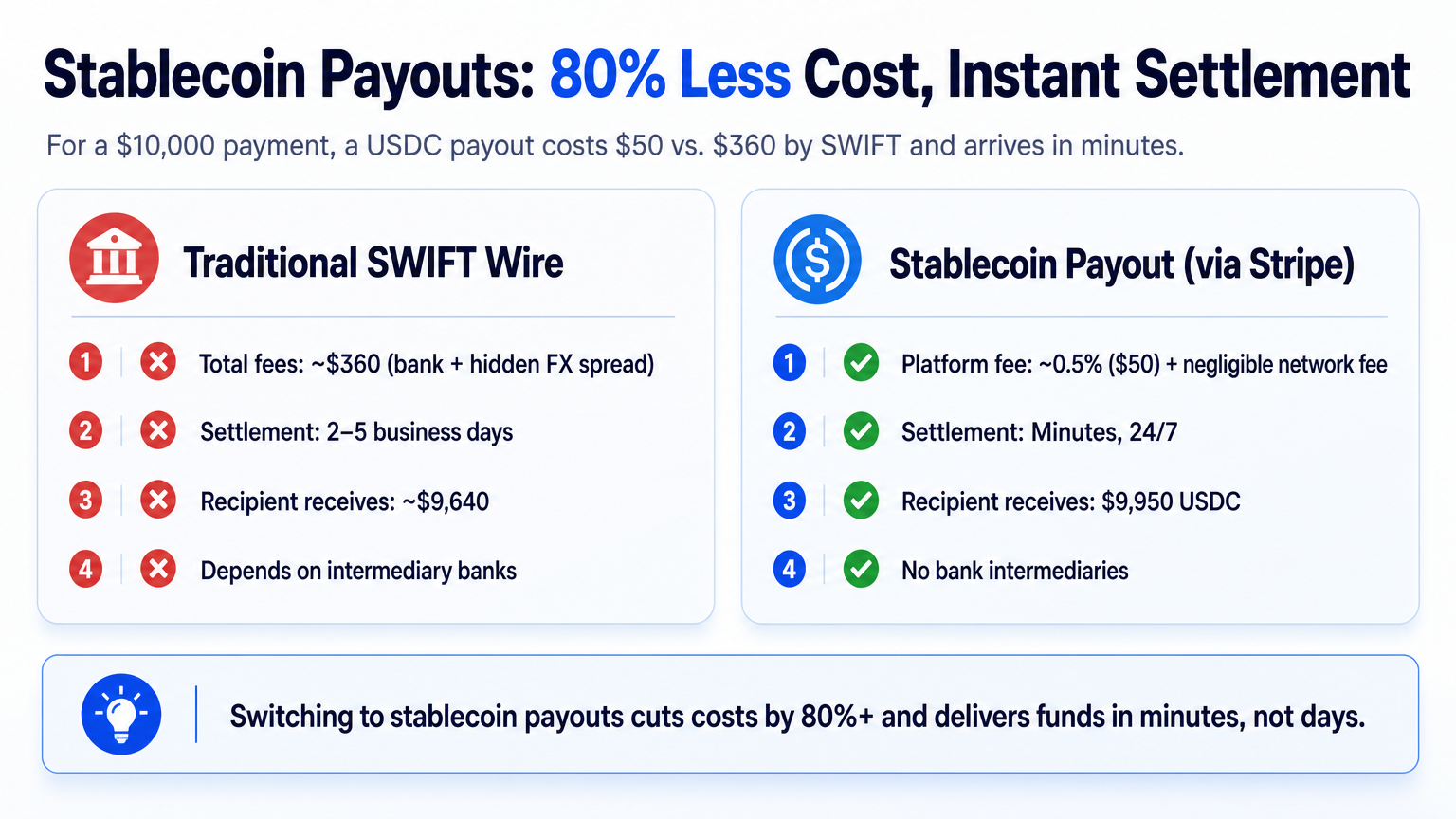
A $10,000 payment from a US company to a contractor in the Philippines illustrates the shift.
| Payment method | Typical fees & costs (as of Nov 2026) | Settlement time | Recipient receives |
|---|---|---|---|
| Traditional SWIFT wire | Bank sending fee $30; intermediary $20; receiving bank $10; 3% FX spread hidden in rate: ~$300 | 2–5 business days | ~$9,640 (after fees & FX loss) |
| Stablecoin payout (e.g., Stripe) | Platform fee ~0.5% ($50); network fee <$0.01 (Solana) | Minutes | $9,950 in USDC (minus any cash-out fee by recipient) |
Stablecoin payout fees vary by processor, but they almost always undercut SWIFT costs by 80% or more for the sender. Recipients who keep USDC or cash out through a low-fee local exchange keep more of their earnings. Real-time settlement means no cutoff times, no return codes, and no recalls. Funds move 24/7.
Speed and operational efficiency
On-chain finality beats even same-day ACH improvements, and faster settlement reduces currency fluctuation risk during the payment window—especially when the recipient converts to a volatile local currency immediately.
Compliance and custody: not just regulatory hurdles
Stablecoin transfers are irreversible and transparent, so they shift key management and compliance burden to the sending business. Businesses must use institutional-grade custody—multi-signature wallets, insured qualified custodians, or platforms that secure assets on infrastructure like Fireblocks. Under the TRAVEL Rule and evolving GENIUS Act frameworks, stablecoin transactions require know-your-transaction (KYT) monitoring. Stripe’s payout service handles compliance on its side, but a business holding a USDC treasury needs its own KYC/KYB processes. The best practice is a platform that bakes these checks into the flow—enabling stablecoin treasury management without building a compliance team from scratch.
What This Means for Your Payment Stack
What should businesses do to prepare for wider stablecoin adoption?
Start with a payment-flow audit. Identify cross-border payout corridors where fees exceed 2% and settlement takes more than two days. If the recipient can receive USDC and convert it to local fiat at a known cost, pilot stablecoin payouts as a parallel rail while keeping wires for fallback.
Next, choose infrastructure. Avoid siloed tools. A unified fiat-crypto platform that provides free USDC withdrawals, competitive FX, and scalable permissioning reduces operational complexity. This is especially true for DAOs, where customizable roles and multi-signature controls are a must.
How can businesses integrate stablecoin payments with their existing fiat operations?
Integration runs on three tracks:
- Banking layer: Use a multi-currency account that natively holds fiat and stablecoins. OneSafe supports USD, Euro, and CAD accounts alongside free USDC deposits and withdrawals.
- Payment execution: Fund mass payouts from the platform’s USDC balance through Stripe’s stablecoin payout endpoint. The platform handles on/off-ramp and compliance, while Stripe manages last-mile disbursement.
- Reconciliation: Integrate fiat and crypto ledgers into your accounting system and keep real-time wallet balances alongside fiat balances in one dashboard.
A practical checklist: set up a crypto-friendly business banking account that supports USDC and fiat; configure payout schedules; define an FX conversion policy; train finance teams on wallet address verification and transaction monitoring; and implement multi-factor authentication and role-based controls.
For teams that need to turn these changes into everyday internal or customer education, Joyrise: your blog, written and published every day plans, writes and publishes illustrated SEO articles to your Webflow blog every day; read your first article before you pay.
When to use stablecoin payouts vs. traditional wires
Choose stablecoin payouts when the recipient is crypto-literate, the destination market has liquid USDC-to-local-currency ramps, and speed or cost are primary concerns. Stick with traditional wires when the recipient requires a bank statement for tax or regulatory reasons, when the payment must travel through a strictly monitored channel, or when the recipient cannot easily cash out USDC without excessive fees.
A hybrid approach works best: maintain both rails and route each payment through the most efficient method.
The case for a unified fiat-crypto platform
Fragmentation creates risk. A business that uses one bank for fiat, a separate exchange for crypto, and a third payout processor for stablecoins faces reconciliation nightmares, multiple compliance touchpoints, and delayed FX. A consolidated fiat-crypto platform lets you hold EUR in a segregated account, pay a contractor in USDC from the same interface, and see the consolidated balance in real time. For DAOs, customizable roles and native Fireblocks custody ensure governance and security aren’t an afterthought.
As stablecoin payment adoption accelerates, moving fluidly between fiat and crypto isn’t a luxury—it’s the baseline for global financial operations.
What to Watch Next: Open Questions and the Road Ahead
What are the regulatory and security considerations for stablecoin payments?
Regulation remains the most consequential variable. The GENIUS Act, if enacted, would create a federal framework for payment stablecoin issuers, while OCC final rules already permit banks to custody stablecoins and engage in related activities (see GENIUS Act Stablecoin Regulation: A Compliance Guide). Businesses should watch how these rules interact with state money transmitter laws and with expected FSOC designations in 2027.
Security risk is custody. Any business that accumulates a USDC balance must decide whether to self-custody or use a qualified custodian. Institutional options with bank-grade security and on-chain governance—multi-sig, time locks, hardware security modules—are becoming standard. Multi-factor authentication and a strict whitelist of payout addresses are non-negotiable.
The political calendar adds uncertainty. The US midterm elections in November 2026 could shift legislative appetite for stablecoin bills; regulatory clarity may accelerate or stall (see Stablecoin Payments After the Midterms: What Changes). Businesses that wait for perfect clarity may miss the window to build operational muscle and partner relationships that early adopters are already using.
Key Takeaways
- Stripe’s expansion of stablecoin payouts to 160+ markets signals that cross-border USDC business payments have reached mainstream readiness.
- A typical $10,000 international payment can cost 80% less and settle in minutes via stablecoins compared to SWIFT wires.
- Businesses should integrate stablecoin payouts into existing fiat operations through a unified platform that holds both fiat and crypto, rather than siloing crypto activity.
- Security and compliance must be proactive: institutional custody, KYT monitoring, and strict address controls are prerequisites.
- Regulatory evolution—especially the GENIUS Act and post-midterm shifts—will shape adoption, but waiting risks operational disadvantage.
Sign up at OneSafe to see how a unified fiat-crypto platform can streamline your cross-border stablecoin payments.