
Trybit’s November 17, 2026 mass payout upgrade introduces line-by-line validation, per-recipient status tracking, and an API for automated workflows, giving finance teams running stablecoin payroll the control once reserved for traditional banking. It’s a clear sign that crypto payroll infrastructure is maturing beyond the “send and pray” era.
Table of Contents
- Upgrade at a Glance
- What just happened with Trybit's mass payout upgrade?
- How does line-by-line validation improve crypto payroll?
- What is per-recipient status tracking?
- How does this affect compliance for businesses?
- Should we consider switching to API-driven crypto payroll?
- What are the risks of automated crypto payroll?
- Key Takeaways
Upgrade at a Glance
| Feature | What It Does | Why It Matters for Crypto Payroll |
|---|---|---|
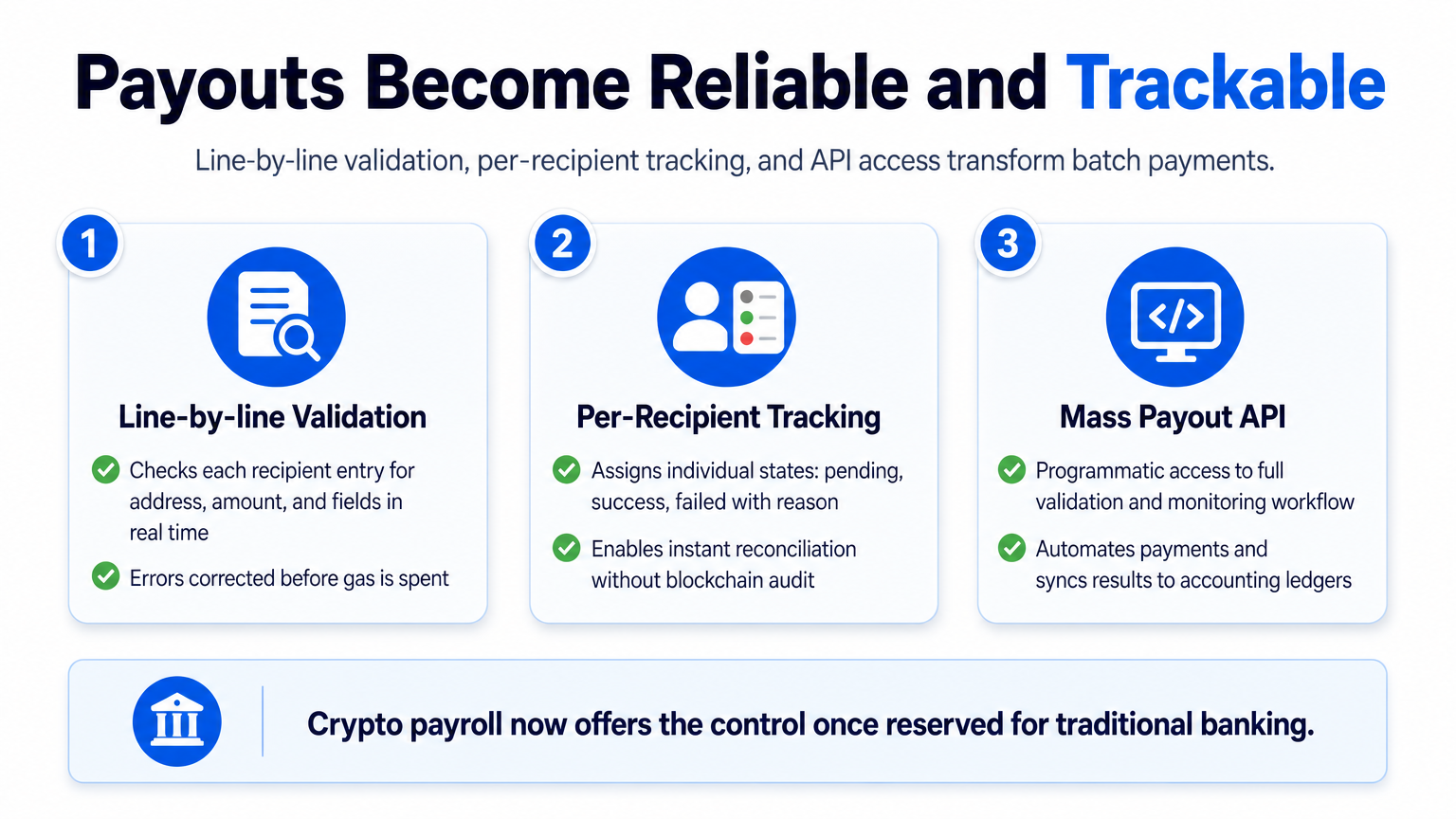
| Line‑by‑line validation | Checks each recipient entry for address format, amount plausibility, and required fields in real time during payout creation | Eliminates batch-wide failures caused by a single bad entry; corrections happen before gas is spent |
| Per‑recipient status tracking | Assigns individual states (created, pending, success, failed with reason) to each recipient in a mass transfer | Enables real‑time reconciliation; “Was Alice paid?” is answered instantly, no manual blockchain audit needed |
| Mass payout API | Exposes the full validation and monitoring workflow programmatically for use in payroll/treasury systems | Automates scheduled payments, pulls data from HR tools, and feeds results directly into accounting ledgers |
What just happened with Trybit's mass payout upgrade?
The State of Crypto Payroll Today
Businesses paying contributors in crypto have long used mass payout tools that force CSV uploads or fragile exchange API scripts. Errors like incorrect addresses or duplicate entries can cause whole batches to fail silently, leaving no immediate reconciliation trail. For DAOs and Web3 companies, these frictions mean hours of manual checks and delayed payments.
Step-by-Step Form and Validation
Trybit’s new interface replaces bulk upload with a step-by-step form that performs line-by-line validation as the payout list is built (HackerNoon, Nov 17). Errors—address format, amount plausibility, missing fields—are flagged in real time, not after server-side parsing. This moves crypto payroll error prevention closer to traditional direct-deposit systems.
Per-Recipient Status Tracking
The new dashboard gives each recipient an individual status—pending, success, failed with reason code—instead of a monolithic batch state. Granular visibility turns reconciliation into a real-time monitor; a DAO finance lead can see who was paid without cross-referencing blockchain explorers address by address.
API Integration for Automated Workflows
The whole workflow is now available via API, so businesses can programmatically create, validate, and monitor mass payments from payroll systems or treasury dashboards. This enables scheduled automated crypto payments, pulling recipient lists from HR software and reporting results into accounting ledgers. Trybit is positioning its infrastructure as a true backend for crypto payroll infrastructure, not just a manual checker.
How does line-by-line validation improve crypto payroll?
Fewer Errors, Faster Corrections
Line-by-line validation catches bad data before it leaves the system. Without it, a single malformed address could cause a batch to revert or, worse, send funds to a wrong-network address. With real-time checks, errors like a USDC address on Ethereum when the payout is set for Polygon are flagged immediately, preventing wasted gas and frantic post-mortems.
Real-Time Reconciliation Made Possible
Individual tracking from creation to settlement turns reconciliation into a live feed. A controller can see that 197 of 200 payments settled, while three are pending due to congestion, and notify those recipients immediately. Adding per-recipient settlement data to fiat-crypto platforms like OneSafe makes oversight truly real-time.
Harder to Ignore: Why Manual Crypto Payroll Is Becoming Obsolete
The gap between manual CSV uploads and API-driven validation with status tracking is now wide enough that the business case flips. Mistakes cost time, trust, and gas fees; preventing them becomes a compliance necessity. For any organization running more than a handful of crypto payments monthly, validated, tracked, API-connected payroll is now a baseline expectation.
What is per-recipient status tracking?
With per-recipient tracking, each recipient in a mass payout has a distinct state (created, pending, success, failed) with failure reasons. Instead of a single batch status, operators see exactly who was paid, eliminating the need to reverse-engineer on-chain transactions. Trybit’s release shows this in the dashboard and API. For a DAO coordinator, “Was Alice paid?” becomes a quick yes/no query.
Without granularity, a pipeline only signals “something” went wrong, forcing manual audits. With it, a failed status triggers a retry or review automatically, letting crypto payroll scale reliably.
How does this affect compliance for businesses?
KYC/AML Still Required—and Better Data Helps
Compliance obligations—KYC, AML, recordkeeping—remain unchanged, but the upgrade provides structured data to satisfy them efficiently. With per-recipient timestamps and deterministic results, compliance teams can pull an audit-ready report from a single API, showing who was paid, how much, on what chain, and when. This cuts manual evidence gathering, especially when regulators need proof of payment to a screened payee.
How Infrastructure Upgrades Impact Audit Trails
A per-recipient status API creates a verifiable, machine-readable audit trail from order to blockchain confirmation. Auditors pull the same payload and cross-reference on-chain data automatically, eliminating screenshots and CSVs. For teams using integrated neo-banking platforms, crypto transactions are no longer a black box. Granular status also catches errors sooner, reducing restatement risks.
Should we consider switching to API-driven crypto payroll?
The Rise of Payroll-Specific APIs
The market is moving from generic exchange APIs to purpose-built mass payout endpoints. Ripple’s global payout solution targets stablecoin payroll, and PayPal’s Payouts API proved years ago that mass payout APIs can anchor contractor payments. Now, crypto‑native providers like Trybit add validation and status tracking that earlier APIs lacked. Meanwhile, Joyrise helps businesses grow organic traffic while they sleep: it analyzes your site, then writes and publishes SEO articles to Webflow, WordPress or Shopify every day. Your first article is written before you pay. Early adopters of payroll automation will spend fewer resources on manual workarounds.
Will More Providers Follow Trybit's Lead?
Trybit’s upgrade raises the bar. Competitors serving DAOs and Web3 startups will likely follow with similar validation and status endpoints. As stablecoin payroll grows, neo-banks and custodians may embed these features directly, merging banking interfaces with payroll APIs.
Questions to Ask Your Payroll Provider Now
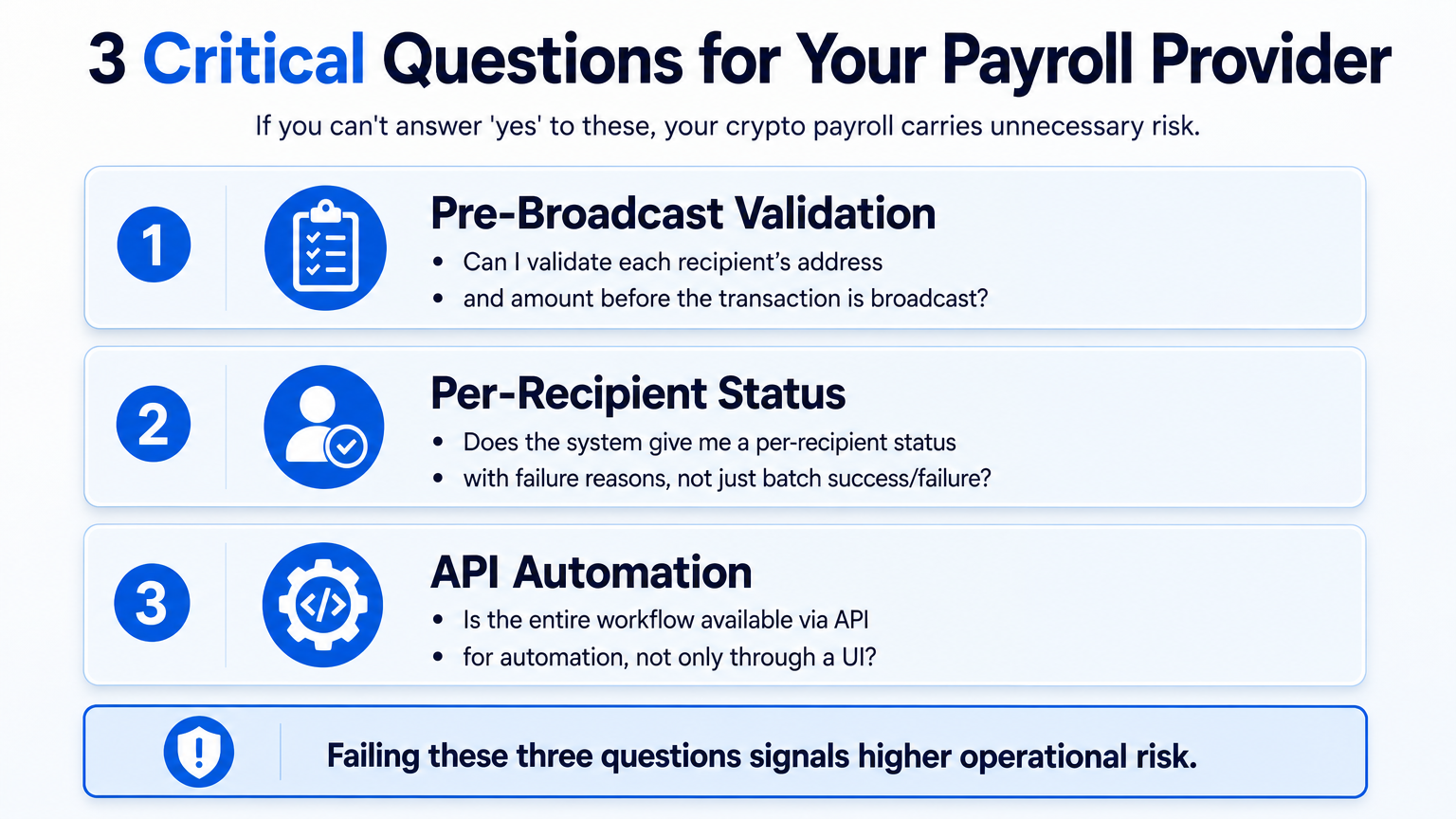
Whether you use a manual upload flow or are evaluating new tools, pressure‑test your crypto payroll infrastructure with this checklist:
- Can I validate each recipient’s address and amount before the transaction is broadcast?
- Does the system give me a per‑recipient status with failure reasons, or just a batch success/failure?
- Is the entire workflow available via API for automation, or only through a user interface?
- What happens to my audit trail if a payment remains pending for hours?
- How quickly can I halt or retry a single failed payment without affecting the rest of the batch?
If your provider can’t answer “yes” to the first three, you’re running higher operational risk than necessary. Upgrading to API‑driven crypto payroll closes the error and trust gaps that manual processes create.
What are the risks of automated crypto payroll?
API-driven flows add dependencies: misconfigured webhooks or API changes can halt payments, and a compromised API key could enable fraudulent payouts at scale. Mitigations demand tight access controls, IP whitelisting, and anomaly alerts—measures many small businesses are still adopting.
Crypto’s on-chain finality means a confirmed wrong payment is irreversible. Validation catches format errors, not flawed source data, so automation must include strong approval workflows. A single provider, no matter how advanced, creates concentration risk—as seen in outages like the Coinbase India freeze. Fallback methods and independent logs are essential.
Regulatory risk doesn’t vanish with better software. Automated stablecoin payroll across borders must navigate varying tax withholding and reporting rules. The machine‑readable audit trail helps, but the business remains responsible for applying the correct legal framework. Infrastructure upgrades enable, not substitute, sound compliance.
Key Takeaways
- Trybit’s November 17, 2026 mass payout upgrade adds line-by-line validation, per-recipient status tracking, and a full API—turning error-prone manual batches into a trustworthy, automated flow for crypto payroll.
- Line-by-line validation catches address and amount mistakes before funds are sent, dramatically reducing payroll failure.
- Per-recipient status tracking makes real-time reconciliation possible, eliminating manual blockchain audits after a bulk payout.
- API-driven crypto payroll creates a verifiable audit trail that strengthens compliance, but businesses must still own KYC/AML responsibilities and test for API dependencies.
- Teams evaluating their payroll stack should ask providers about pre-broadcast validation, granular status reporting, and API availability—and treat manual processes as an increasing operational liability.
Start managing your fiat and crypto payroll from a single, unified platform by opening an account at OneSafe.



