
Table of Contents
- What Just Happened: MVB and Velocity Launch Visa Direct Stablecoin Pilot
- Why This Matters for Global Business Payments Now
- Concrete Implications for Your Business: From Acceptance to Settlement
- Recommended Actions for Finance and Operations Leaders
- Open Questions and What to Watch Next
- Key Takeaways
- Sources
What Just Happened: MVB and Velocity Launch Visa Direct Stablecoin Pilot

The pilot explained: stablecoin funding for push-to-card payouts
On September 9, 2026, MVB Financial and Velocity announced a partnership that places stablecoin settlement directly inside the Visa Direct network. Velocity, which operates a stablecoin-powered enterprise payments and treasury platform, will supply the infrastructure. MVB—a bank that serves fintechs and innovation-driven companies—will use stablecoin payments to fund and settle its Visa Direct push-to-card payouts.
A push-to-card payout lets a business send funds directly to a recipient's debit card, typically settling within minutes. In this pilot, the funding leg that feeds those payouts moves on stablecoin rails. That means MVB can pre-position liquidity, settle obligations, and deploy capital using USDC or other approved stablecoins, rather than relying solely on Fedwire, ACH, or correspondent banking sweeps. The pilot keeps existing Visa Direct endpoints intact—cardholders see a normal deposit—while the back-end plumbing shifts to a faster, programmable settlement layer.
Why MVB, Velocity, and Visa are betting on stablecoin settlement now
Three forces converged in 2026 to make this pilot inevitable. First, the regulatory picture has sharpened: the GENIUS Act, passed in 2025, established federal guardrails for payment stablecoin issuers, giving banks like MVB a compliance framework they can operate within. Second, enterprise demand for crypto payments for business has moved beyond crypto-native companies. Traditional importers, payroll providers, and marketplace platforms now hold stablecoin liquidity and want to deploy it without converting to fiat through multiple intermediaries. Third, Visa has steadily expanded its crypto settlement capabilities—this pilot is the company's latest move to make stablecoin rails interoperable with the card network that already touches millions of endpoints.
Why This Matters for Global Business Payments Now
Faster settlement cycles and reduced costs vs. traditional FX and wires
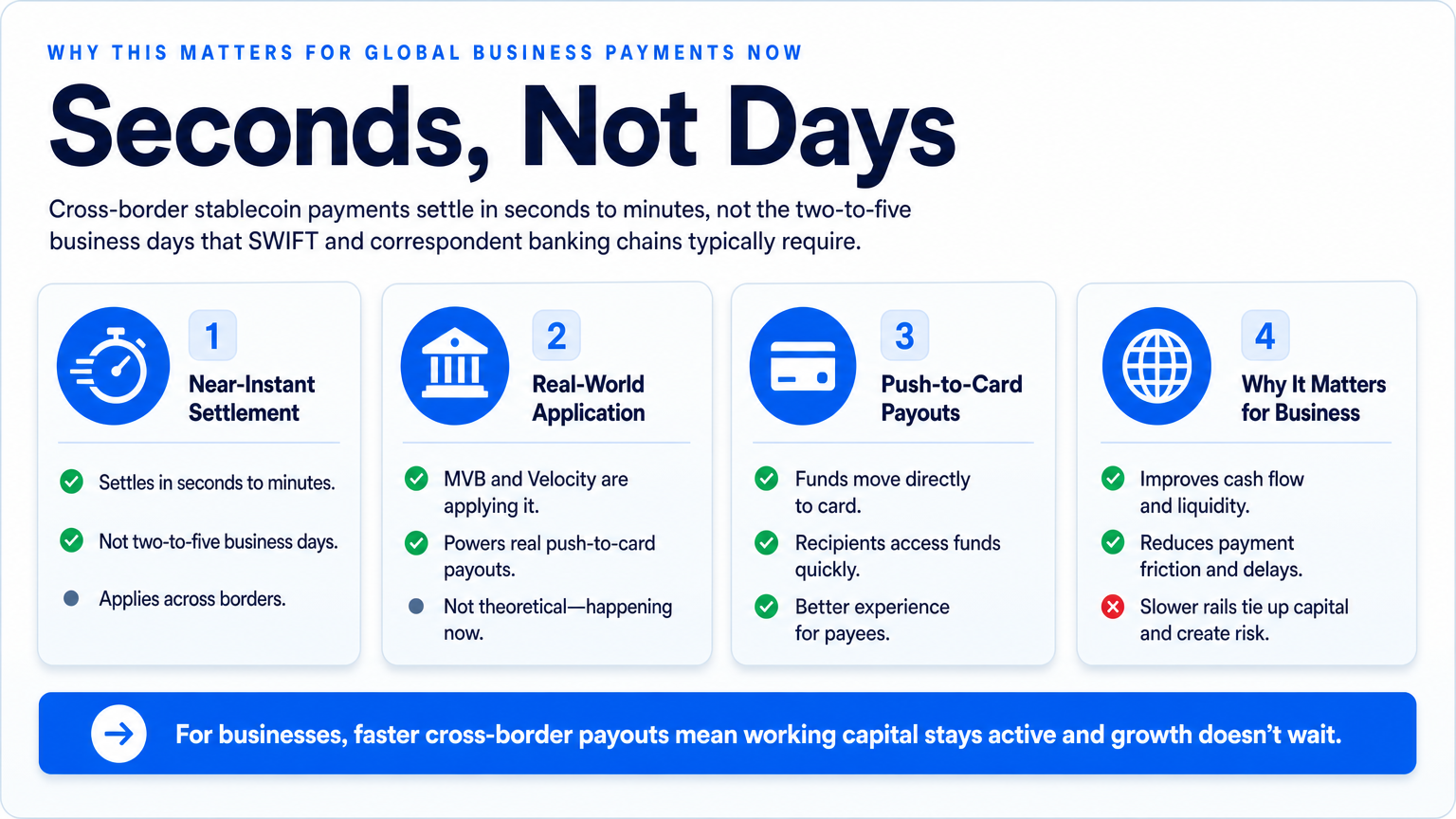
Cross-border stablecoin payments settle in seconds to minutes, not the two-to-five business days that SWIFT and correspondent banking chains typically require. That speed isn't theoretical here—MVB and Velocity are applying it to real push-to-card payouts. For a business paying freelancers in Latin America or settling supplier invoices in Southeast Asia, eliminating the float time on working capital can materially change treasury planning.
Cost is the second lever. Traditional cross-border wires incur correspondent bank fees, FX markups, and intermediary charges that often total 3–5% of the transaction value. A stablecoin payment processing stack that uses Visa Direct as the last mile can compress those costs significantly: stablecoin network fees are often fractions of a cent, and Visa Direct's existing fee structure is transparent and predictable.
Bridging the gap between crypto-native liquidity and the existing Visa network
One underappreciated friction is the air gap between on-chain liquidity and traditional payment endpoints. A DAO treasury might hold millions in USDC but struggle to disburse fiat wages, because each payout requires a manual off-ramp through an exchange, then a wire, then reconciliation across two separate ledgers. The Visa Direct stablecoin pilot collapses that chain: stablecoin held in a Velocity account can fund a push-to-card stablecoin payout that arrives in the recipient's local currency, all without the sender touching multiple banking interfaces.
Concrete Implications for Your Business: From Acceptance to Settlement
What the Visa Direct pilot changes for treasury operations and liquidity planning
Treasury teams that currently manage multi-currency cash pools across correspondent banks can now ask a new question: can a single stablecoin position fund outbound payments to any Visa debit card globally? The MVB-Velocity pilot suggests the answer is yes, provided the banking partner supports the flow. A company can hold a USDC balance with a partner bank, draw on that balance to settle push-to-card payouts, and avoid the pre-funding and currency conversion steps that fragment liquidity across accounts in different jurisdictions. This shifts the FX decision to the moment of settlement, and the speed of settlement reduces the amount of working capital that must be in flight at any moment.
Reconciling stablecoin transactions: a new accounting challenge for finance teams
USDC payments settlement introduces a reconciliation headache. An on-chain stablecoin transfer creates a transaction hash on a public ledger. A Visa Direct payout generates a settlement report in a traditional banking format. Finance teams need to map on-chain transaction IDs to internal payment references, track the FX rate applied at the moment of conversion, and ensure that the stablecoin's cost basis is accurately recorded for tax purposes.
For US businesses, the IRS treats stablecoins as property. Every disposition—whether converting USDC to fiat for a push-to-card payout or sending it directly to a counterparty—can trigger a taxable event. Reconciliation workflows must capture the fair market value of the stablecoin at the time of the transfer, the fiat amount delivered to the recipient, and any gain or loss realized.
| Step | Transaction | Record Required | Tax Implication |
|---|---|---|---|
| 1 | Company purchases 100,000 USDC at $1.00 | Cost basis = $100,000 | None at acquisition |
| 2 | Company sends 10,000 USDC to Velocity/MVB to fund payouts | Transfer to settlement account; no sale yet if retained in company structure | None, if still owned |
| 3 | MVB converts 10,000 USDC to pesos at $1.0001/USDC and pushes to 100 recipient cards | FMV at conversion = $10,001; cost basis = $10,000 | $1 taxable gain |
| 4 | Month-end reconciliation | Match on-chain txn hash → Visa Direct settlement batch → FX rate at conversion timestamp | Report gain on Form 8949 |
For a business moving millions in stablecoin payments monthly, the aggregate gain or loss from peg fluctuations and FX movements becomes a meaningful tax line item—one that traditional ERP systems are not natively built to handle.
How neobanks like OneSafe streamline stablecoin payments, settlements, and on/off-ramping
The MVB-Velocity pilot operates at the infrastructure layer. Most businesses won't connect to it directly. They'll access stablecoin settlement through a platform that abstracts the complexity—and this is where neobanks designed for fiat-plus-crypto operations enter the picture.
A platform like OneSafe natively supports both fiat and cryptocurrency transactions, offering instant crypto-to-fiat conversions, multi-currency accounts, and automated payment workflows. For a Web3 startup or DAO that holds treasury in USDC, that means the ability to convert stablecoins to fiat within the same interface used to pay vendors, issue corporate cards, or run payroll—without managing separate relationships at an exchange, a commercial bank, and a card issuer.
Recommended Actions for Finance and Operations Leaders
Audit your current payment stack for stablecoin compatibility and settlement gaps
Start with a ledger-level audit. Map every payment corridor your business uses today—outbound payroll, supplier invoices, marketplace payouts, tax payments—and ask two questions for each:
Where does the funding sit before a payment is initiated? If the answer is a nostro account at a correspondent bank earning no yield and waiting days to clear, you have a settlement gap that stablecoin funding could close.
Can your current banking platform accept, hold, and convert stablecoins? If the answer is no, you are either locked out of using stablecoin liquidity, or you are running a parallel, manual process that introduces reconciliation risk.
Evaluate multi-currency neobanking platforms that natively support fiat and crypto
Once the gap analysis is complete, the next step is platform evaluation. The criteria should include:
- Native USDC on/off-ramp: Can the platform receive USDC from an external wallet and convert it to fiat without requiring an intermediate exchange?
- Push-to-card stablecoin capability: Does the platform support card-based payouts, either natively or through a network like Visa Direct?
- Multi-currency accounts: Can you hold USD, EUR, CAD, and other currencies alongside crypto in the same interface?
- Reconciliation tooling: Does the platform provide transaction-level records that map stablecoin movements to fiat payouts with timestamps and FX rates?
- Compliance and custody: Is digital asset custody handled by an institutional-grade provider? What KYB requirements apply?
Open Questions and What to Watch Next
Will other card networks follow Visa's lead on stablecoin settlement?
Mastercard expanded its settlement capabilities to include stablecoins in June 2026, but its approach has focused on enabling issuers to settle in stablecoins for card transactions. The Visa Direct pilot differs in that it targets the push payment use case—outbound disbursements rather than consumer card purchases. The question is whether Mastercard Move, its own push-payment rail, integrates stablecoin funding in a similar way. If both networks offer stablecoin settlement for push-to-card within 18 months, the default assumption for global B2B payouts shifts from correspondent banking to stablecoin rails virtually overnight.
What is the MVB-Velocity Visa Direct stablecoin payment pilot?
The MVB-Velocity pilot is a partnership, announced on September 9, 2026, in which MVB Financial—a regulated US bank—uses Velocity's stablecoin treasury platform to fund and settle Visa Direct push-to-card payouts using stablecoins. It is a live test of stablecoin settlement operating inside existing banking and card network infrastructure.
How do stablecoin payments work for businesses?
A business holds stablecoins like USDC in a treasury wallet or on a banking platform that supports crypto. To make a payment, it initiates a transfer—either peer-to-peer on-chain or through an integrated platform that converts the stablecoin to fiat at the moment of settlement. The payment can be delivered to a recipient's bank account, debit card (via Visa Direct or Mastercard Move), or crypto wallet. The key distinction from traditional payments is that the funding leg moves on blockchain rails, which settle in seconds and eliminate the chain of correspondent banks that slow down and add cost to cross-border wires.
What are the benefits of using stablecoins for cross-border payments?
Cross-border stablecoin payments offer three structural advantages over traditional correspondent banking: speed (near-instant settlement versus multi-day waits), cost (stablecoin network fees measured in cents, not percentage-based intermediary charges), and liquidity efficiency (no requirement to pre-fund nostro accounts in foreign currencies). When connected to a push-to-card rail like Visa Direct, they also extend that efficiency to the last mile—the recipient doesn't need a crypto wallet; they just need a debit card.
How does the Visa Direct pilot change stablecoin settlement and card payouts?
The pilot proves that a regulated US bank can use stablecoin settlement as the funding leg for push-to-card payouts that travel over the Visa Direct network. Previously, stablecoin payments and card network payouts operated in separate ecosystems—a business might hold USDC and use a card network, but the connection between them required manual off-ramping. The MVB-Velocity pilot creates a direct, programmatic link: stablecoin in, card payout out, all under the existing Visa Direct framework and banking compliance umbrella.
What are the regulatory considerations for stablecoin payments in 2026?
The US GENIUS Act provides the federal framework for payment stablecoins, establishing issuer requirements around reserves, redemptions, and oversight. Banks participating in stablecoin settlement must ensure their stablecoin partners comply with these standards. Internationally, the regulatory patchwork is tightening: Korea and Europe are coordinating on stablecoin rules, Africa has enacted dedicated stablecoin payment regulations, and the UK has shifted its stance toward an innovation mandate for stablecoins. For a business, the takeaway is that compliant stablecoin rails now exist—the question is whether your banking platform and stablecoin provider operate within them.
How can a business start using stablecoin payments today without overhauling its entire banking stack?
The path of least resistance runs through a multi-currency neobanking platform that natively supports both fiat and crypto. A business opens an account, completes KYB verification, and gains the ability to hold USDC, convert to fiat, and send payments via ACH, wire, or push-to-card—all from the same interface. The existing corporate bank account doesn't disappear; it becomes the fiat leg that the neobank platform connects to the stablecoin rails.
Key Takeaways
- The MVB-Velocity pilot proves that a regulated US bank can use stablecoin rails to fund Visa Direct push-to-card payouts, collapsing the gap between on-chain liquidity and card network endpoints.
- Stablecoin settlement compresses cross-border payment costs and timelines, replacing multi-day correspondent banking chains with near-instant blockchain finality and transparent network fees.
- Reconciling stablecoin transactions with fiat accounting requires new workflows to capture on-chain transaction IDs, FX rates at the moment of conversion, and taxable gain or loss on each disposition.
- Audit your payment corridors for settlement gaps and evaluate multi-currency neobanking platforms that natively support USDC custody, fiat conversion, and push-to-card payouts under one roof.
- Regulatory clarity from the GENIUS Act and parallel frameworks in Korea, Europe, and Africa means compliant stablecoin payment rails are operational now, not years away.
Ready to move your business treasury onto rails that handle both fiat and stablecoin payments natively? Open a OneSafe account today and connect your on-chain liquidity to real-world payouts.
Sources