On November 12, 2026, Visa and Anchorage Digital announced a partnership that will allow eligible Visa partners to settle obligations using USDPT, a dollar-backed stablecoin issued by Anchorage Digital Bank. This stablecoin payments milestone turns a pilot concept into an operational settlement rail for a global card network, signaling far-reaching implications for businesses. While the headlines focus on Visa, the real story is how this move accelerates broader stablecoin adoption and the platforms bridging traditional banking with crypto-native operations.
Table of Contents
- What Just Happened: Visa Taps Anchorage for USDPT Settlement
- Why It Matters for the Stablecoin Payments Landscape
- Stablecoin Payments: The Basics for Business Leaders
- What This Means for Your Cross-Border Payment Strategy
- What to Watch: The Unfolding Future
- Key Takeaways
- Further reading
What Just Happened: Visa Taps Anchorage for USDPT Settlement
What is the Visa-Anchorage deal and how does it affect stablecoin payments?
On November 12, 2026, Visa announced a partnership with Anchorage Digital to let eligible Visa partners settle obligations using USDPT, a dollar-backed stablecoin issued by Anchorage Digital Bank—a federally chartered digital asset bank. Dan Roesbery, Visa’s vice president of global crypto partnerships, said: “As stablecoin payments grow, we’re focused on providing more choice for our partners in how they settle with Visa.” Nathan McCauley, CEO of Anchorage Digital, added: “Stablecoins have made money move faster, but speed alone won’t bring institutions onchain. They need a regulated institution behind the money.”
This Visa stablecoin settlement move means a major payment network now treats a regulated stablecoin as a legitimate settlement asset alongside fiat. It signals that stablecoin rails can move from side channels into core infrastructure, with immediate implications for cross-border stablecoin payments and corporate treasury.
USDPT: A regulated stablecoin enters the Visa network
USDPT is issued by Anchorage Digital Bank under a federal banking charter, a rarity among stablecoins. Fully reserved and operating on Solana, it blends public blockchain programmability with traditional oversight. For businesses evaluating stablecoin rails, this addresses a central concern: the counterparty risk of unregulated or offshore issuers.
Why It Matters for the Stablecoin Payments Landscape
Why are stablecoins becoming a mainstream payment method?
Stablecoins offer 24/7 settlement, near-instant finality, and significantly lower fees than correspondent banking. Business adoption has been held back by regulatory uncertainty and the lack of a direct settlement path within major networks. The Visa-Anchorage deal dissolves much of that uncertainty: USDPT is issued by a federally chartered bank, giving institutional players a sanctioned on/off-ramp. Regulatory tailwinds like the GENIUS Act and bank-led pilots are reinforcing this shift, as explored in our analysis of the stablecoin payments orchestration shift.
From experimentation to operational reality
Visa’s open invitation to its network transforms stablecoin settlement from sandbox pilots into live infrastructure. For treasury teams, the conversation moves from “if” to “when.”
How this accelerates adoption for businesses
When a global card network integrates stablecoin rails, the downstream effect hits merchants, B2B payers, and payroll providers. Settlement cycles compress, and the dollar peg eliminates volatility concerns. This acceleration mirrors broader banking momentum—PNC’s USDC pilot, for instance, signaled a new era for business crypto banking. Visa provides the demand-side counterpart: a distribution channel that moves money.
Stablecoin Payments: The Basics for Business Leaders
What are stablecoins and why the traction?
Stablecoins are digital tokens pegged 1:1 to fiat, typically the U.S. dollar. Leading examples include USDC and USDPT. They gain traction from three practical advantages over legacy rails: near-instant settlement, lower transaction costs, and programmability. For cross-border stablecoin payments, these savings are especially pronounced.
The current state of rails and regulation
Regulatory frameworks and state trust charters are creating compliance pathways for banks and fintechs. Payment gateways have simplified integration, and card networks are actively building stablecoin settlement options. The missing piece for many businesses is a simple on/off-ramp that doesn’t require juggling multiple bank accounts and exchanges.
What This Means for Your Cross-Border Payment Strategy
Benefits and risks of stablecoin settlements
Consider a $50,000 payment to an overseas vendor. A SWIFT transfer might cost $225 and take days, while the same payment via stablecoin could cost under $30 and settle in minutes.
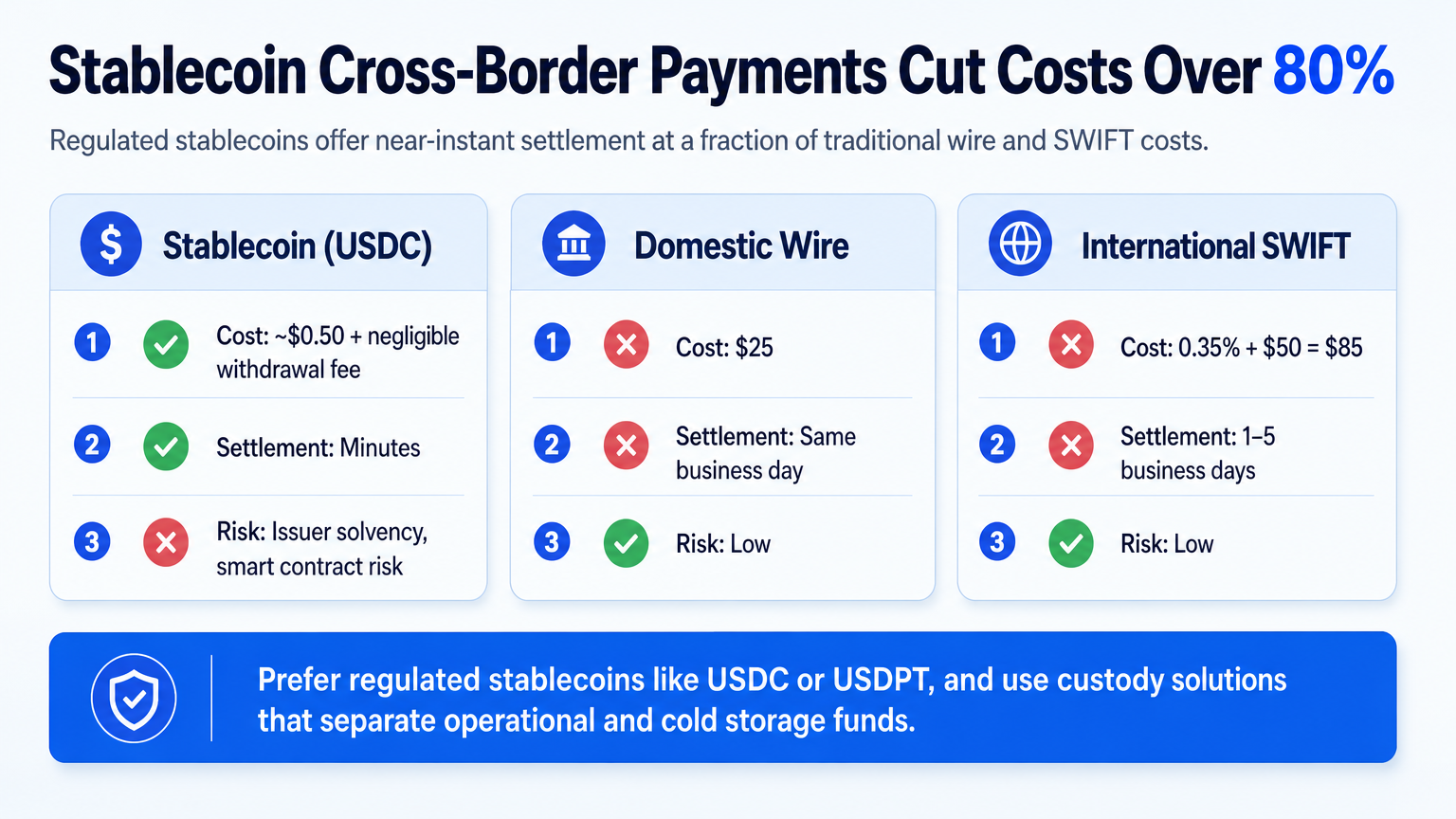
| Payment Method | Cost on a $10,000 Transfer (illustrative) | Settlement Time | Key Risk Factor |
|---|---|---|---|
| Stablecoin (USDC) | ~$0.50 gas + negligible withdrawal fee | Minutes | Issuer solvency, smart contract risk |
| Domestic Wire | $25 | Same business day | Low |
| International SWIFT | 0.35% + $50 = $85 | 1–5 business days | Low |
Note: Stablecoin costs assume a platform with free USDC withdrawals. SWIFT and wire fees are typical published prices as of November 2026.
However, stablecoin settlements carry risks that wires don’t. The issuer’s reserve backing and regulatory status matter. Prefer regulated stablecoins like USDPT or USDC, and use custody solutions that separate operational and cold storage funds.
Evaluating stablecoins vs. wire and SWIFT
Base the decision on counterparty acceptance, total cost including fiat to stablecoin conversion fees, and settlement speed. For many B2B crypto business payments, savings can exceed 80%. When the vendor demands fiat, a platform that handles conversion seamlessly is critical.
How to start using stablecoin payments today
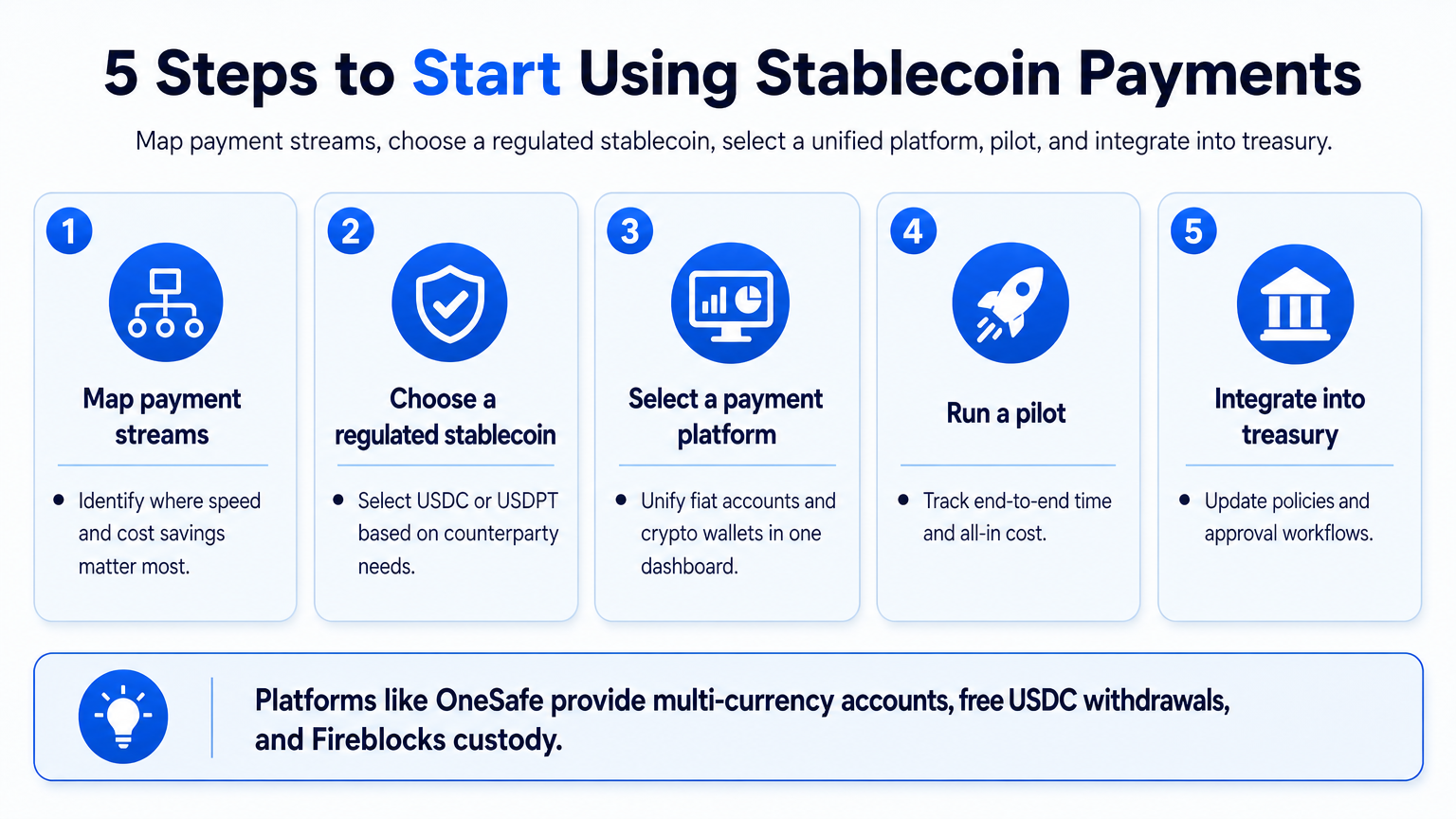
- Map payment streams where speed and cost savings matter most.
- Choose a regulated stablecoin (USDC, USDPT) based on counterparty needs.
- Select a stablecoin payment platform that unifies fiat accounts and crypto wallets.
- Run a pilot to track end-to-end time and all-in cost.
- Integrate into treasury with updated policies and approval workflows.
How platforms like OneSafe bridge fiat and stablecoin payments
OneSafe provides multi-currency accounts, corporate cards, and crypto on/off-ramp capabilities from a single dashboard. A business receiving USD but paying a contractor in USDC can execute the conversion and transfer without a separate exchange. Crypto deposits and USDC withdrawals are free, while domestic wires cost $25 and SWIFT transactions run 0.35% + $50. The platform’s support for segregated accounts, Fireblocks custody, and customizable permissions makes it practical for Web3 startups and global businesses driving stablecoin adoption.
What to Watch: The Unfolding Future
Impact on cross-border payments
Visa’s USDPT settlement demonstrates that a regulated stablecoin can sit at the core of a major card network. Over time, this could enable merchant settlement in stablecoins, reducing float costs and FX exposure. It may push other networks and B2B platforms to accelerate their own programs, creating a multi-rail ecosystem where cost and speed dictate the rail.
Interoperability and open questions
Will USDPT gain enough liquidity for high-volume flows? How will it interoperate with USDC without forcing businesses to hold multiple token balances? The industry must also reconcile ISO 20022 messaging with blockchain-native identifiers—coordination challenges that will take time.
Regulatory tailwinds and milestones
The GENIUS Act provides a federal framework, and state trust charters offer clarity for crypto-native custody. Watch for further bank-issued stablecoin pilots, Federal Reserve guidance, and Treasury’s stance on basis reporting, which could affect crypto payroll—a topic Senator Lummis has tied to settlement speed.
How to plan for a multi-stablecoin world
Prepare by choosing platforms that support multiple stablecoins, building policies around issuer risk, and monitoring regulatory shifts. As the landscape evolves, keeping your own content fresh helps maintain credibility with partners. Joyrise analyzes your site, writes and publishes SEO articles to Webflow, WordPress, or Shopify every day—your first article is written before you pay.
Key Takeaways
- Visa’s partnership with Anchorage Digital marks the first time a major card network accepts settlement in a regulated, bank-issued stablecoin (USDPT), accelerating stablecoin payments from pilots to reality.
- Cross-border stablecoin payments can slash costs by over 80% compared to SWIFT, with near-instant settlement, when businesses use regulated tokens and unified platforms.
- Adopt stablecoin payments today by selecting a regulated token, using a platform that simplifies fiat to stablecoin conversion and crypto business payments, and running a pilot before treasury integration.
- The move signals a multi-rail future where stablecoin settlement and wires coexist, demanding interoperability planning now.
Ready to bring stablecoin and fiat transactions under one roof? Open a OneSafe account and start settling cross-border payments in minutes.
Further reading