A finance lead at a distributed company can start the week with revenue arriving in USD, contractor invoices due in EUR, suppliers requesting local transfers, and a treasury balance partly held in USDC. None of those transactions is unusual on its own. The difficulty comes from coordinating them across currencies, countries, payment rails, approval rules, reporting systems, and settlement times.
That coordination problem is the practical starting point for understanding what is global transaction banking. GTB isn't a bank account or a menu of international transfers. It's the operating system that helps businesses collect money, pay obligations, manage liquidity, finance trade, convert currencies, and understand their cash position.
Table of Contents
- Introduction to Global Transaction Banking in Action
- What Global Transaction Banking Really Means
- Cash management and liquidity
- Payments and collections
- Trade finance
- FX and treasury services
Introduction to Global Transaction Banking in Action
Consider a software company with employees and vendors spread across several countries. Its customers pay in USD, a European contractor sends an invoice in EUR, a manufacturing partner wants a bank transfer, and the company keeps part of its digital-asset treasury in USDC. The finance team has to answer several questions at once: Which account should receive each payment? When should funds be converted? Which payment method will reach the vendor reliably? Who can approve a transfer? How will every movement appear in the ledger?
A basic bank account handles only part of that workflow. Global transaction banking connects the moving pieces, including accounts, collections, payments, liquidity, foreign exchange, trade-related financing, and reporting. The purpose isn't merely to move money from one place to another. It's to make business money visible, usable, controlled, and traceable while it moves through different financial systems.

This guide is for founders, CFOs, treasurers, operations teams, international SMEs, technology companies, and web3 finance teams. You'll learn how to recognize the full scope of GTB, identify its main services, compare bank-led and fintech-enabled delivery, and connect each capability to a real operating problem.
The learning path moves from the simple idea to practical application:
- Start with the infrastructure: Understand why GTB resembles an operating system for corporate money.
- Map the services: Separate cash management, payments, trade finance, and treasury functions.
- Compare providers: See what global banks, correspondent networks, and fintech platforms each contribute.
- Apply the model: Match GTB capabilities to international business and web3 workflows.
- Evaluate the setup: Use controls, coverage, pricing, security, and operational fit as decision criteria.
OneSafe appears later as an example of a platform that connects fiat payment functions with crypto workflows. The point isn't to treat one provider as suitable for every company. The point is to leave with a working mental model you can use when reviewing any global banking setup.
What Global Transaction Banking Really Means
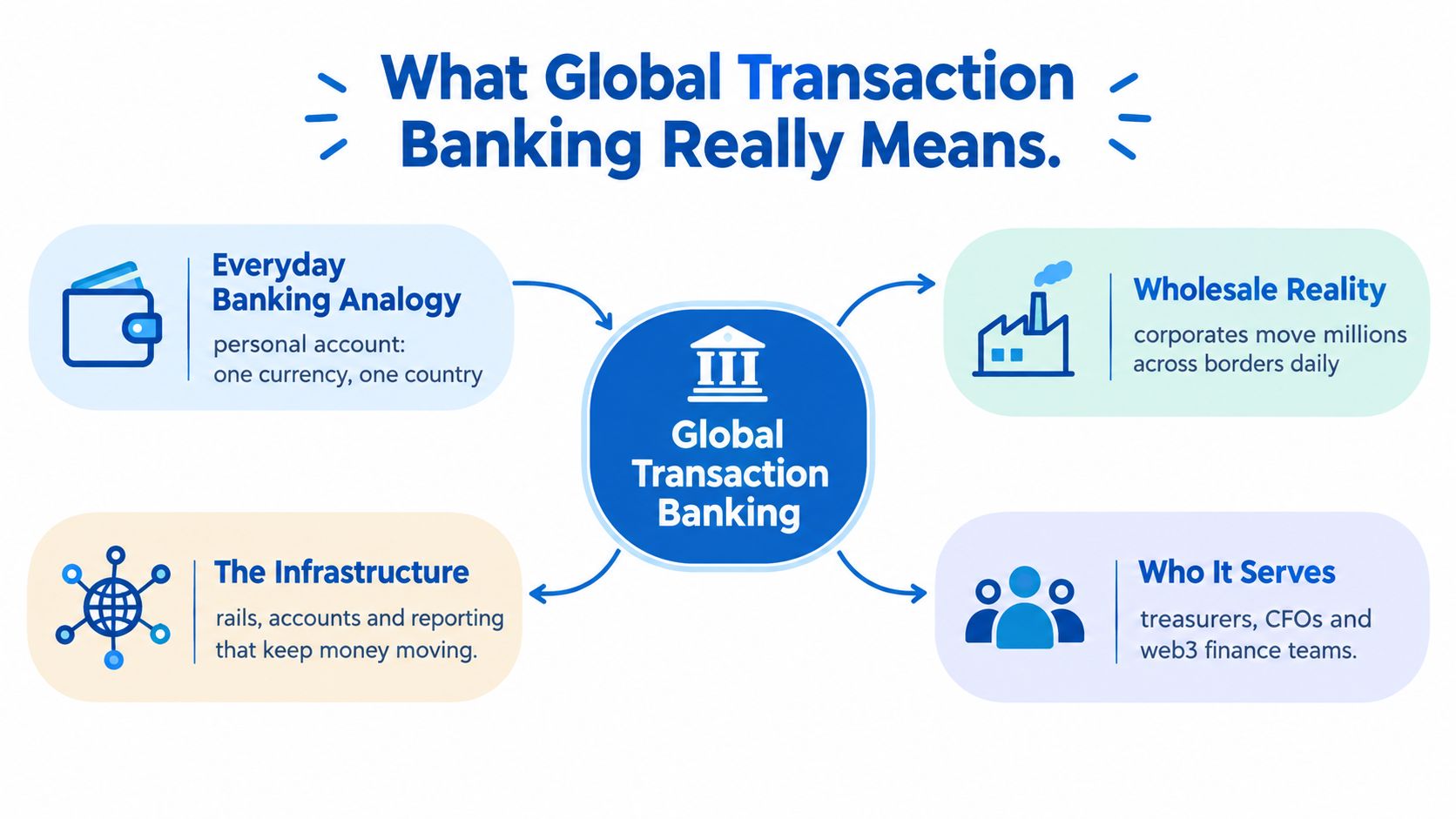
A useful everyday analogy is a household banking app. You might use it to receive income, pay bills, transfer money, exchange currencies, and check your balance. A business with international operations needs the same basic functions, but across more entities, currencies, counterparties, approval layers, payment systems, and reporting requirements.
Global transaction banking is the wholesale-banking infrastructure that supports recurring business money movement. McKinsey defines GTB around trade finance, wholesale banking payments, and liquidity products such as deposits and overdrafts. It estimates that GTB generates almost $1.3 trillion in annual revenue worldwide, while core products including cross-border payments, domestic payments, and trade finance account for $761 billion, or 28% of total wholesale banking revenues. Those figures are from McKinsey's analysis of transaction banking value.
The phrase becomes clearer when you separate the work into layers:
- Money enters the business: Customers pay invoices, marketplaces remit funds, and counterparties send transfers.
- Money moves inside the business: Treasury teams shift balances between entities, accounts, currencies, and operating locations.
- Money leaves the business: The company pays employees, contractors, suppliers, tax authorities, lenders, and partners.
- The business stays informed: Finance teams reconcile transactions, forecast cash, monitor liquidity, and prove who approved each payment.
Core concept: GTB is the operating system for business money movement. The bank account is one component, while the broader system includes rails, liquidity, controls, financing, and information.
GTB differs from retail banking because retail services are designed mainly for individuals and households. It differs from investment banking because investment banking focuses on activities such as capital raising, mergers, acquisitions, and market transactions. Transaction banking supports the daily financial operations that keep a company functioning.
The users are also different. Corporate treasurers manage liquidity and financial risk. CFOs oversee funding, controls, and reporting. Operations teams handle supplier and payroll payments. Web3 finance teams may need to coordinate fiat accounts, digital assets, wallets, and governance approvals.
GTB is considered core financial infrastructure because it sits underneath ordinary commercial activity. A company can have strong sales and healthy margins, yet still struggle if it can't collect revenue, access usable liquidity, settle invoices, or explain its cash position.
Core Services That Power Global Transaction Banking
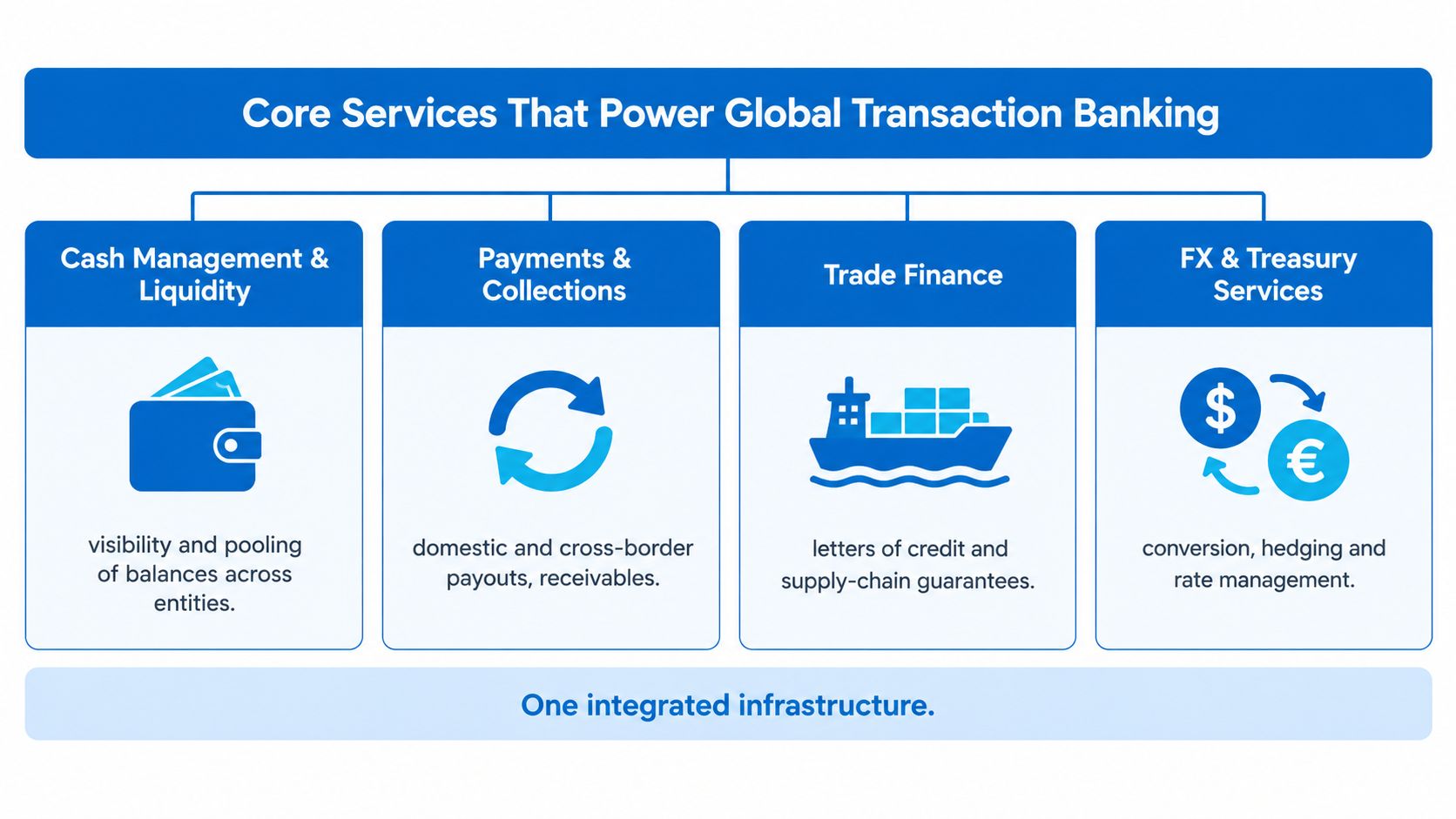
Most GTB offerings can be understood through four connected service pillars. They overlap in practice, but each answers a different treasury question: Where is our money? How do we move it? How do we support trade? How do we manage currencies and financial exposure?
Cash management and liquidity
Cash management gives finance teams visibility into balances and expected movements. A group with several entities may have cash spread across operating accounts, collection accounts, reserve accounts, and accounts held in different countries. Treasury tools can support balance reporting, account structures, liquidity concentration, deposits, overdrafts, and internal funding.
The operational outcome is usable liquidity. A company doesn't just know that it has money somewhere. It can identify which entity holds it, which currency it is in, when it will become available, and whether another entity needs funding.
Payments and collections
Payments and collections cover the inbound and outbound flow of money. Depending on the country and counterparty, a business may use domestic transfers, ACH, wires, or SWIFT. Collection tools can support virtual account structures, receivables matching, payment references, and automated reconciliation.
The job is to reduce uncertainty around both sides of the transaction:
- Receivables: Identify who paid, what invoice the payment relates to, and whether the full amount arrived.
- Payables: Send the correct amount through an appropriate rail, with approvals and payment status visible to the team.
- Exceptions: Investigate returned payments, missing references, fees, or beneficiary details without searching across disconnected systems.
Teams researching the wider payments ecosystem can also review top mobile payments investors UK for context on companies and capital activity around payment technology.
Trade finance
Trade finance supports transactions where goods, services, documents, and payment obligations need additional structure. Instruments may include letters of credit, guarantees, documentary collections, and supply-chain finance arrangements.
The underlying problem is trust and timing. A seller may want assurance that it will be paid, while a buyer may want payment to occur only after agreed conditions are met. A bank can provide financing or a conditional payment structure that helps both sides complete the transaction.
FX and treasury services
Foreign exchange services help a company convert one currency into another for payments, collections, or balance management. Treasury services can also support rate management, hedging, exposure analysis, and settlement planning.
A finance team should ask whether the provider clearly explains the rate, spread, fees, settlement timing, and supported currencies. A low headline fee doesn't necessarily mean a low total cost if the conversion rate or intermediary charges remain unclear.
Modern messaging connects these pillars. ISO 20022 is an open global financial messaging standard that replaces legacy MT messages with structured data models across payments, cash management, securities settlement, and reference data. SWIFT says structured data can improve end-to-end data integrity, reconciliation, payment tracking, cash-flow forecasting, and working-capital management. Cross-border payments moved to ISO 20022, with coexistence ending on 22 November 2025, as described in SWIFT's financial-institutions guidance.
For a practical view of how these services can be combined in a platform, see international business payments. The right question isn't whether a provider offers a long product list. It's whether the services work together around your actual cash cycle.
Who Provides Global Transaction Banking and How It Is Delivered
Traditional GTB is commonly delivered by large banks. These institutions connect corporate accounts to domestic payment systems, international wires, SWIFT messaging, correspondent banks, liquidity products, trade-finance desks, and treasury portals. Their advantage is breadth, balance-sheet capacity, regulatory infrastructure, and established relationships across markets.
Correspondent banking explains much of the international model. When a bank doesn't maintain a direct account relationship in a destination market, another bank may help route and settle the payment. SWIFT provides messaging between financial institutions, while the banks and payment systems handle the underlying accounts and settlement.
The scale of the underlying network is substantial. In its July 31, 2025 release, the Bank for International Settlements reported that global cross-border bank credit expanded by $1.5 trillion in the first quarter of 2025, reaching a record $34.7 trillion. The BIS also states that its Triennial Central Bank Survey was conducted for April 2025, with the next survey scheduled for April 2028. This context matters because transaction banking operates through the same broad cross-border banking and liquidity environment.
Fintech platforms typically take a different role. Rather than replacing every bank rail, they can combine partner-bank services, payment connectivity, account interfaces, compliance processes, dashboards, and workflow controls in one user experience. That can make the operating layer easier to use, especially for smaller companies or teams that don't have a large treasury department.
Comparing delivery models
| Delivery Model | Coverage and Rails | Controls and Experience |
|---|---|---|
| Global bank GTB | Broad account, payment, liquidity, FX, and trade-finance coverage, often supported by correspondent relationships | Deep institutional controls and treasury tools, but onboarding and integration can require substantial internal work |
| Regional or specialist bank | Stronger coverage in selected markets or currencies, with focused relationship support | Useful local expertise, though companies may need several providers for global reach |
| Fintech platform with partner institutions | Unified interface across selected fiat rails and, where supported, crypto workflows | Faster digital workflows, configurable approvals, and clearer user experience, with availability and features depending on jurisdictions and partners |
| Multi-provider treasury stack | Several banks, payment providers, exchanges, and custody systems connected through internal processes | Greater diversification, but more reconciliation, data, permissions, and operational coordination |
A platform's brand doesn't automatically determine where regulated banking services come from. Companies should check the relevant partner institutions, supported jurisdictions, safeguarding or custody arrangements, payment limits, compliance responsibilities, and service availability.
People exploring the wider payments industry can also use Payoneer jobs on LatoJobs to understand the kinds of roles and operating capabilities that support cross-border payment businesses.
Real World Use Cases for Global Businesses and Web3 Teams
GTB becomes easier to understand when you follow the money through a real workflow. An international SME might sell software in USD, collect customer payments into a supported account, convert part of the balance into EUR, and pay suppliers through domestic or international rails. The treasury objective is simple: keep revenue accessible, make obligations predictable, and avoid unnecessary manual reconciliation.
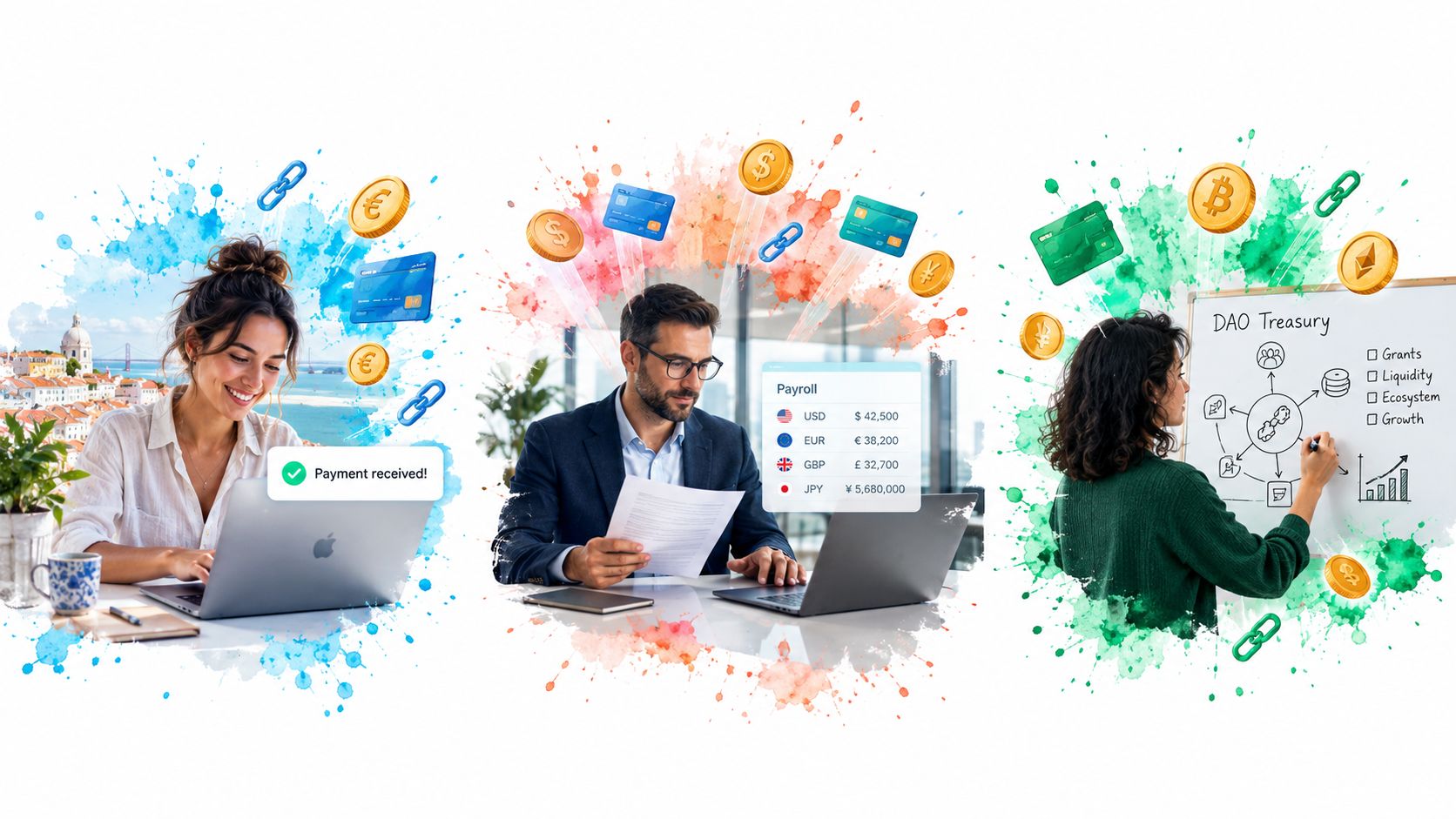
A technology company paying contractors across countries faces a related challenge. Its team may need to choose between ACH, domestic transfers, wires, or SWIFT based on the worker's location, currency, urgency, and payment instructions. A central workflow can attach approvals, assign payment roles, and preserve transaction details for reconciliation.
This setup is most valuable when the company has recurring international payables and wants to reduce dependence on spreadsheets, inbox approvals, and separate banking portals.
Web3 companies add another layer. A protocol team may receive customer or contributor payments in fiat and digital assets, convert USDC to fiat for operating expenses, and keep a portion of treasury funds in digital assets. The finance team has to manage not just currency conversion, but also wallet security, transaction authorization, accounting records, and governance.
The important distinction is between holding an asset and operating a treasury. Treasury operations require permissions, policies, settlement workflows, reporting, and accountability.
A web3 business may issue an invoice in fiat or crypto, accept settlement through the chosen route, convert funds when needed, and pay vendors from the appropriate balance. A DAO may need multiple approvers, documented proposals, role-based access, and clear separation between treasury custody and day-to-day operating spend.
Corporate cards can support another practical use case. A finance lead might give a team member a card for approved software subscriptions while setting merchant controls, spending limits, and approval rules. The company then keeps routine operating expenses within a controlled workflow instead of approving every small purchase manually.
The following video offers another way to connect global payroll, digital banking, and decentralized-finance treasury concepts:
For teams that need to coordinate fiat and digital-asset movements across countries, cross-border payments can be assessed as part of the wider treasury design. The best setup depends on the company's jurisdictions, counterparties, approval model, accounting process, and risk appetite.
How to Evaluate a Global Transaction Banking Setup
A useful evaluation starts with the business's transaction map, not with a provider's feature page. List where revenue arrives, where expenses go, which currencies matter, which payment routes suppliers accept, and who needs access to approve or release funds.
Then score each provider against the following checklist:
- Account coverage: Can the provider support the currencies, entities, and countries your business uses?
- Payment rails: Does it handle the required mix of ACH, domestic transfers, wires, and SWIFT?
- FX transparency: Can you see the exchange rate, stated pricing, settlement timing, and additional charges before approving a conversion?
- Crypto compatibility: If digital assets matter, can the platform support the relevant deposits, withdrawals, conversions, and payment workflows?
- Team controls: Are roles, approval paths, card limits, merchant restrictions, and audit records available?
- Security and custody: How are digital assets protected? Does the setup include controls such as Fireblocks-based custody and mandatory MFA where relevant?
- Onboarding and support: Can the provider handle your company structure, KYB requirements, web3 status, and escalation needs?
A provider may look strong on payments but weak on reporting. Another may support many currencies but offer limited controls for a growing finance team. Treat those gaps as operational costs, because manual work often appears later in reconciliation, approvals, exception handling, and month-end close.
Questions to ask before choosing
Ask for a complete example of a payment journey. What happens from beneficiary creation to approval, release, settlement, notification, reconciliation, and exception handling? Ask which entity provides each regulated service and where the service isn't available.
For treasury teams comparing a unified platform approach, global treasury management provides a relevant reference point for assessing multi-currency operations, fiat payments, and crypto-compatible workflows. Use it as one input in a broader review, alongside legal, compliance, accounting, and security checks.
Key Takeaways for Your Global Transaction Banking Strategy
Global transaction banking is the infrastructure behind recurring business money movement. It connects collections, payments, liquidity, trade finance, FX, treasury controls, and reporting rather than treating each activity as an isolated product.
The clearest way to assess GTB is to map the company's actual flows:
- Identify the money paths: Record incoming revenue, outgoing payments, internal transfers, currency conversions, and digital-asset movements.
- Match each path to a service pillar: Use cash management for visibility, payments for settlement, trade finance for structured commercial risk, and FX services for currency needs.
- Choose the delivery model: Compare global banks, regional institutions, specialist providers, and fintech platforms based on coverage, controls, integration, and operational fit.
- Test the workflow: Confirm how approvals, beneficiary management, reconciliation, reporting, custody, and exceptions work in practice.
ISO 20022 shows why data belongs in the definition of GTB. Structured payment information can support better reconciliation, tracking, forecasting, and working-capital decisions. The financial infrastructure is valuable not only because it moves money, but because it gives finance teams usable information about that movement.
Start with one persistent friction point, such as slow collections, fragmented contractor payments, unclear FX costs, or weak treasury permissions. Document the current process, define the control requirements, and pilot a setup that addresses that problem without creating a new reconciliation burden.
OneSafe offers multi-currency business accounts, ACH, domestic and international wires, SWIFT transfers, corporate cards, crypto-compatible workflows, USDC conversions, web3 invoicing, and team approval controls through a single interface, with regulated banking services delivered by partner institutions. Visit OneSafe to review whether its fiat and web3 treasury features fit your company's cross-border operating model.