
If you’ve asked “what is neo bank?”, you’re not alone. The term now floods startup pitch decks, crypto treasury conversations, and compliance checklists. At its simplest, a neo bank is a technology company that delivers banking-like services—checking accounts, cards, transfers—entirely through an app, without branches. Most neo banks are not licensed banks; they partner with chartered institutions for deposits and regulatory cover, making accounts faster, cheaper, and more flexible.
This article is for founders, finance leads, and crypto-native teams needing to understand neo banks beyond consumer hype. We’ll cover how they work, the licensing line separating them from digital banks, 2026 regulatory shifts, and how global businesses use neo banking for fiat and crypto management.
What is neo bank?
A neo bank is a fintech company offering digital-first financial services—account opening, payments, cards, FX—without a full banking license. It builds on partner banks via banking-as-a-service (BaaS), which hold funds and provide deposit insurance. The neo bank owns the customer relationship and the app. As NerdWallet puts it: “A neobank is a fintech company that offers banking services through a mobile app or website and partners with a traditional bank to hold your deposits.” Your funds sit at the partner, insured where applicable, while the neo bank never touches the core regulated piece.
Why are neo banks popular?
Three forces lifted neo banks. First, legacy banks built onboarding around paper and branches; neo banks replaced that with remote identity checks and a ten‑minute sign‑up. Second, global commerce and remote teams demanded multi-currency account neo bank features that traditional banks rarely deliver without heavy fees—managing USD, EUR, and CAD in one dashboard at near‑market FX rates. Third, the crypto economy needed treasury tools no conventional bank could offer: holding USDC, paying contributors in stablecoins, and instant fiat‑crypto on‑ramps. Neo banks filled that speed‑, reach‑, and crypto‑compatibility gap.
How do neo banks work?
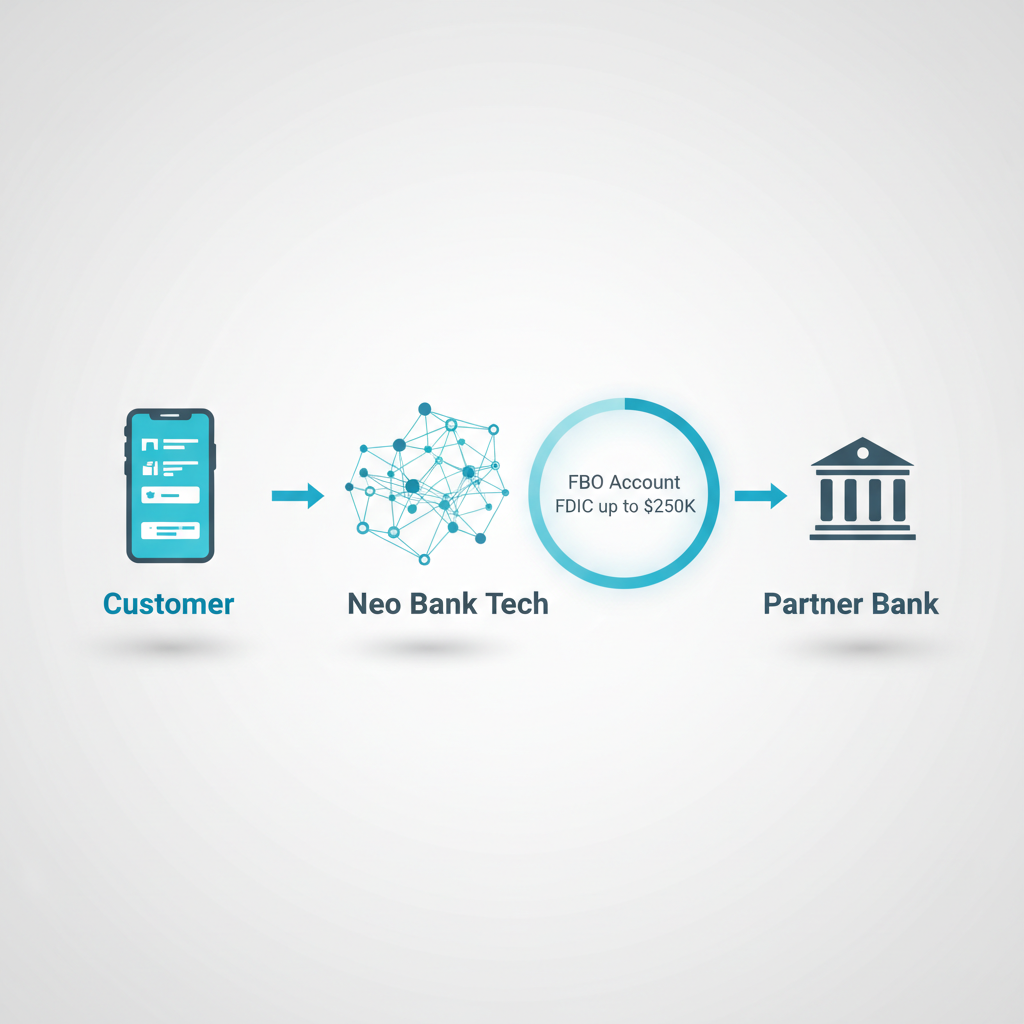
You open an account with a neo bank, which acts as a technology interface. Behind the scenes, a licensed partner bank creates a pooled “for benefit of” (FBO) custodial account. Your funds are sub‑accounted within that pool, and the partner handles regulatory connections—ACH, Fedwire, SWIFT—and FDIC coverage (up to $250,000 for qualifying accounts). The neo bank handles everything you see: app, notifications, card management. Built on modern APIs instead of legacy mainframes, neo banks let you spin up unlimited virtual cards with spend limits, set automated payment rules, and integrate accounting software via direct feeds.
How are neo banks different from traditional banks?
Traditional banks hold full charters, take deposits directly, issue loans, and operate physical branches. Neo banks are typically fintechs or Money Service Businesses; they cannot lend and must rely on partners for deposit‑taking. The trade‑off is clear: traditional banks offer credit products and in‑person services but are slower and pricier. Neo banks deliver speed, lower costs, multi‑currency accounts, and crypto support, but lack lending and—until recently—direct regulatory protections.
Are neo banks FDIC insured?
FDIC insurance comes from the partner bank, not the neo bank itself. When you deposit funds, money sits at a chartered bank that belongs to the FDIC. Your balance, combined with other deposits you hold at that same partner bank through any fintech, is insured up to $250,000—provided the partner bank fails. If the neo bank fails, you are still the beneficial owner of the funds at the partner bank and will eventually recover them, though not instantly. For large balances, sweep excess cash to a directly held bank account or split across partner banks to stay within the coverage cap.
How are neo banks regulated?
Neo bank regulation is a patchwork. In the US, a neo bank typically registers as a Money Services Business (MSB) with FinCEN, under state money transmitter licences, and relies on the partner bank’s compliance umbrella. In Europe, Revolut secured a full French banking licence in August 2026, becoming one of the few neo banks to hold deposits directly and issue loans inside the EU. Across the Atlantic, the OCC rejected Dutch neo bank Bunq’s application for a US national bank charter that same month, underscoring the narrow US path. The partnership model will remain the dominant structure for years.
What is the difference between a neo bank and a digital bank?
The line is a full banking licence. A digital bank holds its own charter, takes deposits on its balance sheet, can lend, and faces full prudential regulation. A neo bank relies on a partner’s licence. This matters for global businesses: digital banks often restrict industries or avoid crypto entirely because their regulator demands it. A neo bank can choose crypto‑friendly partner banks, enabling crypto neo bank capabilities that a fully licensed digital bank might shun. For a deeper breakdown, see Innowise’s 2026 guide.
Can a neo bank handle both fiat and cryptocurrency?
Yes, if purpose‑built. Consumer neo banks stop at fiat accounts and cards. A business neo bank designed for crypto teams—like OneSafe—operates dual rails. On the fiat side, you hold USD, EUR, and CAD in segregated accounts; on the crypto side, USDC and other digital assets sit in custody secured by Fireblocks MPC. Instant fiat‑crypto conversions (fees as low as 0.15%) remove the need to shuffle funds between a bank and a separate exchange. A single interface manages both worlds with unified compliance and reporting.
How do neo banks serve global businesses and startups?
A typical global startup opens an account in under a week via digital KYB (incorporation docs, EIN, photo ID), activates multi‑currency accounts (USD, EUR, CAD with unique IBANs), pays a European contractor in EUR via SEPA, converts incoming USD to USDC for on‑chain yield, and settles a Web3 freelancer in USDC—all from one dashboard. Virtual corporate cards with spend controls replace fragmented banking relationships. For DAOs, role‑based permissions allow a multisig‑protected treasury to manage fiat and crypto operations with automated payment workflows, maintaining on‑chain transparency.
Who uses neo banks?
Users now span four groups: remote‑first startups and SMBs needing multi‑currency without local banks; e‑commerce and marketplace businesses processing high‑volume cross‑border payouts; Web3 startups and DAOs running treasuries partly in stablecoins; and growth‑stage companies that have outgrown PayPal or Wise but find traditional banks too slow and restrictive. Companies requiring large credit lines, interest‑bearing deposit accounts, or in‑person cash services are better served by a traditional bank for those needs.
What are the security measures for crypto in neo banking?
Crypto‑enabled neo banks rely on institutional custody—Fireblocks MPC eliminates single‑point‑of‑failure private key storage by requiring a distributed quorum to sign transactions. Mandatory multi‑factor authentication (MFA) is enforced at account level, and all fiat funds are held in segregated accounts at licensed partner banks. Encryption follows industry best practices, and compliance teams run sanctions screening and transaction monitoring. The combination—MPC custody, segregated fiat, and forced MFA—meets institutional security standards.
How do neo banks make money?
Revenue comes from three sources: interchange fees (a cut every time a card is swiped), FX and transaction fees (small spreads on conversions, flat fees for wires), and subscription plans (premium tiers with higher limits, dedicated support). Unlike banks, neo banks don’t lend deposits, so their model is fee‑based and tied to transaction volume.
How to choose a neo bank for your business
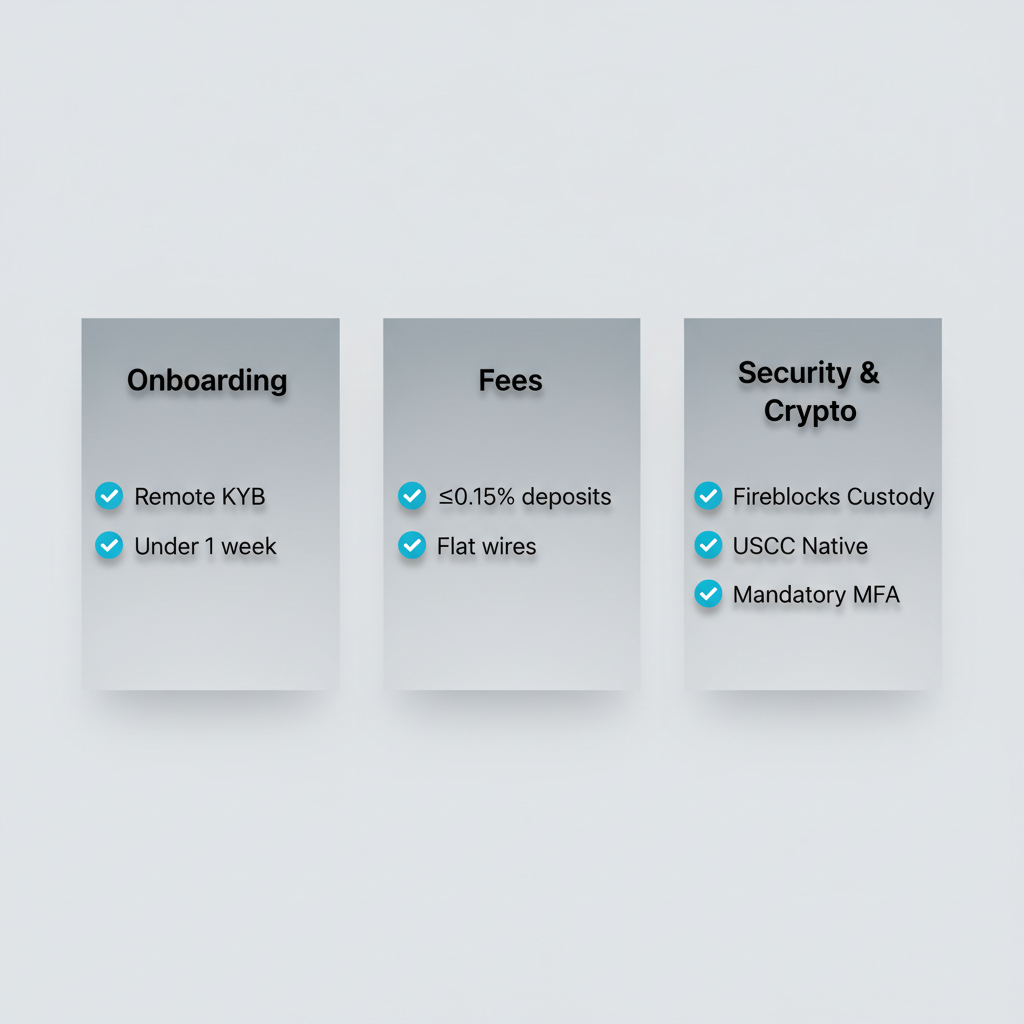
Use this checklist before opening an account.
Onboarding speed and identity verification
- Can I open fully remotely, paperless? Docs: incorporation papers, government ID, EIN.
- Realistic timeline: under one week is good; instant with no KYB is a red flag.
Fee transparency and FX costs
- Incoming/outgoing wire fees clearly stated? Aim for ≤0.15% fiat deposits, flat wires ($25 domestic, $50 international).
- Currency conversion spread 0.25‑0.5% is competitive. Avoid uncapped percentage‑based fees.
- Monthly minimums or inactivity penalties? Good neo banks offer a free tier.
Crypto support, custody, and security
- Holds USDC or major stablecoins natively, not requiring a separate wallet?
- Custodian: Fireblocks, BitGo, or Copper—institutional‑grade.
- Instant fiat‑crypto conversions available off‑peak?
- Mandatory MFA and role‑based permissions for treasury operations.
Founders matching these criteria with a business neo bank save weeks of setup and avoid the account‑closure risks common with crypto‑adjacent companies at traditional banks. The right neo bank acts as the operating system that lets you move money as quickly as your team moves code.