What is Web3 banking? Ask a DeFi purist and a treasury manager, and you'll hear two different answers — which is exactly why this question keeps coming up in ops calls. This guide cuts through the definitional debate and answers the questions that actually matter for your daily operations: onboarding, fees, stablecoins, DAO treasury workflows, and what recent launches mean for your stack.
Table of Contents
- What is Web3 banking?
- How does Web3 banking differ from traditional banking?
- What are the benefits of Web3 banking for businesses?
- What are the risks associated with Web3 banking?
- How do I open a Web3 bank account for my business?
- What types of transactions can I perform with a Web3 banking platform?
- How are stablecoins used in Web3 banking?
- How do DAOs manage their finances with Web3 banking?
- What are the fees for fiat and crypto transactions?
- What recent developments are shaping Web3 banking?
- Key Takeaways
- Sources
What is Web3 banking?
Web3 banking is the delivery of financial services — payments, accounts, custody, and settlement — through blockchain rails, digital assets, and smart contracts, rather than exclusively through a traditional bank ledger. The disagreement among sources is real. Some describe Web3 banking narrowly as banking built on decentralized protocols. Others — and most practical business onboarding guides — use a broader frame that includes hybrid fiat-crypto platforms: regulated fintech companies that hold customer funds through banking partners and offer crypto accounts in the same interface.
Both are right, because Web3 banking is a spectrum. At one end sits permissionless DeFi (decentralized finance), where you custody your own keys and interact with protocols directly. At the other end are neo-banks that sit on top of bank rails but let you move between fiat and crypto without leaving the core account. This is increasingly called neo-banking for startups — a category that blends fintech speed with crypto-native features. McKinsey frames Web3 broadly as an internet built on blockchain and token-based economics — the banking layer is simply where token value meets real-world obligations.
For a business operator, the Web3 banking definition that matters is operational: a financial account where you can hold USD, pay a vendor in USDC, and run payroll in euros from one login. Not a wallet bolted onto a bank app, and not a liquidity pool you need a protocol manual to exit safely.
How does Web3 banking differ from traditional banking?
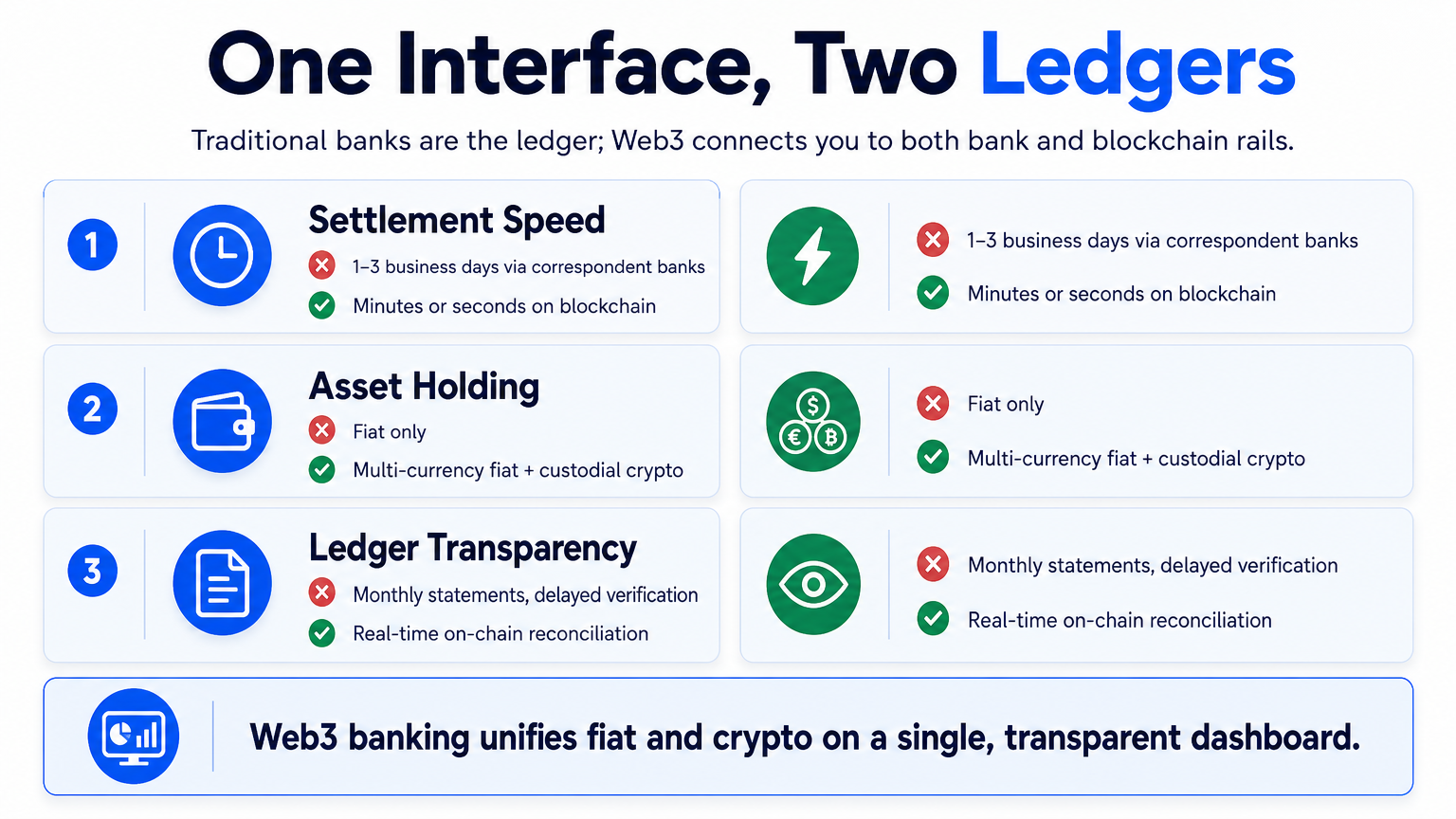
The structural difference is simple: a traditional bank is the ledger, and you can only move money where the bank has rails. A Web3 banking platform gives you access to more than one ledger — the bank ledger for fiat and a public blockchain for digital assets — through one interface. Three operational differences follow.
First, settlement speed. Traditional international wires take one to three business days and route through correspondent banks that each take a cut. Blockchain transfers settle in minutes or seconds, with fees set by network congestion rather than a chain of intermediaries.
Second, what you can hold. A traditional business account holds fiat, full stop. A Web3 banking platform typically offers multi-currency fiat accounts alongside custodial crypto wallets, with conversion between the two built in — what practitioners call fiat to crypto banking. For companies holding crypto treasuries, corporate crypto accounts are the operational hub: one dashboard where you receive stablecoin revenue, convert to fiat, and pay suppliers.
Third, transparency of the ledger. On blockchain rails, a transaction is verifiable the moment it settles. You don't wait for a monthly statement to confirm a payment landed. The underlying primitives — smart contracts and decentralized consensus — make this auditability possible; the business takeaway is that you can reconcile on-chain activity in real time rather than at statement close.
What are the benefits of Web3 banking for businesses?
Strip out the ideology and three benefits stand up to operator scrutiny.
Faster cross-border settlement. When you can send a stablecoin to a contractor in another country in minutes instead of days, your payment policy changes. You can release work on delivery, not on wire confirmation. The operational payoff is a looser cash-flow constraint.
One account for two asset classes. Businesses earning revenue in crypto no longer need a separate exchange account, a manual withdrawal step, and a third reconciliation. The on-ramp and off-ramp live inside the same dashboard where you pay vendors in fiat. That's the crypto banking for business advantage in one sentence.
Programmability. Smart contracts can automate recurring payments, split revenue between wallets, or hold milestone payments in escrow. This is where DeFi-native features leak into everyday finance: a payroll schedule can become a contract, not a calendar reminder. This flexibility is driving global business banking crypto adoption — companies pay contributors across borders without touching correspondent banks.
What are the risks associated with Web3 banking?
Risks cluster in three areas. Mitigation starts with knowing which one you're exposed to.
Regulatory uncertainty is the one that keeps CFOs up. A platform operating legally today can face enforcement tomorrow if stablecoin legislation shifts. Verify a platform's compliance posture before you onboard, not after.
Smart contract and custody risk applies to the crypto side. A bug in a DeFi protocol can freeze or drain funds. Your mitigation is to keep operating treasury with an institutional custodian — like Fireblocks — rather than a hot wallet one engineer controls from a laptop.
Counterparty risk is the one beginners miss entirely. Most Web3 banking platforms are technology companies, not licensed banks. Fiat is often held with partner banks; crypto is held with custodians. Read the custody agreement and know who actually holds your money.
Is Web3 banking secure?
Security has two layers, and only one is the platform's problem. The platform layer is defensible: reputable providers use encryption in transit and at rest, mandate multi-factor authentication at signup, and custody digital assets with institutions like Fireblocks. The account layer is yours, and it's where breaches actually happen. An account protected by SMS-only two-factor authentication is not secure no matter who the platform is. Use an authenticator app or hardware key, enforce role-based permissions for every employee, and keep treasury funds separate from daily spending wallets.
How do I open a Web3 bank account for my business?
The process resembles opening a neo-bank account more than connecting a wallet to a dApp. You apply online, verify business identity, and select the account structure you need.
Concrete example: OneSafe, a hybrid fiat-crypto platform, lets you start the application in about 10 minutes. Onboarding is fully digital and typically completes within a week. The company is a financial technology provider, not a bank — banking services are delivered through its partners, which is the standard structure in Web3 banking. Service is available worldwide except OFAC-sanctioned countries and certain US states.
The decision point before you apply is what the account must do on day one. If you only need USD receiving and a USDC off-ramp, a basic setup works. If you need multi-currency accounts, corporate cards, and automated vendor payments, that changes which plan and permissions you configure.
What documents are required for onboarding?
You'll typically provide three things, and they should match each other exactly:
- Business formation papers — articles of incorporation, LLC operating agreement, or equivalent registration
- Government-issued photo ID for every beneficial owner and authorized signer
- EIN for US companies (or the local tax identifier where you're registered)
Some platforms also request proof of address and a short description of business activity. Missing or mismatched documents are the top reason onboarding stalls — compliance teams don't chase you; they wait.
How long does account opening take?
On digital-first platforms, expect a few days to one week from submission to an approved account, assuming your documents are complete. Every missing sheet resets the clock. Direct traditional banks still run two-to-four-week timelines, which is precisely why hybrid neo-banks are winning the Web3 startup segment.
Pre-application checklist — complete these before you hit "start":
- Legal entity name matches formation papers character-for-character
- Beneficial owner passports valid for at least 6 more months
- EIN or local tax ID on hand
- Proof of address dated within 90 days
- Two-sentence business description written (what you sell, who pays you, where)
What types of transactions can I perform with a Web3 banking platform?
A hybrid platform covers the full fiat-and-crypto surface:
- Fiat rails — ACH, domestic wire, international wire, SWIFT
- Crypto rails — deposits and withdrawals in USDC and other supported tokens
- Conversions — instant crypto-to-fiat and fiat-to-crypto
- Payments — bill payments, automated recurring payments, vendor wires
- Invoicing — in fiat and stablecoins
- Foreign exchange — between supported fiat currencies
The defining capability is the on-ramp and off-ramp: moving value across the crypto-fiat boundary without routing through an external exchange. That's what separates blockchain banking from a traditional business account with a crypto widget on the side.
Can I get corporate cards and pay bills through Web3 banking?
Yes. Corporate cards with spend limits are standard, and bill payments work through ACH, wires, and scheduled payments. The Web3-specific feature is card top-ups in crypto: you can fund a corporate card from token balances without converting to fiat first. One caveat — corporate card foreign exchange usually carries a fee. On OneSafe, the card FX fee is 3%, so if you pay foreign vendors by card frequently, run the numbers against a wire or USDC transfer.
How are stablecoins used in Web3 banking?
Stablecoins are crypto tokens pegged to a fiat currency, usually the US dollar. They give you blockchain settlement speed without Bitcoin-style volatility, which makes them the workhorse of stablecoin banking.
Three concrete uses for a business:
- Vendor payments. A freelancer in another country receives USDC in minutes and converts to local currency on their side.
- Treasury management. Operating cash held in USDC can move instantly into payroll, vendor payments, or crypto investments without a settlement window.
- Payroll. DAOs and global startups pay contributors in stablecoins precisely because settlement is near-instant and identical whether the recipient is in Lagos or Lisbon.
The integration is accelerating. hashbank, part of W Group, launched its integrated fiat banking and external crypto transfer experience in one licensed digital bank app.
How do DAOs manage their finances with Web3 banking?
DAOs — decentralized autonomous organizations, collectives governed by token-holder votes instead of a board — have a structural finance problem. Their treasury lives on-chain, but their rent, payroll, and SaaS bills are denominated in fiat. Web3 banking platforms address this with three things, and DAO-specific neobanking for startups is now a real category.
Customizable roles and permissions. The governance lead can approve a payment without touching private keys. The treasurer can move fiat but not crypto, or vice versa. This is the single most important DAO feature, because DAO banking without role separation is just a shared wallet.
Secure custody. Multi-signature wallets and institutional custody protect treasury funds from one compromised laptop.
Automated payment workflows. Contributor payroll, grant disbursements, and recurring vendor payments can be scheduled and executed with defined approver chains.
The operational rule regardless of platform: never let one person hold both the authority to initiate and to approve a treasury spend.
What are the fees for fiat and crypto transactions?
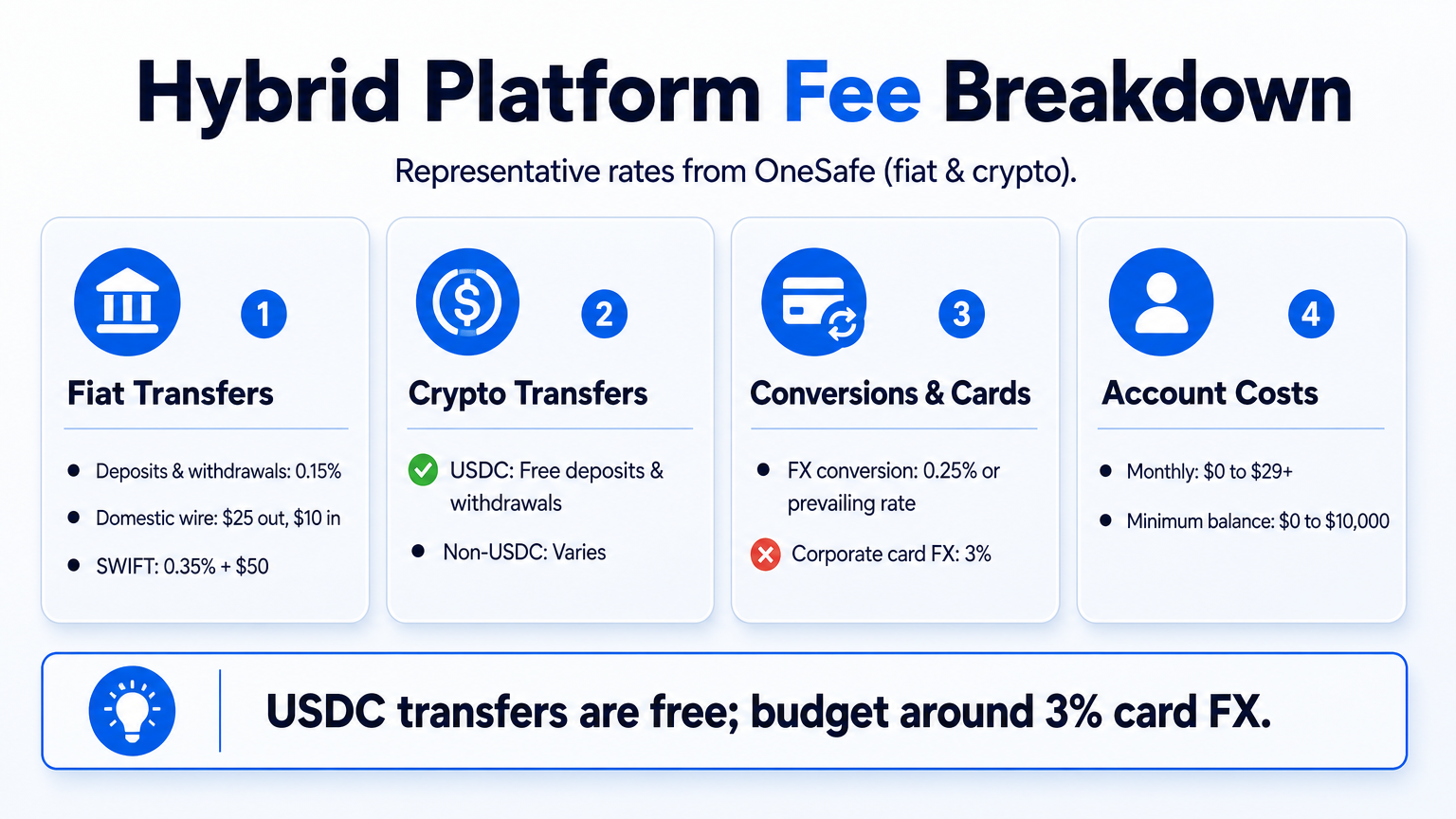
Pricing varies by provider, but the categories are consistent. Here's a representative hybrid platform's fee schedule, using OneSafe's published rates:
| Transaction | OneSafe fee (representative hybrid platform) |
|---|---|
| Fiat deposit / withdrawal | 0.15% |
| Domestic wire withdrawal | $25 |
| Domestic wire deposit | $10 |
| SWIFT deposit / withdrawal | 0.35% + $50 |
| FX conversion | 0.25% or prevailing FX rate |
| Corporate card FX | 3% |
| USDC deposit / withdrawal | Free |
| Non-USDC crypto deposit / withdrawal | Varies |
| Monthly subscription | $0 to $29+ |
| Minimum balance | $0 to $10,000 |
The fee you'll feel most is corporate card foreign exchange at 3% — budget around it or use wire/stablecoin alternatives. USDC transfers are free on this platform: a $1,000 USDC payment to a contractor costs $0 in platform fees versus $25+ for a wire.
What recent developments are shaping Web3 banking?
Three October 2026 developments tell you where the rails are pointing.
Fiserv went live with its digital asset platform through Bank of North Dakota's Roughrider Coin, a US dollar-backed stablecoin issued by VersaBank and transacting on Solana. Fiserv is incumbent infrastructure — the company that moves money for thousands of banks — and it's now running stablecoin settlement in production, with Fireblocks handling custody and tokenization. This signals that stablecoin rails are entering the financial backbone, not the fringes.
hashbank launched its integrated Web2 and Web3 banking experience, combining fiat banking and external crypto transfers in one licensed universal digital bank app. The "two apps" friction — bank here, wallet there — is dissolving at the product level.
World Liberty Financial partnered with Web3 banking firm Vaulta after a $6 million token purchase, showing institutional crypto capital crossing directly into Web3 banking platforms.
The through-line: Web3 financial services that were experimental in 2024 are production infrastructure in 2026. Businesses that set up hybrid accounts now inherit smoother rails than the ones their competitors will retrofit later.
Key Takeaways
- Web3 banking is a spectrum, not a binary — from pure DeFi to regulated hybrid platforms that hold fiat and crypto in one interface.
- Onboarding is the part you control: have formation papers, photo IDs, and tax IDs ready before you apply, and expect around a week on digital-first platforms.
- Stablecoins — USDC especially — are the operational backbone, moving cross-border value in minutes at near-zero platform fees versus $25+ wires.
- Security is a two-layer problem: the platform's custody and your account hygiene, starting with authenticator apps and role separation.
- Fiserv, hashbank, and World Liberty Financial's October 2026 moves show hybrid Web3 banking entering mainstream financial infrastructure.
Ready to manage fiat and crypto from a single business account? Open your OneSafe account to start onboarding today.
Sources