
Meta description: Which US bank is the most crypto-friendly? This 2026 guide compares traditional, neo, and stablecoin-native banks for businesses, startups, and DAOs.
Which US bank is the most crypto-friendly? 2026 Guide
Which US bank is the most crypto-friendly? Answering that in 2026 isn’t a simple matter of checking who lets you connect to Coinbase. The banking landscape has splintered into traditional institutions that dip a toe in, neo-banks purpose-built for digital enterprises, and even a newly chartered stablecoin-native bank. For global businesses, DAOs, and digital-first companies, the real measure of crypto-friendliness is operational integration—how deeply a bank supports multi-currency treasuries, corporate cards, and cross-border payments alongside crypto rails, areas where modern neo-banks like OneSafe excel.
Executive Summary
A crypto-friendly bank in 2026 is a financial partner that layers fiat accounts with stablecoin settlement, multi-currency ledgers, programmatic payment APIs, and commercial cards that work seamlessly across on-chain and off-chain worlds. We break down the spectrum from basic exchange connectivity to deep API integration, compare traditional giants (JPMorgan, Bank of America) with crypto-native neo-banks (OneSafe, Mercury) and new stablecoin-native charters (Erebor), and address the operational realities of DAOs, Web3 startups, and global enterprises.
What Makes a Bank Truly Crypto-Friendly?
Crypto-friendliness exists on a spectrum: from tolerating ACH wires to approved exchanges, to embedding banking primitives into your own product via API. For a business managing treasury in USDC, paying contractors in EUR, and needing instant reconciliation, only the integration-heavy end works. Key markers: the bank doesn’t flag accounts simply because of crypto transactions; it offers direct APIs for fiat-to-stablecoin conversion; it provides multi-currency accounts that treat USD, EUR, and USDC equally; and it maintains clear policies on which crypto activities are permitted.
A 2026 CoinGecko report found that 74% of the world’s 50 largest banks now support crypto trading via regulated exchanges, yet most limit that support to institutional or wealth-management clients (CoinGecko, April 30, 2026). For businesses, differentiators include whether the bank handles crypto custody, interfaces with stablecoin rails, and how its compliance framework treats on-chain activity. For a deeper landscape overview, see our Comprehensive Crypto Bank List for 2026.
The Crypto-Friendly Banking Landscape in 2026
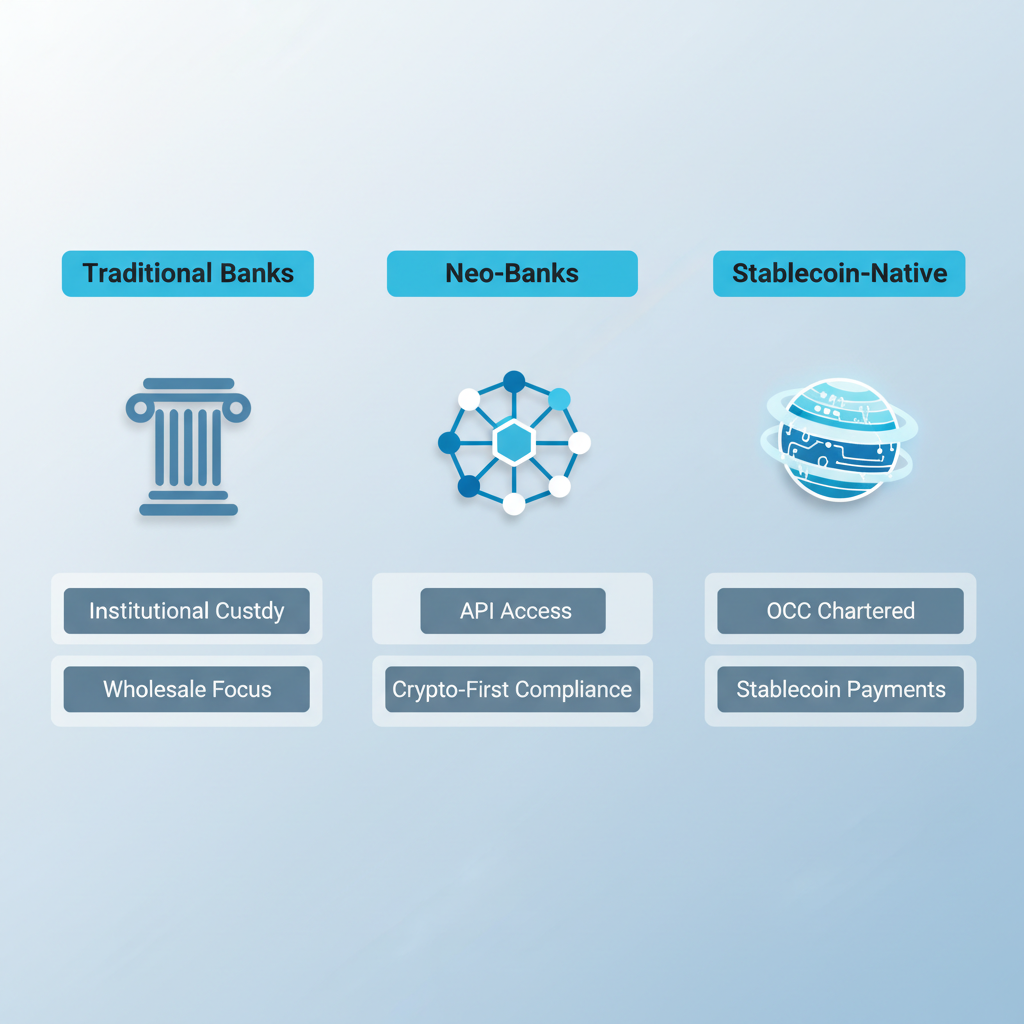
Traditional Banks: JPMorgan, BofA, and More
JPMorgan Chase now offers institutional crypto custody and settlement, plus its own JPM Coin for wholesale clients. Bank of America provides limited support through prime brokerage and research. As the Bitcoin Foundation detailed in March 2026, while several major US banks now claim crypto support, “the reality is often limited to institutional services or stablecoin pilots” (Bitcoin Foundation, March 1, 2026). For a Web3 startup needing straightforward accounts that handle on-chain salary payments, these banks still pose friction.
Neo-Banks: Bridging Fiat and Crypto for Global Business
Neo-banks built for the digital economy openly welcome crypto-adjacent businesses. Mercury provides FDIC-insured fiat accounts, API access, virtual cards, and explicit permission for crypto transactions—TechRepublic named it among the best crypto-friendly banks in May 2026 for its seamless exchange transfers (TechRepublic, May 12, 2026). OneSafe extends this with multi-currency support, global payment rails, and a compliance engine that understands tokenized assets, treating crypto businesses as first-class citizens.
The New Wave: Stablecoin-Native Banks Like Erebor
In February 2026, Erebor Bank received final OCC approval as the first de novo national bank charter focused on stablecoin-native operations, with roughly $625 million in initial capital (insights4vc, April 9, 2026). Erebor combines specialized commercial banking for frontier-technology companies with stablecoin payment infrastructure. While early, it points toward a future where stablecoin banking becomes core infrastructure. For businesses processing substantial stablecoin volumes, this is a category to watch. For scaling insights, see our Stablecoin Payments for Startups: A Complete Guide.
Which US banks support Bitcoin and stablecoins?
Major banks like JPMorgan, Bank of America, U.S. Bank, and Chase allow fiat transfers to regulated exchanges, but do not offer direct BTC holdings. State Street and BNY Mellon have explored stablecoin custody, and Erebor’s charter explicitly includes stablecoin operations. Neo-banks Mercury and OneSafe enable businesses to hold and move stablecoins alongside fiat. The key is not simply “support” but custody capabilities and account stability when interacting with on-chain assets.
Which big American banks back Bitcoin now?
No major US retail bank lets customers hold Bitcoin in a checking account. JPMorgan, Goldman Sachs, and Morgan Stanley offer Bitcoin-related products to high-net-worth and institutional clients. For most businesses, “backing Bitcoin” means the bank won’t block wires to a Coinbase or Kraken account—support detailed in CoinLedger’s review of top crypto-friendly US banks (CoinLedger). If you need a crypto business bank account that understands Bitcoin treasury operations, neo-banks are far ahead.
Beyond On/Off-Ramps: What Global Businesses and DAOs Actually Need
Multi-Currency & Cross-Border Payments
For teams paying contractors globally and holding treasury in USDC, a single-currency US account is a bottleneck. A true best crypto bank for business offers multi-currency accounts that can receive, hold, and send USD, EUR, GBP, and stablecoins with real-time FX and on-chain settlement. OneSafe’s unified global finance account blends fiat and crypto ledgers, so you can pay a freelancer in EUR directly from a USDC balance (Global Finance Accounts: A Comprehensive Guide).
Corporate Cards and Expense Management
Look for platforms that issue virtual and physical corporate cards tied to your crypto-native treasury. Mercury and OneSafe let you fund cards from stablecoin balances, set spending limits, and reconcile instantly, eliminating constant fiat wires and reducing FX markup. For a full breakdown, see our Comprehensive Guide to Corporate Cards.
DAO Treasury Management
DAOs face a structural mismatch: most banks require clear legal entities and UBOs, and many accounts get frozen when funds move on-chain. Specialized DAO banking solutions are rare. Some DAOs use multisig wallets with fiat off-ramps through OTC desks, but few neo-banks now offer entity-free business accounts with shared control—critical for on-chain organizations. While no product yet perfectly solves DAO treasury management, understanding this helps choose a partner that won’t panic at governance token distributions. See Best Banking for Web3: A Definitive Guide.
Can U.S. businesses open cryptocurrency-friendly business accounts?
Yes, but the experience varies. Mainstream banks may allow an account if the company isn’t engaged in unlicensed money transmission, but application processes often involve aggressive questioning and unexplained declines. Neo-banks like Mercury and OneSafe openly welcome crypto businesses with standard KYC/AML checks. For startups handling token sales or DeFi yield, starting with a neo-bank that has built-in compliance for those activities avoids extensive education of a legacy risk department.
Decision Framework: How to Choose the Right Crypto Banking Partner
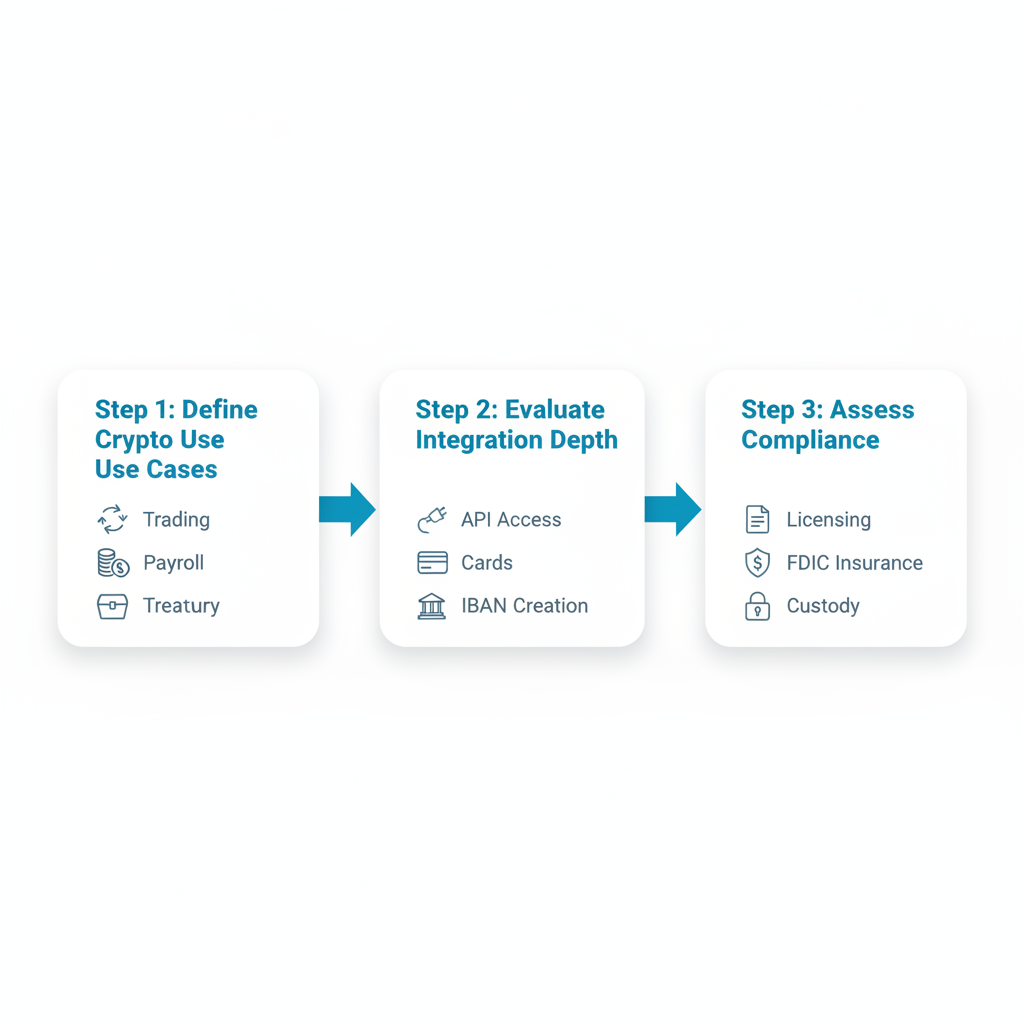
Step 1: Define Your Crypto Use Cases
List exactly how crypto touches your business. Are you funding an exchange for trading? Paying international contractors in stablecoins? Holding crypto treasuries alongside fiat? Each use case demands a different depth of integration. A business that only wires USD to Coinbase monthly can survive with Chase. A company issuing token-based incentives needs API-driven accounts that can programmatically move funds.
Step 2: Evaluate Integration Depth
Integration depth separates contenders from the rest. Ask providers: Can I programmatically create IBANs? Do you offer a REST API for fiat and stablecoin transfers? Can I issue cards linked to multi-currency wallets? OneSafe exposes APIs that let businesses automate payment flows and manage global payments without leaving their dashboard. When banking becomes infrastructure, your treasury becomes a competitive advantage.
Step 3: Assess Compliance, Insurance, and the Fine Print
A crypto business bank account must be held at a bank with clear regulatory compliance. Ask about licensing, BSA/AML programs, and blockchain analytics. FDIC insurance covers only fiat deposits—never crypto. Confirm whether the bank partners with qualified custodians for any crypto held on your behalf. Scrutinize account closure policies; the safest crypto-friendly US banks provide transparent acceptable-use policies and an escalated review path (CEX.IO).
Are business accounts at crypto-friendly banks FDIC insured?
Yes, but only for fiat balances, up to $250,000 per depositor per insured bank. It does not cover crypto assets. Mercury provides pass-through FDIC insurance for fiat deposits through partner banks, while crypto assets sit with external qualified custodians. Always confirm where your assets sit.
What is the difference between a crypto exchange and a crypto-friendly bank?
An exchange lets you trade digital assets. A crypto-friendly bank manages fiat operations—wires, multi-currency accounts, corporate cards—and may facilitate fiat-crypto movement. Exchanges typically aren’t regulated as banks; a crypto-friendly bank is subject to banking regulations and deposit insurance, providing a safer base for operational cash.
Which bank account is best for crypto trading?
For personal trading, an account that reliably connects to major exchanges without triggering fraud alerts works—Chase, U.S. Bank, and many credit unions fit this. For active business trading, a neo-bank account at Mercury or OneSafe handles high volumes of both fiat and crypto-related transactions without freezing. The key is a risk model that understands rapid exchange-related wires are normal.
For those investing in cryptocurrency within the United States, which bank works best?
Any FDIC-insured bank allowing ACH transfers to Coinbase, Kraken, or Gemini will work. Major banks generally permit such transfers, though some flag large, repeated transactions. U.S. Bank and Ally are consistently cited as investor-friendly (fitsmallbusiness.com). For moving larger sums or holding stablecoins directly, a neo-bank that supports both fiat and stablecoin accounts is more efficient.
Common Myths and Mistakes
- Myth: “Exchange access means crypto-friendly.” Many banks still freeze accounts after on-chain activity. True crypto-friendliness means understanding DeFi flows.
- Mistake: Not vetting stablecoin policy. Some banks treat any stablecoin transaction as suspicious, even for legitimate vendor payments.
- Myth: “FDIC insurance covers my crypto.” It never does. Understand what portion of your balance is protected.
- Mistake: Believing a charter means deep integration. Erebor’s charter is promising but evaluate the live feature set, not the press release. For more on regulatory layers, see Understanding Crypto Banking: The Future of Finance.
The Future of Crypto Banking and Your Next Steps
Preparing for Regulatory Shifts
The OCC’s Erebor approval signals stablecoin-native banking is moving from idea to infrastructure. Expect more charters and responses from existing banks with stablecoin settlement networks. Businesses should choose a bank that adapts its compliance framework as rules evolve.
How to Get Started Today
- Audit treasury flows across payroll, vendor payments, and investment income.
- Match tools to use cases. If you only need fiat exchange connectivity, a traditional bank may suffice. For multi-currency accounts, card issuance, and stablecoin settlement, start with OneSafe.
- Test the platform’s API and policies before fully migrating: open a trial account, run a small stablecoin payment, and see how compliance responds.
- Layer in DAO-specific tooling if needed, pairing your bank account with multisig treasury platforms like Gnosis Safe and on-chain-aware accounting tools.
The most crypto-friendly bank for your business isn’t the biggest name; it’s the one that integrates into your operational stack with deep API access, stablecoin readiness, and transparent compliance. Choose a partner that grows with you, not one that freezes your account at the first governance token deposit.