
On October 19, 2026, Unchained Crypto reported that World, the identity network co-founded by Sam Altman, is bundling human-verification tools for banks and financial firms. The announcement drags deepfake-resistant identity checks into the center of crypto banking at the same moment business and DAO operators are asking whether their account access controls can survive AI impersonation. The practical answer is forming faster than most compliance teams expect.
Table of Contents
- World Pitches Human-Verification Tools to Banks on October 19
- Why Deepfake-Proof Verification Matters for Crypto Banking
- How Crypto Banking Verification Works Today
- What Founders and Finance Leads Should Do Now
- Open Questions and What to Watch Next
- Key Takeaways
World Pitches Human-Verification Tools to Banks on October 19
The bundle: World ID app, Zoom deepfake check, and AI-agent tools
World is packaging three existing verification products into a single offering called World ID for banking and finance. According to the October 19, 2026 report from Unchained Crypto, the bundle has three parts:
- World ID app, an identity wallet where people store and present credentials World calls Proofs.
- World ID for Zoom, a tool that checks whether the person on a video call is a real human. It is now generally available after a limited beta that began in April.
- World ID for Agents, the tool World launched as AgentKit with Coinbase in March and widened in June, letting a verified person hand credentials to an AI agent.
World said four design partners — including Bain Capital and VanEck Funds — will explore uses, but it named no bank customer. That last point matters: the bundle is still a pitch, not yet a compliance standard. For a closer look at what this shift could mean for crypto banking platforms, see World ID Suite for Banks: A Crypto Banking Shift.
Why financial firms are the target now
Banks are a rational first market because their existing verification stack still assumes documents, static selfies, and occasional video checks. Deepfakes break that assumption. A 2026 Best Human Verification for Banks listing from POY Verify shows identity verification for banks increasingly focused on liveness and AI detection, not just document matching. The cost of a falsely verified human is high: authorized access, outbound wires, and account takeovers.
World's pitch targets that gap. It wants to become the human-verification layer for financial institutions before regulation forces a particular standard. This is human verification banking in its emerging form: real-time proof of a live person, attached to credentials, on a specific call.
What did World announce on October 19, 2026?
On October 19, 2026, Unchained Crypto reported that World announced a bundle for banks and financial firms: the World ID app, the World ID for Zoom deepfake check, and World ID for Agents, marketed together as World ID for banking and finance. Four design partners — Bain Capital and VanEck Funds among them — are exploring the tools, but World named no bank as a customer.
Why Deepfake-Proof Verification Matters for Crypto Banking
The rise of deepfakes in financial fraud
Deepfake-driven fraud is no longer theoretical. The identity verification industry has moved past passive selfie checks because attackers can synthesize faces, voices, and video well enough to pass legacy controls. Ondato describes identity verification for banks as a blend of document authentication, liveness checks, and AI-powered fraud detection — not a one-time KYC step.
The concern is especially acute when a finance team approves a transaction on a video call and the "CFO" on the screen is generated. This is why deepfake security crypto is becoming a distinct problem: crypto transactions are fast and typically irreversible, so a fraudulent identity that gains account access can move funds before a human reviewer catches up.
Why business crypto accounts are prime targets
Business crypto accounts hold more than just balances. They hold the ability to send domestic wires, international transfers, payroll runs, and stablecoin payouts. A startup or DAO that manages fiat and crypto in one place concentrates that access. Attackers target finance personnel because they are the human node between identity and treasury.
The operational pattern makes deepfakes dangerous: many teams approve high-value payments via video call or Slack, and an AI-generated voice plus a realistic video can reset the "who asked for this wire" question. For stablecoin payment flows that now reach hundreds of billions in volume, the blast radius of a single impersonated approver is larger than a consumer card fraud.
What is crypto banking?
Crypto banking is financial infrastructure that combines fiat accounts, payment rails, and cryptocurrency custody or conversion in a single relationship — often delivered by a fintech or neo-banking platform rather than a traditional licensed bank. For businesses, it means paying a contractor in USDC, converting inbound stablecoins to USD, and sending a domestic ACH from the same dashboard. NerdWallet describes crypto banking as services that let customers hold, trade, and spend cryptocurrency alongside traditional cash accounts; Visa's crypto in banking overview frames it as the infrastructure allowing businesses and consumers to move value between fiat and digital assets.
How do deepfakes threaten business crypto accounts?
A deepfake threatens a business crypto account when an attacker impersonates a founder, finance lead, or DAO signer during an authentication or approval step. If the platform relies on video-call verification, the attacker can fake the face and voice. If the platform relies on static selfies, the attacker can generate a matching image. The result is not just a stolen password — it is a fraudulent human passing a "I am this person" check and then moving funds. TrueLayer's guide to bank account verification notes that verification is really about establishing that the person and account are legitimately linked. Deepfakes attack that link precisely.
How Crypto Banking Verification Works Today
From KYC documents to behavioral biometrics
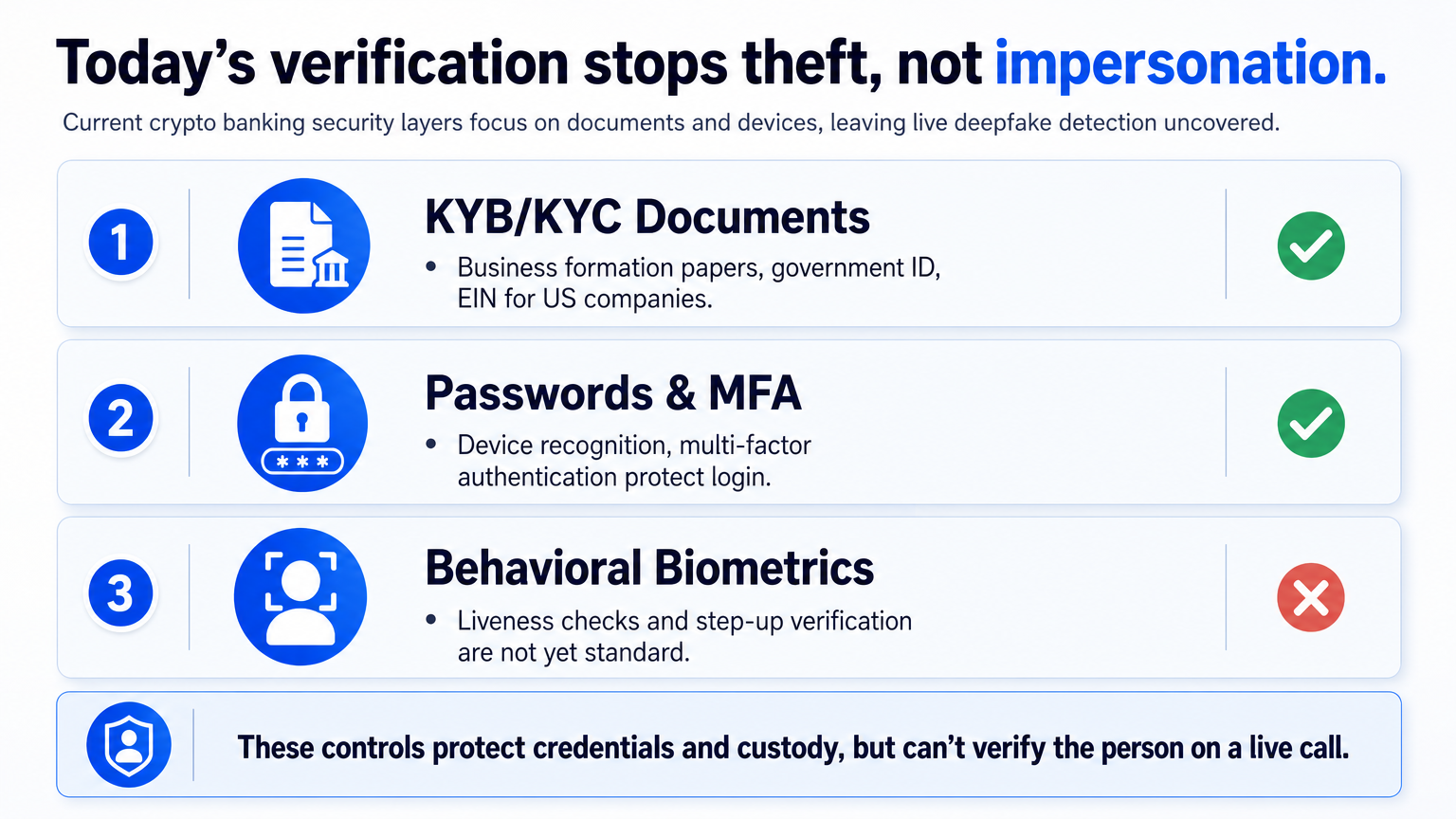
Most crypto banking platforms still run a know-your-business (KYB) and know-your-customer (KYC) process at onboarding: formation documents, a government-issued photo ID, and sometimes an EIN for U.S. companies. After onboarding, ongoing verification usually shrinks to passwords, device recognition, and multi-factor authentication. That is adequate against credential theft but not against a live impersonation attack. The next layer — behavioral biometrics, liveness checks, and continuous step-up verification — is what onboarding verification crypto providers are starting to add, but adoption varies.
What a crypto-native platform like OneSafe already does (MFA, Fireblocks)
Some crypto banking platforms have hardened the basics without waiting for deepfake-specific tools. A typical security model includes mandatory multi-factor authentication at signup, digital asset custody through Fireblocks that separates key management from the transaction interface, encryption and compliance protocols covering personal information and balances, and document-based onboarding with business formation papers and government-issued ID. These controls stop a meaningful share of account-takeover attempts, but they do not yet solve the live-video deepfake problem on their own. That is exactly the gap World's bundle targets.
In a related development on October 19, 2026, World pitched a bundle of human-verification tools — the World ID app, a Zoom deepfake check, and AI-agent tools — to banks and financial firms, as reported by Unchained Crypto in "World Pitches Banks a Bundle of Human-Verification Tools to Counter Deepfakes." This move signals that the industry is beginning to treat deepfake detection as a banking-layer problem, not just a security add-on.
How does OneSafe currently protect against identity fraud?
OneSafe security rests on a layered model: onboarding requires business formation papers and a government-issued photo ID; MFA is mandatory upon signup; digital assets are held via Fireblocks custody; and the platform applies encryption and compliance protocols across account data. These are session and custody controls — strong but not yet a substitute for live deepfake detection on every video or voice approval. The relevant point for operators: one platform's current protections cover credential and custody risk well; they do not, by themselves, verify that the human on the other end of a call is who they claim to be.
What Founders and Finance Leads Should Do Now

Demand stronger identity proofing from your banking partner
Don't wait for a vendor announcement to become a standard. Ask your crypto banking provider three questions:
- Does your onboarding flow include liveness detection or still-image KYC?
- Can you add a second human approver for critical actions such as wire and crypto withdrawals?
- Does the platform support hardware-key phishing-resistant MFA for all team accounts?
This is not about moving banks tomorrow; it is about negotiating the next security update with the vendor you already use.
Revisit team access controls and transaction limits
Most business crypto accounts are compromised through the finance team, not the platform. A practical checklist:
- Remove departed employees and contractors from all payment roles immediately.
- Set per-user transaction limits and dual approval for anything above a threshold.
- Restrict crypto withdrawals to pre-approved whitelisted addresses.
- Require dedicated devices for finance approvals, not personal phones.
| Control | What to set | Why it reduces deepfake risk |
|---|---|---|
| Dedicated approval device | Finance team uses managed laptops | Harder to intercept via personal malware |
| Dual approval threshold | Two signers above a defined limit | A single impersonated founder cannot move funds |
| Whitelisted withdrawal addresses | Pre-approved destinations only | Limits blast radius if approval is faked |
| Phishing-resistant MFA | Security keys, not SMS | Stops credential replay that often precedes deepfake calls |
Treat human-verification as an insurance policy, not overhead
The right framing is not "another KYC step" but an underwriting question: can you afford a single human to be impersonated for a $50,000 wire? If the answer is no, then human-verification tools are an insurance policy against a known, growing attack path. That does not mean every startup needs World ID for banking on day one; it means treat identity proofing as part of your operational risk budget, not a compliance checkbox.
What does this mean for my startup’s or DAO’s banking security?
Concretely, the threat model has shifted from password theft to persona theft. For a startup or DAO, the next security review should ask how the platform verifies who is acting at the moment of a transaction, not just who opened the account. The World announcement does not change your immediate stack, but it changes the benchmark: if a provider is not at least thinking about live human-verification, it is likely behind where the market is heading. For a DAO banking platform, the same applies to signers and governance roles — roles and permissions are necessary but insufficient if the human behind a signer can be faked.
Should I wait for banks to adopt these tools or take action now?
Take action now on the controls you control. Implement dual approval, whitelisted addresses, device hygiene, and hardware-key MFA this quarter. Those reduce risk independent of deepfake detection. Meanwhile, monitor whether your bank or crypto banking partner adds live verification and be ready to pilot it when it does. Waiting entirely for banks to adopt World's bundle cedes the easiest wins to attackers.
Open Questions and What to Watch Next
Will banks adopt World’s tools—or wait for regulation?
The announcement has no named bank customer, only four design partners. That is a meaningful gap. Financial institutions often wait for clear regulatory expectations before adding a vendor's proprietary identity network, especially one involving biometrics and AI-agent credentials. The next signal to watch is whether a bank or large fintech announces a pilot — not a design partnership — and whether regulators comment on privacy or data-protection limits. The FDIC has clarified the process for banks to engage in crypto-related activities, but that does not yet establish deepfake-verification requirements.
How long until deepfake-resistance becomes table stakes in crypto banking?
If the current pace holds, deepfake-resistant verification will move from "differentiator" to "table stakes" within roughly the next 12 to 24 months — but that is an analyst's estimate, not a confirmed timeline. The forcing functions are rising fraud losses, new regulatory expectations, and the simple fact that AI-generated impersonation is becoming cheap. For operators, the safer assumption is that your next provider contract or security audit will include questions about live human verification. For more on the institutional crypto banking shift, see Crypto Banking in 2026: What Big Banks’ Shift Means for Business and Crypto Banking Shift: Business Ops After Schwab’s Move. The AI-agent angle is covered in Stablecoin Payments Get an AI Agent Twist.
Key Takeaways
- World's October 19, 2026 bundle puts deepfake-proof human verification in front of financial firms, but it still has no named bank customer.
- Business crypto accounts are prime targets because they combine high-value payment authority with fast, often irreversible crypto settlement.
- Founders and DAO operators should act now on dual approval, whitelisted addresses, device hygiene, and phishing-resistant MFA rather than waiting for bank adoption.
- Deepfake-resistance is likely to become table stakes in crypto banking within 12 to 24 months, making live identity proofing a procurement question, not a novelty.
- Current crypto banking security — mandatory MFA, document-based onboarding, and Fireblocks custody — protects credentials and funds but does not yet verify the human on a live call.
If you want to review your startup or DAO's onboarding and access controls against this new threat model, sign up for a crypto banking account built for Web3 teams.



