
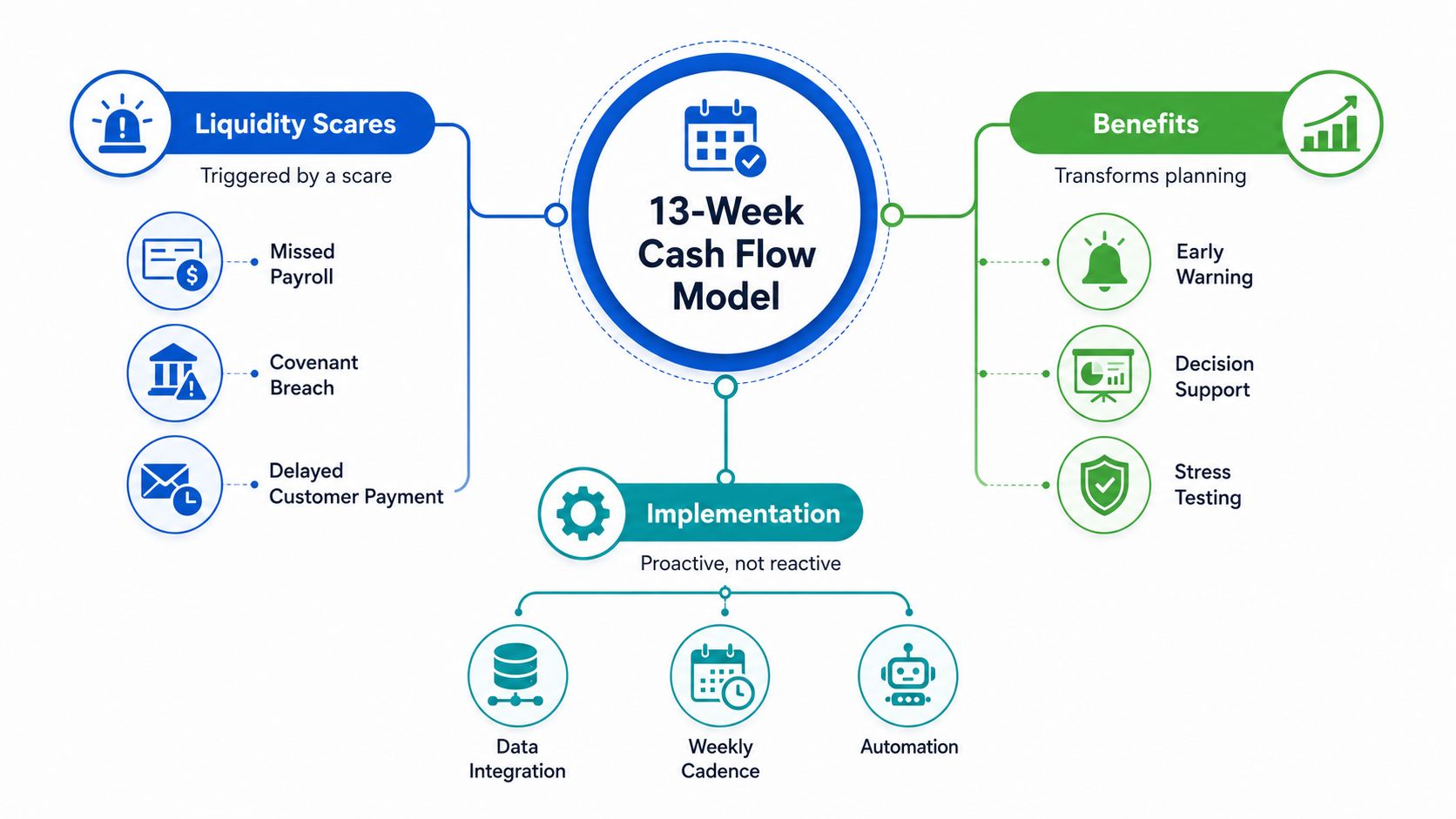
The first sign usually isn't a headline crisis. It's the Tuesday where payroll lands, a vendor wants payment early, and the bank balance doesn't match the comfort level in the monthly forecast. That's when 13 week cash flow modeling stops being a spreadsheet exercise and becomes the only view that tells you whether the business can keep moving without improvising every Friday.
For operators, the model works because it is brutally practical. It tracks opening cash, weekly inflows, weekly outflows, and ending cash on a rolling basis, which is why it's widely used by PE-backed companies and lenders for liquidity management and covenant reporting (Centime). For global and web3 teams, the same discipline matters even more because cash doesn't just arrive late, it can arrive in the wrong currency, on the wrong rail, or after a conversion step that adds timing risk.
Table of Contents
Why the 13-Week Horizon Matters for Modern Treasury
A CFO I've worked with used to describe the first good cash forecast as the moment the panic moved from the bank account to the spreadsheet. The team had a customer delay, a payroll date that didn't move, and enough runway to see the issue only after it had already started to shape decisions. That's exactly where a 13-week horizon earns its place, because it gives treasury teams a near-term view before monthly statements or quarterly budgets become useful.
The window is typically built as a rolling weekly forecast covering about 90 days, and the industry has standardized around it because that span is short enough for high-confidence operating decisions and long enough to catch trouble early (Centime). In practice, the forecast is refreshed every week, with the completed week dropping off and a fresh week added to keep the horizon intact. That cadence is what turns the model into a control mechanism instead of a static document.
What the model actually measures
The core structure is simple on purpose. It starts with opening cash, then projects weekly receipts and disbursements, and finishes with ending cash for each of the 13 weeks (Centime). That simplicity is useful because treasury teams don't need a grand narrative, they need to know whether payroll, suppliers, debt service, and other short-term obligations will clear.
The model also uses the direct method, which means it forecasts real cash movement rather than accrual-based profit. That distinction matters in any business where revenue recognition and cash collection don't line up cleanly, and it matters even more in global operations where payment timing can shift by rail, counterparty, or currency. A monthly P&L can tell you that the business looks fine. A direct cash forecast tells you whether the money is there.
Practical rule: if a line item can't be tied to a cash receipt or cash disbursement date, it doesn't belong in the weekly forecast yet.
For teams that want a template-oriented starting point, the 13 week cash flow template tips resource is useful because it stays close to the operational reality of building the model rather than turning it into theory. For larger treasury setups, a broader operating view such as global treasury management helps frame how the weekly forecast fits into cross-border decision-making.
Building the Model Structure and Gathering Inputs
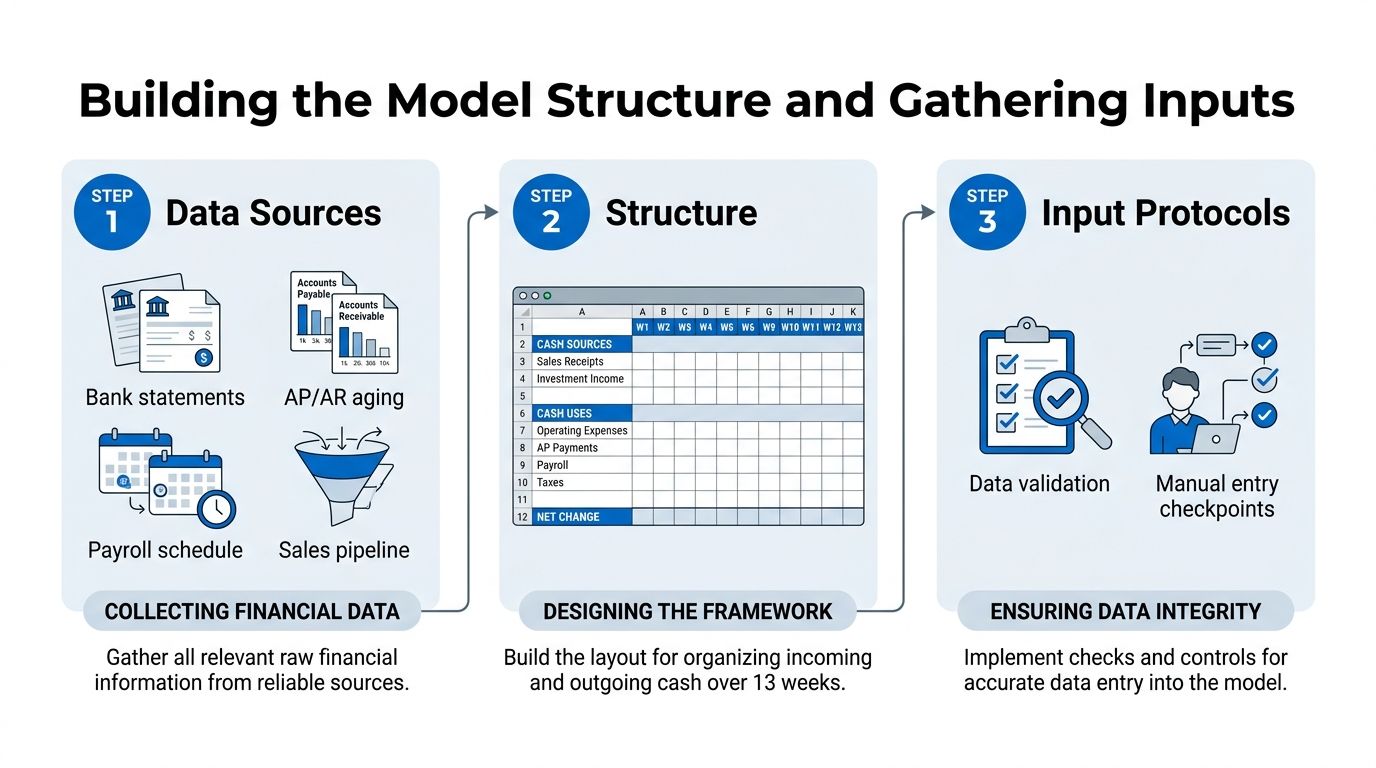
A usable model starts with fewer assumptions than most finance teams expect. The point isn't to make the spreadsheet clever, it's to make it honest. That means pulling actual timing data from the systems that already know what's happening, then forcing the forecast to follow the cash, not the other way around.
Start with the right data sources
The most reliable inputs come from bank balances, AR aging reports, AP aging reports, payroll schedules, debt service calendars, tax payment dates, and known capex items. A model built without those sources is usually just a guess with columns.
Collections deserve special attention because they can account for 60% to 80% of total forecast variance, which is why collection timing often dominates the forecast conversation (CFO Tech Stack). That doesn't mean every receipt needs to be modeled with false precision. It does mean the person owning receivables needs to give treasury a weekly view that is specific enough to be actionable.
For recurring businesses, a guide to recurring revenue helps clarify which receipts are structurally predictable and which ones still need collection discipline. The important distinction is between revenue that has been booked and cash that has landed.
Keep the structure blunt and readable
A working layout is usually the same whether you're in Excel, Google Sheets, or a treasury platform. The top row shows opening cash. The middle of the sheet holds categorized inflows and outflows. The bottom shows net cash change and ending cash for each week. That design is useful because it forces every forecasted movement into a visible weekly lane.
The mistake I see most often is mixing accrual revenue into the cash section. Another common error is hiding one-time items, like tax payments or capex, inside a recurring line. Once that happens, the model may still look tidy, but it stops being a forecast and becomes a summary of hope.
A clean approach is to separate:
- Recurring inflows, such as customer collections tied to actual invoices.
- Recurring outflows, such as payroll, rent, and supplier payments.
- One-time events, such as tax bills, legal settlements, or equipment purchases.
- Financing flows, such as debt draws or repayments.
The best weekly model is boring in a good way. Every line has an owner, every date has a source, and every exception has a place to go.
Layering Multi-Currency and Crypto Flows Into the Forecast
Single-currency models break the moment a business starts collecting in one place and paying in another. That's normal for cross-border SMEs, and it's even more common for web3 teams moving between fiat and digital assets. The forecast doesn't need to become complex, but it does need to admit that money can be “available” on paper long before it is available to spend.
Build parallel currency lanes
The cleanest way to handle multi-currency cash flow is to keep parallel lanes inside the same weekly framework. One lane tracks the base currency, another tracks major operating currencies, and a separate lane tracks conversion events. That lets treasury see both the local operating picture and the consolidated liquidity picture without collapsing everything too early.
If a team is trying to assess rate pressure, assess relative currency power can be a helpful external reference point, but it shouldn't replace an internal cash schedule. Forecasting isn't about predicting markets perfectly. It's about making sure the timing of the conversion doesn't surprise the team.
The key operational question is not “what is the FX rate today?” It's “when does the cash become usable after settlement and conversion?” SWIFT, ACH, card settlement, and blockchain confirmation all behave differently, so they belong in different timing buckets. A treasury team that lumps them together usually discovers the gap after the week has already closed.
Useful rule: treat every cross-currency move as two events, the payment event and the availability event.
For businesses handling both fiat and crypto in one operating stack, multi-currency business accounts can reduce the reconciliation burden because the cash picture is visible in one place rather than spread across disconnected portals. The operational win is not just convenience, it's fewer places for timing mismatch to hide.
Respect conversion windows and settlement friction
Crypto adds a second layer of timing risk. A USDC receipt may be fast, but the cash planning question is still whether that asset sits as a usable balance, gets converted immediately, or waits for a treasury decision. That gap matters when payroll, vendor settlement, or tax obligations are already scheduled for the same week.
The best practice is to model crypto-to-fiat conversion as its own weekly line with a specific settlement assumption. That keeps the forecast aligned with reality and avoids overstating spendable cash. I've seen teams get into trouble when they treated digital asset balances as though they were already operating cash, then found themselves waiting on conversion or internal approval.
A practical setup also assigns a buffer to volatile currencies and conversion timing. Not because the forecast needs to be conservative for its own sake, but because liquidity mistakes are expensive when obligations are near-term and irreversible. In a global or web3 business, the 13-week model works best as a translation layer between how money moves and how the business spends it.
Running the Weekly Refresh and Variance Analysis
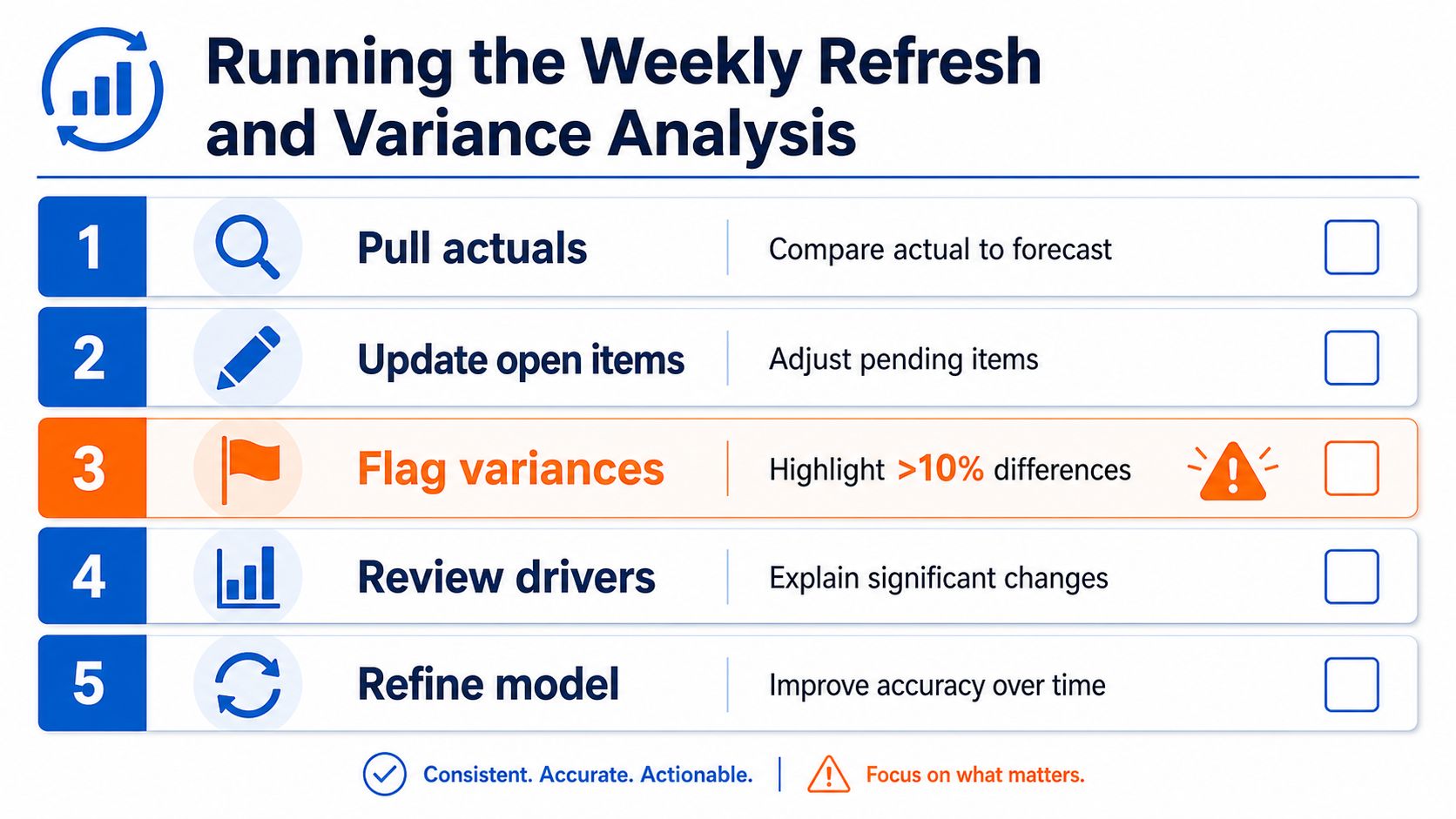
A forecast that isn't refreshed weekly is just a historical artifact with a future-looking header. The operational value comes from the rhythm. Each week, the team closes the prior week, pulls actuals, updates the remaining horizon, and asks the same hard question, where did the forecast diverge from reality?
Use actuals to tighten the model
For mature models, near-term accuracy can get quite granular. One industry guide says weeks 1 to 4 can target accuracy above 85%, with line-item accuracy ranges of 80% to 92% for accounts receivable collections and 88% to 95% for accounts payable payments (CFO Tech Stack). That doesn't mean every forecast should chase false precision. It means the first month of the model should be treated as a weekly operating commitment, not a loose estimate.
The refresh cadence is straightforward. Drop the completed week, add a new week at the end, and update actual bank activity from the latest feeds. Then compare forecast to actual, isolate the deltas, and mark the drivers. Collections usually need the most scrutiny, because customer behavior is where the model tends to drift first.
A useful way to run variance analysis is to split it into three questions:
- What changed? Identify the exact line item that missed.
- Why did it change? Separate timing issues from true volume changes.
- What should we do differently? Turn the finding into a collection action, payment adjustment, or spending decision.
Assign ownership, not just accountability
Most spreadsheets fail because nobody owns the lines. Treasury owns the model, but AR owns the collection assumptions, AP owns supplier timing, HR owns payroll timing, and operations owns many of the one-off cash events. If those owners don't participate, the model becomes one person's best guess about everyone else's work.
Variance review is not a reporting ritual. It's the meeting where the next week's decisions get better.
The point of the weekly cadence is that it gives the business a disciplined feedback loop. If the forecast keeps missing on a specific line, the assumption gets tighter. If a payment habit changes, the team updates the model. Over time, the forecast becomes a working instrument rather than a static plan.
Automating Cash Flow Workflows and Reducing Manual Work
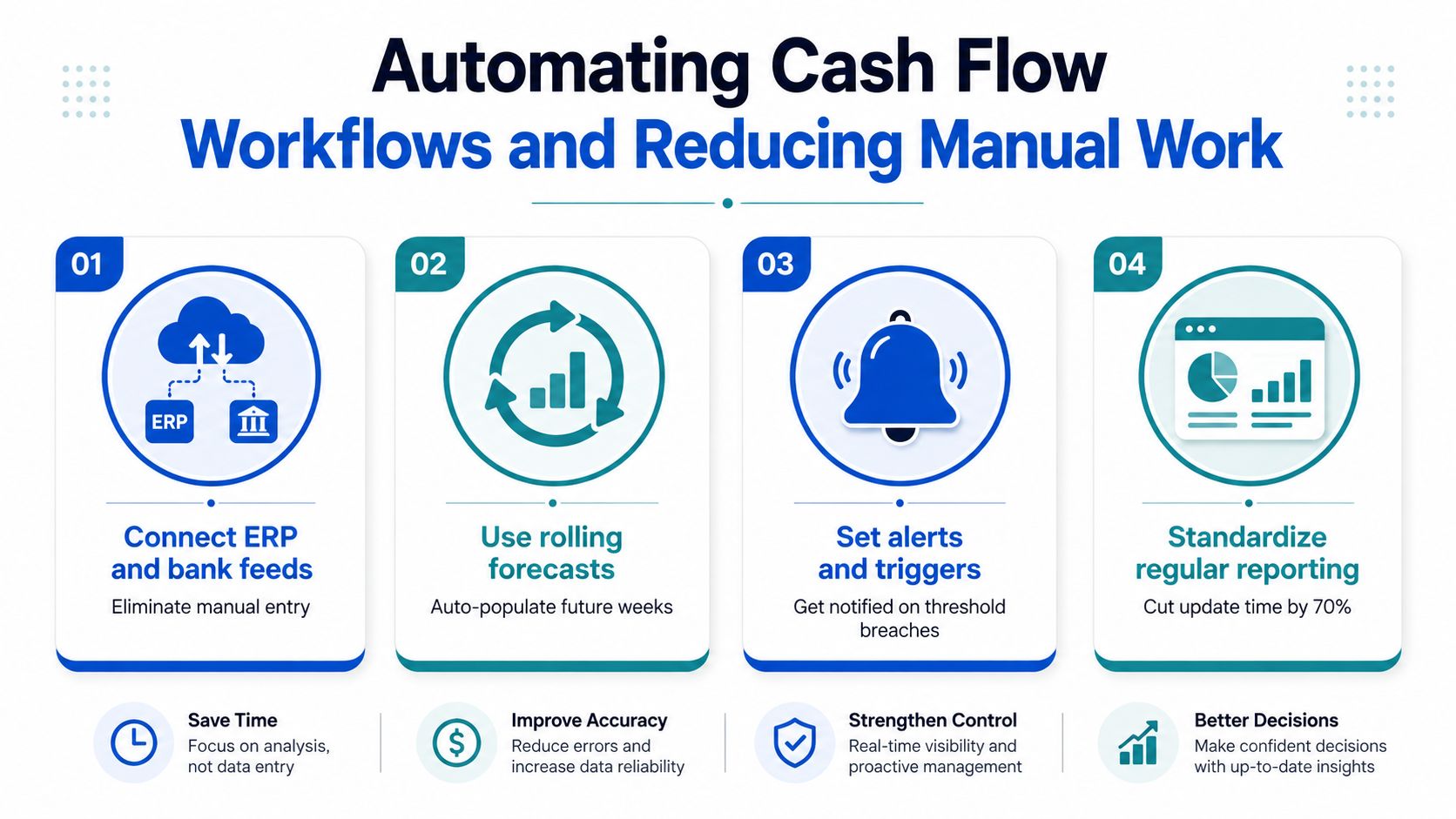
Manual update fatigue kills more forecasts than bad formulas do. Spreadsheets don't fail because the math is difficult, they fail because the data gets stale, the copy-paste step gets rushed, and the weekly refresh turns into a chore nobody wants to own. Automation helps most when it removes the repetitive parts, not when it tries to replace treasury judgment.
Automate the boring inputs first
The first automation targets should be the least controversial ones, bank feeds, ERP pulls, and scheduled exports from AR and AP. Those are the data sources that change every week and cause the most copy effort. Once they're connected, the forecast stops depending on manual transcription.
A lot of teams start with scenario analysis because it feels strategic, then discover they still can't trust the base case. That's backwards. Scenario planning only gets useful once the core model is fed by timely actuals. After that, best-case, base-case, and stress-case versions become easy to maintain because the skeleton is already current.
For crypto-fiat workflows, a unified payments and treasury interface can eliminate a lot of reconciliation work, especially when ACH, wire, SWIFT, and digital asset activity all touch the same operating account. That matters because every disconnected system adds one more place where the weekly refresh can stall. A helpful reference for teams that want to think specifically about this operational layer is automated payment solutions for crypto invoicing.
Standardize alerts and exception handling
The gain from automation isn't just speed. It's that the team can focus on exceptions instead of re-entering routine data. If the forecast is wired to flag threshold breaches, delayed receipts, or unusual payment patterns, treasury gets to react earlier.
A production-ready setup usually includes:
- Automated bank reconciliation, so opening and closing balances aren't hand-keyed.
- Scheduled AR and AP imports, so timing assumptions reflect current aging data.
- Alerting on variance thresholds, so misses don't wait until Friday.
- Reusable scenario templates, so stress cases don't need to be rebuilt from scratch.
That last piece matters more than people think. Once scenario inputs are standardized, the team can ask faster questions. What happens if collections slip? What happens if a conversion settles a day later? What happens if a vendor decides not to wait? Those are the questions a treasury operator needs answered before the business commits.
Treating the 13-Week Model as a Liquidity Floor
The biggest mistake I see is treating the 13-week model as the whole treasury plan. It isn't. It's the liquidity floor, the highest-confidence view of near-term cash, and that makes it indispensable. It also means it has a boundary, because structural risks like seasonality, long sales cycles, or currency mismatches don't always show up cleanly inside a 13-week frame.
A better setup is layered. The 13-week model handles near-term cash decisions, while a longer-horizon forecast captures seasonal working-capital swings, financing events, and strategic capital allocation. That avoids the false comfort of a single forecast trying to do every job at once.
The other advantage of the layered approach is communication. Boards usually need the short-term cash view, because it answers whether the business can stay liquid through the next operating cycle. Operators need the same view translated into decisions, whether that means holding back discretionary spend, accelerating collections, or delaying a conversion until the timing is right.
A 13-week model deserves to be the most trusted forecast in the finance stack, not the only one. Treat it as the weekly control layer, then let broader planning tools carry the strategic horizon. That separation keeps the model honest, the team focused, and the decisions grounded in actual cash instead of accounting comfort.
If you're trying to build a cleaner weekly treasury process across fiat and crypto, OneSafe can help you bring the cash movements, multi-currency balances, and payment workflows into one operating view. Visit OneSafe to see how its global accounts and payment tools can support the same liquidity discipline this model depends on.