A supplier payment leaves your ERP on time. Treasury approves it. Your bank accepts the file. Then the payment stalls because the beneficiary address is incomplete, a regulatory field wasn't structured correctly, or a counterparty detail can't pass validation on the receiving side.
That's the moment many finance teams realize ISO 20022 compliance isn't just a bank project.
For a long time, companies could treat payment formatting as something their bank or TMS would “handle in the background.” That assumption is getting weaker. The shift to richer, more structured payment messages means upstream business data now matters much more. If vendor onboarding stores addresses in free text, if AP teams use inconsistent naming, or if treasury exports old fields into new formats, a payment can still fail even when everyone involved thinks the organization has already migrated.
This matters most for businesses that move money across borders often: international SMEs, marketplaces, payroll teams, web3 firms, and companies paying global vendors in mixed fiat and digital-asset workflows. If your operations depend on speed and low manual touch, structured payment data has become part of day-to-day execution, not just infrastructure policy.
Table of Contents
- Introduction to ISO 20022 Compliance and Why It Matters Now
- From message text to structured fields
- Why richer messages help operations
- A simple example
- The phased rollout across major infrastructures
- The cutoff that changed the tone
- What this means in practice
- Why “valid” and “compliant” aren't the same thing
- The bank view and the corporate view
- A useful way to think about it
- Where the failures start
- Why this issue keeps showing up
- Why smaller international teams feel it first
- Start with payment flow mapping
- Clean and structure source data
- Test with banks and system providers
- Update people, not just platforms
Introduction to ISO 20022 Compliance and Why It Matters Now
A payment can leave your ERP, pass internal approval, and still fail for a reason the finance team did not expect. The bank has funds. The supplier is real. The instruction looks complete. Then the payment is stopped because the beneficiary address sits in one free-text field, a legal name does not match the record on file, or a required detail cannot be read cleanly by the receiving system.
That kind of failure changes how companies should view ISO 20022 compliance. It is not only a bank network upgrade. It is a test of whether your business stores payment data in a form that other systems can validate and use.
The timing feels more immediate because ISO 20022 is already shaping how payment infrastructures exchange information across major markets. For finance teams, the practical question is no longer whether the standard matters. The practical question is whether your vendor, payroll, customer, and treasury data can survive stricter validation once a payment leaves your systems.
A useful way to frame it is this: ISO 20022 works like a move from handwritten shipping labels to machine-readable labels. If the destination street, postal code, or recipient name is incomplete, the courier does not care that your warehouse software is modern. The parcel still gets pulled aside. Payment operations now work much the same way.
Practical rule: If a cross-border payment needs manual repair after submission, your ISO 20022 risk usually starts in the source data.
This is why technically ready firms still get caught out. Their bank may support the right message format. Their TMS or ERP may produce the right file type. But if supplier onboarding stores addresses inconsistently, if AP abbreviates legal entity names, or if treasury inherits outdated counterparty records, the payment can still be rejected, delayed, or routed for review.
That problem shows up most clearly in businesses that operate across multiple rails and jurisdictions. Teams managing international payouts alongside digital-asset operations often face the same underlying issue described in banking challenges for web3 companies: fragmented rails usually come with fragmented data ownership.
For finance teams, the core shift is straightforward. Compliance now depends on data governance as much as connectivity.
That includes:
- Counterparty records: Legal names, addresses, and account details need consistent structure, not just a filled-in text box.
- Payment instructions: References, purpose fields, and regulatory details need to be complete before the file is created.
- Team ownership: Treasury cannot correct data that procurement, AP, HR, or vendor onboarding never captured properly.
A company can be connected to modern payment infrastructure and still be unprepared operationally. That gap is where many payment exceptions now begin.
What ISO 20022 Is and How It Changes Payment Messages
The easiest way to understand ISO 20022 is to compare old payment messages with old paper forms.
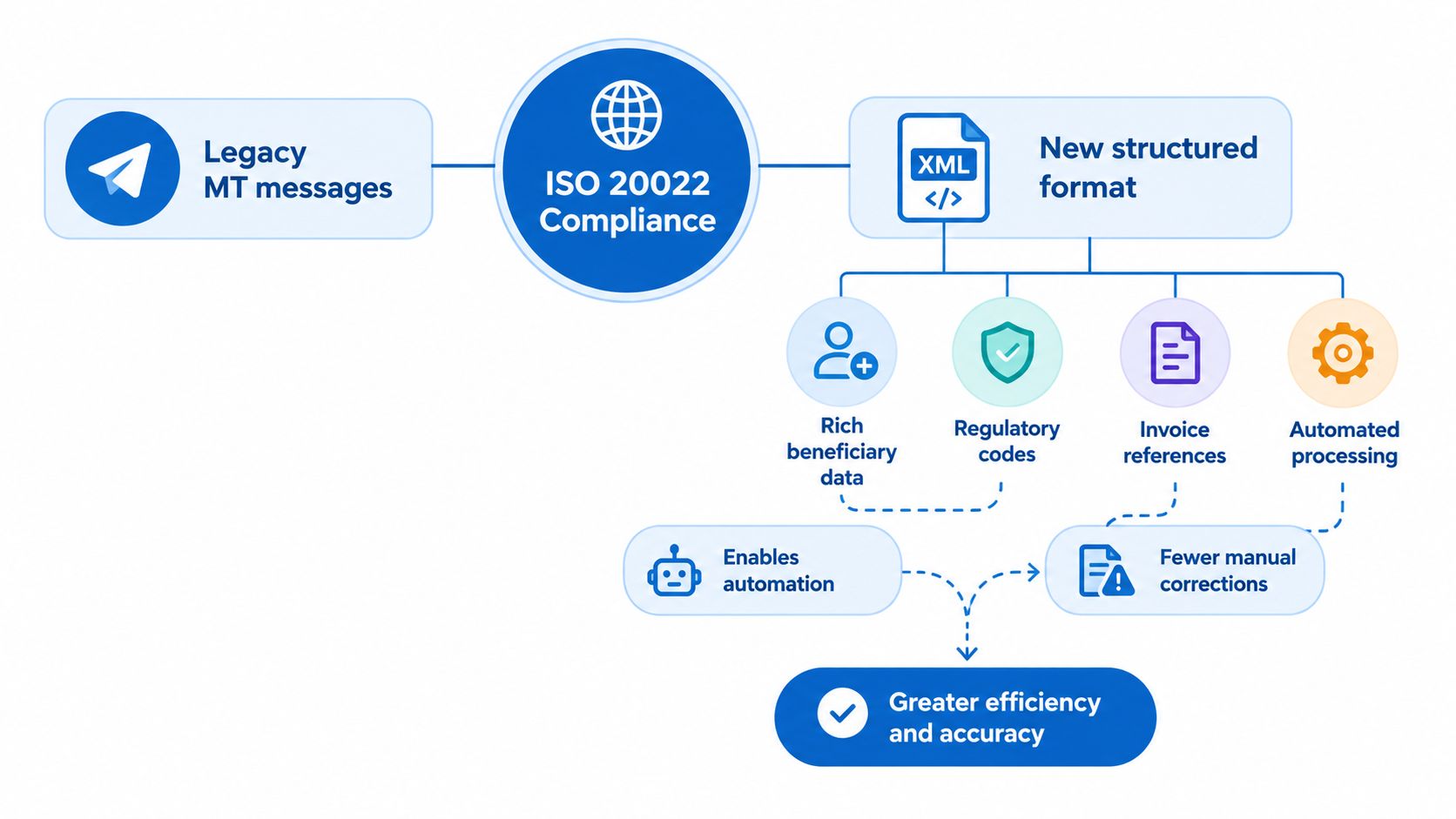
Legacy MT messages are a bit like tightly compressed telegrams. They carry the essentials, but they often squeeze multiple pieces of information into limited text fields. ISO 20022 works more like a structured digital form. Instead of packing details into one text box, it separates them into defined fields that systems can read more reliably.
That doesn't only help banks. It helps any business that needs cleaner reconciliation, better sanctions screening, clearer remittance information, and fewer manual repairs.
From message text to structured fields
With ISO 20022, payment data is typically exchanged in XML-based message structures. Finance teams don't need to become XML experts to grasp the practical impact. The key point is that structured messages break information into named elements.
Instead of one long free-text line, a payment can distinguish between:
- Beneficiary identity: Legal name and related counterparty details
- Address components: Structured location information instead of one messy field
- Regulatory data: Data needed for screening and reporting
- Remittance details: Invoice or payment references that support reconciliation
That structure reduces guesswork. A receiving institution doesn't have to infer whether part of a line is a city, invoice number, or compliance note.
Why richer messages help operations
Structured messages improve how payment data moves through internal systems. Treasury can reconcile faster when invoice references stay intact. Compliance teams can screen more consistently when names and addresses are stored in dedicated fields. AP can spend less time answering “what was this payment for?” after the transfer has already left.
For teams that rarely touch international payment plumbing, a primer on why Swift matters for credit unions is also useful because it shows the role of the messaging network behind many cross-border flows. Once you understand that the network carries instructions, not just money, the importance of message quality becomes more obvious.
Richer payment messages don't magically fix poor source data. They expose it.
A simple example
Suppose your company pays a contractor abroad.
In a legacy-style setup, the payment instruction might carry a single address line and a short reference that gets shortened again downstream. In an ISO 20022-style flow, the contractor's details can be separated into clearer fields and the remittance information can travel with more structure. That gives each party in the chain a better chance of interpreting the payment correctly.
For finance teams, the practical takeaway is this:
| Message style | Typical behavior | Operational result |
|---|---|---|
| Legacy compressed format | Multiple details crammed into limited text fields | More interpretation and more repair work |
| Structured ISO 20022 format | Data split into defined fields | Better automation and cleaner downstream handling |
The standard changes payment messaging from “read this line and figure it out” to “read this field and process it.”
Global Migration Timeline and Key Deadlines You Should Know
A finance team can feel "done" with ISO 20022 because the bank says its migration is complete, then hit a payment rejection the first week a new corridor goes live. The file moved. The message format was accepted. The supplier address or beneficiary record still failed further down the chain.
That is why the timeline matters. It is not only a bank technology calendar. It is a schedule for when stricter data expectations start affecting real payments.
The phased rollout across major infrastructures
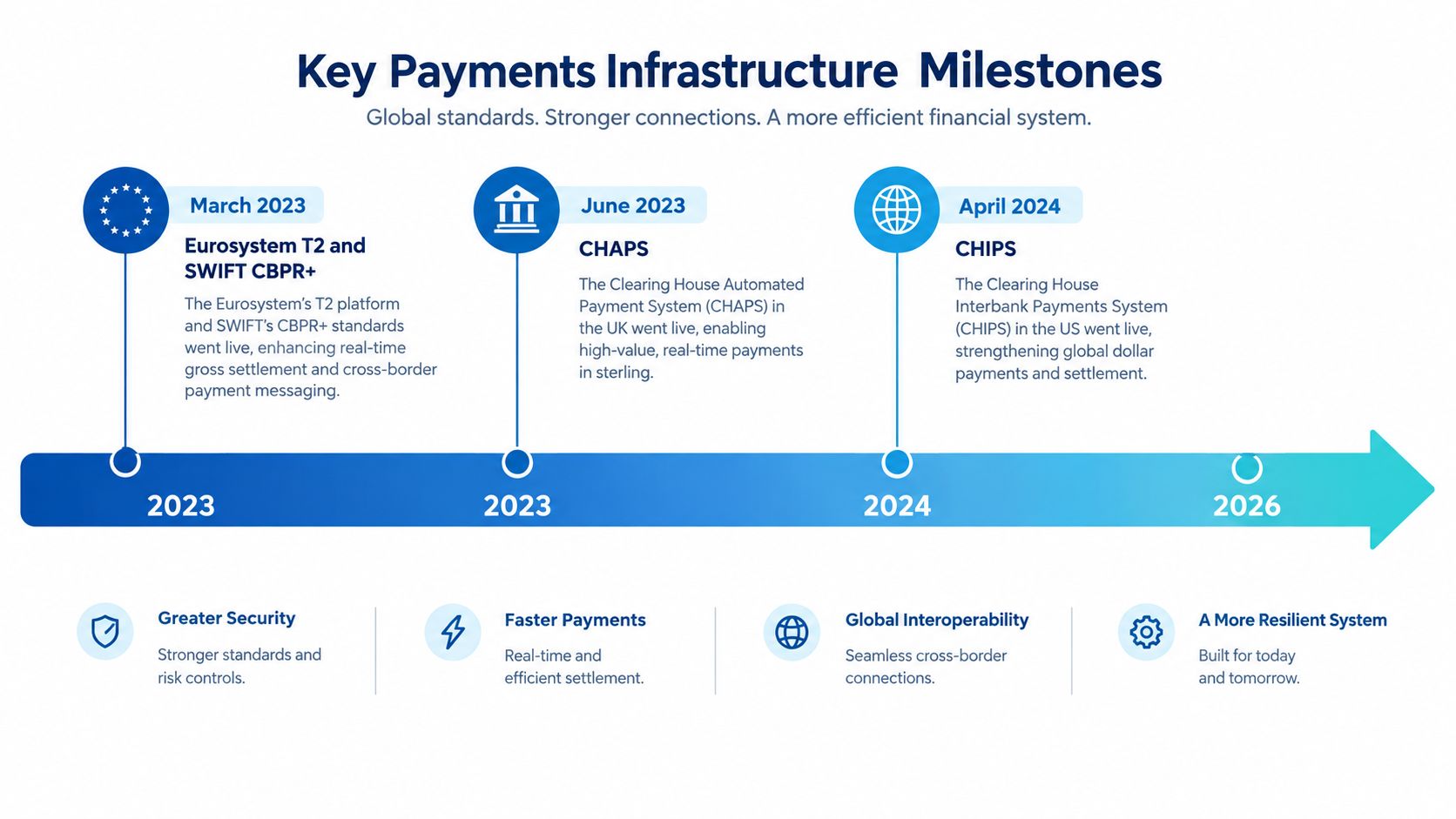
The global shift has happened in stages. Major infrastructures moved on different dates, including Eurosystem T2 and SWIFT CBPR+ in March 2023, CHAPS in June 2023, CHIPS in April 2024, and Fedwire Funds Service in July 2025, as noted earlier.
That staggered rollout creates a practical problem for corporates. A company can send clean domestic payments through one banking channel and still struggle with cross-border flows through another. The reason is simple. Different rails, banks, and market practices start enforcing richer field usage at different times.
A useful comparison is airport security. Your passport may get you through one checkpoint, but another checkpoint may stop you because a supporting document is incomplete. Payment data works the same way. The XML structure may pass, while the address, name, or remittance details still fail a market rule or bank validation step.
This becomes more visible in supplier payments, payroll, and treasury settlements that cross borders. Teams reviewing B2B cross-border payment operations across different rails often find that the question is not only which network is in use, but which source system owns the party data that feeds it.
The cutoff that changed the tone
One deadline changed the conversation from migration planning to operating discipline. For SWIFT cross-border payments in CBPR+ scope, the coexistence period for MT and MX messages ended on 22 November 2025, after which in-scope cross-border payment instructions must be exchanged in ISO 20022 format. SWIFT also states that from 1 January 2026, additional charges apply for contingency processing for MT senders and for in-flow translation of payment instruction messages (SWIFT CBPR+ timeline and charging update).
For finance and operations teams, that means fallback is no longer a comfortable buffer. It becomes an exception path with cost, delay risk, and more manual repair work.
A short explainer can help if you need to brief colleagues or leadership:
What this means in practice
The dates are easier to manage if you read them in three layers:
- Bank readiness: Your banks may already support the new message standard on the corridors you use.
- System readiness: Your ERP, TMS, payment factory, or middleware may still export data in ways built around older field limits.
- Data-governance readiness: Your vendor and customer records may still store addresses, legal names, and references as free text that breaks validation once richer fields are enforced.
The third layer is where technically ready firms often get caught. Their bank connection is live. Their file can be generated. Their counterparty master data is still too messy to pass consistently.
The deadline your team feels first is the one that exposes weak source data.
That is why ISO 20022 timelines should be read as a data-governance timeline for corporates, not only as a migration schedule for banks.
What ISO 20022 Compliance Really Means for Banks and Corporates
A lot of confusion comes from one false assumption: that ISO 20022 compliance is a certificate you either have or don't have.
It isn't.
The ISO 20022 community states that there is no official certification authority, so compliance is generally established by implementing the relevant scheme rulebook, message definitions, and validation controls for the specific market or network. It also notes that a message can be structurally valid ISO 20022 and still fail network rules such as CBPR+ or local implementation guidelines (ISO 20022 compliance checklist).
Why “valid” and “compliant” aren't the same thing
A payment message can pass an XML schema check and still be rejected by the network it's meant to travel on.
That's because there are usually two layers of validation:
- Schema validation checks whether the message fits the technical structure.
- Market or scheme validation checks whether the message follows the rulebook for that specific rail.
The second layer is where many teams get caught off guard.
| Validation Level | What It Checks | Example Failure |
|---|---|---|
| Schema valid | The message is technically structured correctly | A field exists in the right format, but content is too generic for market use |
| Network compliant | The message follows scheme rules and usage guidelines | A payment is rejected because required market-specific data is incomplete or used incorrectly |
The bank view and the corporate view
Banks usually focus on message construction, translation, routing, sanctions screening, and network acceptance. Corporates often focus on file generation, payment approval, and successful settlement. Those views overlap, but they aren't identical.
For a corporate finance team, “we're compliant” should mean something narrower and more practical:
- Our systems can produce the right message structure
- Our data meets the rule expectations of the banks and rails we use
- Our operations team knows what to do when a bank changes field requirements or usage guidance
That last point matters because the standard is global, but implementation is not perfectly uniform.
A useful way to think about it
Treat ISO 20022 compliance like tax filing in multiple countries. The basic framework may be familiar, but each jurisdiction still applies its own rules, formats, and local expectations. Knowing the form exists doesn't mean your filing will be accepted.
Working rule: A technically correct message can still be operationally wrong for the rail you're using.
That's why corporate treasury shouldn't stop at “our bank supports ISO 20022.” The better question is, “Which message types, fields, and data rules apply to our payment flows, and who owns them internally?”
Why Data Quality Is the Real Compliance Failure Point
A payment file can leave your ERP, pass internal approval, reach the bank, and still fail for a reason that has nothing to do with message syntax. The problem is often the underlying record. A supplier address stored in one free-text line, a legal name copied three different ways, or a missing country field can break validation even when the XML structure is correct.
That is why many finance teams discover that ISO 20022 compliance is not only a formatting project. It is a data-governance test. The standard asks your systems to send payment information in a more structured, machine-checkable form. If the source data was collected loosely, the payment process exposes it.
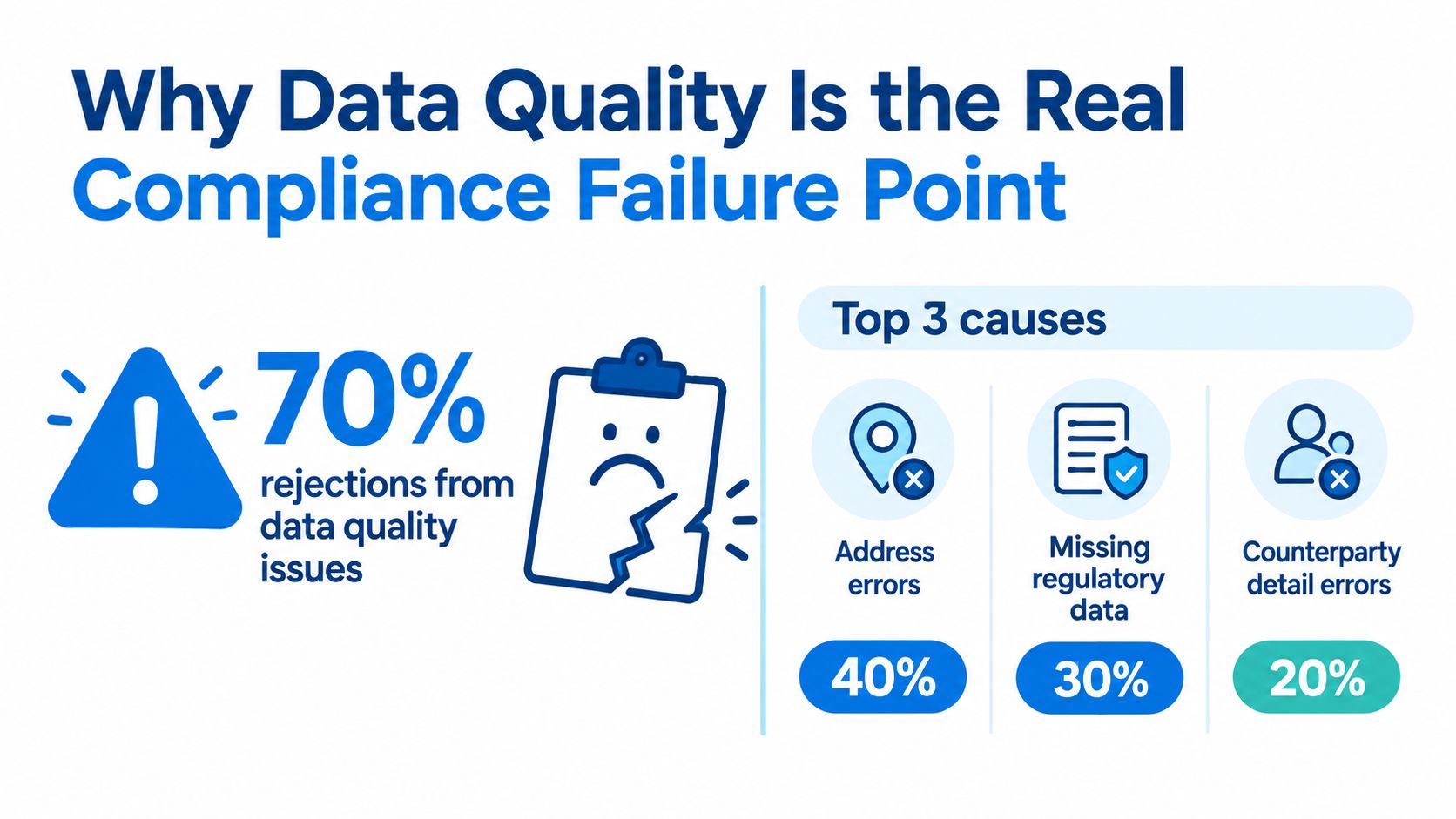
Recent industry coverage has warned that companies are underprepared as rejections rise when beneficiary address fields, regulatory data, or counterparty details fail validation. It also notes that unstructured address data is scheduled to no longer be accepted for many cross-border payments in the November 2026 phase, while MT101 initiation messages are scheduled to be retired (TIS warning on corporate readiness).
Where the failures start
The failure usually begins long before the bank sees the payment.
A useful comparison is shipping. If the label printer works but the customer record says only “Acme, near the station,” the parcel system is not the problem. Payments work the same way. ISO 20022 gives the network a clearer label format, but your vendor and beneficiary records still need the right parts in the right places.
Common upstream failure points include:
- Vendor onboarding: Supplier legal names, addresses, and banking details are entered with different conventions across teams or regions.
- Accounts payable: Staff copy payment details from PDFs, emails, or contracts into systems that do not enforce structure.
- Payroll and contractor payouts: International payee records may be missing location or regulatory fields needed for cross-border checks.
- Treasury file generation: Older export logic may still push combined text strings into fields that now expect cleaner formatting.
By the time a payment is rejected, treasury is often seeing the last symptom, not the first cause.
Why this issue keeps showing up
Structured messaging is already part of live cross-border traffic, not a side project. SWIFT reported that it was processing over 1,000,000 CBPR+ messages per day, representing 25% of total cross-border payments traffic on the SWIFT network. SWIFT also said CBPR+ involved more than 1,250 sending institutions and more than 5,750 receiving institutions, while 25% of received traffic was already in ISO 20022 format without in-flow translation (SWIFT CBPR+ adoption update).
For corporate finance teams, the lesson is straightforward. A company can pass a technical bank-connectivity project and still run into payment repairs, rejects, and manual callbacks because its master data was never built for structured validation.
Why smaller international teams feel it first
SMEs and web3 firms often see the impact sooner because they run lean, move fast, and pay across borders often. They may use several banks, local payout partners, and crypto workflows at the same time. That creates more handoffs and more chances for inconsistent counterparty records to slip through.
They also have less room for manual repair work. If one bank asks for a structured town and country code, and another tightens beneficiary name checks, operations feels the friction immediately. Someone has to fix the record, resend the payment, answer the supplier, and explain the delay internally.
That is why ISO 20022 compliance should be treated as a corporate data-readiness program. The firms that struggle are often not the ones with the weakest bank connection. They are the ones with payment-critical data scattered across ERP fields, spreadsheets, onboarding forms, and email trails.
Practical Steps to Prepare Your Business for ISO 20022
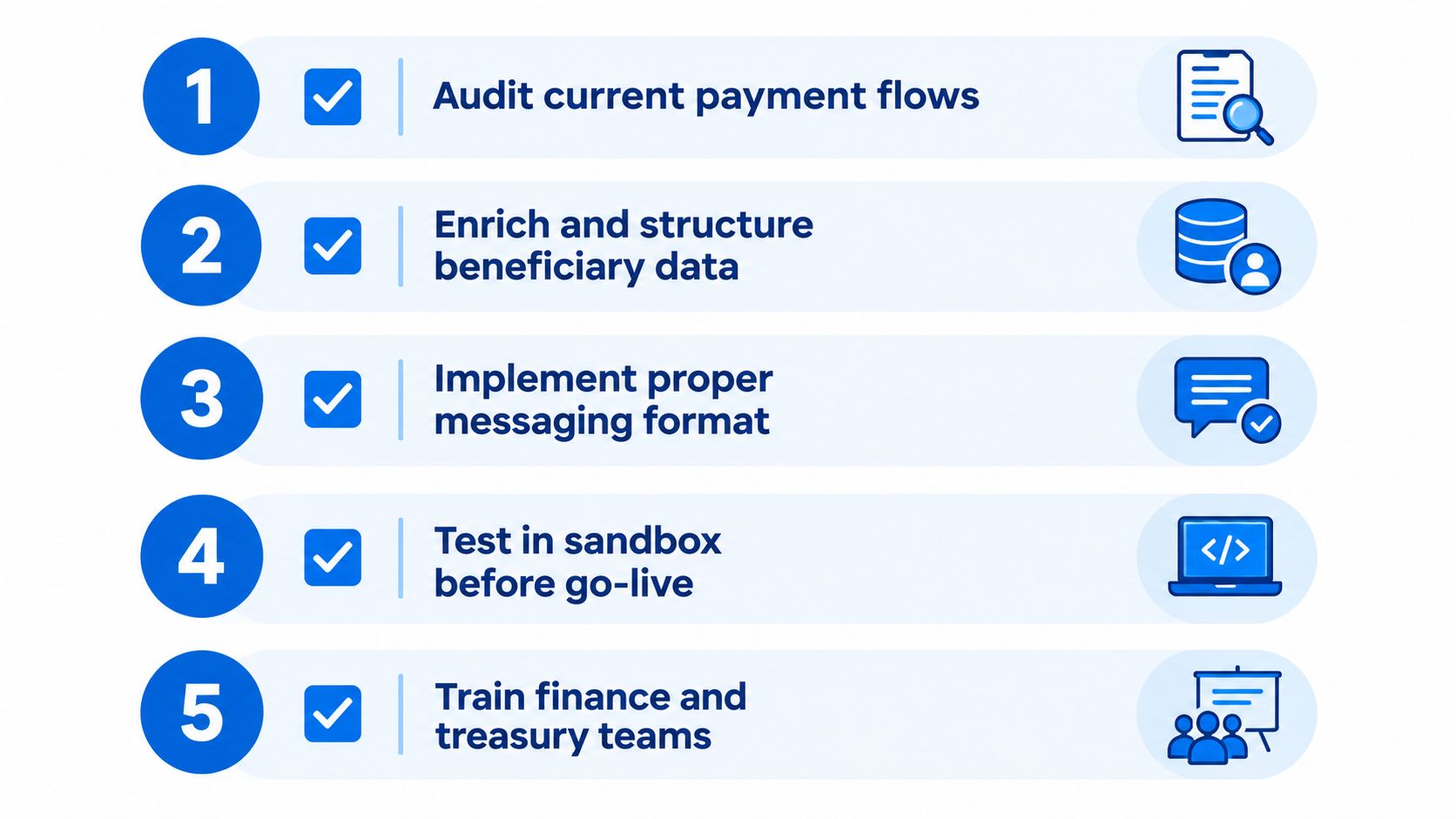
Most companies don't need a grand transformation program first. They need a disciplined cleanup plan with clear owners.
Start with payment flow mapping
Before changing systems, identify which payments matter most.
List your main outbound flows:
- Supplier wires: Especially cross-border and higher-value payments
- Payroll and contractor payouts: Including non-domestic recipients
- Treasury transfers: Intercompany and liquidity-related movements
- Customer refunds or marketplace payouts: If your business sends large volumes outward
Then note which bank, rail, file type, and internal source system supports each one. This often reveals hidden dependencies on old templates, old field assumptions, or manual enrichment done by one employee who “just knows how it works.”
Clean and structure source data
This is usually the highest-return step.
Review vendor, beneficiary, and counterparty records for:
- Address structure: Separate fields rather than one free-text block where possible
- Legal entity consistency: Avoid nickname-style payee naming
- Reference quality: Make sure invoice and remittance references are stable and readable downstream
- Required regulatory details: Capture them where they originate, not at release time
If procurement owns supplier onboarding, involve them early. If HR or payroll owns contractor data, involve them too. Treasury shouldn't be the only team carrying readiness work.
Readiness test: If your team still fixes beneficiary records by email right before payment release, your controls are too late in the process.
Test with banks and system providers
Ask your banks and vendors practical questions, not generic ones.
For example:
- Which ISO 20022 message types do we send or receive for our use cases?
- Which fields are mandatory in your implementation, even if the schema treats them more flexibly?
- Do you truncate, map, or reject unstructured values in specific fields?
- Where are we still relying on MT formats or translation services?
If any critical cross-border flow still depends on residual MT handling, plan its removal. SWIFT's charging changes for contingency and translation make lingering dependence more expensive operationally, even before you consider the support burden.
Update people, not just platforms
A clean implementation also needs training.
Finance operations staff should know:
- What a data-related reject looks like
- Which team owns remediation
- When to fix a vendor master record versus when to resubmit a payment
- How to escalate recurring field-level issues with banks or software providers
The strongest ISO 20022 programs usually look ordinary from the outside. They rely on better data capture, tighter review rules, tested payment flows, and teams who know where formatting risk really starts.
How OneSafe Helps Businesses Stay Compliant Across Fiat and Crypto Rails
For companies operating across both traditional banking rails and crypto workflows, one of the biggest practical problems is fragmentation. Payment data lives in one system, approvals happen in another, crypto conversions happen elsewhere, and treasury loses a clean view of what was sent, why it was sent, and which record supports it.
A unified operating model reduces that risk. One option is OneSafe, which provides multi-currency business accounts, global ACH, domestic and international wires, SWIFT transfers, corporate cards, and crypto-compatible workflows in one interface. For businesses that handle fiat and digital-asset activity together, that kind of setup can reduce handoffs between disconnected tools and make structured payment data easier to manage within one operating environment.
Why a unified rail view helps
ISO 20022 readiness gets harder when teams have to reconstruct payment context across separate systems.
A platform approach can help by keeping these elements closer together:
- Payment initiation and approvals: So treasury can apply consistent controls before release
- Multi-currency balances and FX activity: So settlement decisions don't sit outside the payment record
- Spend policies and user permissions: So governance doesn't rely on inbox approvals
- Fiat and crypto workflows: So operations teams don't lose visibility when value moves between rails
For firms building global operations with digital-asset exposure, this also overlaps with account structure. Practical setup considerations often start with basics like entity onboarding, account ownership, and workflow design, which are closely related to business bank account setup for fiat and crypto integration.
Controls matter as much as connectivity
The post-migration environment is not just about sending the right format. It's about preserving governance across multiple rails. That's where controls such as role-based approvals, spending policies, MFA, and Fireblocks-based digital asset custody support a more disciplined operating model.
That won't replace the need for clean source data. But it does help businesses centralize payment execution, reduce manual repair loops, and keep clearer audit trails when managing both bank and crypto activity.
If your team is dealing with cross-border payments, structured payment data, and mixed fiat-crypto operations, OneSafe offers a way to centralize those workflows in one place. You can use it to manage multi-currency accounts, SWIFT and wire payments, approvals, cards, and crypto-linked treasury activity with stronger operational visibility.