The books look right on Monday. By Friday, the bank balance no longer agrees with the ledger, a refund is sitting against the wrong invoice, and the foreign-currency settlement has used a rate nobody can explain. Nothing crashed. The sync accepted two different interpretations of the same transaction.
That's the uncomfortable reality of accounting software integration. A connector can be active, authenticated, and moving records while still creating reconciliation work, weak audit evidence, and doubt in management reporting. I've seen this during migrations from monolithic ERP environments to API-driven stacks. The hard part wasn't making systems communicate. It was deciding what each system meant, when a transaction became authoritative, and how finance could prove what happened afterward.
Table of Contents
- Phase one, map the data before building
- Phase two, design exceptions as normal work
- Phase three, test the cases that look harmless
- Phase four, cut over with evidence
When a Silent Sync Becomes a Quarter-End Problem
At quarter-end, the finance team usually discovers the problem through a mismatch rather than an alert. The payment platform marks an invoice as settled, the accounting system records a deposit net of fees, and the bank feed shows a different amount after an FX conversion. Each system is internally consistent. Together, they produce an exception that someone has to investigate manually.
Refunds expose the same weakness. An e-commerce platform may send a refund event before the original payout reaches the bank. A payment processor may group several refunds into a net settlement. The ledger still needs the original invoice, refund, tax treatment, payment reference, and settlement relationship. If the integration only transfers totals, the finance team inherits the translation work.
Practical rule: A successful API call proves that a system accepted data. It doesn't prove that the ledger received the right accounting meaning.
This is why an integration should be treated as a production reliability and finance-control problem, not a feature toggle. The foundational survey of SMB accounting and financial management software found that only 51% of respondents said all or most financial applications were integrated, while 45% still used manual entry through Excel or batch uploads and 29% used third-party tools such as Zapier or MuleSoft (SMB Group financial survey). The same survey found a clear size effect, with more than half of SMBs with over 500 employees reporting that almost all applications were integrated, compared with about one-quarter of businesses with fewer than 20 employees.
The practical consequence is familiar: staff spend close time chasing missing records, auditors ask why an adjustment lacks a source event, and executives stop trusting dashboards that should be fed automatically. A useful accounts payable audit guide can help expose control gaps, but the integration itself must preserve enough evidence to make those audits efficient.
This playbook focuses on the parts connector lists usually skip: schema mismatches, multi-currency behavior, exception handling, authentication, and transaction-level audit trails. It won't recommend a magic vendor or pretend that every workflow belongs in real time. Instead, it lays out the design choices that hold up after launch.
What Accounting Software Integration Actually Means
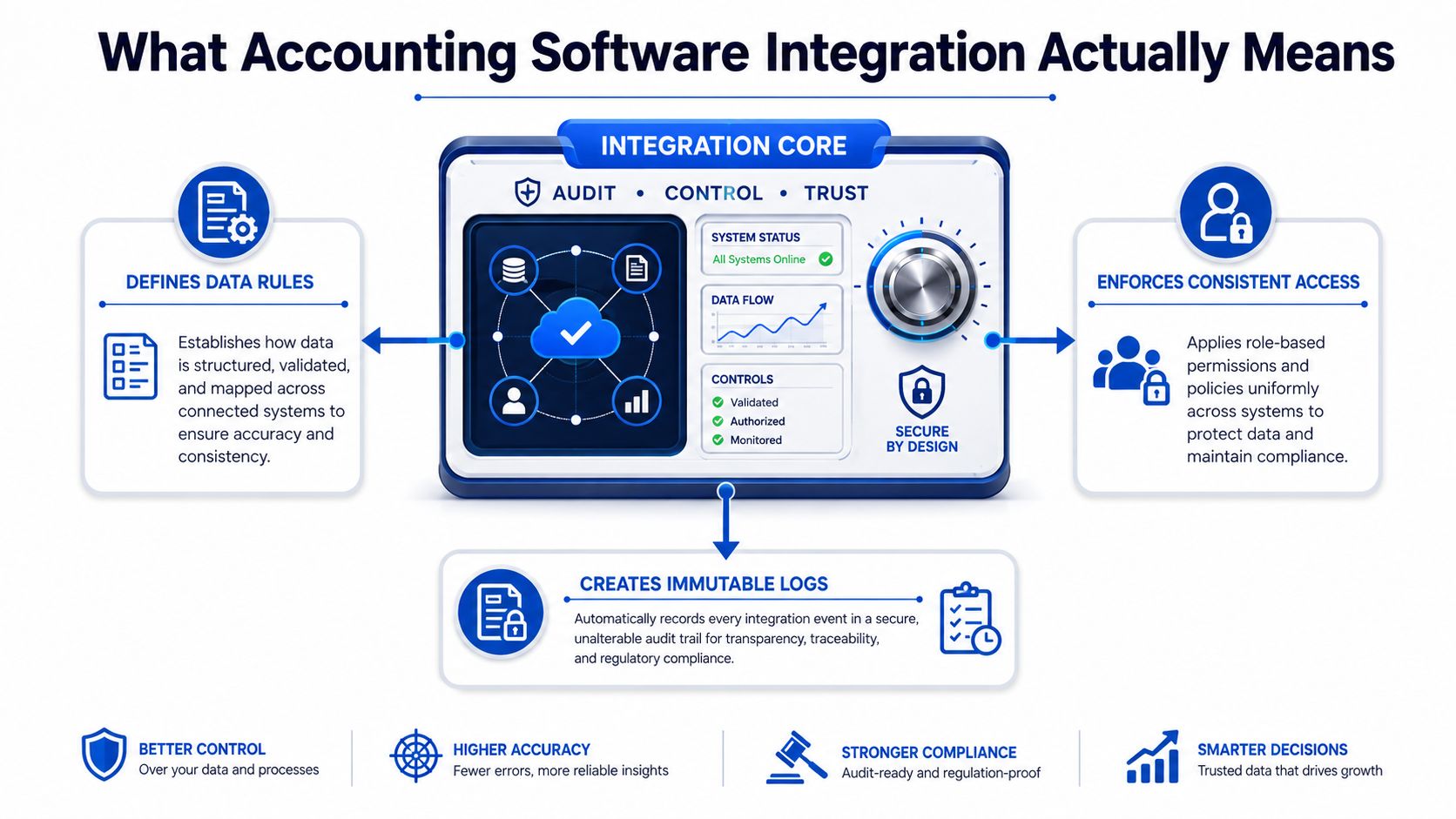
A working definition starts with the ledger, not the API. Accounting software integration is a persistent data-and-control contract between systems. That contract defines what objects move, how fields map, which system owns each value, when changes sync, how duplicates are prevented, and what happens when a record fails validation.
A connector that copies invoices from a billing platform into QuickBooks may satisfy a narrow data-transfer requirement. A production integration also needs to preserve invoice identity, line-item meaning, tax treatment, currency, payment status, approval state, and the evidence linking the source event to the journal entry. Without those controls, synchronization can create records while weakening reconciliation.
The five parts of a durable contract
A finance-grade integration normally answers five questions:
- Schema: How does an invoice, payment, journal, tax code, or customer map between providers?
- Identity: What stable identifier prevents one business event from becoming multiple ledger records?
- Timing: Should the system use a webhook, polling, scheduled batch, or controlled manual release?
- Exceptions: Where do rejected, incomplete, duplicated, or out-of-order records go?
- Policy: Who can authorize access, approve changes, release payments, or override a mapping?
This distinction matters because point-to-point connectors often hide their assumptions. A broader integration fabric makes mappings, credentials, event history, retries, and controls visible to both engineering and finance. That visibility becomes especially important when a business connects several accounting providers, payment systems, payroll tools, and regional tax workflows.
Historically, this architecture grew out of a shift away from monolithic ERP designs. Earlier systems such as SAP, Oracle E-Business Suite, and Oracle PeopleSoft centered finance, HR, and operations data in a shared database instance. Modern stacks more often connect separate systems through APIs, message-based protocols, and external integration layers. The integrated accounting software market was estimated at USD 21.38 billion in 2025 and projected to reach USD 44.78 billion by 2034, with a projected 8.56% CAGR, according to Fortune Business Insights' integrated accounting software market estimate.
For a practical comparison of the concept across specialized financial environments, the discussion of software integration for church extension funds is useful because it reinforces the same principle: integration has to preserve controlled financial workflows, not merely move fields.
Common Integration Targets and What Each Must Preserve
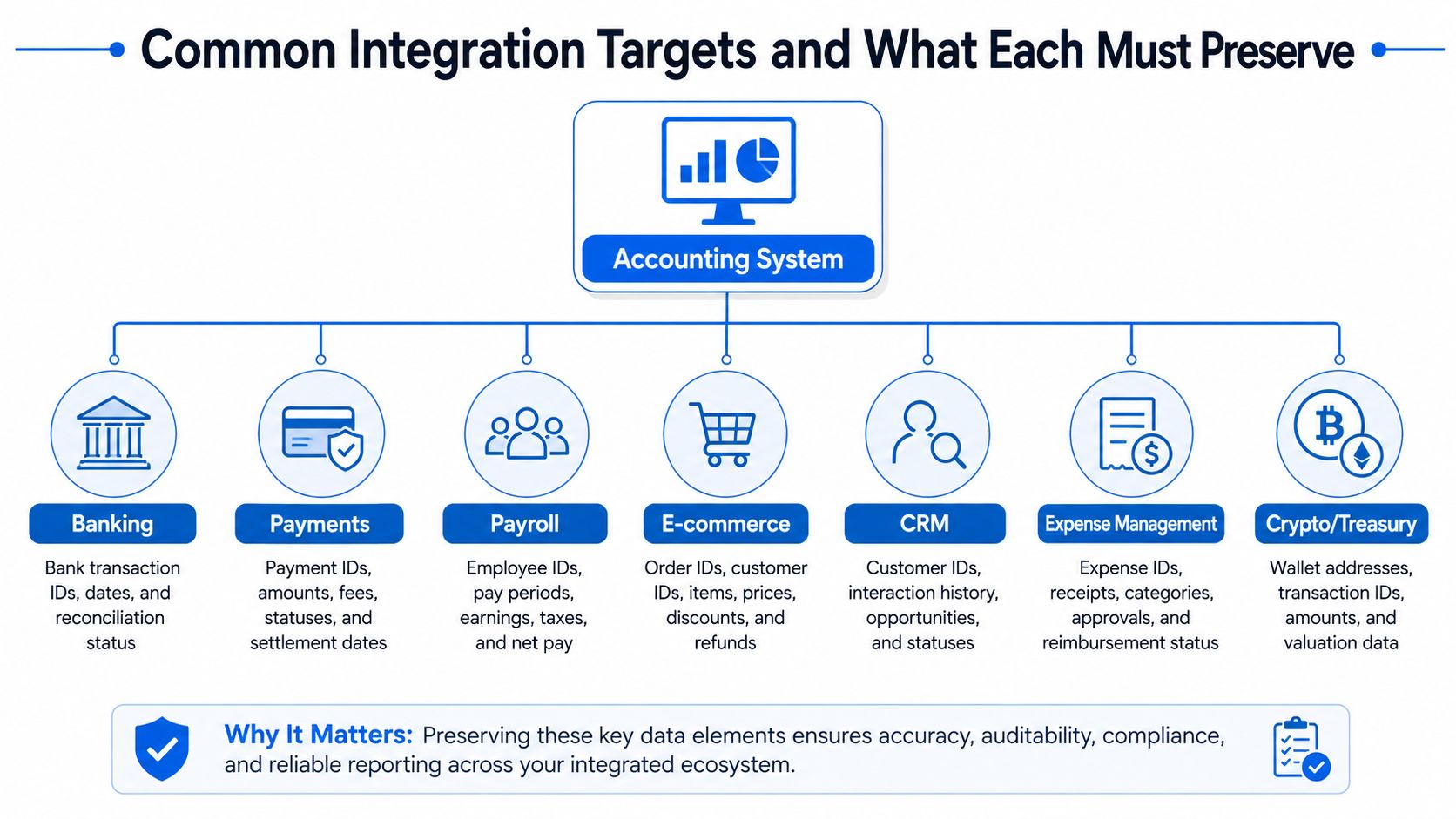
Every target system speaks a slightly different financial language. The accounting ledger needs a normalized interpretation, but normalization mustn't erase the detail needed to explain a balance.
Banking and payments
A bank integration should preserve the bank transaction ID, posting date, value date where relevant, amount, currency, counterparty, balance impact, and reconciliation status. Deduplication must use the provider's transaction identity rather than only amount and date. Otherwise, recurring payments or same-day transfers can be merged incorrectly.
Payment processors require more context. The ledger should distinguish the gross customer charge, processor fee, reserve, refund, chargeback, tax component, and net settlement. A single payout often represents many underlying orders, so the integration needs a settlement relationship that finance can trace back to source transactions.
Payroll, expenses, and CRM
Payroll should reconcile to gross wages, employee deductions, employer taxes, benefits, reimbursements, and net cash movement. Posting only the cash payment creates an incomplete expense picture and makes accruals difficult to defend. For related accrual workflows, the treatment of timing and reversal entries deserves separate attention in accounting entries for accruals.
Expense systems need more than merchant names. They should carry employee or cardholder identity, cost center, project, approval status, tax treatment, receipt reference, and reimbursement or settlement status. CRM data usually supports customer and contract context rather than direct journal creation, so the integration must define which CRM events can create billable activity and which remain operational metadata.
E-commerce and crypto treasury
An e-commerce integration owes the ledger an auditable chain from order to invoice, tax calculation, payment, refund, and payout. It also needs to handle cancellations, partial fulfillment, discounts, gift cards, shipping, and marketplace fees without collapsing them into an unexplained net figure.
Crypto and treasury platforms add settlement and custody concerns. A useful posting model separates the on-chain asset movement, wallet or custody account, network fee, fiat conversion, realized gain or loss, and bank settlement. Teams evaluating automated DeFi tax reporting tools should apply the same test: can the output explain both the blockchain event and the accounting treatment?
The standard is simple. A target is integrated only when its exceptions survive the round trip into the general ledger without manual translation. If finance has to reconstruct the meaning from spreadsheets after every payout, the connection is automated in appearance but manual in substance.
Integration Methods Compared Without the Marketing
Connector choice should follow the control requirement. Native integrations can be excellent for a narrow workflow, while direct APIs provide flexibility that becomes expensive to maintain. Middleware can coordinate many systems, but its convenience often hides execution, monitoring, or transformation costs. Webhooks reduce latency, yet they're not a complete accounting architecture because events can arrive late, twice, or out of order.
A practical comparison
| Method | Control of Error Handling | Auditability | Time-to-Value | Typical Hidden Cost |
|---|---|---|---|---|
| Native connector | Usually limited to vendor-defined behavior | Depends on exported logs and record history | Fast for supported workflows | Provider lock-in and weak edge-case coverage |
| Direct API | High, including mappings, retries, and exception routing | High if events and journal links are logged | Moderate | Rate limits, token maintenance, schema changes, and on-call work |
| Middleware or iPaaS | Partial, controlled by platform features | Variable, often split across systems | Fast for simple workflows | Usage charges, latency, transformation limits, and difficult debugging |
| Webhooks | High for event handling if replay and deduplication exist | High only when payloads, acknowledgements, and replays are retained | Fast for event-driven flows | Missed events, replay gaps, ordering problems, and provider-specific behavior |
A native connector works when the source and destination share a clear data model and the vendor exposes the exceptions finance encounters. It stops working well when the business needs custom tax logic, multi-entity routing, or a provider-specific field that the connector discards.
Direct APIs make sense when the workflow is strategically important or unusually specialized. Build for idempotency, structured retries, dead-letter handling, rate-limit awareness, and an operator view of failed records. Don't treat a 200 response as completion until the destination record and its accounting effect can be verified.
Middleware is useful for orchestration, notifications, and straightforward internal automation. It's a riskier choice for high-volume, bidirectional ledger synchronization unless the platform offers durable queues, tenant isolation, replay, detailed logs, and clear ownership of transformations.
Webhooks are a notification mechanism, not a reconciliation strategy.
The safest production designs are often layered. Use a webhook to learn that something changed, then retrieve the authoritative record through an API, apply mapping and policy rules, post it idempotently, and reconcile the result against the source. That approach costs more design effort than a simple connector, but it prevents a missed event from becoming a silent accounting error.
Implementation Checklist and Testing That Actually Catches Breakage
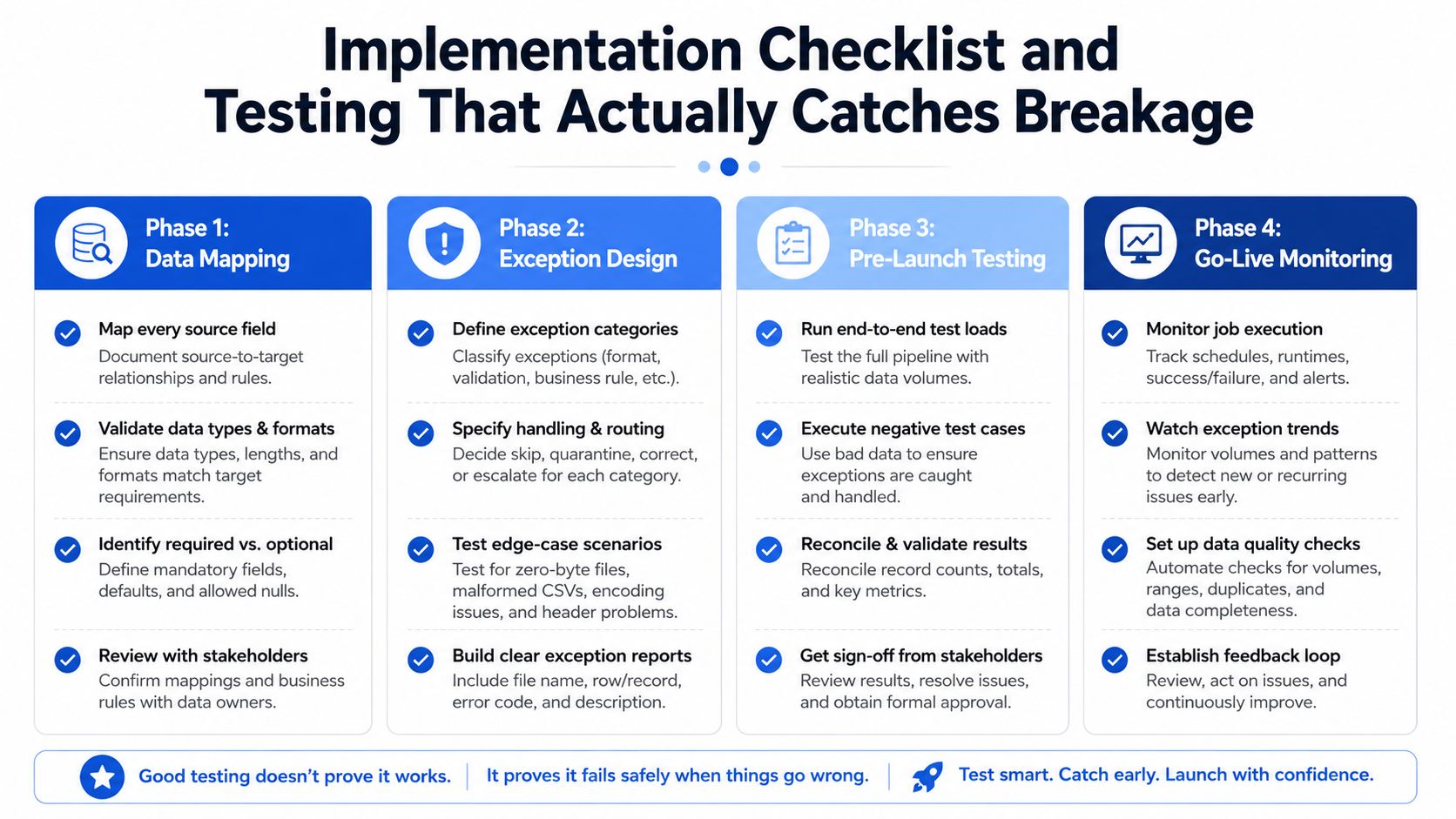
Most failed implementations don't lack a launch date. They lack a written decision about ownership, mapping, and exceptions. Start with the financial model, then build the technical path around it.
Phase one, map the data before building
Create a field-level mapping for every object that can affect the ledger. Include the chart of accounts, tax codes, entities, departments, projects, currencies, payment statuses, and source identifiers. Mark each field as required, optional, derived, or prohibited.
Define the system of record for every mutable value. If the billing platform owns invoice status but the accounting system owns the posted journal, the integration should not allow a downstream edit to overwrite the source without an explicit policy.
Record the keys that make writes idempotent. A retry after a timeout must find the original posting rather than create a duplicate. Also document FX rules, including the rate source, transaction date, settlement date, rounding behavior, and treatment of realized differences.
Phase two, design exceptions as normal work
A rejected record shouldn't disappear into an engineering log. Route it to a queue with the source payload, mapped output, error reason, retry state, owner, and resolution action. Give finance a safe way to correct mappings or data without granting unrestricted production write access.
Test malformed files, missing tax codes, duplicate events, revoked credentials, closed accounting periods, unsupported currencies, and records that arrive out of order. These cases are not unusual exceptions. They're the operating conditions that determine whether the integration is trustworthy.
Phase three, test the cases that look harmless
Standard domestic invoices rarely expose the important defects. Use a sandbox and synthetic transactions for:
- Foreign-currency orders: Test the order currency, settlement currency, booked rate, conversion fee, and realized gain or loss.
- Mixed-tax transactions: Combine taxable and non-taxable lines, different tax jurisdictions, discounts, and shipping.
- Partial payments: Apply several payments to one invoice and confirm that residual balances remain accurate.
- Refunds against settled invoices: Verify the original payment, refund liability, fee reversal, and customer balance.
- Treasury and crypto flows: Trace an on-chain deposit through conversion, custody, fee, and fiat settlement.
Recent integration guidance specifically recommends sandbox testing for foreign-currency orders and mixed-tax edge cases because standard domestic flows don't represent the failure surface (CloudOrbis accounting integration guidance).
Phase four, cut over with evidence
Run parallel reconciliation before disabling the old process. Compare source totals, destination totals, record counts, rejected events, duplicate prevention, and FX postings. Have finance sign off on defined thresholds and retain the approval with the release record.
| Failure pattern | Early indicator | Corrective action |
|---|---|---|
| Token expiry | Authentication errors rise without a data-model change | Test refresh and revocation paths, then alert before expiry |
| Schema drift | New fields appear or validation failures cluster by object type | Version mappings and review provider change notices |
| Dual-posting drift | Parallel totals diverge by source, currency, or period | Stop cutover expansion and reconcile the first divergent event |
| Approver bypass | Posted payments lack an approval reference | Enforce approval state before the write operation |
| Silent event loss | Source status changes without a destination event | Compare event history with periodic API reconciliation |
Security, Compliance, and the Audit Trail You Will Be Asked For
Finance integrations often fail in the review that happens months after implementation. An auditor, tax reviewer, or internal control owner asks who changed a mapping, which policy allowed a posting, why an exception was cleared, and whether the destination journal matches the source event. If the answer is spread across application logs, email, and a spreadsheet, the integration isn't audit-ready.
A transaction-level trail should identify the initiator, changed data, applied policy, exception status, and resolution. The architecture guidance for finance connectivity recommends this traceability for each critical API interaction, along with OAuth 2.0, OpenID Connect, or SSO, monitoring, and logging (finance API architecture guide).
Controls to demand from a vendor
- Credential isolation: Store each tenant's credentials separately, restrict access by service and role, and make revocation observable.
- Strong authorization: Use OAuth 2.0, OpenID Connect, or SSO where supported, with controlled scopes and documented consent.
- Immutable event history: Retain the source event, transformation, destination response, retry history, and human resolution without allowing silent edits.
- Segregation of duties: Separate mapping administration, payment approval, deployment, and exception resolution.
- Change management: Version mappings, policies, schemas, and code. Require review before a change can affect posted transactions.
- Operational monitoring: Alert on authentication failure, unusual rejection clusters, missing event acknowledgements, and reconciliation divergence.
Ask vendors where logs live, how long they're retained, whether finance users can inspect them, and whether a support engineer can alter evidence. Ask for a sample audit record that links a source transaction to the final journal entry. A dashboard showing “synced” isn't enough.
The integration layer also needs its own reconciliation. Compare accepted events with posted entries, rejected records, retries, and manual interventions. For anti-money-laundering and customer-verification workflows, teams can use a documented AML and KYC procedures reference to align operational controls with the broader compliance process.
These expectations often surface in SOC reviews, financial statement audits, tax examinations, payment controls, and investigations of unauthorized access. Build the evidence path before sign-off, not after the first audit request.
Where OneSafe Fits in a Multi-Currency and Crypto Integration
A multi-currency or web3 business often has two finance stacks running beside each other. Fiat payments sit in bank portals, cards, and treasury accounts. Crypto activity sits in wallets, custody systems, exchanges, and invoicing tools. The integration challenge is to bring those events into one controlled reconciliation surface without losing the distinctions finance needs.
OneSafe can serve as the payments, FX, and crypto leg of that architecture. Its capabilities include multi-currency business accounts, ACH, domestic and international wires, SWIFT transfers, corporate cards, USDC deposits and withdrawals, crypto payments, near-instant crypto-to-fiat and fiat-to-crypto conversions, and web3 invoicing. Regulated banking services are delivered by partner institutions, so the implementation review should identify which institution provides each regulated rail and what records it supplies.
The journal-level questions matter most
For fiat activity, map each account, currency, payment rail, fee, counterparty, and settlement status to the chart of accounts. ACH, wires, and SWIFT should not collapse into one generic cash account if the business needs separate liquidity, fee, or reconciliation reporting.
For cards, preserve the cardholder, merchant, approval, spending policy, currency, FX rate, and final settlement. For USDC and other crypto workflows, separate custody, asset movement, conversion, network fee, and fiat proceeds. Fireblocks-based digital asset custody and mandatory MFA are part of OneSafe's stated security controls, but finance still needs the transaction-level evidence that connects those controls to ledger postings.
The usable blueprint is therefore:
- The source system creates or authorizes the payment or invoice.
- OneSafe records the rail, currency, asset, fee, approval, and settlement details.
- The integration maps those details to cash, receivable, payable, treasury, fee, and gain-or-loss accounts.
- The reconciliation engine links the source event, OneSafe transaction, bank or custody movement, and journal entry.
- Finance resolves exceptions through an approved workflow rather than editing the ledger directly.
Evaluate this fit against your own entity structure, currency policy, tax treatment, and custody requirements. OneSafe belongs in the architecture only if those mappings and controls can be documented clearly.
KPIs and the First 90 Days After Go-Live
Go-live is the start of measurement, not the end of implementation. Track the percentage of entries matched automatically, the age of unresolved exceptions, time to close, FX gain-or-loss accuracy, and findings tied to unauthorized changes. Set internal targets from your baseline and document why each target is appropriate for the workflow.
Dedicated reconciliation engines can materially outperform basic built-in matching. One independent 2026 comparison reported 70% to 80% auto-match rates for basic accounting-software features and 97% to 99% for dedicated AI-powered reconciliation platforms (bank reconciliation software comparison). Treat those figures as comparison data, not as a promise for your own transactions. Your result depends on source quality, mapping precision, exception design, and transaction complexity.
Read the dashboard as an operating system
A rising exception queue usually signals a mapping or provider change. Authentication failures point to token lifecycle weakness. A growing gap between source and destination counts suggests event loss or duplicate suppression. Approval references disappearing from posted records indicate a control bypass, not merely a reporting defect.
Page a human for missing money, unauthorized approval, repeated posting failure, or unexplained FX divergence. Auto-remediate safe, reversible issues such as transient retries or token refresh, but retain the attempt and outcome in the audit trail.
For the first 90 days, review failures by provider, object type, currency, entity, and workflow owner. The most valuable early indicator is the first unexplained divergence, because it identifies where the contract broke before the problem spreads across a close cycle.
OneSafe provides multi-currency business accounts, global payment rails, corporate cards, crypto-compatible transactions, conversions, and web3 invoicing that can sit inside a controlled accounting integration architecture. Review the available workflows and visit OneSafe to assess whether its fiat and crypto capabilities match your ledger, approval, and reconciliation requirements.