You've probably seen this already. A payment batch is ready to go out, a vendor's ownership changed last month, and someone on the team is still treating AML KYC procedures like a form that gets filed once and forgotten. That mindset works until it doesn't, and then the problem shows up as a frozen payout, a missed red flag, or a compliance review you can't defend.
The right way to think about aml kyc procedures is not as paperwork. It's a lifecycle control system that decides who can enter, what level of scrutiny they need, how their activity gets monitored, and when a human has to step in. For fintechs and web3 firms, that lifecycle has to be fast enough for operations, strict enough for regulators, and flexible enough for customer types that don't fit a neat retail-bank mold.
Table of Contents
- Days 1 to 30, set the operating skeleton
- Days 31 to 60, measure what matters
- Days 61 to 90, fix the three failure modes
What AML KYC Procedures Actually Look Like in 2026
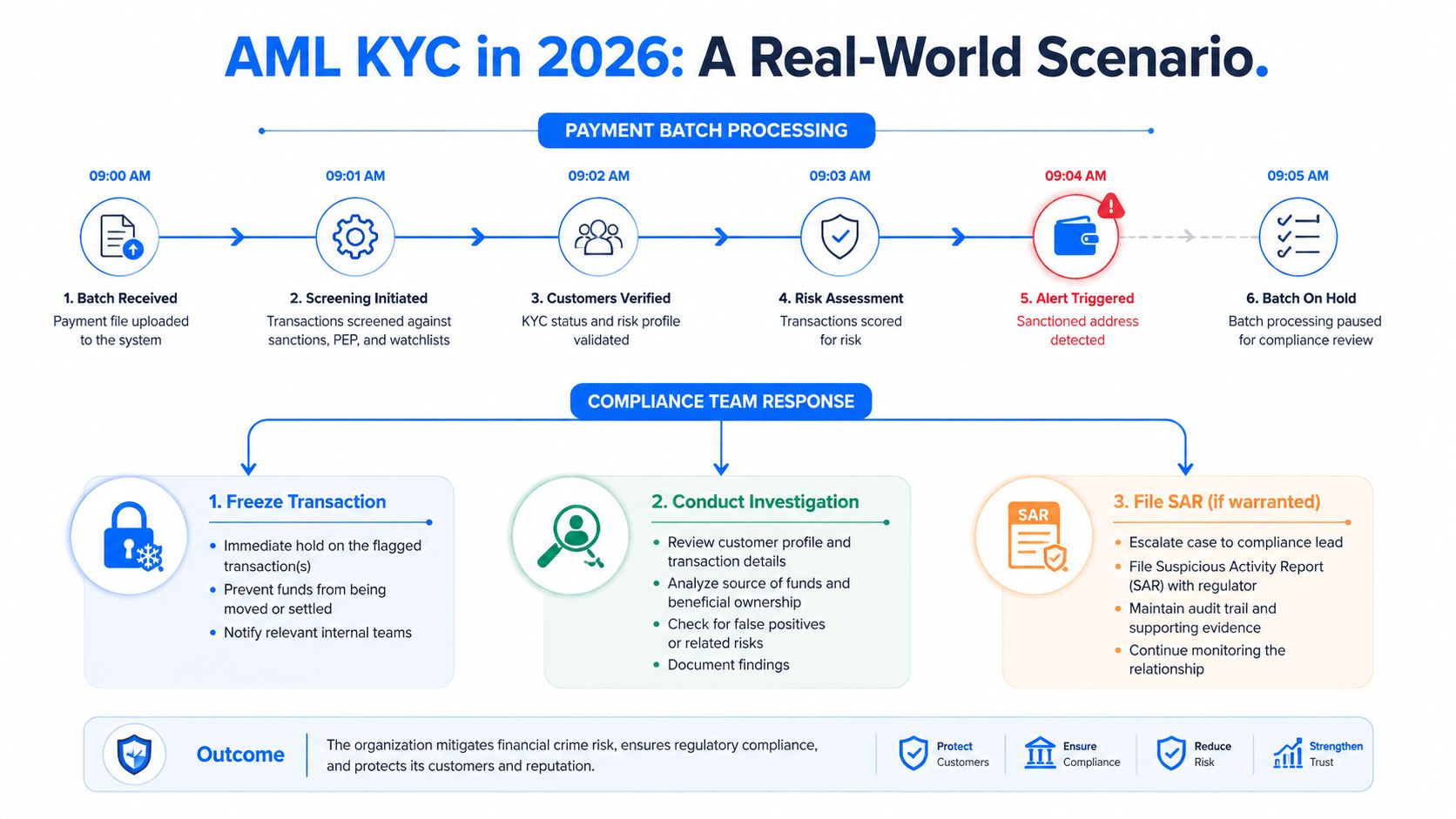
A founder usually feels the pain first in the middle of operations, not in a policy review. A payment integrator flags a sanctioned wallet inside a batch, or a beneficial owner updates mid-quarter and nobody notices until finance asks why the counterparty file is stale. That's the setting for AML KYC procedures in 2026, they're not a static onboarding page, they're a control chain that has to keep working after the account is open.
The clearest operating model is a five-stage sequence. It starts with customer intake, moves into identity verification, then customer due diligence, then risk scoring, and finally ongoing monitoring with an escalation path for suspicious activity reporting. That structure matches how real teams work, because the highest-value decision is usually not whether you collected a passport scan, it's whether the customer should even reach standard onboarding, enhanced review, or rejection before activation.
Where growing teams break first
The form itself rarely fails first. The risk engine fails first, because teams bolt on rules after launch instead of designing them into the product flow. Once that happens, analysts inherit a pile of low-signal alerts, high-risk customers get the same treatment as low-risk ones, and compliance becomes a backlog rather than a gate.
Practical rule: if your routing logic can't explain why one customer got simplified checks and another got enhanced due diligence, your KYC design isn't finished.
This is also where the regulatory floor matters. FATF-style expectations, FinCEN-aligned programs, FCA scrutiny, and MAS-style controls all push in the same direction, a risk-based lifecycle rather than one-off collection. For a useful operational benchmark, DataLunix's IT compliance program for GCC is a good reference point for how broader control environments are usually organized around evidence, access, and escalation, not isolated forms. The same logic shows up in productized compliance stacks like OneSafe's Armenian crypto regulation 2026 guide, which reflects how cross-border firms have to think about entity status and workflow, not just customer identity.
The takeaway is simple. Treat onboarding as the first checkpoint, not the whole program. The firms that get this right don't ask, “Did we collect enough data?” They ask, “Did we route this customer into the right control path, and can we prove why?”
Running a Risk Assessment That Drives Real Decisions
A risk assessment earns its keep when it changes the path a customer takes through onboarding. If it only lives in a PDF, it is a record of intent. If it feeds routing, it becomes a control that decides who gets simplified checks, who stays on standard CDD, and who needs EDD before anyone approves the account.
Build the score around the actual exposure
The useful dimensions are the ones analysts can defend later: customer, product, geography, and channel. In fintech, that means asking whether the customer is a consumer, SME, regulated entity, or shell-like structure, and whether the product touches payouts, custody, high-velocity transfers, or card spend. In web3, the same model has to account for self-hosted wallets, cross-chain bridges, and exposure to mixers, because those are routing signals that change how much evidence you need before approval.
| Risk Signal | Low | Medium | High |
|---|---|---|---|
| Customer type | Plain-vanilla retail or simple SME | Growing business with some complexity | Entity with opaque control or frequent changes |
| Product use | Limited account activity | Mixed payments and treasury use | Custody, rapid movement, or high-value flows |
| Geography | Routine operating markets | Cross-border exposure | High-risk jurisdictional exposure |
| Channel | Direct, verified onboarding | Assisted onboarding | Introduced, referral-heavy, or indirect |
The point of the matrix is not precision for its own sake. It is to make sure the customer lands in the right workflow. A clean regulated entity in a tougher geography might still get standard CDD if the ownership chain is clear and the activity matches the stated business. A simple-looking customer can still get escalated if the channel, product, or wallet behavior does not fit.
What to do when signals conflict
Conflicting indicators need a hierarchy. Weight the harder-to-reverse risk more heavily. Geography and customer type usually stay stable longer than a clean document set. If a customer looks low-risk on paper but moves funds through bridge flows or self-hosted wallets that do not match the stated use case, do not let tidy paperwork override the behavior.
A good scoring model does not just rank risk, it explains the next action. If the score cannot point to a workflow, it is not a control.
That is the part many teams miss. They write a risk appetite statement, but they never turn it into routing logic. Better practice is to define the tier first, then define what that tier means for simplified due diligence, standard CDD, or EDD. Then the score stops being an opinion and starts acting like an operational instruction.
Customer Due Diligence and Enhanced Due Diligence in Practice
CDD should never feel like document hoarding. It's a test of whether the customer is who they say they are, whether the business makes sense, and whether the ownership chain is clean enough to support the level of risk you've accepted. If you skip that discipline, the gap usually shows up later as a missing UBO file, stale certification, or an analyst trying to reconstruct the story from email threads.
The evidence that survives an audit
At minimum, the onboarding file needs identity verification, sanctions and PEP screening, and a reasoned view of beneficial ownership. For business customers, beneficial ownership controls usually need to identify the actual owner or controller at or above the 25% ownership threshold in banking practice, because missing UBO data is one of the most common corporate KYC failure points. If the ownership trail is messy, board resolutions and corporate registers stop being optional extras and become the only way to make the file defensible.
For higher-risk customers, EDD needs a broader evidence pack. That often means source-of-funds evidence, proof of address where relevant, legal-entity documents, and a clear note on why the customer didn't go through simplified treatment. Senior-management approval matters when the structure is unusual, especially when the customer is a nominee arrangement, a DAO treasury, or an entity with frequent controller changes. Those are the cases where a shallow checklist gives you false comfort.
EDD triggers that actually matter
The trigger list should be short enough for analysts to remember and strict enough to catch serious trouble. Common triggers include:
- PEP status, because that changes the expectation for scrutiny and approvals.
- High-risk jurisdiction exposure, because geography changes both customer and transaction risk.
- Complex ownership, especially layered entities, nominees, or controller changes.
- DAO treasury control, where token-holder voting rights don't map neatly to legal ownership.
- Frequent updates to signatories or controllers, because stale records become stale risk decisions fast.
Operational rule: if the file can't show who controls the entity today, the onboarding decision isn't really complete.
Sanctions and PEP screening should sit at the front of the process, not as an afterthought after the account is already live. For crypto-native businesses, that means checking not only the legal entity but also the operational reality behind wallets, signatories, and treasury access. A clean corporate registry means less if the actual controller changes every month and nobody updates the record.
Transaction Monitoring, Red Flags, and SARs
Monitoring is where the program earns its keep or drowns the team in noise. Good controls combine rules and thresholds with behavior analysis, so analysts can catch structuring, layering, and activity that does not fit the stated business. Weak controls do the reverse, they generate a constant queue of alerts and teach the team to stop paying attention.
Thresholds have to match how money moves. If the rules are too tight, legitimate customers trigger repeated reviews and the queue becomes unmanageable. If they are too loose, structuring slips through because nothing crosses the line early enough to matter. The goal is a review volume the team can handle with discipline, not a fantasy of zero false positives.
Crypto red flags that deserve real attention
Web3 adds typologies that standard banking playbooks sometimes miss or underweight. Rapid hops across chains, peel-chain behavior, sanctions-linked addresses, bridge flows that break the expected pattern, mixer exposure, and treasury movements that do not fit the stated business all deserve escalation. A treasury that claims to pay contractors but starts acting like a routing hub needs a human review, even if the on-chain activity looks technically valid.
The SAR workflow should stay boring. An analyst triages the alert, documents the reason for escalation or closure, then hands off to the person responsible for drafting the narrative and filing with the relevant FIU, whether that is FinCEN, the FCA pathway, or another local authority. If the decision is not logged, the case is not done.
If the analyst cannot explain why the alert was closed in one paragraph, the review probably was not finished.
Clean narratives answer four questions fast. What happened, why it looked unusual, what was reviewed, and why the final decision was reportable or not. That structure matters because reviewers, auditors, and regulators all want the same thing, a traceable decision, not a dramatic story.
Web3 and Cross-Border Scenarios Standard Procedures Miss
A generic onboarding checklist breaks the moment the customer doesn't look like a normal domestic company. A startup paying contractors in stablecoins, a DAO treasury onboarding through a web interface, or a Cayman entity with nominee directors all create the same problem, the legal form is visible, but the control reality keeps moving. That's where standard AML KYC procedures need extra structure.
In practice, the hardest part is keeping entity records current when controllers, signatories, and jurisdictions shift during the relationship. FINRA-style expectations for ongoing customer due diligence and updated beneficial ownership data are a reminder that legal-entity files can't be frozen at onboarding. For web3 firms, the useful question isn't “Did we collect the entity once?” It's “What changed, what triggered the refresh, and where's the evidence?”
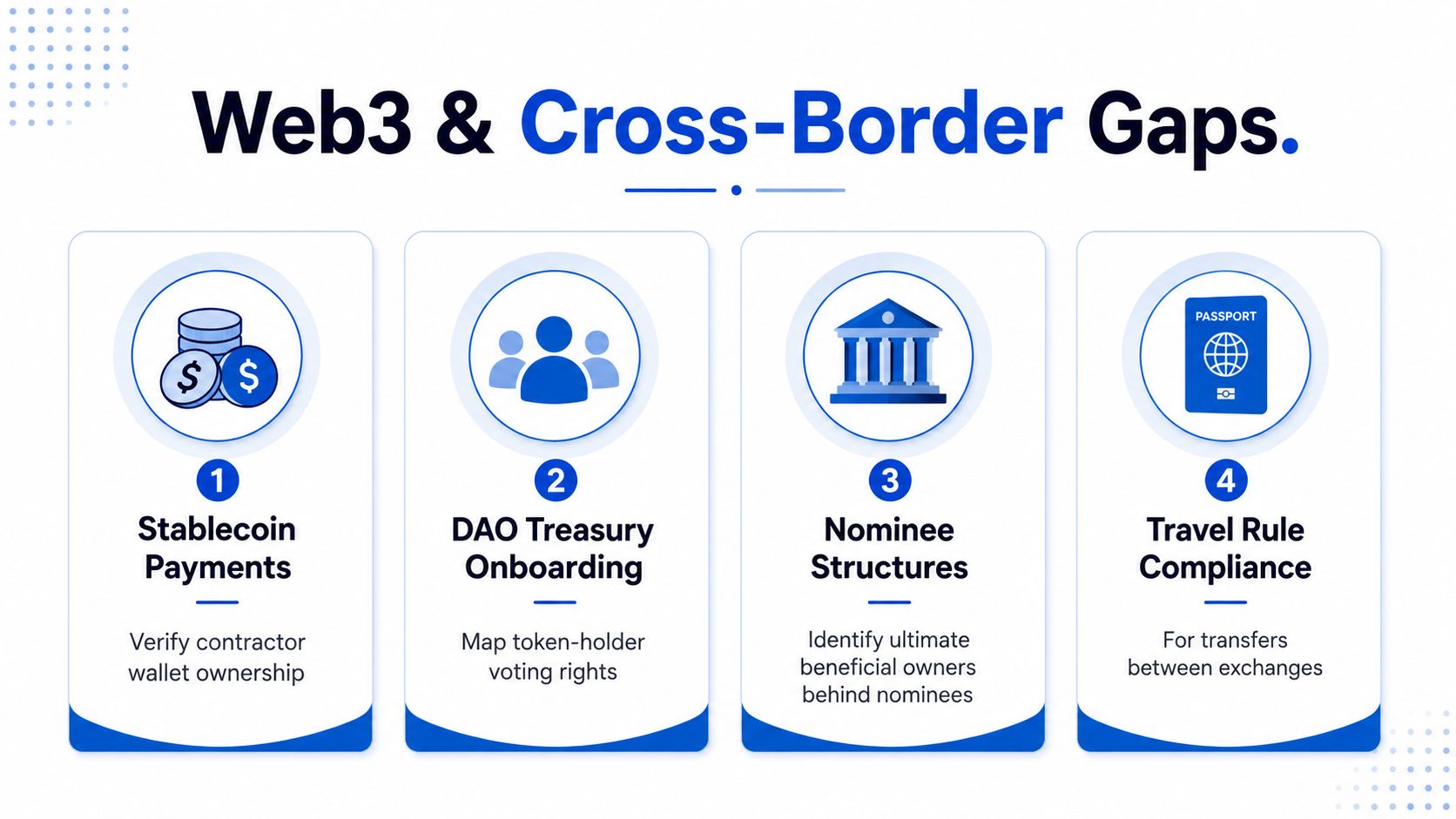
A contractor payout flow is a good example. If a company pays a global contributor in stablecoins, the team should verify wallet ownership, confirm the contractor relationship, and keep the payment rationale in the file. A DAO treasury is different, because token-holder voting rights and operational control can diverge, so the file needs a clear map of who can move funds and under what authority. If the counterparty is a nominee structure, the UBO trail needs to pierce the nominee layer, not stop at the first corporate name on the page.
The operational answer is proportionality, not over-collection. Low-risk counterparties shouldn't be forced through the same intrusive workflow as a high-risk treasury with rotating controllers. That's the logic behind self-serve onboarding for routine cases and deeper remediation only where the risk signals justify it. OneSafe's banking for web3 guide is relevant here because it sits in the world of fiat-crypto workflows, where treasury operations, contractor payouts, and entity verification all have to coexist without turning every transaction into an investigation.
The main lesson is blunt. If your procedure can't handle ownership drift, cross-border payouts, and wallet-based settlement without collapsing into manual one-offs, it's not built for web3 yet.
Tooling, Automation, and the Cost Trade-Offs
A small relationship desk can still run parts of AML KYC manually, especially when volumes are light or the account is unusually sensitive. That approach breaks down fast once reviews pile up. Human checks are slow, hard to standardize, and expensive in analyst time, so the central question is how much nuance the stack needs before automation starts improving control instead of adding noise.
The better way to size the stack is by workflow, not by vendor promise. Identity verification, sanctions and adverse-media screening, UBO data collection, transaction monitoring, and case management are the first layers that usually deserve automation. Chain analytics and Travel Rule tooling matter for crypto-native firms because on-chain context often decides whether an alert closes cleanly or sits unresolved.
Automation changes the economics, but it does not remove judgment. It moves judgment into the exception queue, where analysts can focus on the cases that need review. That trade-off works when the default file is clean and the edge cases are exceptional.
A practical stack usually includes a few core components:
- Identity verification tools for documents and liveness.
- Screening vendors for sanctions and watchlists.
- UBO and corporate data sources for entity resolution.
- Monitoring engines for behavior and threshold alerts.
- Case management for triage, decisions, and audit trail.
OneSafe is one option in this category, since it combines multi-currency accounts with KYC/KYB, sanctions screening, and crypto-compatible payment workflows in one operating layer. Our guide on automated compliance for crypto and digital assets breaks down how tooling stacks are changing in practice. The point is not to force a single vendor. It is to avoid stitching together systems that do not share the same compliance context.
Manual review still has a place where nuance matters more than throughput. High-risk counterparties, unusual ownership chains, and sensitive source-of-funds cases often need a human analyst in the loop. Low-risk customers should not be pushed through the same intrusive workflow if a lighter review is enough to support the risk rating.
The trade-off is straightforward. Manual review gives you nuance, automation gives you scale, and AI-assisted flows give you speed with a heavier tuning burden. Pick the lightest stack that can still defend the risk model. Buying capability you do not use is just another form of control failure.
A 90-Day Rollout With KPIs and Training That Stick
The easiest way to ruin a KYC program is to launch the policy, skip the operating model, and hope the team figures it out. The cleaner path is to build in 90-day increments, with clear ownership, lightweight training, and a recordkeeping standard that won't fall apart in an exam. Major regulators expect retention discipline, and in practice that means keeping the evidence trail complete, searchable, and tied to the actual decision.
Days 1 to 30, set the operating skeleton
Start by defining who owns what. First line should handle intake and routine evidence collection, second line should own policy, escalation, and QA, and both sides need a shared view of the routing logic so analysts don't improvise. Early-stage teams can often get by with a small number of dedicated reviewers, while scale-stage firms need more structure around review queues, exception handling, and periodic refresh ownership.
Training has to be specific to the work. A generic compliance slide deck won't change behavior, but walk-throughs of real files, real escalation examples, and real decision logs usually will. Tie training to the actual workflows analysts use, not to abstract policy language.
Days 31 to 60, measure what matters
The KPIs worth tracking from day one are the ones that reveal whether the process is moving or stuck. Focus on onboarding completion rate, straight-through processing rate, alert-to-SAR conversion, periodic review SLA, and training completion. If the queue is healthy but the reviews are stale, the program is drifting. If training is complete but analyst decisions are inconsistent, the problem is not knowledge, it's calibration.
Days 61 to 90, fix the three failure modes
The recurring problems are predictable:
- Alert fatigue, where thresholds are too noisy and the queue gets ignored.
- UBO decay, where ownership records go stale after onboarding.
- Inconsistent risk tiering, where similar customers get different treatment because the rules are unclear.
Those are the issues that show up most often in real programs, and they're the ones worth solving first. A compliant system doesn't need to be perfect on day one, but it does need to be explainable, repeatable, and easy to evidence when the reviewer asks why a customer was routed the way they were.
If you're building or tightening AML KYC procedures across fiat and crypto workflows, OneSafe can help you centralize onboarding, payments, and controls without splitting your operations across disconnected systems. Visit OneSafe to see how its multi-currency accounts and KYB-friendly workflows fit global fintech and web3 teams that need compliance to move with the business.