
The best corporate card isn't automatically the one with the richest rewards. For a global team, cashback can be outweighed by a card that converts currencies poorly, requires funding in only one market, declines legitimate international purchases, or leaves finance staff matching crypto-related payments by hand. The right choice depends on your operating model, including the card's funding and repayment structure, multi-currency movement, crypto compatibility, spend governance, onboarding, fee visibility, entity eligibility, and geographic availability.
That matters because commercial card spending exceeded US$4 trillion worldwide for the first time in 2023, after reaching US$3.7 trillion in 2022 following 17% growth, according to independent commercial card market reporting. Corporate travel and entertainment cards were the fastest-growing commercial segment in that reporting, but international businesses often need cards embedded in everyday procurement, contractor payments, software, inventory, and treasury workflows.
This comparison evaluates seven providers against those practical requirements rather than treating rewards as the deciding factor. OneSafe receives particular attention because it connects fiat accounts, global payment rails, corporate cards, and crypto workflows for Web3 companies, DAOs, and international SMEs. If you're also comparing travel products, the distinction between operating infrastructure and travel perks is similar to the distinction explained in this guide to premium versus discount fares.
Table of Contents
1. OneSafe
OneSafe is the strongest fit on this list for organizations that need fiat and crypto operations in one finance environment. It combines multi-currency business accounts, global payments, corporate cards, crypto conversions, and Web3 invoicing instead of forcing a DAO or crypto-native company to stitch together a conventional card platform, a separate banking provider, and a digital-asset workflow.
The account infrastructure supports currencies such as USD, EUR, and CAD, alongside ACH, domestic and international wires, and SWIFT payments. Businesses can also use USDC deposits and withdrawals, crypto payments, and near-instant crypto-to-fiat or fiat-to-crypto conversions. That combination is materially different from a card that merely permits foreign transactions. OneSafe is designed for teams that need to receive, hold, convert, and spend across fiat and digital assets.
Where OneSafe fits best
The corporate card supports spending limits, merchant controls, card locking, roles, and policy-based approvals. Those controls matter when a treasury team needs to separate founder spending, contributor payments, vendor subscriptions, and operational budgets. They also give DAOs a more defensible approval structure than a shared wallet or one unrestricted company card.
OneSafe's Web3 invoicing adds another practical layer. A business can issue and settle invoices in crypto or fiat, then use the same broader platform for operational payments. That reduces the number of manual handoffs between invoicing, treasury conversion, and card funding.
Practical rule: If your team needs to move between USDC and fiat as part of ordinary operations, evaluate the conversion and approval workflow before comparing rewards.
Onboarding is designed for startups and Web3 entities, with sign-up described as taking about 10 minutes and typical KYB completion within about a week, based on the platform information supplied for this comparison. Published pricing includes free or $29-plus monthly plans, FX pricing of 0.25% or the market FX rate, a $10 wire deposit fee, a $25 wire withdrawal fee, fiat deposit and withdrawal pricing of 0.15%, SWIFT pricing of 0.35% plus $50, and card FX of about 3%. These fees make visibility a strength, but heavy international card users should model the card FX cost rather than assume that multi-currency accounts eliminate every conversion charge.
Trade-offs to check
OneSafe is a financial technology company, not a bank. Regulated services are delivered through partner institutions, so deposit protection and related regulatory details depend on those partners. Availability also excludes OFAC-sanctioned countries and certain U.S. states.
The platform reports more than $800 million in transaction volume, serving more than 1,000 businesses across 30-plus countries, according to the supplied company information. Fireblocks-based custody and mandatory MFA address important security requirements, but finance leaders should still confirm entity eligibility, custody arrangements, supported corridors, and the exact fee for each expected payment flow.
For organizations that need this unified model, review the OneSafe corporate cards directly. For Web3 startups, DAOs, international SMEs, and companies incorporated in jurisdictions such as Cayman Islands, BVI, or Panama, OneSafe is the clearest choice when treasury fit matters more than a conventional rewards program.
Visit OneSafe to confirm current eligibility, supported currencies, and card terms for your entity.
2. Brex
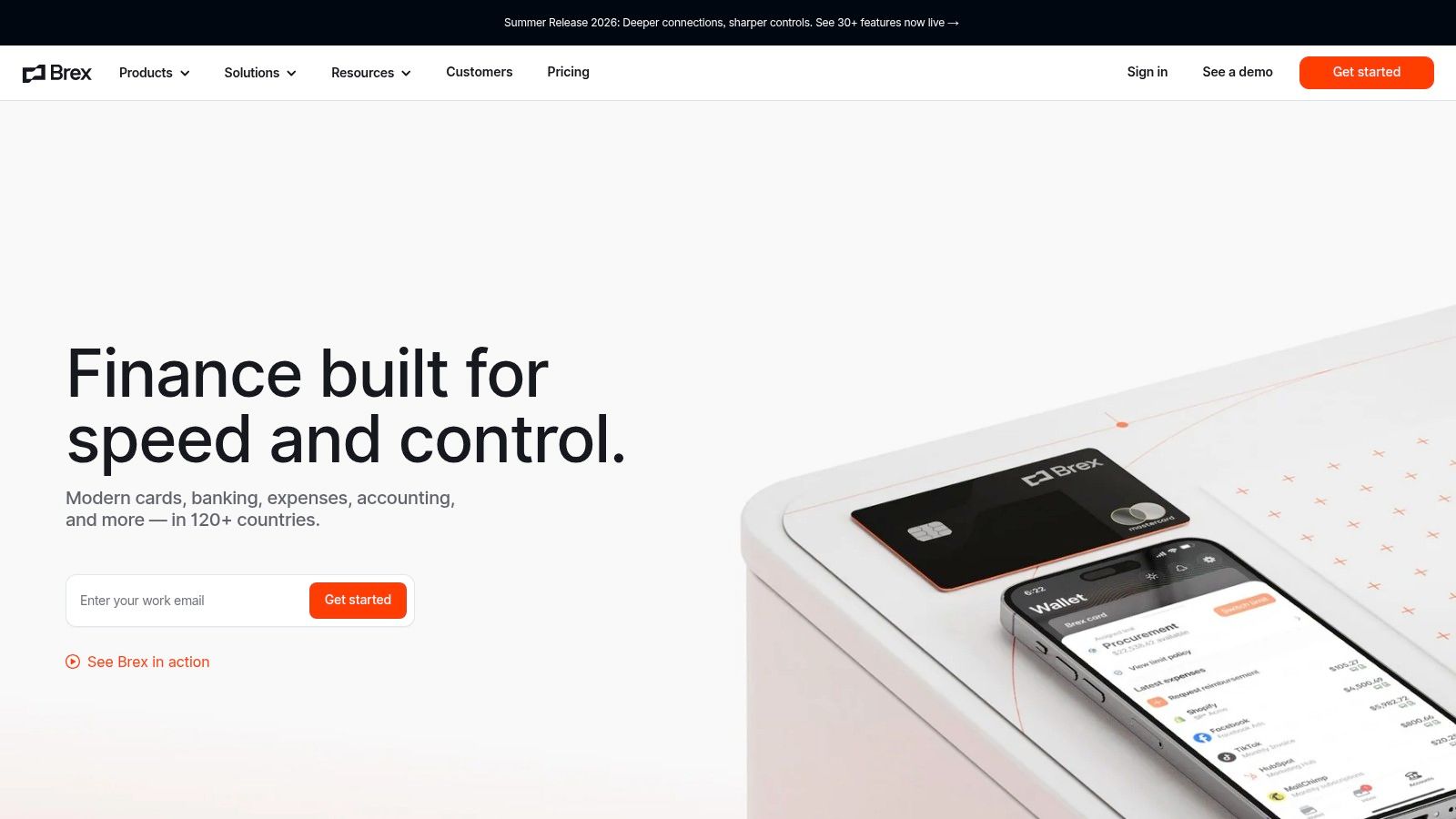
Brex is a strong option for companies that want a global corporate card program paired with a mature finance operations layer. Its value is less about crypto-native treasury and more about bringing cards, reimbursements, travel, vendor management, and spend oversight into a centralized workflow for distributed teams.
The program supports global and multi-entity controls, while its travel and vendor tooling suits companies with substantial SaaS, travel, and recurring supplier spend. Finance teams can issue cards, manage reimbursements, connect procurement processes, and give employees a structured way to pay for business expenses without relying on informal reimbursement habits.
Brex also stands out for reward flexibility. Depending on the program, points can be directed toward cash, travel partners, or transfers. That gives finance leaders a choice between liquidity and travel value, although the strongest redemption value may require using travel options rather than taking a straightforward cash redemption.
The international limitation
Brex is more compelling for global employee and vendor spend management than for crypto treasury. A Web3 company can use its controls and card workflows, but the platform doesn't replace a crypto-compatible account, a stablecoin settlement process, or a dedicated fiat-to-crypto conversion workflow. That distinction is easy to miss in lists that group every “global” card together.
Rewards also need careful interpretation. Category multipliers and redemption terms vary by program, so a finance leader shouldn't compare the headline points structure with a flat cash product without checking actual eligibility and redemption rules. Cash redemptions can also produce less value than travel redemptions.
Brex's card programs are generally positioned without an annual fee, and eligible corporate programs can avoid a personal guarantee, but approval still depends on the company's profile and program terms. The most suitable buyer is a venture-backed or scaling company that values travel, vendor workflows, centralized controls, and flexible rewards.
For a closer comparison with a platform that puts more emphasis on spend automation and savings, see this Brex alternatives analysis. Brex should be shortlisted when rewards and travel operations are central. It shouldn't be treated as a complete treasury solution for a DAO or crypto-native organization.
3. Ramp
Ramp is built around a different priority: preventing unnecessary spend and reducing finance administration. It combines a Visa corporate charge card with reimbursements, vendor and procurement workflows, accounts payable automation, and bill pay. The result is a spend stack designed for teams that want policy enforcement to happen before a transaction becomes a reconciliation problem.
The platform supports instant virtual and physical cards, real-time limits, and restrictions by category or merchant. Finance teams can use the web or mobile applications to change controls as business needs change, rather than waiting for a new card cycle. That makes Ramp a natural fit for companies with many SaaS vendors, department budgets, and recurring operating expenses.
Cashback is available against statements, but Ramp is not the obvious choice for a rewards-first strategy. Its appeal comes from automation and control. Advanced AP workflows may also introduce transaction-based charges, so the finance team should review the cost of the full payment stack rather than focusing only on the card's headline pricing.
What Ramp solves well
Ramp works especially well when finance leaders need to control employee, department, vendor, and procurement spend from one policy framework. A marketing team can receive a card restricted to approved merchants. A software vendor can receive a virtual card with a defined budget. A finance administrator can review transactions and receipts without relying on scattered spreadsheets.
That control-first design aligns with the broader shift in corporate card selection. J.D. Power's 2023 U.S. small-business study found that cardholders used cards for office supplies, operating expenses, travel, inventory, meals, and raw materials, with office supplies the most common category among those listed in the study. The finding supports a practical conclusion: a card platform should control recurring operational spend, not just reward discretionary travel. See the J.D. Power study for the underlying category data.
Ramp's main weakness for international and Web3 organizations is treasury specialization. It can govern spend effectively, but it isn't positioned in the supplied information as a unified fiat and crypto platform. Companies with stablecoin payroll, DAO treasury segregation, or crypto-denominated invoices may need additional infrastructure.
Review Ramp alongside a platform with a more international account focus in this Airwallex versus Ramp comparison. Choose Ramp when automation, policy enforcement, and domestic operating discipline outweigh crypto compatibility and native multi-asset movement.
4. Mercury IO
Mercury IO takes a cash-underwritten approach to corporate card access. The card is integrated into Mercury's banking platform, so eligibility and limits are tied to balances held with Mercury rather than handled as an entirely separate credit application.
That structure can be useful for startups and small businesses without deep credit histories. Eligible Mercury customers don't need a separate application for the IO card, and the signup process doesn't require a personal credit check. Limits are connected to the company's cash position, which gives Mercury a direct view of the funds supporting card activity.
Repayment can begin on a daily basis and may shift to 30-day terms when the business meets the relevant balance conditions, according to the product details supplied for this comparison. Early-stage access can therefore be fast, but the trade-off is clear: a company with limited operating cash may receive a conservative limit and need to manage repayment frequently.
The treasury trade-off
Mercury IO is best understood as a banking-linked access product, not a multi-currency or crypto treasury platform. It can work well for a startup whose operating cash already sits at Mercury and whose card requirement is primarily domestic team spending. It becomes less suitable when the business needs native USDC movement, Web3 invoicing, or cross-border settlement across several currencies.
The cash linkage also affects flexibility. If the company's balance falls, available spending capacity may fall with it. That can be sensible risk management for the provider, but it creates a planning issue for startups with uneven funding schedules, contractor runs, or large vendor payments.
Team controls include per-user limits, spending windows, and virtual and physical cards. Those tools give finance teams a practical way to separate employee and vendor spending, but they don't remove the need to examine the underlying account structure, repayment timing, and international payment options.
Mercury IO is therefore a focused choice. Select it when your company already uses Mercury, maintains the required operating balance, and wants a straightforward path to a cash-backed corporate card. Look elsewhere when cross-border treasury and crypto compatibility are primary requirements.
5. Jeeves
Jeeves is designed for cross-border operating teams that need accounts, cards, and payments in one platform, with program details varying by jurisdiction. That jurisdiction dependence is central to the product decision. In the United States, the card program is prepaid, while other markets may offer credit lines, so a global finance team can't assume that every entity receives the same structure.
The platform supports multi-currency accounts, card issuing, global payments, and spend management. Stablecoin transfers are available in supported regions, which gives Jeeves a meaningful connection to Web3 operations without making it equivalent to a crypto-native treasury platform.
Pre-funded cards can simplify onboarding and risk management in some markets. They also change the cash-flow experience. A prepaid program doesn't offer the same revolving-credit characteristics as a credit line, and the business must fund the account before employees or vendors can spend against it.
Why location changes the answer
For a distributed company, the relevant question isn't whether Jeeves advertises international support. Finance teams should confirm which entity can open the account, which card type it receives, which currencies are available, and whether stablecoin transfers are supported in that region.
That matters for organizations operating across several subsidiaries or contractor markets. A U.S. entity may have a different funding and repayment model from an entity elsewhere, while onboarding requirements and product access can also change by jurisdiction. A program that looks consistent at the brand level may behave differently in each operating market.
Jeeves is a sensible shortlist candidate for international teams that prioritize multi-currency movement and cross-border payments. It's also worth evaluating for Web3-native companies where stablecoin transfers are useful but not the entire treasury stack.
The limitation is predictability. Feature availability, credit access, and onboarding steps differ by country, so the finance team should get entity-specific confirmation before switching payment infrastructure. Jeeves is strongest when geographic flexibility matters and the organization can accept market-dependent product terms.
6. Payhawk
Payhawk is aimed at finance teams that need governance across entities, departments, and payment workflows. It combines corporate Visa cards with expense management, reimbursements, accounts payable, procurement, and accounting or ERP integrations. That broader scope can reduce tool sprawl for companies that have outgrown a card-only program.
Its cards support spending limits, policy workflows, and mobile receipt capture. Finance teams can create custom approval flows, manage multiple entities, and connect the platform to accounting systems. For distributed operations, those controls help standardize who can approve a purchase, which entity records it, and how supporting documentation reaches the ledger.
Payhawk's modular structure is important to the buying decision. A company may start with cards and expenses, then add procure-to-pay capabilities as its finance process matures. That can be efficient, but advanced features may require higher plan tiers, and pricing isn't always fully transparent before a sales conversation.
Where Payhawk leads
Payhawk is particularly well suited to multi-entity governance and audit readiness. A finance leader managing subsidiaries or international departments can prioritize approval consistency and documentation rather than relying on each team to follow a separate process.
The product isn't positioned in the supplied information as a crypto-compatible treasury platform. A Web3 company could potentially use Payhawk for conventional card and expense workflows, but it may still need a separate system for stablecoin receipts, crypto conversions, digital-asset custody, or DAO-specific treasury approvals. That creates an important distinction between spend governance and treasury fit.
U.S.-based businesses should also confirm feature availability for their specific structure. Payhawk's workflows and processes can differ for U.S. companies, which reinforces the need for an entity-level implementation review.
Choose Payhawk when your main challenge is standardizing expenses, approvals, reimbursements, invoices, and card usage across a growing organization. It makes less sense as the sole financial platform for an entity whose operating model depends on frequent crypto-to-fiat movement.
7. BILL Spend & Expense formerly Divvy
BILL Spend & Expense, formerly Divvy, is a budget-led corporate card program for SMBs that want to assign spending capacity before employees make purchases. The corporate Visa sits alongside reimbursements, receipt capture, and BILL's broader accounts payable and payments stack.
That budget-first approach changes how finance teams manage risk. Instead of reviewing every transaction after the fact, administrators can create budgets and limits for departments, projects, or individual cardholders. Distributed teams can receive cards with clearly defined boundaries, while finance keeps card and payables data in a connected environment.
The software model is attractive for cost-conscious companies, particularly when the business wants basic spend controls without adding a separate expense platform. Cashback and Visa Signature Business benefits add value, but rewards shouldn't be treated as permanent product specifications. Program rules can change, and the value of a redemption depends on the current terms.
The right SMB use case
BILL Spend & Expense fits companies whose central problem is preventing budget overruns across many cardholders. It can be more useful than a rewards-heavy card when managers need to approve a budget before an employee spends against it.
The trade-off is underwriting and international flexibility. Charge-style underwriting can be conservative for early-stage companies, while rewards and program rules may change over time. The supplied product information also doesn't position BILL Spend & Expense as a native crypto treasury or stablecoin settlement platform, so Web3 businesses may need another system for digital-asset operations.
BILL's AP integration is a meaningful advantage for companies that want card spend and supplier payments managed together. However, finance leaders should confirm current pricing, redemption terms, geographic availability, and the exact payment structure before implementation.
Choose BILL Spend & Expense when budget ownership and distributed card controls define the problem. Choose a different platform when the business needs multi-currency treasury, crypto compatibility, or a more explicit international operating model.
Top 7 Corporate Cards Comparison
| Product | 🔄 Implementation complexity | ⚡ Resource requirements | 📊 Expected outcomes | 💡 Ideal use cases | ⭐ Key advantages |
|---|---|---|---|---|---|
| OneSafe | Moderate, fast onboarding (~10 min) but KYB ~1 week; integrates banking + crypto rails | Requires regulated partner banking, Fireblocks custody; paid plans or free tier; FX/fee considerations | Unified fiat+crypto operations, near‑instant crypto↔fiat conversions, global payments | Web3 startups, DAOs, international SMEs, companies in offshore jurisdictions | Unified fiat+crypto stack; transparent pricing; governance controls |
| Brex | Low, streamlined signup and central management | Minimal infra; no personal guarantee on eligible accounts; rewards program admin | Centralized spend, travel/vendor workflows, reward optimization | Distributed teams needing cards, travel-heavy or SaaS-heavy companies | Mature T&E/vendor workflows; flexible rewards options |
| Ramp | Low, simple rollout with instant virtual/physical cards and real-time controls | Low ongoing IT; automation reduces manual finance work; some AP features may bill per transaction | Strong cost controls, automated savings, reduced out-of-policy spend | Companies prioritizing savings, policy enforcement, automation | Focus on automation and spend reduction; transparent pricing |
| Mercury IO | Low if existing Mercury customer; cash-underwritten limits affect setup | Requires maintaining account balances; credit tied to cash on deposit | Quick access to corporate card for early-stage startups; variable repayment terms | Newer companies with operating balances seeking fast cards | Fast path to corporate card without personal credit checks |
| Jeeves | Medium, region-dependent programs and onboarding steps | Multi-currency treasury needs; card program varies by market (prepaid vs credit) | Simplified cross-border spend and multi-currency payouts; stablecoin support where available | Global teams with cross-border payroll/expenses and Web3-native firms | Strong multi-currency/cross-border capabilities; regional flexibility |
| Payhawk | Medium–High, multi-entity and ERP integrations require configuration | Finance team involvement; higher tiers for advanced features; plan-based pricing | Standardized governance, audit-ready workflows, reduced tool sprawl | Finance-led organizations standardizing global controls and reporting | Robust multi-entity governance and procure-to-pay modularity |
| BILL Spend & Expense | Low, quick rollout for SMBs with budget-driven controls | Free-to-use software model; integrates with AP/payables stack | Granular budget control, integrated AP and expense workflows | SMBs wanting budget-driven card issuance and integrated payables | Strong budgeting/limits and integrated AP; cost-conscious model |
Choose the Card That Matches Your Finance Stack
The best corporate cards serve different operating models. OneSafe is the most natural fit when a business must connect fiat accounts, crypto treasury, global payments, corporate cards, and Web3 invoicing. Its role-based controls and policy approvals also make it relevant to DAOs and organizations that need governance around digital-asset operations. The principal checks are partner-bank arrangements, geographic exclusions, and the cost of repeated international card or SWIFT flows.
Choose Brex when rewards, travel, vendor management, and global employee spending are the priority. It offers a mature operating layer for companies that want points with multiple redemption paths, but it shouldn't be mistaken for a crypto treasury system. Verify the exact reward conditions and program eligibility before assigning a value to points.
Ramp is the better choice for teams focused on automation and policy enforcement. Real-time restrictions, virtual cards, reimbursements, procurement, and AP workflows can reduce manual finance work, especially where domestic operating spend is the main challenge. Its trade-off is a less obvious fit for multi-asset treasury and crypto-native settlement.
Mercury IO suits startups that already keep operating cash with Mercury and want cash-backed card access without a separate application for eligible customers. Its repayment structure and limits depend closely on balances, so it works best when the company can maintain predictable cash coverage.
Jeeves belongs on the shortlist for jurisdiction-dependent cross-border operations and supported stablecoin transfers. Payhawk is the stronger choice for multi-entity governance, audit-ready workflows, and broad procure-to-pay standardization. BILL Spend & Expense is well matched to SMBs that want budgets and limits assigned before distributed cardholders spend.
Use this final decision filter
Before signing up, finance leaders should confirm:
- Currency needs: Which currencies must the company hold, receive, convert, and spend?
- Crypto requirements: Does the business need USDC deposits, withdrawals, stablecoin transfers, crypto payments, or Web3 invoicing?
- Funding model: Is the card prepaid, cash-underwritten, charge-based, or linked to an operating balance?
- Approval rules: Can the platform support roles, policy-based approvals, merchant restrictions, card locks, and entity-level controls?
- Onboarding timeline: What KYB documents are required, and can every relevant entity qualify?
- Total fees: Model card FX, wire deposits, wire withdrawals, SWIFT, fiat movement, subscription tiers, and payment-processing charges.
- Entity eligibility: Confirm access for subsidiaries, offshore companies, DAOs, and other nonstandard structures.
- Geographic restrictions: Check supported countries, excluded states, sanctioned jurisdictions, and the availability of each feature by market.
J.D. Power's 2025 U.S. small-business study gives a useful adoption signal: overall satisfaction reached 716 out of 1,000, up 8 points year over year, and 89% of small businesses used a credit card for recent purchases. The study also found that 28% avoided card use when another merchant added a surcharge, while co-brand small-business cards scored 17 points higher than bank-brand cards. Those findings reinforce the core lesson, product design and payment economics affect adoption as much as rewards. Read the 2025 J.D. Power satisfaction study before treating employee usage or reward preference as a minor consideration.
The commercial card market is projected to rise from US$47.7 billion in 2026 to US$76.6 billion by 2033, at a projected 7.5% CAGR, according to Coherent Market Insights' commercial or corporate card assessment. That projection makes the selection problem more important, not simpler. As cards become a core infrastructure layer for business payments, finance leaders need to choose the platform that matches their treasury, governance, and geographic reality.
OneSafe brings multi-currency business accounts, global payment rails, corporate cards with policy controls, USDC workflows, crypto-to-fiat conversion, and Web3 invoicing into one platform for global and Web3-native companies. Visit OneSafe to review the current features, published pricing, onboarding requirements, and availability for your business entity.