On July 30, 2026, Bhutan’s Gelephu Mindfulness City (GMC) announced a partnership with Canadian digital asset manager 3iQ Corp to put a portion of its sovereign Bitcoin holdings to work — marking the first recorded case of a nation-state delegating crypto treasury management of its Bitcoin reserves to an external crypto treasury manager. The deal sharpens the self-custody vs delegation debate: it introduces a concrete example of prudent yield when a treasury separates custodial reserves from a yield allocation. For founders and CFOs of Web3 and global businesses, it’s a decision framework for segmenting crypto treasury management without surrendering control.
Table of Contents
- What Just Happened: Bhutan Delegates a Bitcoin Treasury
- Why Does Bhutan’s External Bitcoin Treasury Deal Matter?
- What Is Crypto Treasury Management?
- How Is Treasury Management for Crypto Different?
- What Does Secure Treasury Management Look Like for Crypto?
- Should a Company Self-Custody or Delegate Part of Its Crypto Treasury?
- What Governance and Permissions Are Needed When Outsourcing Crypto Treasury Management?
- How Can a Finance Team Manage Fiat and Crypto Treasury in One Place?
- What to Watch Next and Open Questions
- Key Takeaways
What Just Happened: Bhutan Delegates a Bitcoin Treasury
The deal in reported facts, dated
Bhutan’s GMC has engaged 3iQ Corp to oversee a segment of its Bitcoin reserves and generate returns using low-risk, market-neutral strategies (TradingView, November 2, 2026). The segment’s size is undisclosed; but in December 2025, King Jigme Khesar Namgyel Wangchuck dedicated up to 10,000 BTC to fund GMC’s development. 3iQ will establish a physical presence in Gelephu, invest in local talent, and transfer knowledge alongside transparent capital management. This is the first known instance of a sovereign Bitcoin treasury managed externally — a departure from just holding in cold storage. The manager is regulated by a Canadian securities commission, tasked with yield while preserving capital.
What ‘low-risk, market-neutral’ means here
Market-neutral Bitcoin yield strategies aim for returns uncorrelated to price direction — through basis trades, funding-rate arbitrage, or delta-neutral options — earning yield irrespective of BTC’s movements. “Low-risk” means tightly controlled counterparty risk, liquid venues, and short-duration instruments. For a sovereign treasury, the goal is modest return on idle assets with minimal additional risk above cold storage. Finance teams should demand granular reporting: instruments used, notional vs. collateral exposure, rebalancing frequency, and venues holding collateral. Without these, “market-neutral” can hide directional bets.
Why Does Bhutan’s External Bitcoin Treasury Deal Matter?
A first for sovereign crypto treasury management
Before this, public-sector Bitcoin holdings were almost entirely passive — self-custodied cold wallets. Bhutan’s decision signals that even sovereign treasurers see a cost to idle capital and accept structured delegation with proper governance. That’s a direct read-across for corporate and DAO treasuries hesitant to move beyond cold storage.
Self-custody is no longer the only defensible default
Guides often treat self-custody as the only secure practice. The Bhutan arrangement shows self-custody and external delegation can coexist when a treasury segments reserves: a core custodial tranche under full control, and a yield allocation outsourced with explicit governance, reporting, and controls. The task is building that safe split.
What Is Crypto Treasury Management?
Crypto treasury management extends traditional treasury policies — liquidity, funding, risk, governance — to digital assets, covering on-chain custody, key management, yield generation, stablecoin float, and 24/7 settlement. It answers: how can an organization hold, safeguard, deploy, and account for crypto assets in pursuit of financial strategy?
How Is Treasury Management for Crypto Different?
Key management replaces bank signatories; losing a private key loses all funds. Markets never close, so intraday liquidity risk can strike at any time. On-chain settlement is final in minutes, eliminating ACH/wire reversibility. Custody risk shifts to smart-contract and multisig reliability. Reporting must cover real-time valuation, gas costs, and taxable events. These differences demand a blend of operational security and financial policy that traditional TMS platforms don’t support, leading most businesses to run fiat and crypto in silos.
What Does Secure Treasury Management Look Like for Crypto?
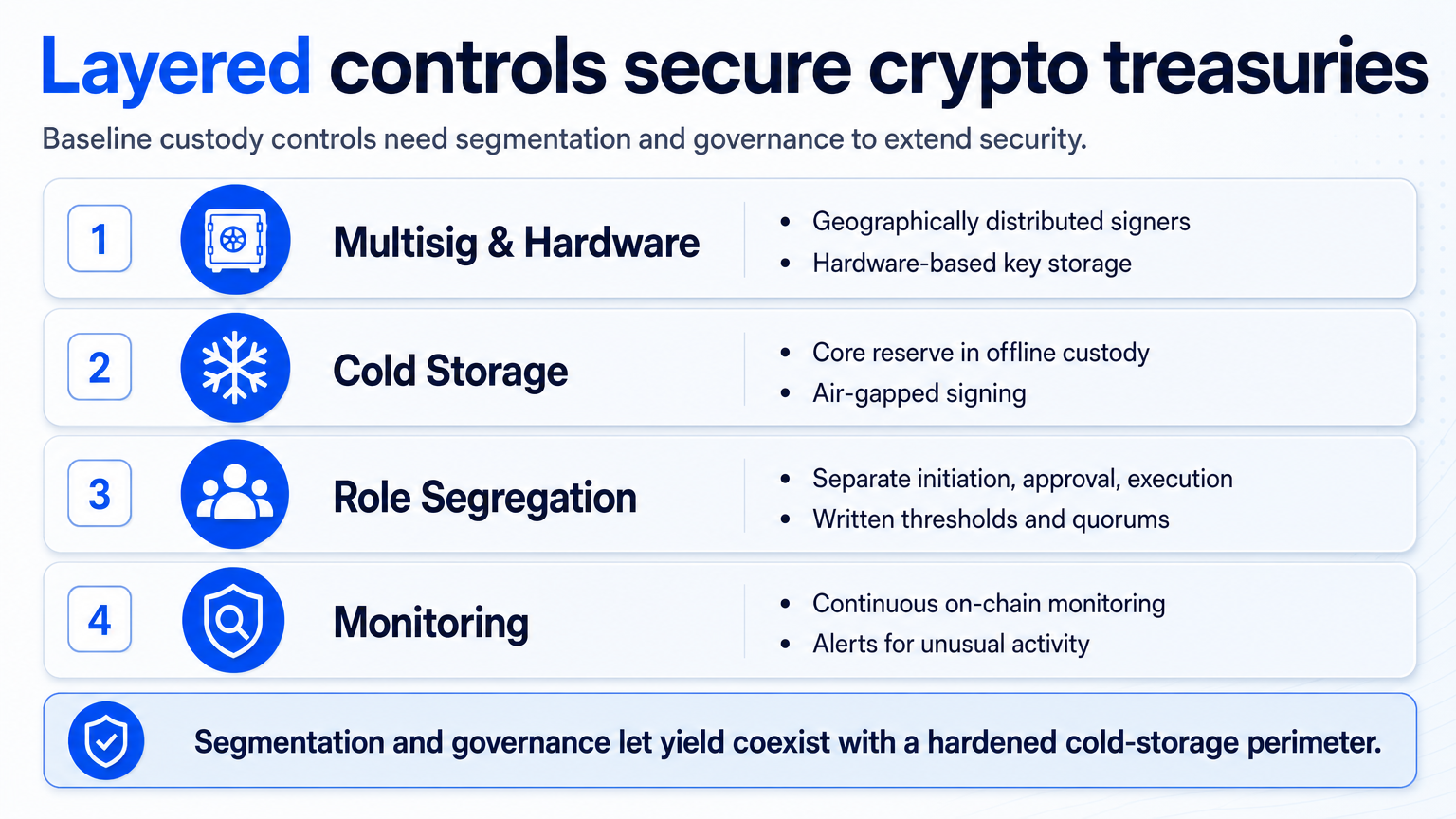
Secure crypto treasury management relies on a layered defense-in-depth:
- Multisignature wallets with geographically distributed signers and hardware-based key storage.
- Cold storage for the core reserve, with air-gapped signing.
- Role segregation separating initiation, approval, and execution.
- Written authorization policies with thresholds and quorums.
- Continuous on-chain monitoring and alerts.
These are the baseline. Yet most crypto treasury best practices guides stop at custody, as the Ripple corporate treasurers’ guide notes, and don’t address safely integrating a yield component without breaking the security model. The Bhutan deal forces that question: the answer lies in segmentation and governance — a separate allocation with its own controls, not weakening the cold-storage perimeter.
Should a Company Self-Custody or Delegate Part of Its Crypto Treasury?

No universal answer exists; a governance-first framework helps. Treat delegation as an allocation decision, analogous to holding cash in an operating account and investing surplus in money-market funds.
| Dimension | Self-Custody (Cold Storage) | Delegated Yield Allocation |
|---|---|---|
| Primary goal | Capital preservation, sovereign-grade control | Modest yield on idle assets |
| Custody model | Multisig, hardware wallets, own key ceremony | External qualified custodian or regulated asset manager |
| Risk profile | Operational, physical, key-person risk | Counterparty, manager, smart-contract, strategy risk |
| Governance | Internal signer quorum, time locks, policy engine | Contractual SLAs, reporting cadence, permissioned withdrawal |
| Suitability | Core reserve, long-term hold | Surplus beyond near-term operating needs |
Segment only after establishing clear treasury policy: maximum allocatable percentage, permitted manager qualifications, reporting frequency, and exit path. Without these, delegation is gambling.
What Governance and Permissions Are Needed When Outsourcing Crypto Treasury Management?
Before delegating, embed five governance pillars, which form the backbone of Bitcoin treasury governance:
- Board/DAO-approved allocation limit. Cap the delegated capital, e.g., “no more than 15% of the Bitcoin treasury at any time.”
- Manager qualification criteria. Specify regulatory status, audit history, insurance, and track record. 3iQ’s Canadian securities regulation provides a tangible benchmark.
- Segregated custody and reporting. Assets must be in segregated accounts with daily position-level reporting.
- Permissioned withdrawal architecture. Treasury retains recall rights to a whitelisted cold wallet with a defined notice period. For DAOs, platforms with customizable roles can mirror this control across fiat and crypto.
- Independent oversight. A risk committee or internal auditor reviews manager reports and stress-tests portfolios, ensuring no single signer reviews alone.
To maintain stakeholder confidence, consistent communication is vital. Joyrise, which plans, writes and publishes illustrated SEO articles to your Webflow blog every day, can help treasury teams share regular updates without manual effort.
How Can a Finance Team Manage Fiat and Crypto Treasury in One Place?
Fragmented operations — separate banking portals, crypto wallets, and manual reconciliation — cause most treasury errors. A unified platform handling both asset classes eliminates that complexity. A modern multi-currency treasury platform enables teams to hold fiat and crypto on institutional-grade custody, convert instantly, execute wires and crypto payments from one interface with role-based approvals, and issue corporate cards — all while keeping treasury segregated. For example, OneSafe provides a single operating environment where global businesses and DAOs manage fiat and crypto together, with multi-currency accounts, on/off-ramps, and permission structures that enforce governance uniformly. This gives a real-time view of total liquidity, strengthening crypto treasury risk management by enabling instant crypto-to-fiat conversion when liabilities come due.
What to Watch Next and Open Questions
Sovereign disclosure and reporting standards
Bhutan hasn’t disclosed the delegated segment’s size or instruments. Pressure will grow for a standard monthly reserves fact sheet naming manager, allocation, strategy, and performance. Without it, delegated sovereign crypto treasuries risk eroding public trust.
Accounting and regulatory treatment of delegated crypto yield
Yield from market-neutral Bitcoin strategies sits in a gray zone: is it interest, capital gain, or return of capital? Few jurisdictions provide guidance. As stablecoin regulation tightens — highlighted by the OCC’s 2027 deadline — parallel rules for crypto-yield income recognition will follow.
Will DAOs and companies follow Bhutan’s model?
The logic transfers. A DAO sitting on idle BTC could adapt the segmentation model if governance passes a formal proposal. The hurdle is lacking a legal entity to contract externally, making DAO treasury management reliant on smart-contract delegation. Several DeFi delta-neutral vaults exist, but governance integration is immature. The next 12 months will test if Bhutan’s move is an outlier or the start of an institutional shift.
Key Takeaways
- Bhutan’s GMC delegated a portion of its Bitcoin treasury to 3iQ for market-neutral Bitcoin yield — the first sovereign external crypto treasury management.
- Self-custody and delegation coexist when a treasury segments core reserves from a defined yield allocation with tailored governance.
- Before outsourcing, a treasury must have board-approved limits, manager criteria, segregated custody, permissioned withdrawal, and independent oversight — the pillars of Bitcoin treasury governance.
- A unified multi-currency platform eliminates reconciliation gaps and strengthens real-time liquidity visibility.
- Accounting treatment remains unsettled; transparent reporting and cautious governance are essential.
Start managing your crypto and fiat treasury on a single, secure platform at OneSafe.