On November 2, 2026, bitcoin and ether reeled from a record $6.3 billion heist at Binance—a blow that instantly reframes what crypto banking security must deliver for businesses holding digital assets. The same morning, traders braced for US midterm elections that could shift control of the federal purse strings and the regulatory future of crypto itself. For founders and finance leads operating across fiat and crypto, these two events are a stress test for every banking stack.
Table of Contents
- What Just Happened: The Binance Hack and Market Tremors
- Why This Matters for Crypto Banking Now
- Crypto Banking 101: What Every Founder Must Know
- Immediate Implications for Your Business
- Recommended Actions for Founders and Finance Leads
- What to Watch Next
- Key Takeaways
What Just Happened: The Binance Hack and Market Tremors
The $6.3B Heist: A Record-Breaking Breach
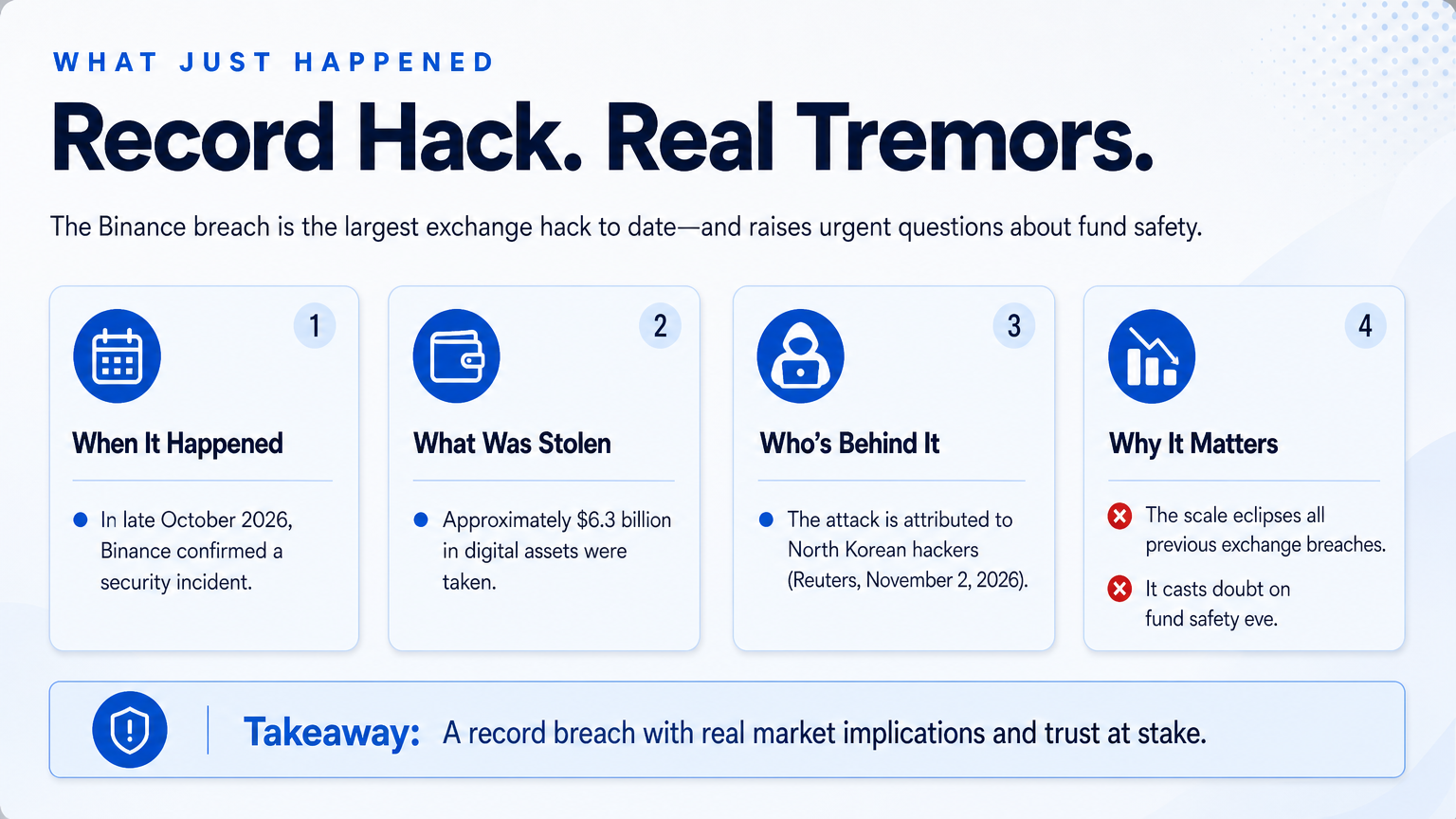
In late October 2026, Binance confirmed a security incident resulting in the theft of approximately $6.3 billion in digital assets, attributed to North Korean hackers (Reuters, November 2, 2026). The scale eclipses all previous exchange breaches and casts doubt on fund safety even at top venues. Bitcoin and ether prices plunged; volatility remained elevated. The attack makes crypto banking security an immediate operational concern, not an academic one.
Midterm Elections Add Economic Uncertainty
The US dollar was rangebound as investors eyed the midterms, which could shift Congressional power and fiscal control. Central bank decisions in the UK, Australia, Norway, and Sweden, plus US jobs data, added to a hectic macro week. Political upheaval and fiscal uncertainty form the backdrop against which any new crypto legislation will be debated—making the outcome directly relevant for businesses building on crypto-fiat rails.
Why This Matters for Crypto Banking Now
How does the Binance hack affect my business's crypto banking?
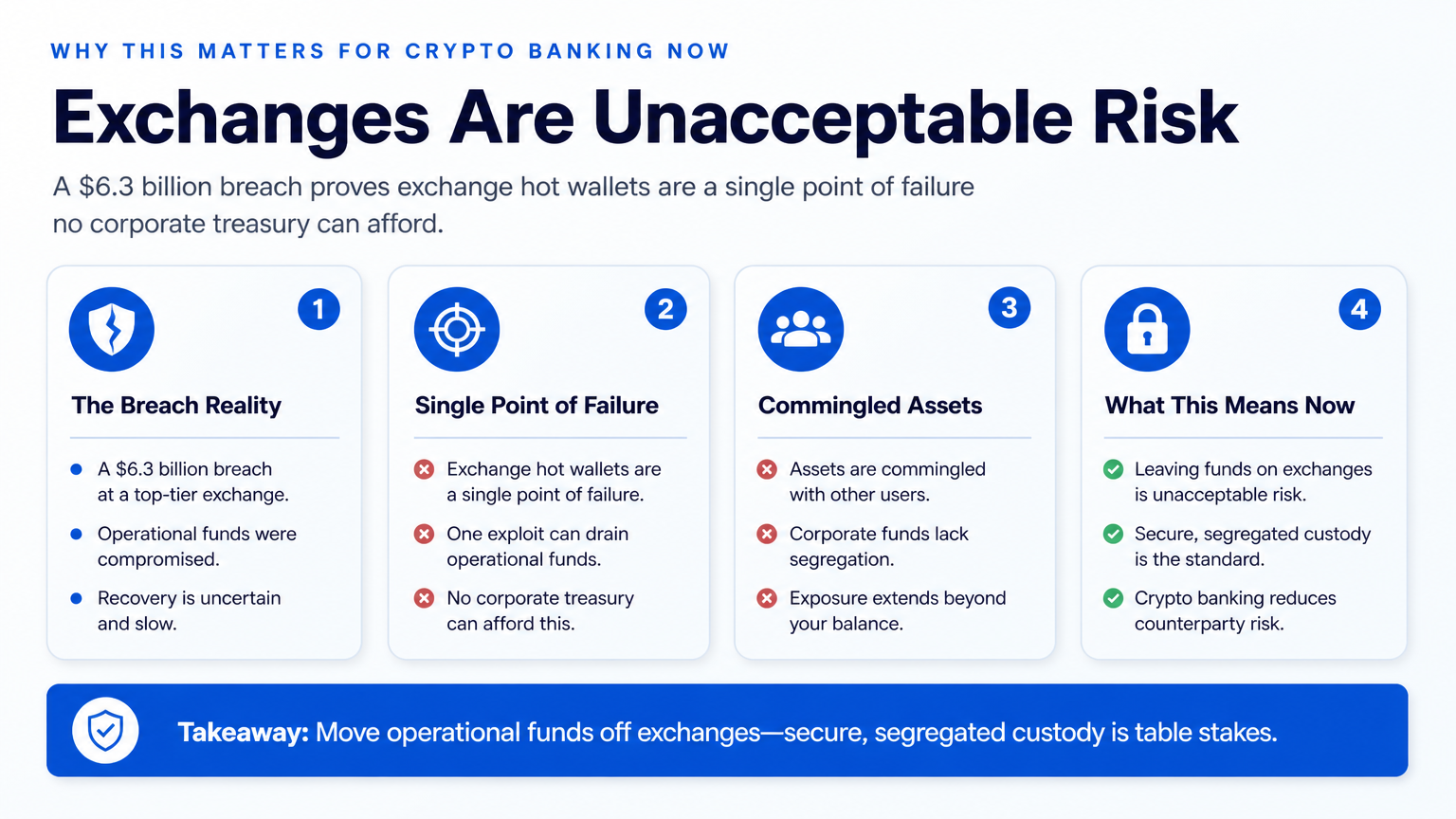
A $6.3 billion breach at a top-tier exchange demolishes the assumption that leaving operational funds on a trading platform is acceptable risk management. Exchange hot wallets are a single point of failure that no corporate treasury can afford—assets are commingled and recovery depends entirely on the exchange’s balance sheet and willingness to make users whole.
The immediate consequence is a forced separation of trading from custody. A company might still use an exchange for execution, but the bulk of its crypto holdings must sit in segregated, institutional-grade custody that does not expose assets to a single venue’s flaws. This distinction is the core of modern crypto banking: it is not merely “banking for crypto,” but a framework where a business’s funds are isolated from counterparty risk.
A joint interagency statement on crypto-asset safekeeping from the FDIC, Federal Reserve, and OCC already warns that digital asset custody requires controls beyond traditional custody. The Binance heist turns that guidance into an urgent operating mandate.
Regulatory Ripples from the Midterm Outcome
The midterms arrive as crypto banking pushes further into the mainstream. If the election shifts committee chairmanships, the path for crypto regulation 2026 could accelerate or stall. A favorable Congress might advance stablecoin legislation and custody rules; a skeptical one could invite agency enforcement. Regulatory fragmentation already forces businesses to choose banking partners that can adapt without freezing operations. (For more on stablecoin regulation and the banking layer, see our analysis.)
Crypto Banking 101: What Every Founder Must Know
Bridging Fiat and Crypto: The Operational Reality
Businesses operating across currencies need a crypto business account that treats on-chain and fiat settlements as a single cash flow—not separate silos. That means ACH, wires, bill payments, and crypto-fiat integration, with conversions that happen near-instantaneously so a euro supplier can be paid from a USDC balance. A multi-currency business account natively holding fiat and stablecoins eliminates multiple banking relationships.
OneSafe provides exactly this: global accounts supporting USD, Euro, and CAD (more on the way), corporate cards with spend limits, and on/off-ramps for crypto. It processes domestic wires, ACH, SWIFT transactions, and handles stablecoin custody for USDC with no deposit or withdrawal fees. Finance teams manage the entire stack from a single interface—a critical advantage when speed and auditability matter.
What is the safest way to custody business crypto?
The safest model is segregated, multi-signature custody backed by a dedicated third-party custodian. Assets sit in accounts legally and operationally separated from the platform’s own balance sheet. Multi-signature requires multiple independent approvals to move funds, preventing a single compromised credential from draining the treasury. When that infrastructure is provided by a specialist like Fireblocks—using hardware security modules (HSMs), policy engines, and cryptographic proof of reserves—the risk profile drops dramatically compared to an exchange hot wallet.
The market often markets “crypto banking” as inherently secure, but the Binance hack exposes how exchange-centric models concentrate assets into lucrative targets. Not all crypto banking is built on the same custody architecture. Platforms integrating Fireblocks keep customer assets in wallets never commingled with trading pools and inaccessible to a single actor. This is the dividing line between safe operations and breach exposure. (For practical steps to manage treasury risk after a major hack, see our guide.)
Immediate Implications for Your Business
How can I avoid exchange risk with my company's digital assets?
Avoiding exchange risk doesn’t mean abandoning crypto—it means restructuring the custody layer. Use this quick audit to gauge exposure:
Exchange Risk Audit Checklist
- List every platform where your business holds crypto, including exchanges, OTC desks, and payment processors.
- For each, determine if funds sit in omnibus hot wallets (pooled) or segregated accounts in your business’s name.
- Verify whether the custodian provides theft insurance and what scenarios it excludes.
- Check if withdrawal approvals require multi-party authorization (multi-sig) or rely on a single user/API key.
- Document the time required to move funds to cold storage or institutional custody.
Any line item revealing a pooled hot wallet with single-approval withdrawals is an unacceptable vulnerability. Firms that relied on Binance’s internal wallets face uncertain recovery; those that segregated assets with a third-party custodian were insulated.
The Case for Segregated, Multi-Sig Custody
A platform using Fireblocks security as its custody backbone provides a concrete alternative. Fireblocks employs MPC (multi-party computation) and a hardware isolation layer, ensuring private key material never exists in a single place and that transaction policies (spend limits, address whitelisting, mandatory multi-approver workflows) are enforced at the infrastructure level. Layering Multi-Factor Authentication (MFA) on top—mandatory at signup and for sensitive actions—further shrinks the attack surface. Businesses adopting this stack treat crypto banking security as an architectural requirement.
Recommended Actions for Founders and Finance Leads
Audit Your Exposure: Exchange vs. Custodial Wallets
Run the checklist above. Many crypto-native companies still keep working capital on an exchange for convenience; post-Binance, that premium is unjustified. Segregate operating liquidity into a custodial account off-exchange, keeping only the minimum required for active trades on exchange wallets, and move those funds back to custody immediately after settlement.
What security measures should I look for in a crypto banking platform?
When evaluating a provider, demand the following:
- Segregated accounts: Customer digital assets in separate, identifiable wallets, not a commingled pool.
- Institutional custody partner: A named third-party custodian like Fireblocks, Coinbase Custody, or a bank-backed service. Self-custody without dedicated hardware and policy controls is risky for business.
- Multi-signature workflows: All withdrawals require at least two independent authorizers, configurable to your approval matrix.
- Mandatory MFA: Every user must enable MFA (preferably hardware-based) at account creation.
- Real-time transaction monitoring and alerting: Unusual movements trigger instant alerts.
- KYB compliance and auditability: Proper business verification and ID checks as required by AML rules.
A platform’s security page is less informative than its technical implementation. Ask whether it uses Fireblocks as the underlying infrastructure, supports a treasury management workflow with role-based controls, and has undergone a recent penetration test covering on-chain components.
How will the US midterms change crypto regulation?
The election outcome directly influences the pace of crypto regulation 2026. If one party gains both chambers, stablecoin legislation could move quickly, introducing federal prudential standards for issuers and clarifying token custody rules. If control splits, expect continued reliance on agency guidance—which can shift abruptly with a new administration. Crypto banking platforms will face changing compliance; businesses should choose a partner that can adjust without suspending key services, and maintain fiat on-ramps in multiple jurisdictions to prevent a single regulatory pivot from freezing cash flow.
What to Watch Next
Binance Fallout: Investigation and User Reimbursement
The immediate question is whether Binance will fully reimburse affected users—and from what source. As of November 2, 2026, no concrete plan has been announced. The reimbursement mechanism will test whether exchange-held balances are truly senior or effectively unsecured loans.
Midterm Results and the Path to Crypto Regulation
Results arrive after November 3. A tech-friendly majority could accelerate a comprehensive digital asset market structure bill; a more conservative lineup may tighten enforcement. The direction will become clearer within weeks, setting the legislative tone for the rest of 2026.
The Long Game: Institutional Adoption Despite Headwinds
Even as the Binance hack reverberates, institutional adoption of tokenized assets continues. Uber’s pilot with HSBC on tokenized deposits and Deutsche Bank’s foray into institutional-grade crypto custody signal that secure custody and settlement are competitive necessities, not a speculative bet. Businesses building their banking stack around segregated, multi-sig custody now will be positioned to ride that wave without balance-sheet trauma.
For teams that need to maintain a steady flow of SEO-optimized content on topics like crypto banking, Joyrise plans, writes, and publishes illustrated SEO articles to your Webflow blog every day—read your first article before you pay.
Custody Model Comparison
| Custody Model | Risk Profile for Business | Insurance & Recovery | Example Implementation |
|---|---|---|---|
| Exchange Hot Wallet | Very High – pooled assets, single point of failure | Unclear; exchange-dependent | Binance pre-hack operational wallets |
| Self-Custody (personal hardware/software) | Medium-High – user error, loss of keys, no policy engine | None unless self-insured | Ledger, Metamask (institutional unsupported) |
| Institutional Segregated Multi-Sig (via Fireblocks) | Low – isolated wallets, multi-approver, MPC | Programmable, often included | Platforms that custody assets through Fireblocks |
| Platform with Fireblocks + MFA + Role-Based Permissions | Very Low – layers of technical and organizational controls | Typically backed by Fireblocks insurance and platform security | OneSafe’s digital asset custody layer |
Key Takeaways
- The Binance hack redefines acceptable risk: Business crypto must move off exchange hot wallets and into segregated multi-sig custody immediately.
- Security is architectural, not cosmetic: Choose a crypto banking platform that integrates Fireblocks and mandates MFA at the infrastructure level.
- Midterm-driven regulation could accelerate or freeze stablecoin and custody rules within months, so your banking partner must be adaptable across jurisdictions.
- A segregated, multi-signature custody model is the only approach that isolates your business from a single exchange’s failure.
- Audit every pooling point in your current banking stack—any pooled hot wallet with single-approval access must be eliminated.
Start building a financial stack that withstands exchange-level crises rather than depending on them. Open a global account that unifies fiat and crypto operations with institutional-grade custody.