On November 10, 2026, Bottomline—a provider of corporate payment and cash management software—disclosed that it had completed live USDC transfers inside its enterprise payments platform. The initial transfer, described as an intra‑company movement between Bottomline entities, marking a step forward for crypto treasury management, ran across the company’s Global Payments Hub and Cash Management platform (TradingView, November 12, 2026). The announcement marks the first time a traditional treasury management vendor has publicly embedded a stablecoin payment within the same interface that finance teams already use for ACH, wires, and account reconciliation.
For treasury professionals watching the slow merge of crypto capabilities with mainline enterprise systems, this is a tangible signal: crypto treasury management is shifting from separate, specialist tools to native enterprise workflows.
Table of Contents
- What Just Happened
- Why This Matters for Crypto Treasury Management
- Crypto Treasury Management 101: What You Need to Know
- The Real‑World Implications for Finance Teams
- How Platforms Like OneSafe Are Already Bridging the Gap
- What to Watch Next in Enterprise Crypto Treasury
- Key Takeaways
What Just Happened
The Bottomline announcement
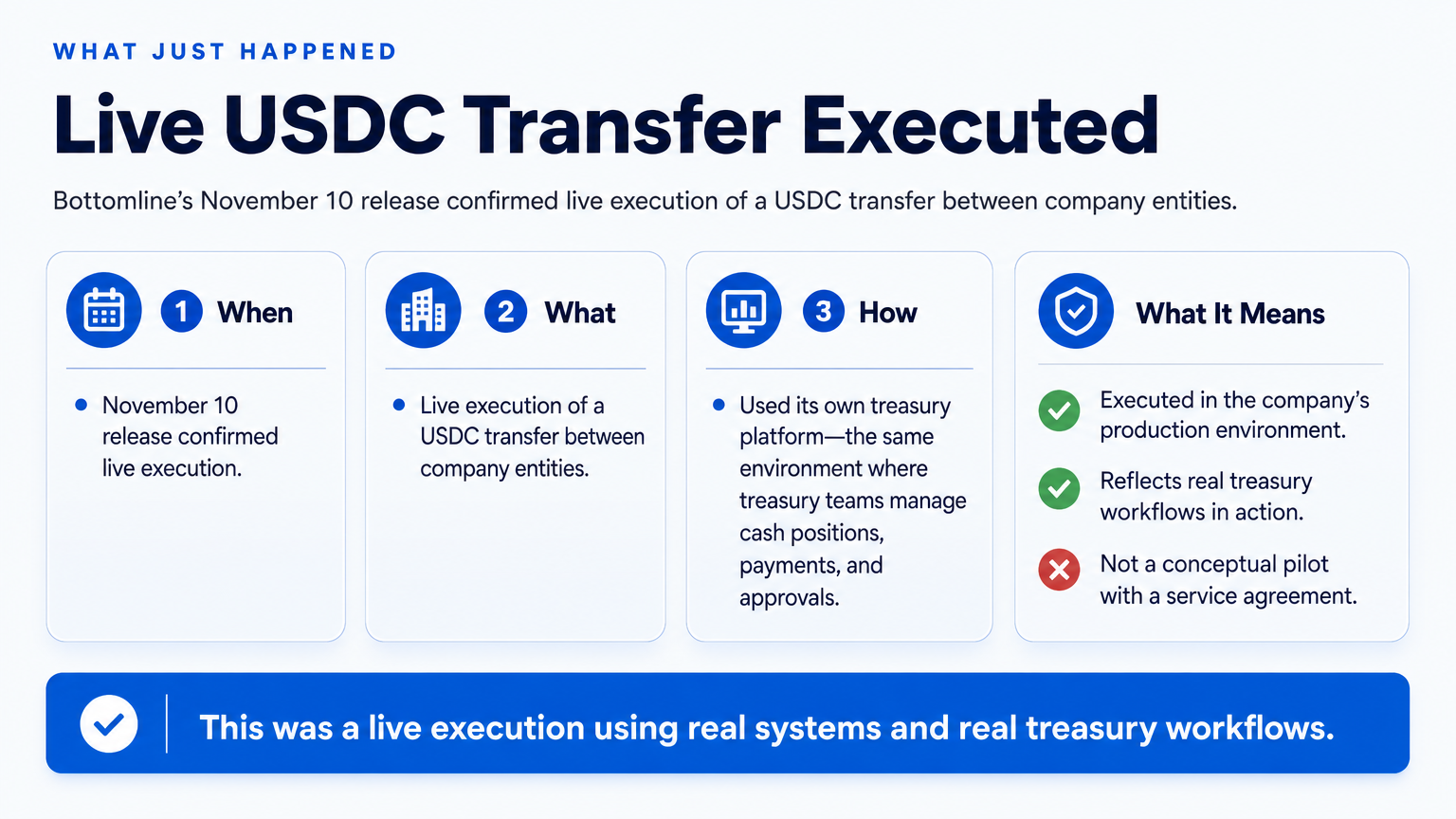
Bottomline’s November 10 release confirmed live execution of a USDC transfer between company entities. The company used its own treasury platform—the same environment where treasury teams manage cash positions, payments, and approvals. The move is not a conceptual pilot with a sandbox token; it used real USDC and went through the production controls that a finance team would rely on.
Bottomline’s public statement frames the capability as a way for treasury teams to handle stablecoin payments alongside traditional methods, retaining familiar approvals, controls, and audit processes. The company highlighted near-real-time settlement, particularly for cross‑border payments, as part of the value proposition. No per‑transaction cost saving or average fulfillment‑time data was included, so the announcement is directional rather than a benchmark.
The significance of intra‑company USDC transfers
Running a USDC transfer between its own entities lets Bottomline test the operational integrity of the integration without exposing client funds. It demonstrates that the payment rail, the accounting hooks, and the compliance checks all function inside the platform. But it also means the industry hasn’t yet seen external, multi‑party USDC corporate transfers executed through a traditional treasury management system at scale. Bottomline’s move is, therefore, a proof point for the plumbing, not yet a volume metric.
Why This Matters for Crypto Treasury Management
Stablecoins enter the enterprise treasury stack
Most enterprise stablecoin experimentation has happened at the largest banks and payment networks. Visa settled a test transaction on the Monad blockchain in September 2026 (covered in Stablecoin Payments: Visa Adds Monad—What It Means), and Circle has steadily expanded USDC’s multi‑chain availability. Bottomline’s announcement brings the stablecoin conversation into the mid‑market treasury technology layer—the software that thousands of finance teams use daily.
The difference: when a business can execute a USDC payment from within its cash management dashboard, enterprise crypto payments no longer require separate crypto wallets, new signing processes, or manual reconciliation outside the ERP. Enterprise crypto payments become another rail choice, not a side system.
From side experiment to core infrastructure
Just a few years ago, corporate crypto treasury meant holding bitcoin on a balance sheet and managing it with a custody provider. The Bottomline integration reflects a more mature vision—using stablecoins for crypto cash management and stablecoin treasury operations, not just investment. This shift toward stablecoin treasury is the same shift that Crypto Treasury Management: What PNC’s Stablecoin Move Means documented when PNC began exploring USDC for corporate payments: the utility layer, not the store‑of‑value layer, is what brings crypto treasury inside the finance function.
Crypto Treasury Management 101: What You Need to Know

Most ranking pages already cover the foundational definitions; what follows compresses that context so we can focus on what’s new.
What is a crypto treasury?
A crypto treasury (or blockchain treasury) is the structure a business uses to hold, transact, and manage digital assets—stablecoins, major cryptocurrencies, and tokenized instruments—alongside or in place of fiat balances.
What is crypto treasury management?
Crypto treasury management encompasses the strategies, tools, and processes that finance teams use to control liquidity, risk, payments, and reporting for those digital asset holdings. (For a robust framework, see these navigating crypto treasury strategies.) It extends cash management to an asset class that settles 24/7 and relies on private‑key custody rather than bank‑ledger entries.
How is treasury management for crypto different from traditional treasury management?
Traditional treasury operates inside banking hours, with settlement times measured in days and a well‑defined regulatory perimeter. Crypto treasury adds unique challenges: volatility (for non‑stablecoins), custody models based on multisig or custodial partnerships, smart‑contract programming risk, and fragmented on‑chain data that doesn’t natively plug into ERP systems. A finance team adopting crypto must also manage new security practices—hardware wallets, key rotation, and role‑based access on‑chain—that have no equivalent in a SWIFT‑based workflow.
The Real‑World Implications for Finance Teams
Operational efficiency and real‑time settlement
When stablecoin payments become a native payment option inside a cash management platform, the theoretical 24/7 settlement of blockchains translates into a practical treasury tool. A U.S. entity paying a subsidiary abroad could settle in USDC within minutes, bypassing correspondent bank delays and time‑zone restrictions. Finance teams can then fund that payment from their existing cash pool, using the same approval flow as a wire.
Compliance and auditability inside existing workflows
One reason enterprise adoption has lagged is that generating audit‑ready records for on‑chain activity has required custom integration. Bottomline’s approach—embedding USDC inside an environment that already supports dual approval, segregation of duties, and automatic general‑ledger posting—addresses that gap. The payment record, the approval trail, and the on‑chain hash sit together, not in a separate wallet interface.
This convergence is critical for mid‑market firms whose compliance teams can’t audit crypto screens they don’t control. DeFi Compliance: The Illinois Tax Case Explained highlights how regulatory scrutiny around digital asset transactions is intensifying, making embedded audit trails a requirement, not a luxury.
What this means for mid‑market and global businesses
Large enterprises can afford to build custom integrations between their TMS and a stablecoin provider. For mid‑market CFOs, the cost and complexity of stitching together a wallet, a custodian, and a treasury system has kept crypto treasury out of reach. When the TMS itself handles USDC transfers natively, mid‑sized businesses—especially those with cross‑border vendor or payroll needs—gain a simpler on‑ramp. The same logic applies to global businesses that already run multi‑currency pools and could use stablecoins to reduce FX spread and float.
A practical checklist for finance leads evaluating the shift:
- Does your current TMS have any stablecoin payment roadmap, or is crypto a separate tool?
- Will adding USDC payments require new banking relationships or regulatory filings in your jurisdictions?
- Can your accounting system ingest on‑chain transaction data automatically via APIs?
- Is your custody model auditable under your existing SOC‑2 or internal control framework?
- Are the stablecoin’s reserves transparent and subject to regular attestation (e.g., Circle’s monthly reports)?
A “yes” to the first question with “no” to the others suggests a gradual adoption path is opening; a “no” across the board means the infrastructure isn’t ready yet.
How Platforms Like OneSafe Are Already Bridging the Gap
While TMS vendors like Bottomline begin integrating stablecoin rails, neo‑banking platforms already give Web3 startups, DAOs, and global businesses a unified fiat‑crypto integration, enabling a single interface for both fiat and crypto treasury operations. OneSafe, for example, provides multi‑currency accounts, corporate cards, wire capabilities, and on‑chain USDC transfers in a single interface—free of separate wallet logins or manual reconciliation between fiat and crypto ledgers.
The case for a unified fiat‑crypto platform
Finance teams managing both fiat and crypto typically juggle a traditional bank portal plus a crypto custody tool, with manual accounting for each conversion. OneSafe’s platform processes over $800 million in transaction volume from more than 1,000 businesses across 30+ countries, offering features like ACH and international wires, instant crypto‑to‑fiat conversions, and free USDC deposits and withdrawals. The value is the elimination of the operational gap: a DAO paying contributors in USDC, for instance, can use the same approval workflow and GL tags as its USD wire batch.
Key features to look for (and how OneSafe stacks up)
When evaluating a platform that bridges fiat and crypto treasury, the checklist includes:
- Multi‑currency support (OneSafe currently handles USD, Euro, CAD, with more currencies coming soon)
- Native stablecoin rails (USDC transfers are free; conversion to fiat is near‑instant)
- Custody security (OneSafe secures digital assets via Fireblocks, with mandatory MFA)
- Role‑based access and compliance (segregated duties, customizable roles for DAOs)
- Accounting integration (automated payment reconciliation, invoicing in multiple fiat and stablecoins)
These capabilities mirror the design principles that Bottomline is now building toward—but with a crypto‑native DNA that predates the TMS integration push.
What to Watch Next in Enterprise Crypto Treasury
Will other TMS providers follow?
Bottomline’s move likely accelerates conversations inside competing treasury platforms. Kyriba, FIS, and SAP Treasury have all explored blockchain integration, but other treasury management solutions have not yet announced a production USDC transfer inside their core payment module as of this writing. The next signal to watch is external, multi‑party transfers—when a hospital system pays a supplier or a manufacturer settles an intercompany invoice in USDC via a TMS, the adoption narrative moves from lab to ledger.
The regulatory and accounting questions ahead
The U.S. lacks a comprehensive stablecoin regulatory framework, though multiple bills have been floated in Congress. The accounting treatment of stablecoins—whether they should be marked as cash equivalents or as intangible assets—remains unsettled, leaving finance teams to navigate divergent auditor opinions. Meanwhile, the global push toward stablecoin regulation, explored in Stablecoin Regulation After Trump's Crypto Backlash, affects how quickly corporates can add USDC to their payment mix without running afoul of evolving guidance.
Does the future of treasury management require support for crypto assets?
Not tomorrow, but the direction is unmistakable. As more B2B payment flows move on‑chain and major ERP systems add stablecoin modules, a treasury stack that can’t handle crypto becomes a constraint. By starting with stablecoins in a controlled intra‑company setting, Bottomline offers a model for incremental adoption: start inside familiar workflows, prove the controls, then extend externally. For heads of treasury, the question is shifting from “if” to “how soon will my current platform support this?”
What does Bottomline's USDC transfer mean for crypto treasury management?
It proves that stablecoin payments can live inside the same enterprise treasury interface that manages every other cash movement, with real compliance and audit controls—not in a standalone crypto dashboard. That proof moves crypto treasury management from a niche discipline into the enterprise software roadmap, and it gives CFOs a concrete reference point for demanding the same capability from their own providers.
| Key Event | Date | Significance |
|---|---|---|
| Bottomline executes intra‑company USDC transfers inside its platform | November 10, 2026 | First TMS vendor to embed live stablecoin payments with native controls |
| Visa settles on Monad blockchain | September 2026 | Shows major network’s commitment to stablecoin rails |
| PNC begins exploring USDC for corporate payments | 2025‑2026 | Large U.S. bank tests operational stablecoin use for business clients |
Key Takeaways
- Bottomline’s live USDC transfer, while intra‑company, signals that stablecoin payments are on the enterprise TMS roadmap, not a separate crypto experiment.
- Finance teams should evaluate whether their current treasury stack can handle fiat and crypto natively, and start planning for integration before a business need forces a rushed addition.
- Real‑time settlement, embedded compliance, and simpler cross‑border payments are the practical drivers that will bring stablecoins into mid‑market treasury operations.
- Platforms like OneSafe already demonstrate how a unified fiat‑crypto account structure can eliminate the operational gap between traditional banking and on‑chain finance for global businesses and DAOs.
- The next milestone to watch is external, multi‑party USDC transfers executed and reconciled inside a TMS; when that happens, the early‑adopter window will have closed.
For businesses that publish content as efficiently as they manage treasury, tools like Joyrise: grow organic traffic while you sleep can handle SEO publishing on autopilot. If your organization is ready to explore a banking platform that already unifies fiat and crypto operations in one account, open an account with OneSafe.