

meta description: Canada’s 2026 stablecoin consultation proposes a 1% redemption fee cap, full reserves, and no interest. Learn how businesses can prepare for fall 2027.
Canada Stablecoin Regulation: What Businesses Must Know
On October 26, 2026, Canada’s Department of Finance opened a 60-day public consultation on draft stablecoin regulation for non-bank issuers, marking the start of the official Canada stablecoin consultation. The proposals include a 1% cap on redemption fees, full reserve requirements, and a continuing ban on interest paid to holders. For global businesses that rely on stablecoins for cross-border payments, treasury, and DAO financial management, the move is a sharp signal that unregulated stablecoins face a narrowing path—but it also charts a clear compliance roadmap. Understanding the specifics now can help you turn regulatory shifts into an operational edge.
Table of Contents
- What Just Happened: Canada Proposes New Stablecoin Rules
- Why This Matters for Businesses Using Stablecoins
- The Global Regulatory Context
- How to Prepare Your Business for the New Rules
- What to Watch This Fall and Beyond
- Key Takeaways
What Just Happened: Canada Proposes New Stablecoin Rules

The draft regulations, published in the Canada Gazette and detailed on the government’s stablecoin framework page, outline requirements for fiat-referenced crypto-asset issuers that are not banks or federally regulated financial institutions. This Canada stablecoin consultation invites comments until December 23, 2026, with the government targeting a fall 2027 effective date (Bitcoin Foundation, October 26, 2026).
The Draft Regulation’s Key Requirements
The proposed Canada stablecoin rules set a high bar for anyone issuing a Canadian-dollar-linked stablecoin:
- Redemption at par within 3 business days, backed by a reserve of liquid assets equal to 100% of the outstanding tokens.
- A 1% maximum fee on redemptions—this stablecoin redemption fee cap directly limits what issuers can charge holders to exit.
- A prohibition on interest or yield paid to stablecoin holders, including indirect payments such as airdrops or other incentives tied to holding the token.
- Bank of Canada supervision of registered issuers, with requirements for regular reporting, capital buffers, and risk management.
The rules are explicitly designed to separate payment instruments from investment products. A government statement noted that the framework “aims to bring Canada’s standards in line with those developing in the United States and other jurisdictions.”
Consultation Timeline and Regulatory Path
The 60-day window means businesses and industry groups have until late December 2026 to submit feedback. Ottawa intends to finalize the regulations afterward, with an expected implementation date in fall 2027. This gives firms roughly a year to adapt once the final rules are published—a relatively compressed timeline given the operational changes many will need.
Why This Matters for Businesses Using Stablecoins
Stablecoin regulation 2026 is no longer a distant prospect; it’s moving into implementation across multiple large economies. Canada’s proposals carry immediate implications for how businesses manage crypto liquidity, pay vendors, and structure their treasury operations.
Impact on Cross-Border Payments and Treasury
For a mid-sized e-commerce exporter using USDC or a proprietary CAD-stablecoin to settle invoices with Asian suppliers, the 1% redemption fee cap may seem like a consumer protection. But it also establishes a cost floor. If an issuer charges just under 1% every time you convert stablecoins back to fiat, the cumulative drag on margins over hundreds of transactions can be significant. This fee structure may push businesses toward holding fiat longer or using platforms that optimize off-ramps with lower effective costs.
Moreover, the full reserve requirement and ban on interest mean a CAD-stablecoin will be a sterile asset. Unlike some yield-bearing alternatives in other jurisdictions, Canadian-compliant stablecoins will not generate passive income for holders. For treasurers managing working capital, this forces a choice: accept zero yield for the certainty of 1:1 redeemability, or keep funds in unregulated instruments that may face future crackdowns. This is a concrete trade-off that directly shapes cross-border stablecoin payments strategies.
DAOs and Web3 Startups: A New Compliance Challenge
Decentralized autonomous organizations and crypto-native startups often hold significant stablecoin reserves, use them for payroll via crypto payroll, and manage DAO financial management through on-chain tools. Under Canada’s proposed regime, any CAD-referenced stablecoin an organization holds will come from an issuer that must be registered and supervised. While the rules don’t directly regulate holders, they indirectly impose a compliance filter: if your preferred stablecoin isn’t approved in Canada, its liquidity and acceptance may shrink.
For DAOs, the challenge is magnified by the need to handle fiat on-ramps and off-ramps for operational expenses while maintaining transparency. A unified banking platform that allows you to manage both fiat and crypto within one dashboard—and provides customizable roles for multisig approvals—can reduce the overhead of dealing with multiple, jurisdictionally siloed financial providers.
The Global Regulatory Context
US and EU Approaches in Brief
Canada’s move doesn’t exist in a vacuum. In the US, the GENIUS Act, passed in early 2026, established a federal framework for payment stablecoins. The Treasury issued proposed rules implementing that law, and the Federal Reserve put out its own proposal in September 2026. Critically, the US framework also limits interest on stablecoins but allows certain “rewards” structures, a nuance Canada’s blanket ban does not share. For more on the GENIUS Act’s October 2026 status, see our update.
The European Union’s Markets in Crypto-Assets (MiCA) regulation came into force in 2025, treating stablecoins as e-money tokens with strict reserve and redemption rules. Both US and EU models heavily influence Canada’s approach, and Ottawa has explicitly stated its intention to achieve cross-border alignment.
The Push for Cross-Border Alignment
Canada’s stablecoin consultation emphasizes that the rules are designed “to complement regimes in other G7 countries.” This alignment is critical for businesses operating in multiple jurisdictions: a single, globally coherent set of stablecoin rules could let you standardize compliance rather than creating a country-by-country patchwork. The OCC’s recent interpretative letter on stablecoin activities by US national banks (September 2026) illustrates the same trend—regulators want clarity, and they want it interoperable.
How to Prepare Your Business for the New Rules
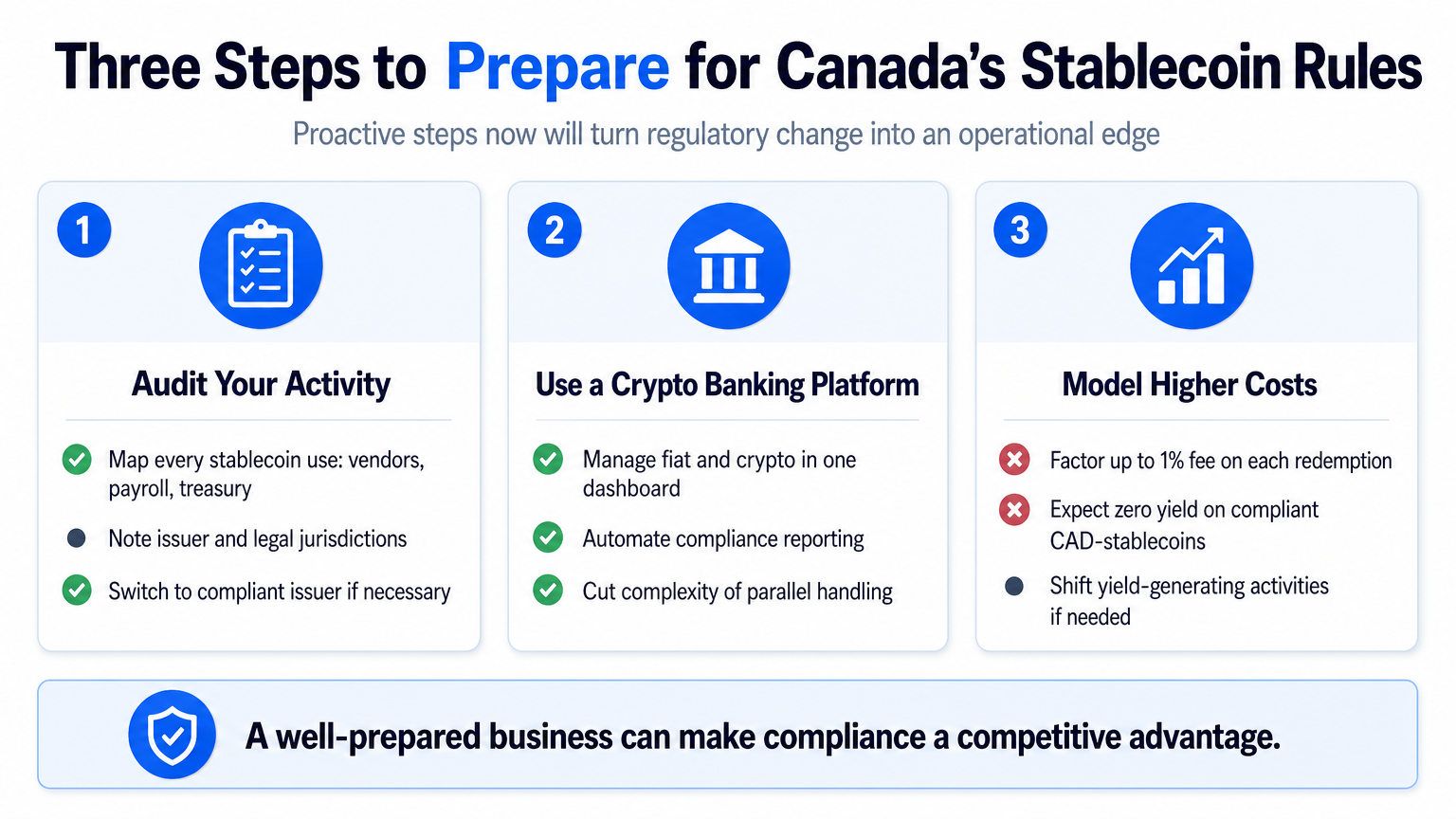
The 2027 effective date may feel distant, but the steps you take over the next six months can determine whether you’re scrambling or ready.
Audit Your Stablecoin Activity and Jurisdictional Exposure
Start by mapping every place your business uses stablecoins: vendor payments, payroll, treasury reserves, on-chain governance. For each stablecoin, note the issuer and the legal jurisdictions where your corporate entities operate. If you hold a CAD-anchored token that isn’t likely to meet the new Canadian standards, you’ll face a decision: swap to a compliant issuer now, or be prepared for potential liquidity issues later. This audit is the bedrock of crypto business compliance under the new regime.
Use a Crypto Banking Platform to Manage Fiat and Crypto Compliance
Managing fiat and crypto across multiple banks and wallets creates a fragmented trail that’s hard to reconcile—especially when stablecoin rules differ by country. That’s where a crypto banking platform becomes practical. OneSafe, for example, lets businesses maintain multi-currency accounts in USD, EUR, and CAD, run on/off-ramps for crypto, and automate compliance reporting—all through a single interface. Because it’s a fintech company, not a bank, its services sit atop licensed banking partners, but the unified dashboard cuts the complexity of handling fiat wires, ACH, and stablecoin conversions in parallel.
While not a substitute for legal advice, using a platform that logs all transactions and supports segregated accounts helps meet the transparency expectations that regulators are building into frameworks like Canada’s.
Prepare for Higher Redemption Costs and Possible Yield Loss
If you routinely move large volumes, factor a potential 1% cost into your financial models. Even if issuers charge less, the cap sets a ceiling that allows for fees right up to that limit. Similarly, if your treasury currently earns yield on algorithmic or yield-bearing stablecoins, prepare for the reality that compliant CAD-stablecoins will not provide any. You might shift yield-generating activities to other currencies or instruments, but that comes with additional FX and counterparty risk.
What to Watch This Fall and Beyond
The consultation closing on December 23, 2026 will be pivotal. Industry feedback could soften or tighten certain aspects—such as the treatment of indirect rewards or the redemption timeline. Keep an eye on the Bank of Canada’s supervisory approach: the central bank’s posture toward fintech innovation will strongly shape how registrants are treated in practice. Also watch the interplay with US rulemaking; if the Federal Reserve’s final rules or the Treasury’s GENIUS Act implementation allow more flexibility on yields, that could pressure Canada to adjust.
Open questions remain: Will the 1% fee cap apply to all redemption scenarios, including emergency market conditions? How will the interest ban handle staking-like services that might not be “interest” but provide a de facto return? And how will decentralized stablecoins without a clear issuer be affected? The government’s draft explicitly targets non-bank issuers, so algorithmic or DAO-governed tokens that don’t have a registrable entity may be forced to register or cease operations for Canadian users.
Staying on top of stablecoin regulation can fuel your content strategy. Joyrise writes and publishes illustrated SEO articles to your Webflow blog every day—and you can read your first article before you pay.
What are Canada’s proposed stablecoin rules?
The draft regulations, published on October 26, 2026, require non-bank stablecoin issuers of Canadian-dollar-referenced tokens to: maintain 100% liquid reserves; redeem tokens at par within three business days; charge no more than a 1% fee on redemptions; prohibit paying interest or yield to holders; and register with and be supervised by the Bank of Canada. They are expected to take effect in fall 2027.
How will the 1% redemption fee cap affect businesses?
The cap sets a maximum cost for converting stablecoins to fiat, but it also means issuers can charge up to that 1% on every redemption. For businesses with high transaction volumes, this could increase operational costs. It may also discourage frequent on/off-ramp moves, nudging companies to keep more funds in stablecoins or fiat for longer periods.
What does full reserve and no interest mean for stablecoin users?
Full reserve means every token is backed by liquid, low-risk assets, reducing the risk of a “run” and giving holders confidence they can redeem at any time. No interest means you won’t earn a yield simply by holding a compliant Canadian stablecoin. This design distinguishes payment tokens from investment products, but it eliminates the passive income some businesses have relied on from yield-bearing stablecoins elsewhere.
What timeline should businesses prepare for?
The public consultation runs until December 23, 2026. Ottawa then reviews comments and aims to publish final rules, with an effective date in fall 2027. Businesses should use the first half of 2027 to adjust treasury structures, transition to compliant issuers, and integrate any necessary technology or platform changes.
How can fintech platforms like OneSafe simplify stablecoin compliance?
A fintech platform that integrates fiat and crypto—such as OneSafe—can reduce the operational burden of adapting to new stablecoin rules. Instead of juggling a traditional bank for fiat and a separate crypto exchange or wallet for stablecoins, you manage both from one interface. Features like multi-currency accounts in CAD, automated off-ramp conversions, and consolidated transaction reporting help teams demonstrate compliance and streamline reconciliation. When the platform also handles corporate cards, bill payments, and invoicing, it centralizes the data trail that regulators increasingly expect.
| Canadian Stablecoin Proposal | Key Detail | Business Implication |
|---|---|---|
| Redemption fee cap | 1% maximum | Potential added cost per exit; model into treasury flows |
| Reserve requirement | 100% liquid assets | Higher safety, lower counterparty risk |
| Redemption window | 3 business days | Predictable liquidity; plan settlement timing |
| Interest ban | No yield to holders | No passive income from CAD-stablecoins; source yield elsewhere |
| Supervision | Bank of Canada oversight | Registered issuers face ongoing compliance; choose partners carefully |
| Timeline | Fall 2027 effective date | 12-18 months to adapt after final rules |
Key Takeaways
- Canada’s proposed stablecoin rules, unveiled October 26, 2026, set a 1% redemption fee cap, full reserves, and a ban on interest, with a target effective date of fall 2027.
- The 1% fee ceiling and zero-yield environment will raise costs and eliminate passive income on compliant Canadian stablecoins, forcing businesses to reassess their treasury and payment workflows.
- Preparing now—auditing stablecoin usage, vetting issuers, and consolidating fiat-crypto management on a unified platform—can turn regulatory compliance into a competitive advantage.
- The consultation’s cross-border alignment focus means Canadian rules will likely mirror US and EU frameworks, reducing fragmentation for global operators.
To future-proof your cross-border payment infrastructure as stablecoin regulation evolves, explore a neo-banking platform built for Web3 businesses.



