

On October 26, 2026, the U.S. Office of the Comptroller of the Currency (OCC) formally urged community banks to apply for authority to issue dollar-pegged payment stablecoins, as reported the same day by BigGo Finance. The push is tied directly to the GENIUS Act’s January 18, 2027 effective date, and it changes a core assumption in business crypto banking: that stablecoin issuance would remain concentrated among large banks and crypto-native firms. For startups, DAOs, and global operators, the headline overstates the near-term shift. The rules are still forming, but usable fiat-crypto rails already exist today.
Table of Contents
- What the OCC Just Did—and When It Takes Effect
- Why This Shifts Crypto Banking for Businesses and DAOs
- The Slow-Burn Background That Led Here
- What Your Business Should Do Right Now
- Open Questions and What to Watch
- What does the OCC’s stablecoin push mean for my business?
- How will the GENIUS Act change crypto banking?
- Can my startup use a crypto banking platform today?
- What are the risks of using a business crypto banking service?
- How do I choose a crypto banking provider?
- Key Takeaways
What the OCC Just Did—and When It Takes Effect
The GENIUS Act’s January 18 launch and what it authorizes
The OCC has finalized implementing rules for the GENIUS Act, which takes effect January 18, 2027, according to BigGo Finance’s October 26, 2026 report. The law establishes a federal authorization path for payment stablecoin issuance, and the OCC is using that framework to recruit smaller institutions. The agency wants community banks to issue stablecoins either directly or through subsidiaries.
The operational caveat: the OCC has not yet begun accepting license applications. No window is open today, and no community bank-issued stablecoin will launch before the effective date. For a closer read, see Stablecoin Regulation: What the OCC’s Latest Move Means.
Why community banks are being urged to enter stablecoin issuance
The stated rationale, per BigGo Finance on October 26, 2026, is to keep payment infrastructure from being left solely to large banks and crypto companies. Adding community banks into OCC stablecoin issuance would diversify the issuer base and give businesses more local stablecoin payment options.
Reception is not uniformly warm. The same report notes the Independent Community Bankers of America (ICBA) has sued the OCC over fairness in its crypto firm approvals, and Senator Elizabeth Warren is demanding an explanation of how those approvals were granted.
Why This Shifts Crypto Banking for Businesses and DAOs
Most crypto-native businesses and DAOs still run fragmented stacks: a traditional bank for fiat payroll and vendor wires, an exchange or OTC desk for conversion, a separate custodian for on-chain assets, and manual reconciliation. The OCC’s direction suggests banks may eventually absorb some of those layers.
The platform layer, however, has already moved. A fintech—not a bank, but a technology company working through banking partners—can provide crypto-fiat integration across a multi-currency business account, ACH and wires, bill payments, corporate cards, and crypto on/off-ramp in one interface. For DAOs and startups, the real question is not when banks will catch up, but which non-bank rails can run the business now.
Stablecoins are working capital. They handle payroll, vendor settlement, cross-border transfers, and increasingly automated flows. Those rails do not require a community bank issuer. They require custody, conversion, and payment rails—all of which already exist through fintech platforms. The OCC’s push matters because it could eventually make bank-issued stablecoins a commodity. “Eventually” is doing the heavy lifting.
The Slow-Burn Background That Led Here
Crypto banking for startups began as an access problem: companies touching bitcoin or ether could not open standard commercial accounts, so they turned to crypto-friendly fintechs and smaller institutions. Stablecoins then became the bridge between fiat and digital assets, and the workaround hardened into infrastructure.
The GENIUS Act crypto framework is the milestone that matters now. Implemented through OCC rules finalized and reported on October 26, 2026, the Act takes effect January 18, 2027. It follows earlier OCC interpretive letters that opened national banks to crypto custody and related activities, but it goes further by inviting smaller institutions into issuance. Businesses tracking the legislative arc should read Stablecoin Regulation: GENIUS Act Update for October 2026 alongside the OCC push.
What Your Business Should Do Right Now
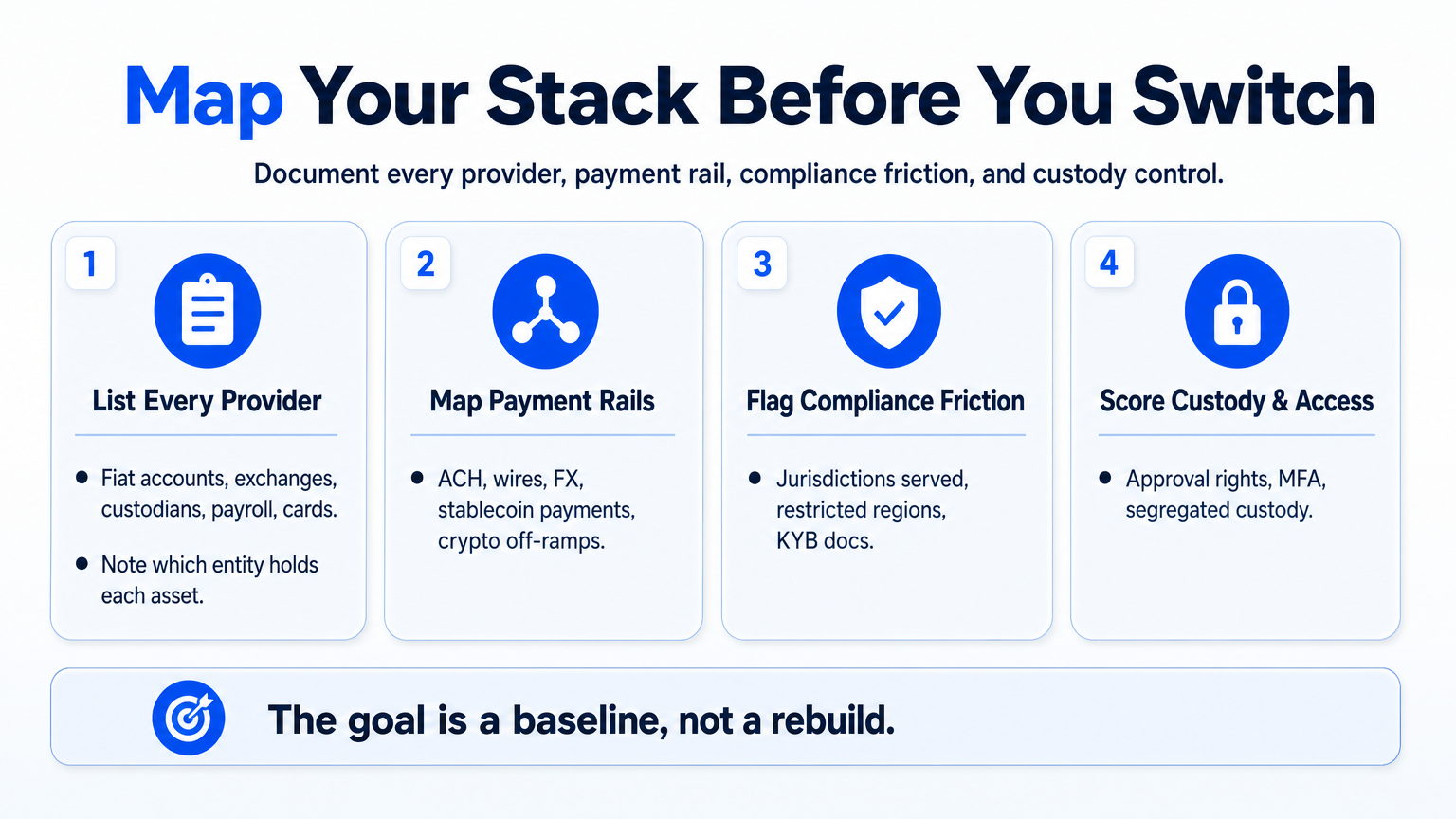
Before changing anything, map what you have. A four-point audit works:
- List every provider—fiat operating account, exchange, custodian, payroll, cards—and note which entity legally holds each asset.
- Map weekly payment rails—ACH, wires, FX conversion, stablecoin vendor payments, and crypto off-ramps.
- Flag compliance friction—jurisdictions served, restricted regions, and KYB documents required.
- Score custody and access controls—approval rights, MFA, and whether digital assets sit in segregated custody.
The goal is a baseline, not a rebuild. When bank-issued stablecoin options arrive, you need a real comparison point.
The decision rule that matters most: do not let regulatory headlines determine when you start running fiat and crypto on unified rails. A business stablecoin banking setup with a multi-currency business account, corporate cards, and crypto-fiat conversion is available now—including for DAOs with multi-signer controls. The OCC’s announcement does not unlock new capabilities today; it signals where bank policy is heading.
License applications are not open. AML rules are incomplete. Litigation is pending. If you wait for a community bank to offer stablecoin issuance, you are likely delaying operations for 12 to 24 months on an uncertain bet. Meanwhile, the practical stack is live today. Some teams also automate stakeholder communications while rules evolve; Joyrise (your blog, written and published every day) plans, writes and publishes illustrated SEO articles to your Webflow blog every day, and you can read your first article before you pay.
Open Questions and What to Watch
Will community banks actually apply?
The OCC wants them to. Community banks, however, run lean compliance teams, and stablecoin issuance brings novel liquidity, redemption, and technology risks. The ICBA suit suggests the industry is not uniformly behind the push. Expect a few well-capitalized regional banks to move first; the long tail waits for finalized AML rules and a track record.
Legal challenges and political pushback
The OCC views community bank stablecoin issuance as safe and necessary. The ICBA has sued over fairness in crypto firm approvals, and Senator Warren is demanding explanations—both reported in the October 26, 2026 BigGo Finance piece. Treat the OCC push as a real direction signal, not a settled legal environment. The implementing rules could still be revised or enjoined, and January 18, 2027 does not guarantee a clean launch.
The missing AML rules and compliance reality
The most consequential caveat is that anti-money-laundering rules remain incomplete. Even after the effective date, core compliance obligations may not be fully specified. That raises the bar for choosing providers now—you want a platform whose own compliance protocols are already operational, independent of federal finality. Cross-border operators should also track parallel frameworks, such as Canada Stablecoin Regulation: What Businesses Must Know, because OCC rules do not solve non-US obligations.
What does the OCC’s stablecoin push mean for my business?
It means the supply of bank-issued stablecoin rails may widen over the next two to three years—but it does not change your day-to-day options today. The OCC has invited community banks into issuance; it has not opened applications, and no community bank stablecoin will exist before January 18, 2027, at the earliest.
How will the GENIUS Act change crypto banking?
The GENIUS Act brings payment stablecoin issuance into a federal framework effective January 18, 2027. For crypto banking, the shift is structural: stablecoins move from an unregulated side activity to a licensed product with defined reporting requirements. The OCC has published reporting forms and instructions for the Act. AML rules are still incomplete, so compliance expectations will keep shifting after the effective date.
Can my startup use a crypto banking platform today?
Yes. If your startup is incorporated, you can onboard to a unified fiat-crypto platform now, without waiting for bank-issued stablecoins. OneSafe—a financial technology company, not a bank, with banking services provided through partners—offers a multi-currency business account in USD, Euro, and CAD, plus ACH, domestic and international wires, bill payments, corporate cards with spend limits, and instant crypto-to-fiat conversion. Digital assets are secured on Fireblocks, and MFA is mandatory at signup. Onboarding is fully digital and typically completed within a week.
What are the risks of using a business crypto banking service?
Four risks dominate:
- Regulatory risk. Rules are forming, and even the OCC’s path is contested. Providers may need to change products or geographic availability.
- Custodial risk. Verify segregated custody, institutional-grade infrastructure, and mandatory MFA before onboarding.
- Fee opacity. Deposit, withdrawal, wire, SWIFT, FX, and card FX fees vary. Get them in writing.
- Platform risk. Fintech platforms are not banks; funds held with them are not bank deposits. Understand exactly who holds your fiat and crypto.
How do I choose a crypto banking provider?

Work through five checks:
- Licensing and partner model—if a fintech, which partner banks hold fiat funds?
- Custody—look for segregated custody with an institutional-grade provider such as Fireblocks.
- Fee transparency—confirm deposit, withdrawal, wire, SWIFT, FX, and card FX fees in writing.
- Supported rails and currencies—ACH, domestic and international wires, bill payments, corporate cards, and crypto on/off-ramp in the stablecoins you actually use.
- Onboarding and geography—ask directly about KYB time, OFAC-sanctioned countries, and US state restrictions.
For a deeper comparison framework, Lightspark’s guide to choosing a crypto business bank account is useful starting material.
Key Takeaways
- The OCC’s October 26, 2026 push invites community banks into stablecoin issuance ahead of the GENIUS Act’s January 18, 2027 effective date, but license applications are not open and AML rules remain incomplete.
- Businesses and DAOs can already run unified fiat-crypto operations on fintech platforms today.
- The ICBA lawsuit and Senator Warren’s inquiry mean the regulatory path is contested—treat the OCC’s direction as a signal, not a guarantee.
- Choose providers on custody, fee transparency, supported rails, and geographic availability, not on whether a community bank will eventually offer stablecoins.
- Run a four-point audit of your current providers and payment rails before adding or switching anything.
If you want to consolidate fiat and crypto operations while the rules settle, sign up for a OneSafe account today.



