When Canada released its long-awaited draft stablecoin regulation on October 24, 2026, the proposal didn’t just add another layer to the global patchwork—it introduced prescriptive, operationally specific requirements that Web3 treasuries and DAOs will have to engineer into their workflows before autumn 2027. The draft’s centrepieces—a 1% redemption fee cap, an outright ban on paying interest or yield, no-minimum redemptions, and a three-business-day fiat transfer window—mean that treasury and custody processes will need significant re‑architecture.
Table of Contents
- What just changed in Canada's stablecoin rules?
- Why the rules matter for businesses and DAOs
- When do Canada's new stablecoin regulations take effect?
- How do Canada's rules compare with broader stablecoin regulation in the US and elsewhere?
- Key operational requirements and treasury implications
- What to watch next
What just changed in Canada's stablecoin rules?
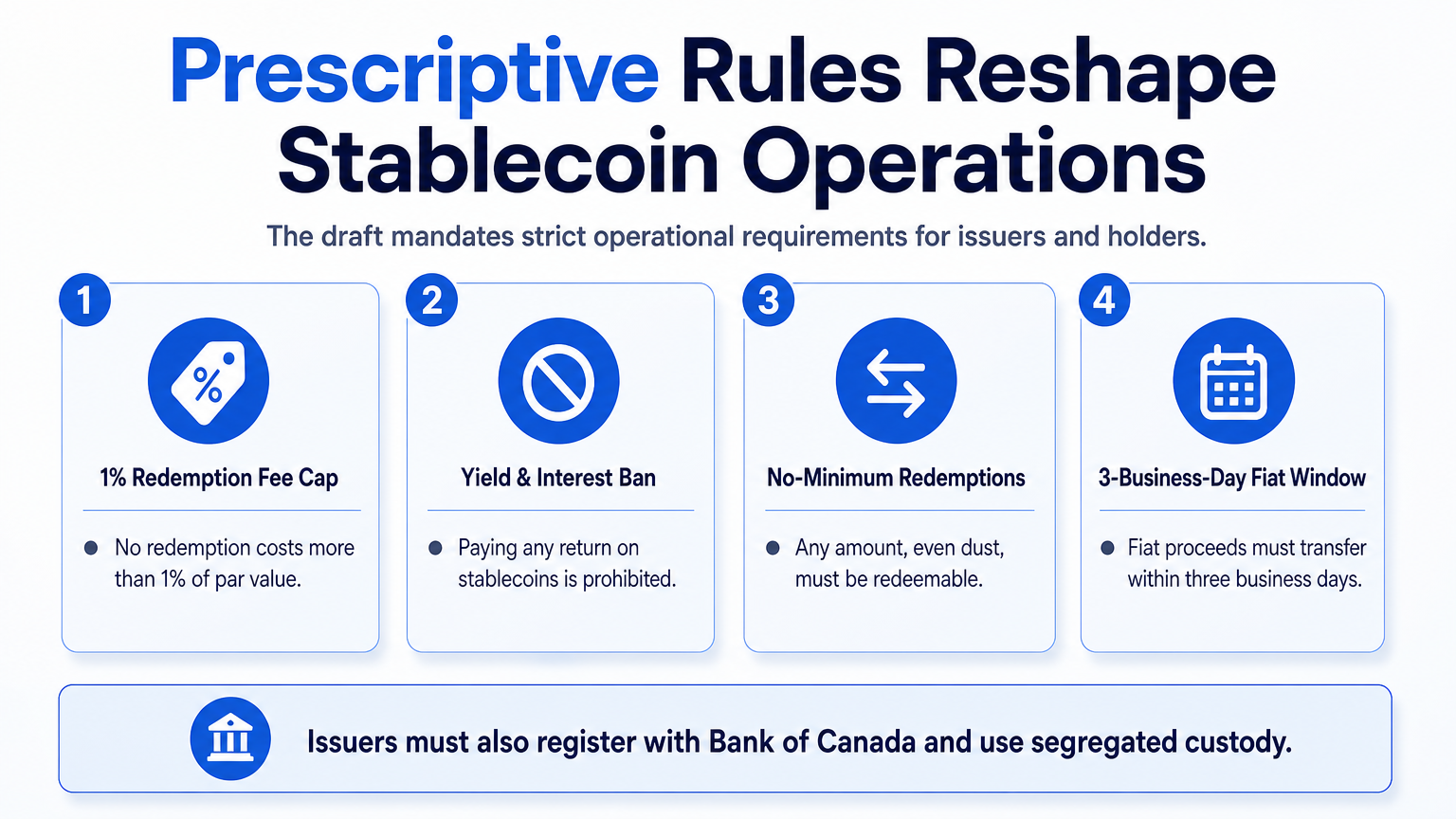
On October 24, 2026, the Canadian government published detailed draft rules under the authority Parliament granted in Bill C-15. The package, which will govern Canada stablecoin rules 2026 onward, ends the previous principles-based approach. It imposes a hard stablecoin redemption fee cap of 1%, forbids any payment of interest or yield (the yield-bearing stablecoin ban), requires redemptions with no minimum amount, and mandates that fiat proceeds be transferred within three business days.
The draft also establishes Bank of Canada stablecoin supervision: issuers must register with the central bank and submit to ongoing oversight. Reserve assets must consist of cash, government bonds with remaining maturities of three months or less, and qualifying money market funds, all held in segregated custody accounts at qualified Canadian custodians—a stablecoin custody requirement that will force many businesses and DAOs to rethink how they safeguard assets.
The 60‑day consultation period closes December 23, 2026, and the government’s target for implementation is autumn 2027.
Why the rules matter for businesses and DAOs
The yield-bearing stablecoin ban instantly removes any token that passes through returns from reserve earnings or staking from Canadian‑regulated wallets. Corporate treasuries that held yield‑bearing stablecoins for a small return must off‑board them, and DAO stablecoin operations that used that yield to fund contributor payments or gas costs will need to find alternative revenue.
The 1% fee cap and no‑minimum redemption, combined with the three‑business‑day fiat window, change cash‑flow forecasting. A DAO that needs to meet payroll in fiat by Wednesday must initiate redemptions by the previous Friday, not Monday morning. Crypto treasury compliance under the new regime means auditing every stablecoin position, mapping issuer compliance, and verifying that redemption SLAs actually meet the three‑day target.
When do Canada's new stablecoin regulations take effect?
The consultation closes December 23, 2026. Final rules are expected by mid‑2027, with a hard implementation target of autumn 2027. The timeline is documented on the Canadian government’s stablecoin framework page. Businesses should treat the autumn 2027 window as a firm deadline and start their compliance projects now—only a few quarterly planning cycles remain.
How do Canada's rules compare with broader stablecoin regulation in the US and elsewhere?
Canada’s October 2026 draft is far more prescriptive than current US proposals. While the GENIUS Act and state‑level trust charters—like the one we examined in our Ripple Trust Bank analysis—focus on licensing and reserves without capping redemption fees or banning yield, Canada’s rules forbid yield outright, cap fees, and demand a three‑day redemption window. The EU’s MiCA allows limited yield models for electronic money tokens, but Canada treats stablecoins almost as narrow bank money, bringing it closer to banking supervision than to the innovation‑first ethos of earlier stablecoin projects. For a deeper look at how regulation is reshaping markets, see our piece on stablecoin regulation redrawing Europe.
Key operational requirements and treasury implications
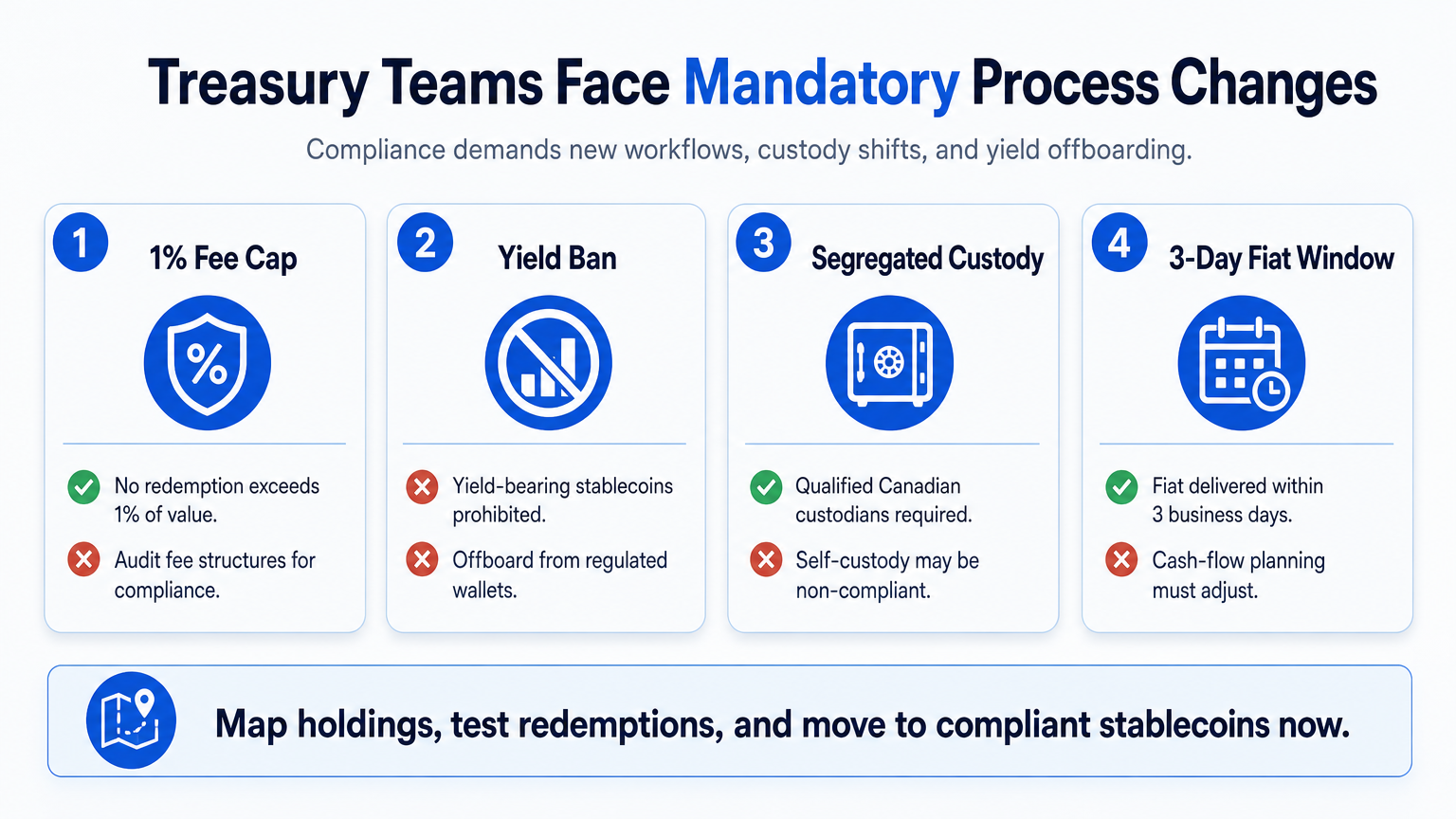
The draft’s main components force immediate action from treasury and compliance teams.
| Requirement | Draft Detail | Operational Impact |
|---|---|---|
| Redemption fee cap | 1% maximum | Businesses must verify fee structures; no redemption can cost more than 1% of the value. |
| Yield/interest ban | Prohibited entirely | All yield‑bearing stablecoins must be off‑boarded from regulated wallets. |
| Minimum redemption | No minimum; any amount must be redeemable | Micro‑redemptions of dust amounts could trigger custodial costs. |
| Fiat transfer window | Within 3 business days | Cash‑flow planning must factor in a three‑day lag from request to bank receipt. |
| Reserve composition | Cash, ≤3‑month gov’t bonds, qualifying money market funds | Issuers cannot use longer‑duration or riskier assets; indirectly strengthens confidence in backing. |
| Stablecoin custody requirements | Segregated custody at qualified Canadian custodians | Self‑custody or offshore custody may not satisfy the rule; many DAOs will need to move to institutional custody. |
| Bank of Canada stablecoin supervision | Registration and ongoing oversight | Establishes a clear regulatory home, with reporting and compliance audits expected. |
Crypto treasury compliance steps: map all stablecoin holdings, flag any yield‑bearing coins, and move to non‑yielding, fully‑backed stablecoins positioned for compliance. Test redemption workflows against the three‑day SLA and automate the request‑to‑fiat pipeline. For DAO stablecoin operations, the loss of passive yield means re‑budgeting operational expenses and adjusting contributor compensation models.
What to watch next
Industry feedback during the consultation could seek a longer redemption window, but the core pillars—fee cap, yield ban, segregated custody—are likely to survive. A major open question is how the rules will apply to yield‑bearing stablecoins issued abroad but held by Canadian residents; the consultation may clarify enforcement reach. Additionally, whether Bank of Canada registration evolves toward banking‑like capital requirements could influence the cost and availability of compliant stablecoins.
For treasury teams that need to keep stakeholders informed as the regulatory landscape shifts, Joyrise plans, writes and publishes illustrated SEO articles to your Webflow blog every day—freeing your finance team to focus on the operational build. As the autumn 2027 deadline approaches, a unified platform that combines segregated fiat‑crypto accounts with institutional‑grade custody becomes essential to stay ahead of Canada’s new stablecoin rules.
Ready to put this into practice? Get started with onesafe.io.