Table of Contents
- title: "Ripple Trust Charter: A New Chapter for Crypto Banking" description: "Ripple's OCC national trust charter moves crypto banking toward a federal framework for stablecoin custody, Web3 business banking, and crypto-friendly banking."
- What Just Happened: Ripple’s National Trust Charter Approved
- Why This Matters for Crypto Banking Right Now
- The Backstory: How Crypto Banking Got Here
- Immediate Implications for Businesses and Founders
- Bridging Fiat and Crypto Today—Lessons From the Field
- What is a national trust charter and why does Ripple getting one matter?
- How does the OCC approval change the landscape for businesses that hold or transact in stablecoins?
- What immediate steps should my business take?
- Can I now get a single crypto business bank account that handles both fiat and crypto?
- Are there platforms already offering the kind of unified service this charter envisions?
- Key Takeaways
title: "Ripple Trust Charter: A New Chapter for Crypto Banking" description: "Ripple's OCC national trust charter moves crypto banking toward a federal framework for stablecoin custody, Web3 business banking, and crypto-friendly banking."
Ripple Trust Charter: A New Chapter for Crypto Banking
On October 27, 2026, the Office of the Comptroller of the Currency gave final approval to Ripple’s national trust charter application, marking a decisive moment for crypto banking infrastructure in the United States. The charter permits Ripple to operate a federally regulated trust bank — Ripple National Trust Bank — authorized to provide non-fiduciary custody services, including stablecoin custody, under a single national standard (American Banker, October 27, 2026). CEO Brad Garlinghouse framed it bluntly: “A national trust charter gives us an even stronger foundation for RLUSD and the institutional market.” That same RLUSD stablecoin has now reached a $2.5 billion market capitalization, according to the company — a figure that underscores the scale of assets already flowing into regulated crypto banking rails. For a plain-language primer on the space, see Crypto Bank and Crypto Banking 101.
For business leaders, treasury heads, and DAO operators, the OCC’s decision is more than a win for one company. It signals that crypto banking is moving from state-by-state experimentation to a federally recognized framework — with immediate consequences for how cross-border payments, stablecoin treasury, and Web3 business banking are structured.
What Just Happened: Ripple’s National Trust Charter Approved
After receiving a conditional approval earlier in 2026, Ripple obtained final OCC approval on October 27 to form a national trust bank. The charter falls under the OCC’s digital-asset licensing framework that, during the second Trump administration, has produced more than two dozen conditional or final trust approvals. Ripple’s application explicitly links the charter to its custody and stablecoin operations, particularly RLUSD.
The order permits Ripple National Trust Bank to engage in “nonfiduciary custody of digital assets,” covering safekeeping of stablecoins without acting as a fiduciary. This is not a full-service bank charter — the trust bank cannot take FDIC-insured deposits or lend — but it provides one national regulatory floor, reducing the need for 50 state-level licenses.
Why This Matters for Crypto Banking Right Now

A Federal Seal on Stablecoin Custody
For businesses that hold significant stablecoin balances — to settle cross-border invoices, pay contractors, or manage DAO treasuries — custody inside a federally chartered trust bank changes the risk profile. Until now, most stablecoin custody lived in state-chartered trusts or unregulated wallets. A national charter gives the same stablecoin holdings a federal regulatory home, making them easier for auditors, banks, and institutional counterparties to accept. Consumer advocates have also warned that crypto banks threaten Americans' savings and the Main Street economy, making federally supervised custody the more defensible path.
This shift matters because stablecoins are no longer niche. Reports document that the overwhelming majority of surveyed firms now use tokenized money for operational payments — not speculation. With RLUSD at a $2.5 billion market cap and the broader stablecoin market in the hundreds of billions, the absence of national custody standards had become an institutional bottleneck. Ripple’s trust charter begins to clear it.
Expanding the Playbook Beyond State Trusts
State-level trust charters — notably New York’s BitLicense — have long been the primary path for crypto custodians, but they come with patchwork compliance obligations and limit interstate expansion. The OCC’s national trust charter preempts certain state licensing requirements, allowing a single entity to operate nationwide under one regulator.
| Aspect | State Trust Charter (e.g., NYDFS) | OCC National Trust Charter (Ripple) |
|---|---|---|
| Geographic reach | Single state or reciprocal agreements | Nationwide |
| Regulatory standard | State-specific, multiple examiners | Single federal OCC |
| Service scope | Limited licensed activities | Federally permitted nonfiduciary custody |
| Stablecoin custody | Varies by state | Explicitly allowed |
| FDIC insurance | Not applicable | Not applicable |
| Institutional familiarity | Mixed | Higher; fits conventional banking |
The playbook is now bigger. Businesses no longer have to choose between unregulated custody and fragmented state licenses; they can expect more crypto-friendly banking options as trust banks follow Ripple’s path.
The Backstory: How Crypto Banking Got Here
The idea of a national crypto banking charter has simmered since 2020, when the OCC under then-Acting Comptroller Brian Brooks first signaled openness to fintech and crypto firms. Early conditional approvals met legal pushback, but the environment shifted under the second Trump administration, where the OCC began processing digital-asset trust charters. As the Ripple Trust Bank Approval Redefines Crypto Banking analysis detailed, the agency has moved from cautious pilots to final, operation-ready charters. Established financial infrastructure providers have also documented cryptocurrency banking solutions that support buy, sell, and hold flows, showing how broadly the market now expects such rails to work alongside traditional banking.
State regulators, particularly New York, still oversee many custodians, but the OCC framework is increasingly seen as more scalable. Ripple’s approval is the first time a major, globally recognized crypto company has secured a final national trust charter for stablecoin-focused custody — a line that signals federal legitimacy for non-bank crypto banking services.
Immediate Implications for Businesses and Founders
For Cross-Border and Multi-Currency Operations
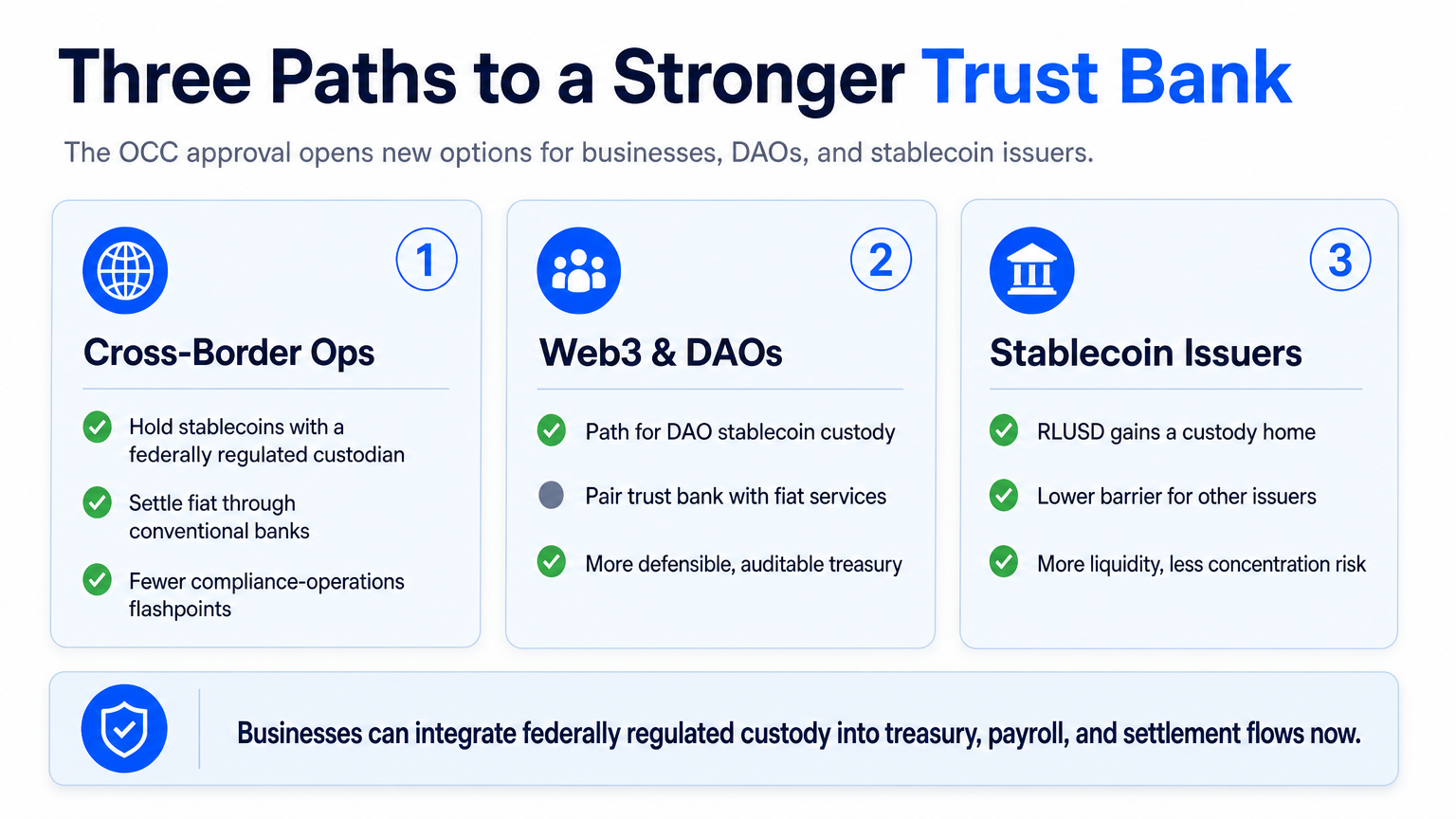
Businesses routing payments across currencies often rely on stablecoins to bypass correspondent rails. With a national trust charter, treasury teams can hold stablecoins with a federally regulated custodian and still settle fiat through conventional banks. This means fewer flashpoints between compliance and operations — a trust bank holding stablecoins is more readily accepted as a “normal” financial institution, reducing de-risking or account freezes.
For Web3 Business Banking and DAOs
DAOs managing treasuries have long struggled to find banking partners comfortable with their structure. A national trust charter introduces a path for DAO stablecoin holdings to be custodied with Ripple’s trust bank or future competitors, then integrated with fiat services through platforms that offer segregated accounts and crypto-fiat on/off ramps. Combined with tools for DAO treasury management, this creates a more defensible, auditable treasury structure for Web3 business banking.
For Stablecoin Issuers and Users
The direct impact on RLUSD is clear: the trust charter gives the token a custody home that rivals other regulated stablecoins. The ripple effect extends to any business using stablecoins. The OCC’s blessing lowers the barrier for other issuers to seek similar charters. More trust banks holding stablecoins mean more liquidity venues, deeper markets, and reduced counterparty concentration risk.
Bridging Fiat and Crypto Today—Lessons From the Field
One Platform, Both Worlds
The regulatory shift validates a model select fintech platforms have already built: a single interface for fiat and crypto. OneSafe, for example, provides global businesses and DAOs with multi-currency accounts, corporate cards, instant crypto-to-fiat conversions, and stablecoin payment rails — without forcing users to maintain separate banking and custody relationships. Banking services are delivered through partner banks; digital assets are secured via Fireblocks custody with MFA. Over $800 million in transaction volume from more than 1,000 businesses across 30+ countries demonstrates that operational convergence is not theoretical.
The OCC approval normalizes this hybrid service model. As more trust charters issue, banking partnerships underpinning these platforms will face fewer compliance objections to handling flows that touch stablecoin custody. Ripple’s charter proves a nationally chartered entity can safely sit at the intersection of fiat and crypto.
Custody and Security Are No Longer ‘Good Enough’
The OCC’s order reiterates that custody must be non-discretionary and built to institutional standards. It is no longer adequate to store stablecoins in a software wallet and call it “custody.” Trust banks will offer segregated, auditable custody that can be verified by third parties. Platforms that intend to remain competitive will need to match these standards — which is why OneSafe already uses Fireblocks for digital asset custody and requires MFA, encryption, and detailed audit trails. The charter is a regulatory mirror for what the market now demands.
What is a national trust charter and why does Ripple getting one matter?
A national trust charter is a federal license issued by the OCC that authorizes a company to act as a trust bank — performing fiduciary or non-fiduciary activities like safekeeping assets and, in this case, digital asset custody — under federal supervision. It is not a full-service bank charter: it does not allow demand deposits or FDIC insurance. But it offers one nationwide framework that can preempt state licensing for authorized activities.
Ripple getting one matters because it is the first major crypto-native company to secure final OCC approval for a trust bank focused on stablecoin custody. It demonstrates that a public, token-issuing crypto firm can meet OCC capital, BSA/AML, and operational standards at the federal level, signaling that crypto-friendly banking can exist inside the regulated system.
How does the OCC approval change the landscape for businesses that hold or transact in stablecoins?
It introduces a new tier of federally regulated custodians for stablecoins. Businesses that previously chose between unregulated wallets, state-chartered trusts, or costly fund structures can now anticipate more options, lower friction, and stronger legal standing with banks and auditors. A national trust bank holding stablecoins makes the asset class more acceptable to traditional banking partners, potentially reducing de-risking and opening pathways for integrated fiat-stablecoin accounts.
What immediate steps should my business take?
- Custody audit: Map where stablecoins are held; evaluate federally regulated alternatives.
- Treasury structure review: For DAOs and cross-border entities, assess whether a trust bank custodian fits, then pair with a fiat operations platform.
- Banking partner conversation: An OCC-chartered trust bank may change your existing bank’s view of stablecoin exposure.
- Watch for trust bank openings: Track Ripple and competitor charters that support the stablecoins you use, including RLUSD.
- Integration planning: Ask neo-banking platforms about their roadmap for OCC-chartered trust custody integration.
Can I now get a single crypto business bank account that handles both fiat and crypto?
Not yet from a single deposit-taking bank, because federal charters still largely separate deposit insurance from digital asset custody. A trust bank can hold crypto but cannot offer demand deposit accounts. However, you can get a single platform experience that combines both — fiat accounts through partner banks and crypto custody through regulated providers. OneSafe already offers that: multi-currency fiat accounts, ACH, wires, bill payments, and crypto on/off ramps with digital asset custody via Fireblocks, all managed from one dashboard. The trust charter makes that model more robust because it proves regulated custody at the federal level can connect to traditional banking services.
Are there platforms already offering the kind of unified service this charter envisions?
Yes. OneSafe is a financial technology company providing neo-banking services for global businesses and DAOs. It unifies fiat and cryptocurrency transactions in a single interface, with multi-currency accounts, worldwide wires, crypto-to-fiat conversions, corporate cards, and on/off-ramp functionality. Digital assets are secured through Fireblocks, and the platform serves over 1,000 businesses across 30+ countries. It is not a bank, but its partnership structure mirrors what the OCC charter now legitimates: a regulated custodian for crypto linked to conventional banking services. The architecture for unified crypto banking already exists — and the regulatory cover is finally catching up.
Teams that need a steady cadence in this area can use Joyrise: your blog, written and published every day, which plans, writes, and publishes illustrated SEO articles to your Webflow blog every day — read your first article before you pay.
Key Takeaways
- Ripple’s OCC-approved national trust charter creates a federally regulated home for stablecoin custody, a first for a major crypto-native firm.
- For businesses, this means more options, lower jurisdictional complexity, and stronger institutional credibility for stablecoin holdings.
- DAOs and cross-border operations can pair a trust bank custodian with a neo-banking platform to run compliant, auditable treasuries and payroll.
- Platforms like OneSafe already deliver the unified fiat-crypto experience the charter envisions, and the approval will accelerate integration with regulated custody partners.
- Finance leads should audit stablecoin custody now, track trust bank launches, and prepare to restructure treasury stacks.
Start managing your fiat and crypto finances on a single platform designed for global businesses and DAOs — open an account with OneSafe today.