
The CFTC's October 14, 2026 announcement opening public consultation on a retail crypto framework marks a turning point for crypto payroll compliance. In this crypto payroll news, the era of piecemeal enforcement is yielding to formal CFTC retail crypto rulemaking — and as crypto payroll regulations 2026 emerge, any business paying employees or contractors in digital assets needs to understand what the shift could mean for stablecoin payroll, tax reporting, and cross-border compensation workflows. Platforms like OneSafe crypto payroll are built to absorb these changes, but the groundwork must be laid now.
Table of Contents
- What Just Happened: CFTC Opens Public Consultation on Retail Crypto
- Why It Matters Now for Crypto Payroll and Global Teams
- Crypto Payroll 101 – How It Works and Who Uses It
- Concrete Implications of the CFTC Framework
- Recommended Actions: Prepare Your Crypto Payroll Now
- What to Watch Next
- Key Takeaways
What Just Happened: CFTC Opens Public Consultation on Retail Crypto
On October 14, 2026, StreetInsider reported the CFTC opened public consultation on a comprehensive framework for retail crypto transactions, pulling regulatory focus back to Washington. A Sheppard Mullin analysis notes the proposal targets leveraged retail crypto trading, while the National Law Review describes an Advance Notice of Proposed Rulemaking. This proactive rulemaking could reach beyond exchanges: because payroll is a retail-facing financial activity, stablecoin wage payments could fall squarely under any new retail crypto definition.
Why It Matters Now for Crypto Payroll and Global Teams
If the CFTC classifies widely used payroll stablecoins as retail commodities, wage payments in those assets inherit that classification — even when the intent is compensation, not trading. The Thomson Reuters tax desk has already flagged that stablecoin payroll momentum is colliding with IRS compliance friction, a preview of how overlapping regimes complicate programs. Businesses using or evaluating crypto payroll must track the CFTC's process to avoid retrofitted compliance when final rules drop.
Crypto Payroll 101 – How It Works and Who Uses It
Crypto payroll encompasses any compensation paid in cryptocurrency. Two models dominate: direct on-chain disbursement (common in DAOs and Web3 startups) and fiat-to-crypto conversion via a payroll platform. Platforms like OneSafe support hybrid workflows — fiat balances, crypto balances, and instant crypto-to-fiat conversions — so teams can pay a contractor in USDC without a standalone crypto treasury. Stablecoins, particularly USDC, have become the default because they mimic fiat stability, simplifying employer-side accounting. OneSafe eliminates fees for USDC deposits and withdrawals, reflecting the compliance-friendly nature of stablecoin rails.
Practitioner consensus (BVNK, Zengo, Lano, Asanify, Boston University Law) is clear: paying in crypto is legal in many jurisdictions, but it never escapes regulation. Employers must still classify workers, withhold and remit taxes in fiat, document fair market value at payment, and file appropriate reports. Blockchain’s auditability helps, but only with consistent valuation and reporting.
Concrete Implications of the CFTC Framework
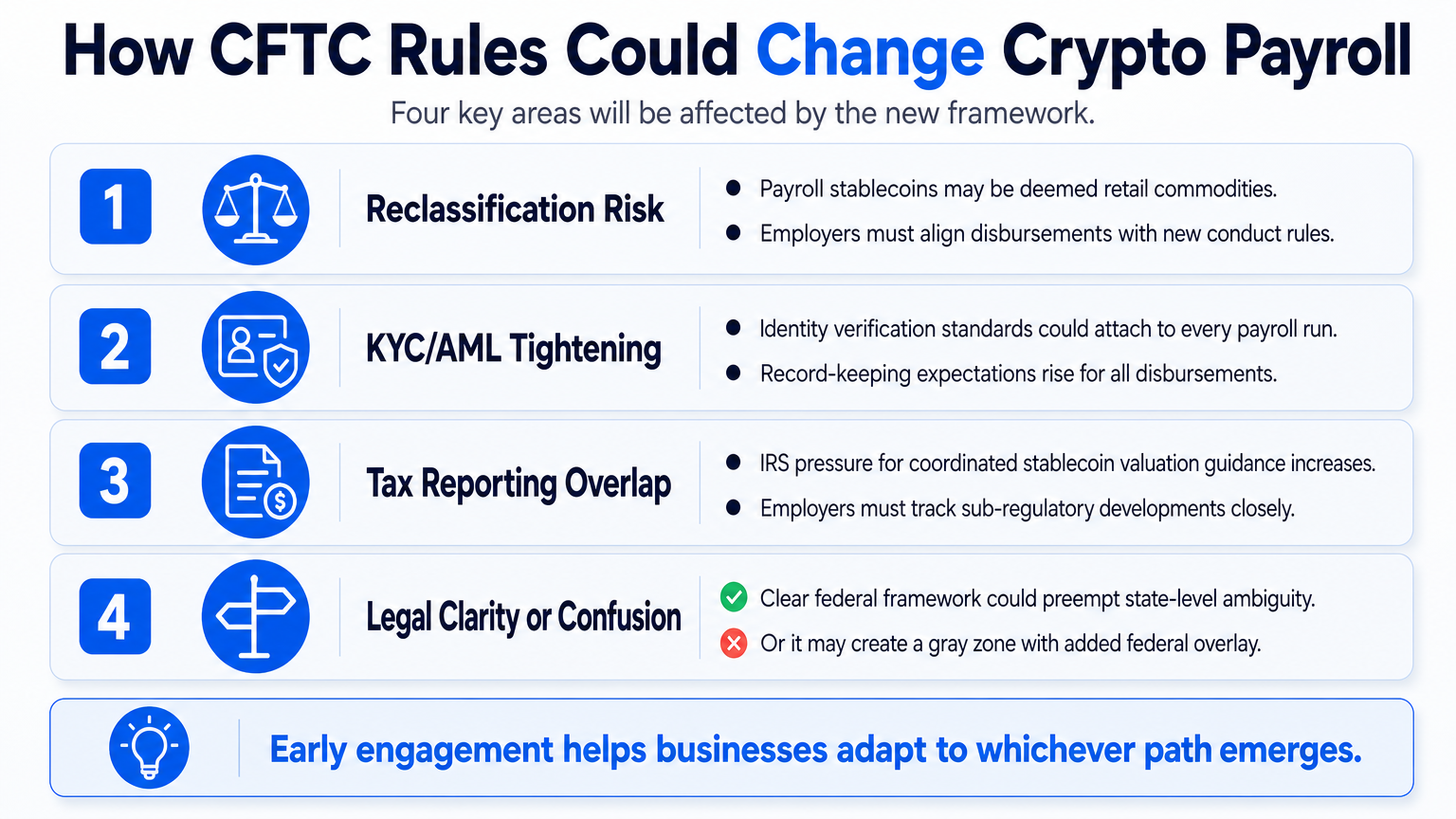
Reclassification risk. If payroll stablecoins are deemed retail commodities, wage payments could inherit commodity-adjacent treatment, requiring employers to align disbursement systems with new conduct or disclosure standards. For global payroll operations routing through multiple intermediaries, any federal overlay adds diligence layered over state money-transmitter law.
KYC/AML tightening. The CFTC is likely to impose identity-verification and record-keeping standards that attach to every payroll run. Research from the BIS on stablecoin regulation suggests regulators are converging on stronger counterparty identification. Platforms with mandatory KYC/KYB, MFA, and institutional custody (OneSafe uses Fireblocks and on-chain transaction histories) are designed for this burden; self-custodied arrangements are not.
Tax reporting overlap. The CFTC's move increases pressure on the IRS to issue coordinated crypto payroll taxes guidance, closing gaps around stablecoin valuation timing and de minimis thresholds. Finance leaders should track IRS sub-regulatory guidance in parallel with the CFTC docket.
Legality clarified or complicated? A clear federal framework that acknowledges stablecoin payroll as regulated activity could preempt state-level ambiguity. A framework that ignores payroll directly would leave employers in a gray zone with a new federal overlay. The answer is not yet known, making early engagement critical.
Recommended Actions: Prepare Your Crypto Payroll Now
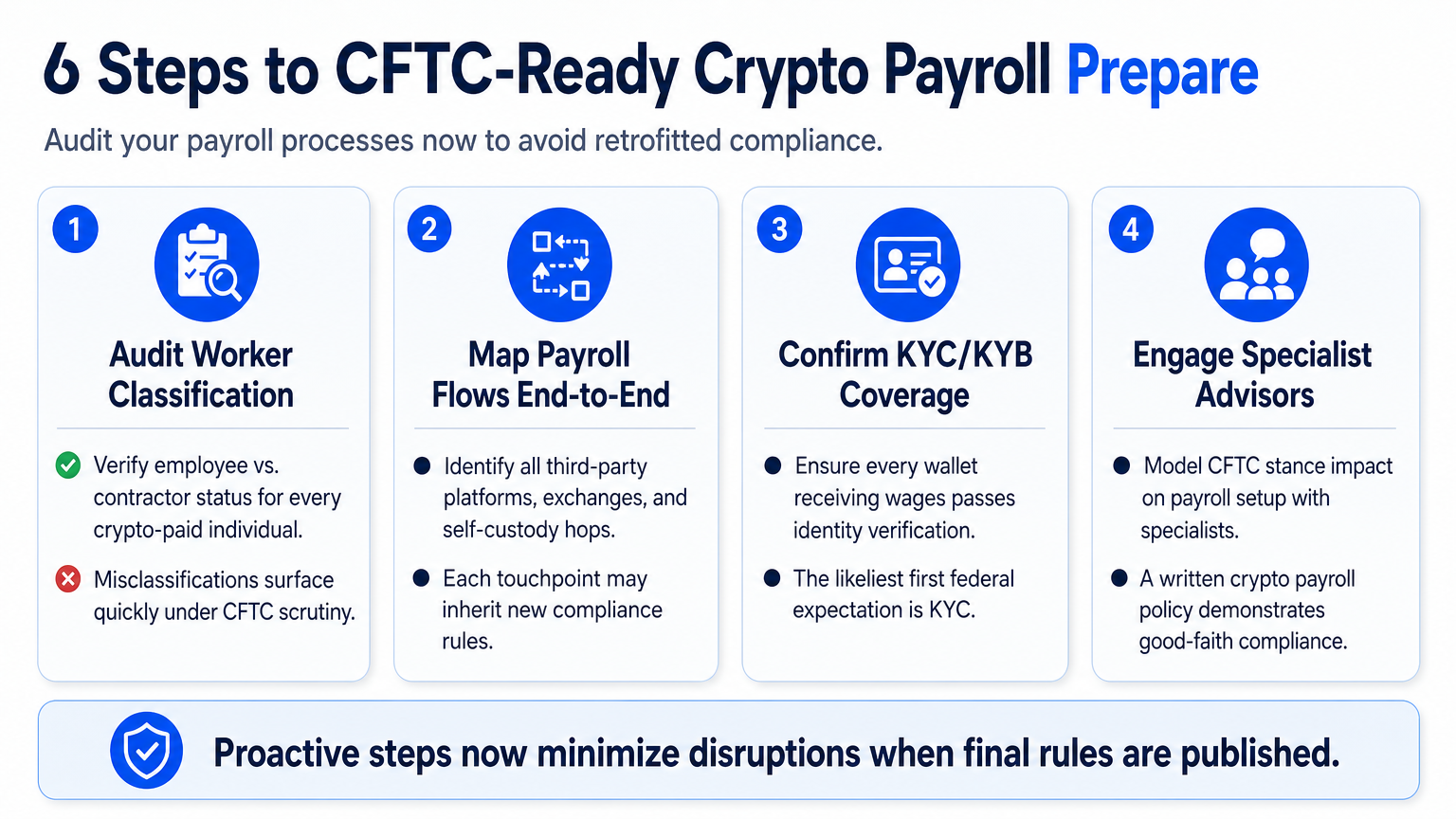
Treat the next six months as a compliance horizon. This checklist converts the CFTC development into an audit:
| Step | Action | Why It Matters |
|---|---|---|
| 1 | Audit worker classification for every crypto-paid individual | Employee vs. contractor status drives withholding; CFTC-era scrutiny surfaces misclassifications quickly. The Jeonbuk Bank stablecoin payroll trial on Solana illustrates how classification and settlement design interact from day one. |
| 2 | Map each crypto payroll flow end-to-end | Identify where funds touch third-party platforms, exchanges, or self-custody — each hop may inherit new rules. |
| 3 | Confirm KYC/KYB coverage for every wallet receiving wages | Identity verification is the likeliest first federal expectation. |
| 4 | Document fair-market-value methodology for each pay period | Tax agencies will request this on audit. |
| 5 | Review your technology stack | Choose platforms with institutional-grade custody, mandatory KYC/KYB, and auditable histories. The OneSafe crypto payroll platform — pairing Fireblocks custody with mandatory MFA and fiat/crypto integration — is engineered for this compliance surface. |
| 6 | Engage specialist legal and tax advisors | Model how the CFTC’s likely stance could impact your setup. A written crypto payroll policy covering volatility, conversion timing, and dispute resolution demonstrates good-faith compliance. |
What to Watch Next
- Consultation timeline: The CFTC has not yet published the full notice with a comment deadline; standard ANPRMs allow 60–90 days. Monitor the Federal Register docket.
- Jurisdictional tug-of-war: The SEC’s stance on stablecoins and the Department of Labor’s wage-hour rules could intersect with the CFTC’s plan. The federal stablecoin law passed earlier in 2026 is another piece of the puzzle.
- International harmonization: The EBA's ruling on USDC, the USDC e-money token designation in the EU, and evolving APAC stablecoin regulation mean global businesses must reconcile multiple regimes.
- Industry reaction: Comments from payroll providers, stablecoin issuers, and advocacy groups will signal what the final framework might tolerate.
Key Takeaways
- The CFTC’s October 2026 public consultation on CFTC retail crypto rulemaking shifts crypto payroll from enforcement ambiguity to proactive regulation.
- Likely impacts: reclassification of payroll stablecoins, KYC/AML standards on disbursements, and accelerated IRS crypto wage guidance.
- Immediate steps: audit worker classification, map every payroll flow, verify KYC coverage, and deploy platforms like OneSafe crypto payroll with built-in institutional compliance.
- A written crypto payroll policy and specialist legal engagement now reduce the cost of adapting to whatever the consultation produces.
- Watch the comment deadline, SEC/CFTC positioning, IRS parallel guidance, and industry comment letters.
Sign up for OneSafe's crypto-friendly business banking platform to run fiat and crypto payroll from a single, compliance-first interface.



