On October 14, 2026, the European Banking Authority (EBA) formally designated Circle’s USDC as a significant e-money token under the EU’s Markets in Crypto-Assets (MiCA) framework. The decision, reported by the European Banking Authority via NewsCord aggregation, marks the first time any of the 45 stablecoins notified in the region has received that classification. For business leaders operating across fiat and crypto rails, this is not just an issuer milestone. It reshapes the compliance perimeter, the custody stack, and the banking relationships that underpin crypto banking for DAOs, Web3 startups, and global treasuries. The world’s second-largest stablecoin—roughly $73 billion in market value—now moves under direct supervisory oversight, with new reserve, liquidity, and recovery-plan obligations. The clock starts ticking: direct EBA supervision begins on November 12, 2026.
Table of Contents
- The EBA Just Raised the Bar for Stablecoins—What It Means
- Why This Shift Spells Big Changes for Crypto Banking
- What is a significant e-money token, and why does it matter?
- How MiCA Created a Rulebook for Crypto Banking
- What does the EBA’s classification mean for businesses using crypto banking?
- How do I prepare my company’s fiat-crypto workflows for MiCA enforcement?
- What should a DAO or Web3 startup look for in a crypto banking platform after this ruling?
- Will my existing crypto banking setup still work under the new rules?
- What to Watch: The Next 12 Months in Crypto Banking
- Key Takeaways
The EBA Just Raised the Bar for Stablecoins—What It Means
USDC designated as a significant e-money token under MiCA
The EBA applied Article 43 of MiCA, a set of criteria that includes the number of holders, the value of transactions, and the interconnectedness of the token with the financial system. USDC met the thresholds, making it the first stablecoin to cross the “significant” line in the 27-country bloc. The practical effect is a shift from national-level oversight to direct EBA supervision, shared with France’s Autorité de Contrôle Prudentiel et de Résolution (ACPR), because Circle’s EU entity is based in Paris. This fundamentally alters the landscape of EBA crypto oversight for any business using regulated stablecoins.
Direct EBA supervision starts November 12—here’s what changes
Starting November 12, 2026, the EBA will have hands-on authority over USDC’s reserve composition, liquidity management, and recovery planning. This means Circle must demonstrate at all times that its reserves are sufficiently liquid, conservatively invested, and segregated. While Circle’s existing attestations are already public, the new regime demands real-time transparency and stress-testing. For businesses, that translates into lower tail risk: the chance of a sudden liquidity freeze shrinks dramatically. But it also introduces a new layer of compliance checks that flows downstream to the exchanges and banking platforms that on-ramp and off-ramp USDC.
The $73 billion stablecoin now faces stricter reserve and liquidity rules
Under MiCA’s e-money token provisions, USDC must now meet requirements similar to those applied to electronic money institutions—at least a 1:1 backing by highly liquid assets, strict investment limits, and a mandatory recovery plan. The EBA will conduct ongoing supervision, which means scrutiny of interest-rate risk, deposit concentration, and operational resilience. The enhanced regime should solidify USDC’s reputation as a compliant, transparent unit of account.
Why This Shift Spells Big Changes for Crypto Banking
From offshore shadow to onshore clarity: the end of unregulated stablecoins in Europe
Since MiCA’s phased rollout began, unlicensed stablecoins have faced a ticking clock. The USDC designation turns a theoretical deadline into a live supervisory relationship. Businesses that previously held stablecoins through offshore structures now confront a clear choice: move onshore into the regulated perimeter or accept growing friction with EU-based banking partners. The era of unregulated stablecoins in European payment flows is effectively over. For platforms focused on business banking for crypto companies, this accelerates the flight to quality.
Businesses lose a key loophole—and gain infrastructure they can build on
The old playbook of routing payroll or treasury reserves through an unregulated stablecoin and a loosely supervised exchange is closing. That loss is a long-term gain. With USDC now carrying a regulatory stamp, corporate treasurers can treat it more like a traditional money-market instrument that settles on-chain. Banks and neobanks that integrate regulated stablecoin rails can offer multi-currency business accounts that seamlessly bridge fiat and crypto without worrying that the token itself will be challenged by a supervisor. The MiCA framework provides a compliance safe harbor that encourages institutional adoption, making true crypto-fiat integration a practical reality for operating businesses.
The domino effect: other stablecoin issuers will follow
Circle is the first, but it won't be the last. Tether's EU operations, other e-money token issuers, and even bank-issued stablecoins will now see the significance threshold as a realistic target. The EBA's precedent sets a template that lowers uncertainty for other projects but also raises the bar for reserve attestations. For treasury managers, this means a future where multiple well-regulated stablecoins compete. It also puts pressure on crypto banking platforms to support a multi-stablecoin environment from day one, a critical capability when choosing any crypto business bank account in 2026.
What is a significant e-money token, and why does it matter?
MiCA divides stablecoins into two broad categories: e-money tokens (EMTs) that reference a single fiat currency and asset-referenced tokens that reference a basket. The USDC significant e-money token designation means the token now functions as critical market infrastructure. For businesses that depend on it, the designation signals that USDC is no longer an experiment. It's a regulated payment instrument with the backstop of a public supervisor.
How MiCA Created a Rulebook for Crypto Banking
MiCA establishes a single rulebook for crypto-assets across the EU. For stablecoins, it creates a licensing regime that distinguishes between ordinary e-money tokens and significant ones. Any EMT issued in the EU—or offered to EU residents—must be authorized and subject to prudential requirements. This framework is the direct reason why USDC now faces EBA oversight. It also explains why the crypto banking landscape is transforming: platforms that want to serve European businesses must integrate with regulated token issuers.
EMTs like USDC are designed to maintain a stable value, making them ideal for corporate treasuries that hold working capital in a digital form moveable instantly across borders. With MiCA compliance, a token received as payment in the EU is backed by enforceable redemption rights against an authorized issuer, supervised by the EBA. That transforms stablecoin payments from a gray-area convenience into a defendable treasury strategy.
What does the EBA’s classification mean for businesses using crypto banking?
Businesses that rely on crypto banking services to hold, convert, or move USDC should expect enhanced due diligence from their banking partners. This isn't friction that will derail operations; it's a structural upgrade that reduces the risk of abrupt de-platforming. The shift means corporate crypto accounts holding USDC will be treated, for regulatory purposes, more like accounts holding traditional e-money. Platforms that want to serve this market must offer a crypto-friendly business bank account that operates cleanly within the new perimeter.
On-ramps and off-ramps face new compliance checks
Every fiat-to-USDC conversion executed through a European banking partner will now involve a chain of regulated entities. Expect additional KYC/AML touchpoints. The practical message: prioritize a crypto-fiat integration that operates within the MiCA perimeter from end to end. Solutions like Coinbase Business, which provide compliant payment and custody infrastructure, exemplify the type of deeply integrated rails that will become the standard.
DAOs and Web3 startups: why segregated accounts matter now
For DAOs and decentralized teams, the USDC ruling amplifies the need for segregated accounts and transparent on-chain reporting. DAO banking that connects multi-sig wallets to fiat payroll will face stricter scrutiny. A regulated platform that offers customizable roles, automated payment workflows, and institutional custody becomes a compliance asset, not just a convenience. When choosing a crypto business bank account in 2026, segregated accounts are the minimum viable requirement.
Fiat-to-crypto conversions: fees, speed, and counterparty risk
Regulation often means higher costs initially, but the trade-off is dramatically lower counterparty risk. A USDC conversion through a MiCA-compliant platform carries a near-zero risk that the stablecoin will break the buck. For a corporate treasurer moving six-figure sums, that security is worth a few extra basis points. The speed of conversions should not suffer; instant settlement on-chain remains.
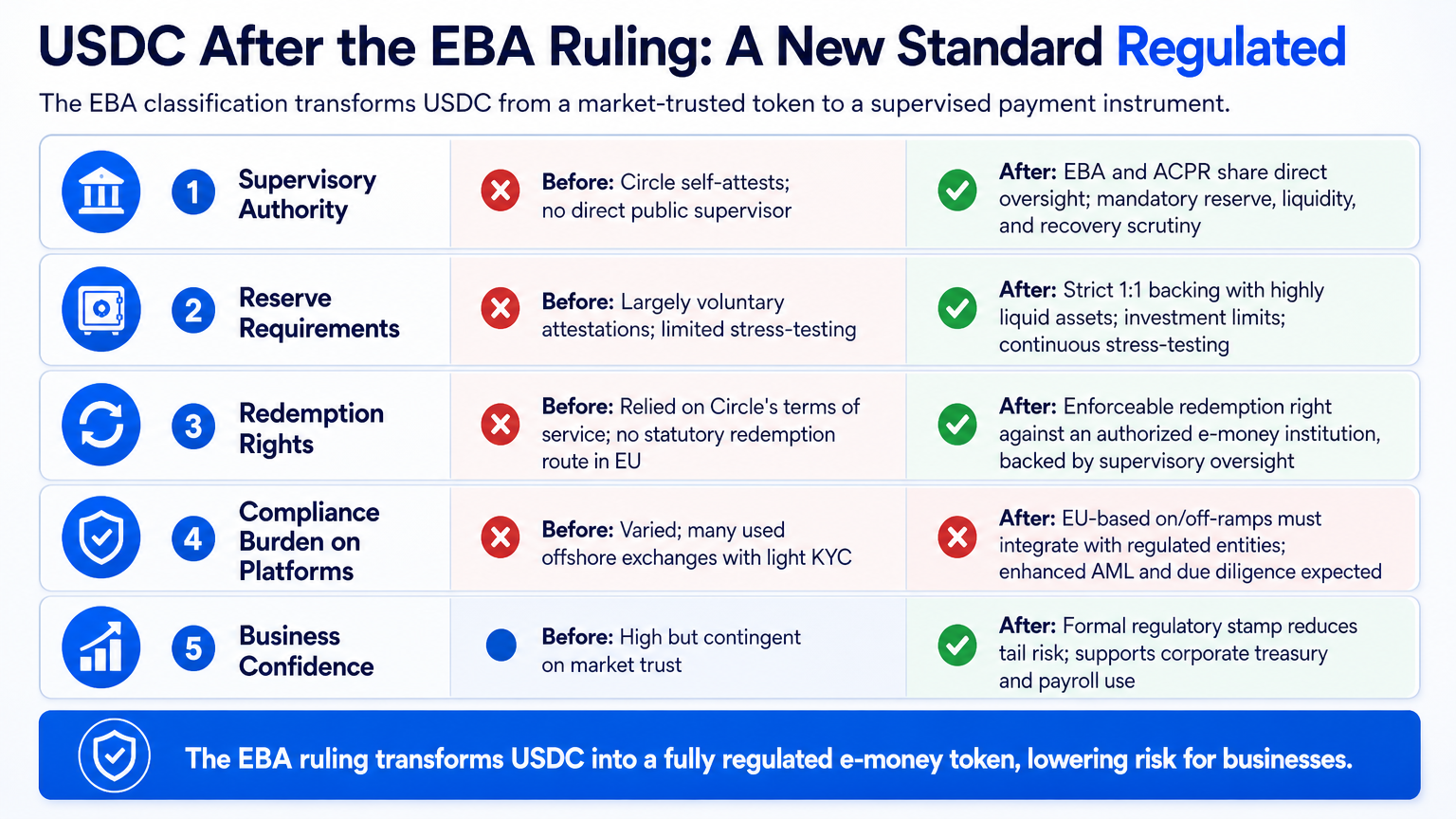
| Aspect | Before EBA Classification | After EBA Classification (Post-Nov 12, 2026) |
|---|---|---|
| Supervisory authority | Circle self-attests; no direct public supervisor | EBA and ACPR share direct oversight; mandatory reserve, liquidity, and recovery scrutiny |
| Reserve requirements | Largely voluntary attestations; limited stress-testing | Strict 1:1 backing with highly liquid assets; investment limits; continuous stress-testing |
| Redemption rights | Relied on Circle's terms of service; no statutory redemption route in EU | Enforceable redemption right against an authorized e-money institution, backed by supervisory oversight |
| Compliance burden on platforms | Varied; many used offshore exchanges with light KYC | EU-based on/off-ramps must integrate with regulated entities; enhanced AML and due diligence expected |
| Business confidence | High but contingent on market trust | Formal regulatory stamp reduces tail risk; supports corporate treasury and payroll use |
How do I prepare my company’s fiat-crypto workflows for MiCA enforcement?
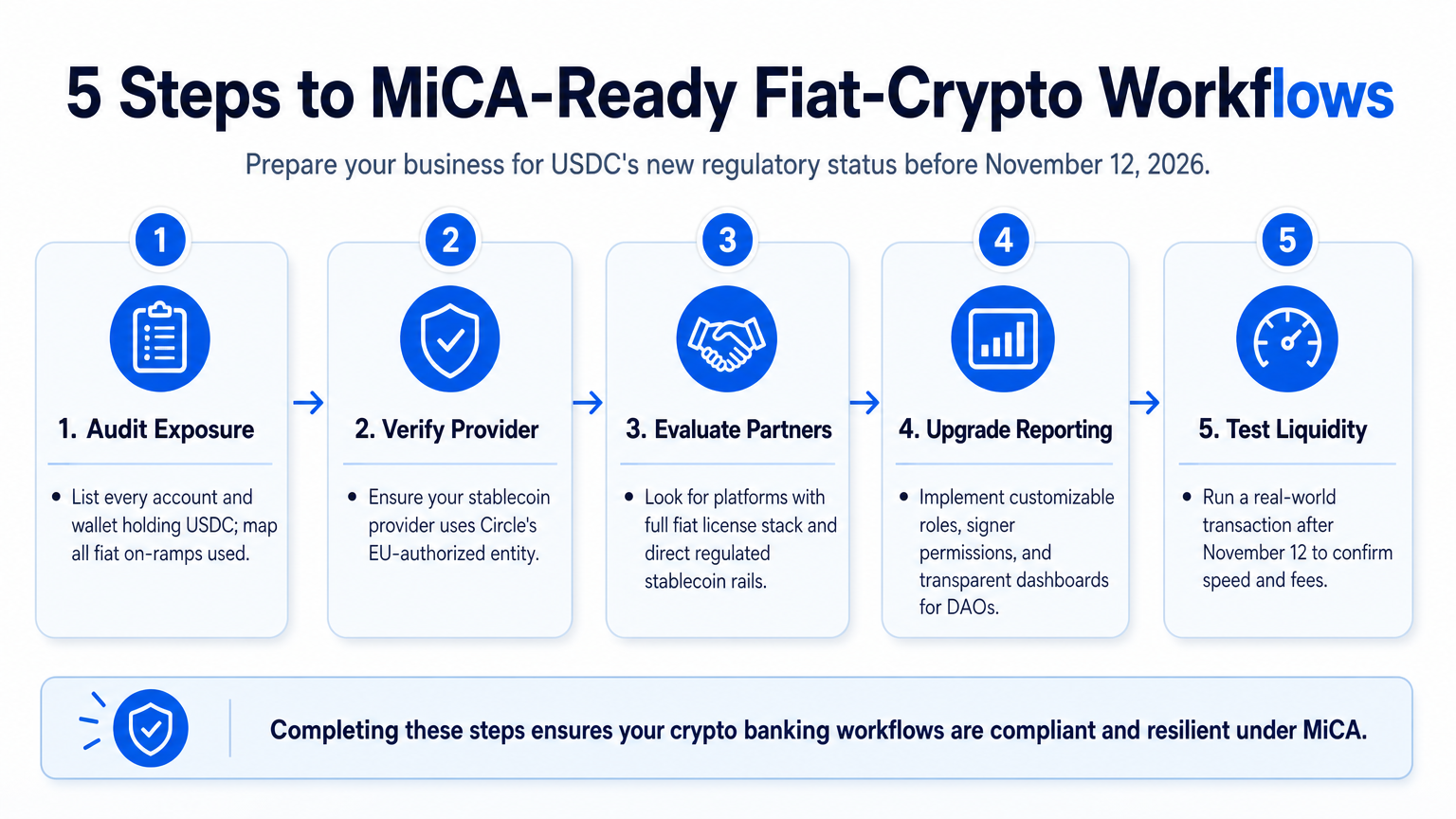
- Audit your current stablecoin exposure. List every account and wallet holding USDC, and map the fiat on-ramps you use.
- Verify the regulatory status of your stablecoin provider. If USDC is your primary token, confirm that your conversion partner uses Circle's EU-authorized entity.
- Re-evaluate your banking partners. A crypto-friendly bank that relies on non-EU liquidity pools may face disruptions. Look for platforms that combine a full fiat license stack with direct integration into regulated stablecoin rails like those listed among the best bank accounts for crypto business.
- Upgrade reporting and permissions. DAOs should implement customizable roles for signers and transparent dashboards to satisfy the enhanced audit trail demanded by MiCA.
- Test conversion liquidity. Run a small, real-world transaction immediately after November 12 to confirm that speed and fees remain within tolerance.
What should a DAO or Web3 startup look for in a crypto banking platform after this ruling?
Post-classification, the key evaluation criteria are:
- Custody infrastructure: Assets should be secured by institutional-grade custodians, ideally with insurance and proof-of-reserves. Fireblocks is the benchmark.
- Segregated accounts and role-based access: DAOs need separate accounts for different working groups, with granular permissions and audit logs.
- Integrated fiat-crypto rails: The ability to pay a vendor in EUR, receive USDC, and convert seamlessly within one interface reduces operational risk.
A traditional bank that layers a crypto API onto its existing core often struggles to match the real-time settlement of a crypto-native platform. The crypto-fiat integration must be deep, not bolted on. This is why a platform purpose-built for business banking for crypto companies often wins over legacy add-ons.
OneSafe, a financial technology company that partners with banks, illustrates what post-significance readiness looks like. The platform supports USDC deposits and withdrawals free of charge, offers segregated global accounts in USD, Euro, and CAD, and provides instant crypto-to-fiat conversions. For DAOs, it layers customizable roles and permissions on top of Fireblocks-based custody. The architecture mirrors the regulated, two-layer model that MiCA envisions.
Will my existing crypto banking setup still work under the new rules?
If your current setup relies on an offshore exchange without a clear EU licensing status or a bank that delays stablecoin-related transfers, the November 12 transition introduces real friction. Even if the token is supervised, the intermediary must demonstrate that it follows MiCA's requirements for custody and transfer. Workarounds that rely on personal accounts or loosely regulated venues will become increasingly difficult to sustain. If your setup already passes through a regulated platform, the change is largely administrative. The key is to verify—before November 12—that your provider has a clear, documented path to full MiCA alignment.
What to Watch: The Next 12 Months in Crypto Banking
The EBA supervision of USDC begins November 12, 2026. National competent authorities will step up enforcement against unregulated stablecoin offerings, and the first enforcement actions are likely to appear within 6-12 months. For businesses, the next 3-month window is crucial.
The "first-mover" advantage in regulation often translates into market share. Circle is positioned to market USDC as the default regulated stablecoin for EU business payments. However, MiCA also lowers barriers for bank-issued stablecoins and euro-backed tokens. The infrastructure that converts USDC to payroll depends on a network of banking partners. The platforms that can secure durable, multi-jurisdiction fiat banking relationships will define the next generation of crypto banking. The ones that try to patch legacy systems with a crypto widget will fade.
Key Takeaways
- The EBA's designation of USDC as a significant e-money token reshapes EBA crypto oversight and compliance for every business that uses USDC in European payment flows.
- DAOs and Web3 startups must now prioritize segregated accounts and a banking partner whose crypto-fiat integration operates entirely within the MiCA perimeter.
- Corporate treasuries gain a regulatory stamp that makes stablecoin payroll and cross-border payments more auditable—but only if the conversion rails are compliant.
- Existing setups that rely on offshore venues will face growing friction; a proactive audit of your fiat-crypto workflows before November 12 is critical.
- The next 12 months will see a race among banking platforms to secure the right licenses; the winners will combine native fiat and crypto capabilities.
For a crypto banking platform designed for the regulatory realities taking shape, explore OneSafe.