Crypto Banking Alert: Chainalysis Breach Fallout
Chainalysis, the transaction monitoring provider behind much of the crypto banking sector, disclosed on November 5, 2026, that an intruder exposed password hashes and live API tokens for all users—and some customer accounts appear to have been accessed without authorization. The admission, reported by American Banker on November 5, 2026, reverses the firm’s earlier no-evidence claim. For any business with a crypto banking account, the Chainalysis breach 2026 is a stark lesson in third-party risk.
Table of Contents
- What just happened: Chainalysis confirms customer account breach
- Why this matters now: the breach’s direct hit on crypto banking
- The background: how crypto banking leans on third-party compliance
- What this means for your business’s crypto banking setup
- What to watch next: open questions and the regulatory ripple
- Your Crypto Banking Questions Answered
- Key Takeaways
What just happened: Chainalysis confirms customer account breach
A timeline of the incident: from denial to disclosure on November 5, 2026
Chainalysis first acknowledged a security incident on October 30, 2026, telling customers it found no indication credentials or session tokens had been accessed. On November 4, it said an unauthorized party may have obtained account credentials. By November 5, the firm disclosed the full scope: password hashes and live tokens for all users were exposed, and the attacker appears to have gained entry into some customer accounts (American Banker, November 5, 2026). That afternoon, Chainalysis still listed screening services as “Under Maintenance,” leaving many crypto banking platforms without real-time compliance checks.
What was exposed: password hashes, live tokens, and unauthorized access risk
The breach exposed cryptographic password hashes—still susceptible to offline cracking—and live API tokens that could grant direct account access. With live tokens, an attacker can impersonate a legitimate client, access screening data, and potentially tamper with watchlists or risk-scoring logic. For crypto banking providers using Chainalysis, the threat is not just downtime but manipulated compliance data or lateral movement into adjacent systems.
Why this matters now: the breach’s direct hit on crypto banking
Chainalysis’s role as a compliance backbone for crypto-friendly banks and fintechs
Chainalysis’s KYT and Reactor tools are used by hundreds of banks, fintechs, and exchanges to screen on-chain transactions for sanctions, money laundering, or stolen funds. For a crypto banking platform, these checks are mandatory before fiat-to-crypto conversion or settlement. When Chainalysis goes down, platforms freeze processing—not because their own security failed, but because their compliance vendor is down. That is third-party risk cascading into operations.
The immediate fallout: frozen screening services and increased account takeover threats
The continued “Under Maintenance” status means live risk-scoring halted for affected crypto banking services. More severe is account takeover: if an attacker captured a platform’s Chainalysis API token, they could replay clean screening results or weaken risk settings. Exposed password hashes also create phishing cover for targeting admins of business crypto accounts.
The background: how crypto banking leans on third-party compliance
Crypto banking 101: fiat-to-crypto rails, multi-currency accounts, and regulatory must-haves
Crypto banking links traditional financial infrastructure to digital assets, allowing businesses to hold multi-currency crypto banking accounts, execute international wires, and convert between fiat and stablecoins. To operate legally in most jurisdictions, platforms must comply with AML and CTF rules. That means every cross-chain payment, fiat on-ramp, and off-ramp must pass through transaction monitoring that flags high-risk addresses and patterns.
Where Chainalysis fits: transaction monitoring that businesses never see—until it fails
Behind every crypto banking interface sits a compliance layer most users never encounter. Chainalysis is one of the largest providers. A business crypto account holder may never know Chainalysis screened a USDC transfer, but the transfer depends on it. The breach exposes a hidden fragility: compliance risk is concentrated in a handful of firms. As more startups turn to crypto banking for startups, that dependency deepens.
What this means for your business’s crypto banking setup
Audit your third-party dependencies: ask your provider about compliance vendors
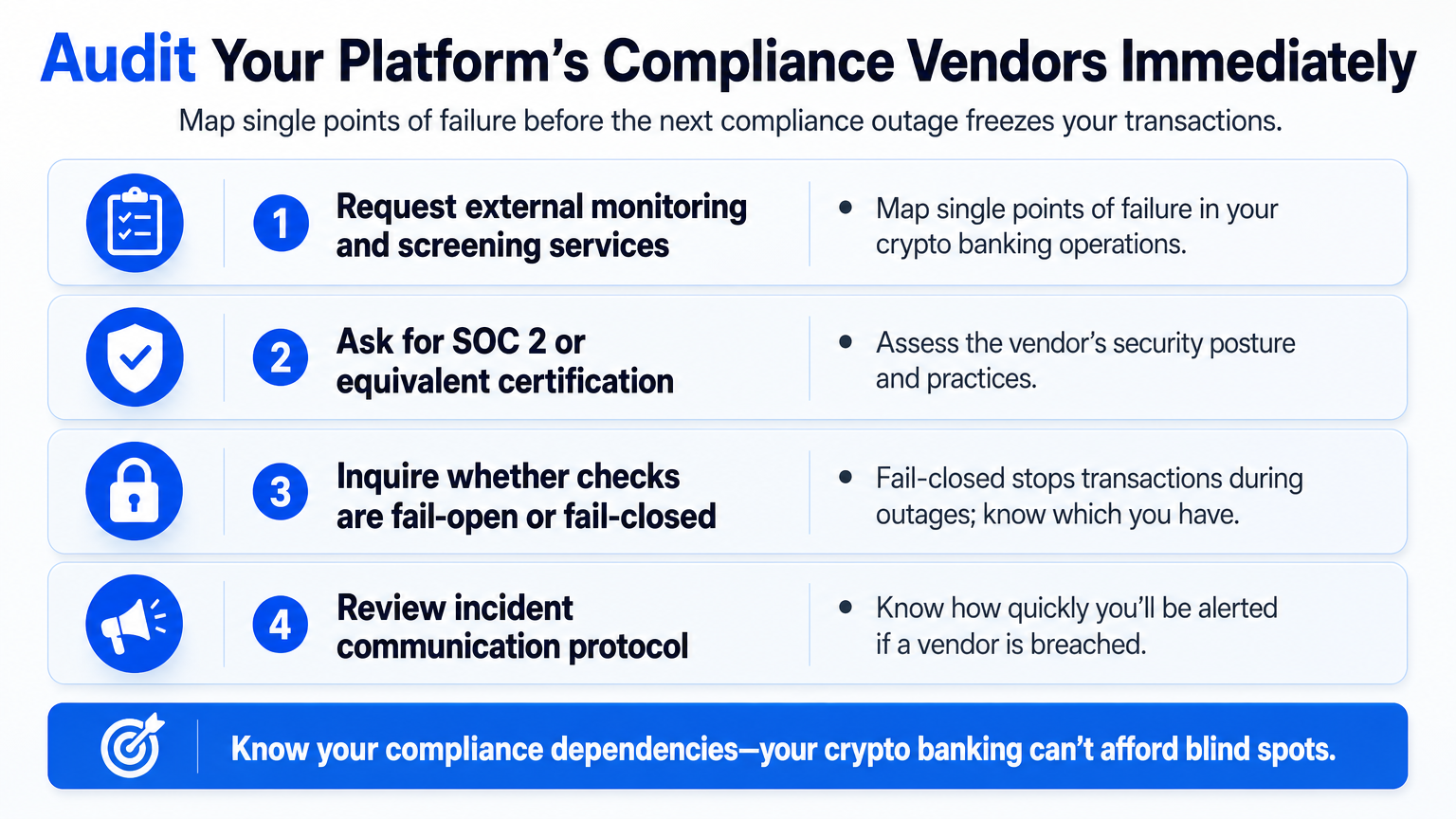
Every business that uses a crypto banking platform should immediately ask which compliance vendors that platform relies on. Key checks:
| Audit Action | Why It Matters |
|---|---|
| Request external monitoring and screening services | Map single points of failure |
| Ask for SOC 2 or equivalent certification | Assess vendor security posture |
| Inquire whether checks are fail-open or fail-closed | Fail-closed stops transactions during outages |
| Review incident communication protocol | Know how quickly you’ll be alerted |
Immediate steps if your platform connects to Chainalysis: rotate tokens, review access logs
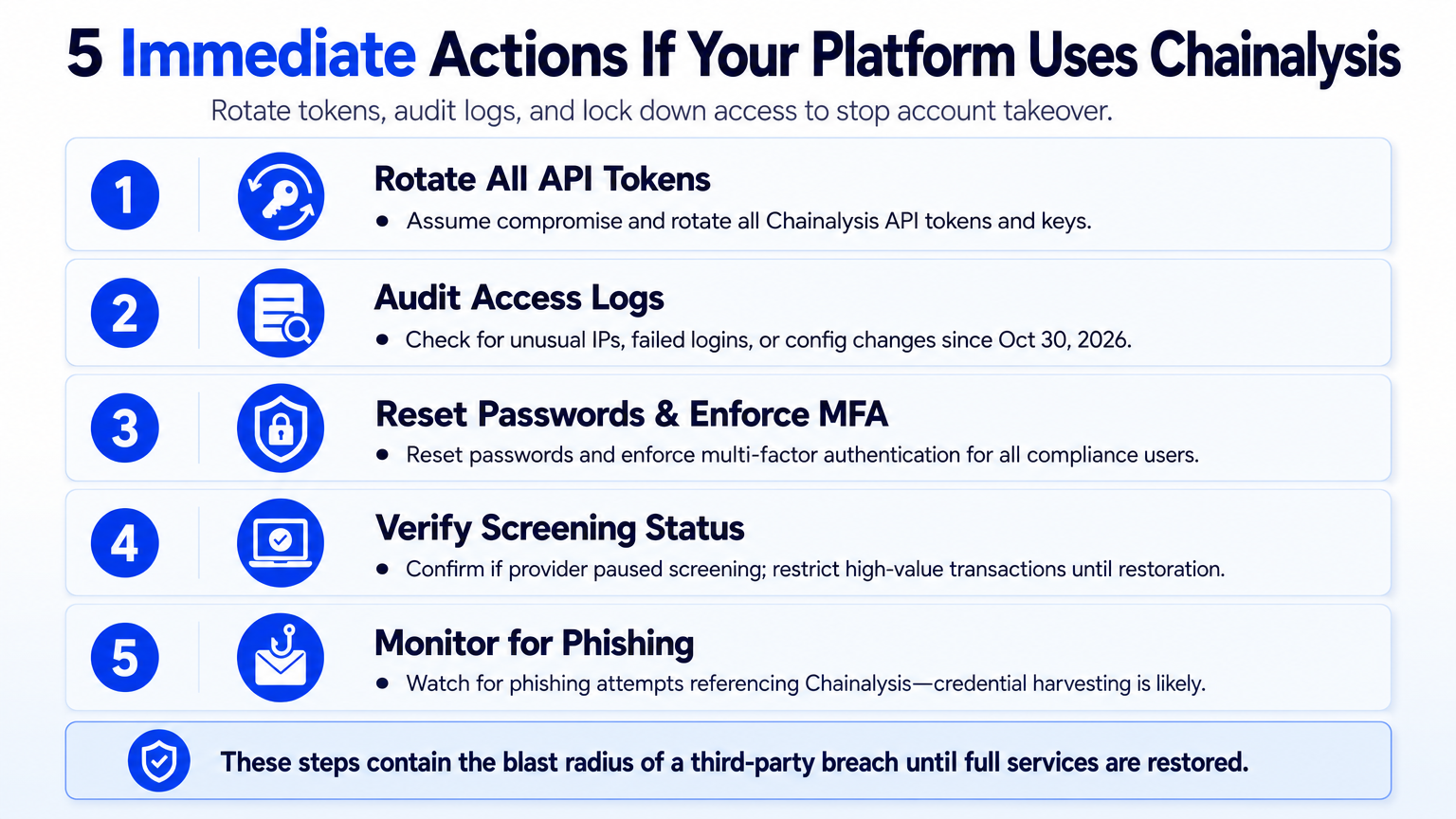
If your provider integrates Chainalysis, act today:
- Rotate all API tokens and keys used for Chainalysis access—assume compromise.
- Audit access logs for unusual IPs, failed logins, or configuration changes since October 30, 2026.
- Reset passwords and enforce multi-factor authentication for all users with compliance access.
- Confirm whether your provider paused or manually overrode Chainalysis-dependent screening; if so, restrict high-value transactions until restoration.
- Monitor for phishing that references Chainalysis—breach news is often used for credential harvesting.
The case for integrated crypto banking: when custody, compliance, and payments live under one roof
The breach highlights a structural weakness in crypto banking stacks that bolt on third-party compliance. When monitoring, custody, and core banking are split across vendors, an incident at one layer can break the whole chain. An integrated crypto banking architecture reduces the attack surface. OneSafe, for example, embeds compliance monitoring and digital asset custody secured via Fireblocks into one platform, so an external analytics breach does not directly expose customer tokens or freeze the full transaction flow. For DAOs and startups, DAO banking custody combined with fiat operations turns crypto banking security from a patchwork of dependencies into a controlled system.
What to watch next: open questions and the regulatory ripple
Will regulators demand stricter audits of crypto compliance vendors?
The Chainalysis incident will almost certainly prompt regulators to scrutinize the operational resilience of compliance tech. The FDIC’s interagency statement on crypto-asset safekeeping already requires banking organizations to assess third-party risks. After this breach, examiners may ask crypto-friendly banks not just “Who do you screen with?” but “What happens when that screener is breached?” Europe’s stablecoin regulation landscape, with MiCA’s operational requirements, may become a template for U.S. rulemaking.
Is this a one-off incident or a signal of systemic risk in crypto-financial infrastructure?
The breach follows high-impact infrastructure failures, including the $6.3 billion Binance hack that sent shockwaves through crypto banking. Unlike a hot wallet theft, this incident shows compliance risk can originate entirely outside a platform’s own walls. Future attacks could aim to poison risk-scoring data or whitelist sanctioned addresses—a threat the DeFi compliance ecosystem is only beginning to address. Keeping track of these changes is demanding; Joyrise, which plans, writes and publishes illustrated SEO articles to your Webflow blog every day, can help maintain a steady flow of awareness updates, though no tool replaces direct engagement with your banking partners.
Your Crypto Banking Questions Answered
How does a breach at a crypto analytics firm affect my business bank account?
If your crypto banking platform integrates Chainalysis, you face two risks: a service outage halting transaction processing, and credential exposure increasing account takeover risk. Even if you never log into Chainalysis, compromised tokens could let an attacker bypass checks or access your account data.
What steps can I take today to secure my crypto banking setup?
Rotate passwords and enable MFA. Ask your provider whether it rotated Chainalysis tokens and whether screening is offline. Review account activity for anomalies, and consider temporarily reducing large balances until third-party services are restored. For the long term, look for an integrated architecture that limits external token exposure.
How are cryptocurrencies bought, traded, and sold within a business banking context?
Through a fiat-crypto integration platform, businesses can deposit fiat, convert to USDC or other digital assets, hold them in a segregated business account, send to external wallets, or convert back to fiat. Each step requires real-time compliance screening, which is why the Chainalysis outage directly interrupts the flow.
Are cryptocurrencies regulated, and how might this incident change oversight?
Crypto is subject to a patchwork of rules. In the U.S., the Bank Secrecy Act and OFAC require transaction monitoring; Europe’s MiCA imposes licensing and operational requirements. This breach may push regulators to require cybersecurity audits of compliance vendors, not just banking platforms.
What is crypto banking, and how does it rely on third-party monitoring services?
Crypto banking lets businesses manage fiat and crypto assets through one interface, covering multi-currency accounts, international payments, and on-chain transactions. Because every transaction must be screened for sanctions and illicit activity, platforms depend on blockchain analytics firms like Chainalysis. A failure at that layer ripples directly into a business’s ability to move money.
Key Takeaways
- A single compliance vendor’s breach can freeze crypto banking transactions and expose accounts to takeover—even if you never interact with that vendor.
- Rotate tokens, reset passwords, and enforce MFA immediately for any platform integrated with Chainalysis.
- Audit your provider’s compliance dependencies as part of crypto banking security; integrated custody and compliance reduce third-party risk.
- Regulators will likely intensify scrutiny of compliance vendor cybersecurity, potentially mandating stricter audits and resilience testing.
- An integrated crypto banking stack limits the blast radius of vendor incidents for startups and DAOs.
Secure your crypto banking operations on a platform built with custody and compliance in one integrated stack—open a OneSafe account today.