Paraguay's Ueno Bank collapse left 3 million locked out, toppled a president. For global businesses, it's a stress test for crypto banking resilience.
Crypto Banking Gets a Wake-Up Call from Paraguay
On November 5, 2026, Decrypt reported that Paraguayan President Santiago Peña resigned after the collapse of Ueno Bank, a digital lender that left roughly three million customers unable to access their accounts. Regulators found Ueno’s capital below half the required minimum while it held roughly $800 million in public deposits. For global businesses and DAOs, the event is a live stress test for crypto banking—not because a crypto firm failed, but because a single-country fiat banking failure produced exactly the kind of systemic lockout that crypto-native treasury tools are designed to blunt.
Ueno Bank's Failure: By the Numbers
| Metric | Detail | Source |
|---|---|---|
| Customers locked out | roughly 3 million | Decrypt, Nov 5, 2026 |
| Public deposits held | roughly $800 million | Decrypt, Nov 5, 2026 |
| Capital adequacy | below half the required minimum | Decrypt, Nov 5, 2026 |
| Political consequence | President Peña resigned; lower house voted 78-0 to impeach | Decrypt, Nov 5, 2026 |
The Political Earthquake
The failure quickly became a crisis of legitimacy. Paraguay’s lower house did not wait for a formal transition: it voted unanimously to send impeachment charges to the Senate. The precise sequence—resignation followed minutes later by a 78-0 impeachment vote—suggests that the bank collapse was the trigger, but not the only fault line. For companies and DAOs, the lesson is not about Paraguayan politics. It is that a single bank’s solvency problem can become a national operational emergency within hours.
Table of Contents
- Why It Matters Now for Global Businesses and DAOs
- The Background: How Traditional Banking Failures Fuel Crypto Adoption
- The Crypto Banking Spectrum: Between Self-Custody and Full Intermediation
- Concrete Implications and Recommended Actions for Your Business
- What to Watch Next: Regulatory Fallout and Market Signals
- Key Takeaways
Why It Matters Now for Global Businesses and DAOs
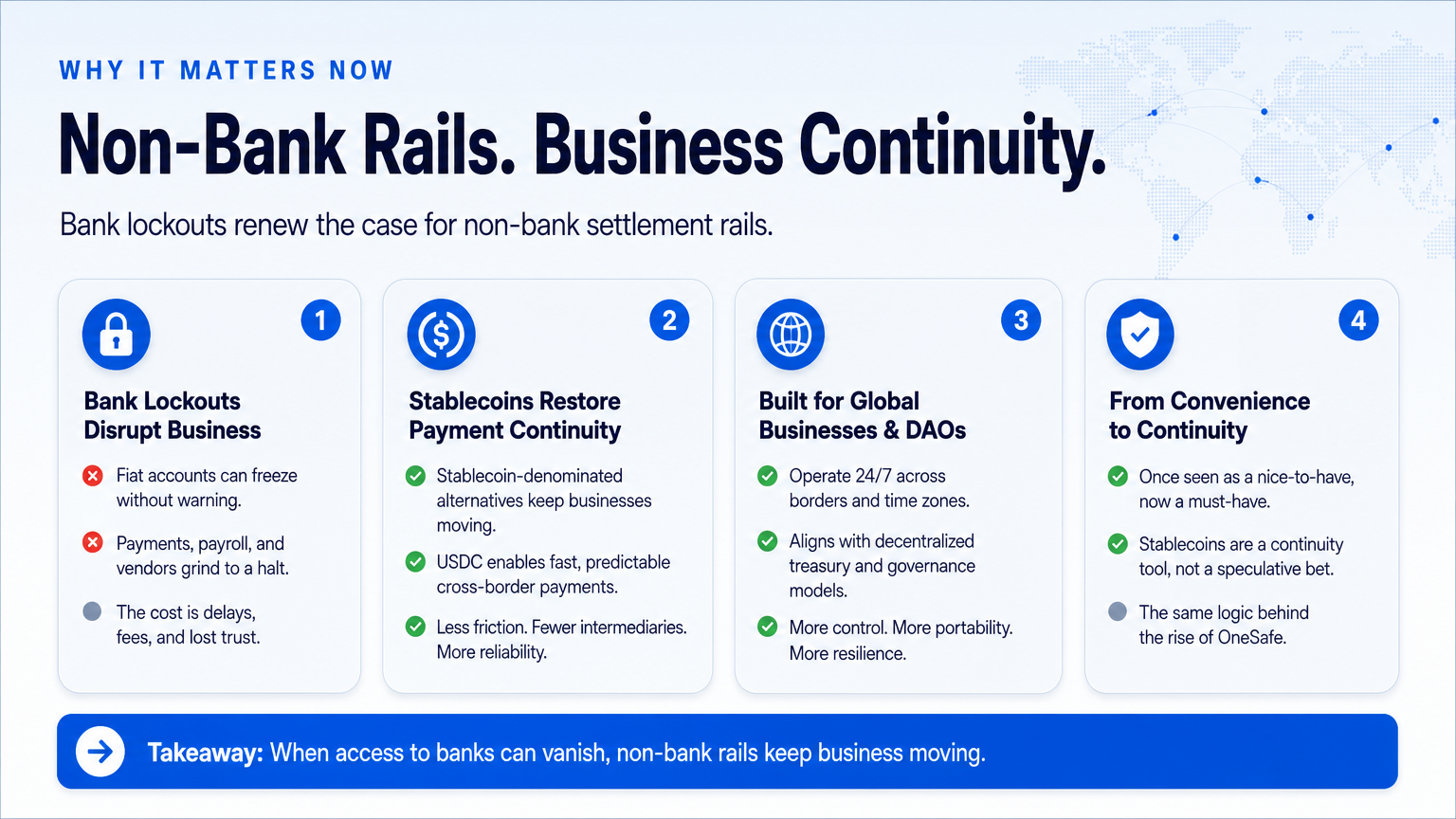
Bank lockouts renew the case for non-bank settlement rails. When fiat accounts freeze, stablecoin-denominated alternatives—especially USDC for cross-border crypto payments—look less like a speculative convenience and more like a continuity tool. This is the same logic behind the expansion of stablecoin payments Stripe has been scaling. A collapse like Ueno’s increases demand for business crypto accounts that combine fiat and crypto access under one operational roof. Companies that previously treated crypto as an investment add-on now evaluate it as a contingency layer. Regulators, meanwhile, tend to respond to visible depositor harm with tighter capital and custody rules, which can raise compliance costs across the board. The bottom line: a bank failure in one country can quickly become a global demand shock for hybrid fiat-crypto infrastructure.
The bank blackout in Paraguay is a reminder that deposit access is an assumption, not a guarantee. Businesses often model credit risk and currency risk, but rarely account access risk. A blackout can interrupt payroll, vendor payments, tax deadlines, and subscription billing even if the company itself is solvent. If your business runs on one banking partner, one payments rail, or one jurisdiction, you have a single point of failure—the same concentration problem regulators flagged when crypto-friendly banks failed earlier. The Ueno case shows that even regulated institutions can fall below capital requirements and freeze depositors for days or weeks. For international companies, the risk is amplified because account freezes may be governed by local administrative processes, not by the business’s own priorities. A second jurisdiction or a crypto-native fallback would have provided options.
The Background: How Traditional Banking Failures Fuel Crypto Adoption
Bank failures have repeatedly accelerated the search for alternative financial infrastructure. A December 2025 Federal Reserve note on bank runs examined how the Silicon Valley Bank failure affected stablecoin behavior and short-term funding markets. The Congressional Research Service has separately addressed the role of cryptocurrency in the failures of Silvergate and Signature. The common thread: when depositors lose access to fiat rails, demand spikes for assets and ledgers that do not depend on a single institution’s balance sheet. What makes Ueno different in degree is the political fallout—a bank failure that forces a sitting president to resign and triggers an impeachment vote is no longer only a financial event. It is a legitimacy event that can shift regulatory priorities across borders.
Decrypt’s November 5, 2026 report framed the Ueno collapse as reviving Bitcoin’s argument for self-custody: if you hold your own keys, no bank can lock you out. The report also acknowledged the flip side—lost keys, theft, and price volatility create separate risks. For a business, a DAO, or any organization with multiple signers, payroll, compliance obligations, and vendor relationships, pure self-custody replaces bank counterparty risk with operational, technical, and governance risks. A single lost key can freeze funds permanently, and governance disputes can be harder to resolve than a bank complaint. The reasoned position: for organizations, a hybrid fiat-crypto banking platform that provides institutional-grade crypto custody—such as digital asset custody secured through Fireblocks—alongside partner-bank fiat rails and, where available, custody insurance, offers the safer middle ground.
The Crypto Banking Spectrum: Between Self-Custody and Full Intermediation
Self-custody appeals precisely because Ueno-type failures are frightening. The peril is permissionless access with no account review or freeze. The pitfalls—key loss, phishing, insider theft, hardware failure, and ambiguity about who controls organizational funds—are just as severe. Hybrid platforms split the difference: they provide segregated fiat accounts, crypto on/off-ramps, and custody controls without requiring the customer to become a cold-storage security team. The OCC’s stablecoin path, for example, is shaping how crypto banking providers can operate with clearer rules. For a business, that means being able to pay a contractor in USDC on Tuesday, convert it to dollars on Wednesday, and route a wire to a supplier on Thursday. This is especially relevant for DAO treasury management: a DAO that holds everything in self-custody may survive a bank failure but struggle with fiat payroll or compliance; a DAO that holds everything in a single fiat bank has the opposite problem. Hybrid accounts solve for both.
Concrete Implications and Recommended Actions for Your Business

Redundancy with controls is the answer—genuinely independent rails, jurisdictions, and settlement mechanisms so that no single institution or jurisdiction can freeze your core operations.
Diversify your banking relationships and jurisdictions. Keep operating accounts at more than one bank and, where practical, in more than one country. Separate payroll and vendor accounts from reserve accounts. A second jurisdiction should be able to process payments if the first becomes unavailable. For US and international businesses, OCC final stablecoin rules provide a compliance reference for evaluating how crypto rails fit into existing banking arrangements.
Integrate crypto-native tools into your treasury. Holding a portion of operating reserves in USDC and using a business account with on/off-ramp capabilities can preserve payment ability during a fiat blackout. The model is operational resilience, not speculation. The Colombian USDC settlement test shows how stablecoin settlement can work in practice for real-world payments.
Stress-test your continuity plan. Run a one-hour tabletop exercise: if your primary bank freezes accounts tomorrow morning, what happens to payroll, vendor payments, and customer inflows? Identify which payments are fiat-only, which can be converted, and which are stuck. That exercise reveals whether your treasury is truly diversified.
What features should a crypto banking platform have for business continuity?
| Area | What to look for |
|---|---|
| Fiat rails | Multi-currency accounts, ACH, domestic and international wires, bill payments |
| Crypto rails | USDC or other stablecoin deposits/withdrawals, on/off-ramp, crypto payments |
| Custody | Institutional-grade digital asset custody, preferably with segregated accounts |
| Access controls | Mandatory MFA, role-based permissions, multi-signer approval workflows |
| Compliance | Clear KYB standards, sanctioned-jurisdiction restrictions, audit trail |
| Continuity | No single signer can move all funds; no single bank is the only fiat rail |
| Support | Responsive support that understands both fiat and crypto operations |
| Pricing | Transparent deposit, withdrawal, wire, FX, and card fees |
The point of this checklist is not to find a perfect institution. It is to avoid replacing a fiat single point of failure with a crypto single point of failure.
What to Watch Next: Regulatory Fallout and Market Signals
DAOs and global businesses should care because they operate across borders by default. A Ueno-style freeze in one jurisdiction can disrupt contributor payments, grant disbursements, and exchange settlements. DAO treasury management therefore needs the same rigor as traditional treasury—if not more, because many DAOs have no centralized finance team to manage a crisis. The Ueno event also pushes neobanking for Web3 closer to the mainstream; as regulated digital lenders and hybrid platforms absorb more fiat and crypto flows, the expectation for continuous access rises.
Fiat-only banking concentrates three risks for international companies: currency conversion risk (every cross-border payment depends on a bank’s FX desk and correspondent network), jurisdictional access risk (an account freeze in one country can halt operations even if the company is compliant), and rail risk (fiat wires are batch-based, while cross-border crypto payments can settle continuously). Paraguay shows the extreme version of the second risk.
Regulatory responses will not be one-directional. Ueno’s failure may push Paraguayan regulators toward stricter capital rules for digital lenders, while globally it may add urgency to deposit-insurance and stablecoin frameworks. The case cuts both ways: it strengthens the argument for safer fiat banking, but it also strengthens the argument that non-bank settlement rails need clear rules rather than prohibition. The December 2025 Federal Reserve note on bank runs and stablecoins suggests U.S. regulators are already thinking in this direction. For businesses, the watch item is whether new capital or custody rules make hybrid platforms more expensive or more standardized. If you run a DAO treasury or crypto treasury program, a shift in custody standards will matter before it shows up in a headline.
The search for safer banking jurisdictions is about finding a portfolio of jurisdictions whose risks do not correlate. The Ueno failure is a reminder that political stability and banking stability can diverge. If your team needs to keep internal stakeholders informed without building an editorial function, a tool like Joyrise—which plans, writes, and publishes illustrated SEO articles to your Webflow blog every day, with a first article available for review before payment—can be a practical part of a client or investor communication plan. But no content cadence replaces an actual treasury contingency plan.
Key Takeaways
- Ueno Bank’s November 5, 2026 collapse locked out roughly three million customers, held approximately $800 million in public deposits with capital below half the required minimum, and triggered Paraguay’s presidential resignation and impeachment vote.
- The event is not a crypto-native failure, but it strengthens the operational case for hybrid crypto banking after bank failures: fiat resilience plus crypto-native fallback rails.
- Pure self-custody removes bank counterparty risk but creates key-loss, theft, and governance risk; for organizations, a hybrid fiat-crypto banking platform with institutional custody controls is usually the safer middle ground.
- Businesses should diversify banking relationships and jurisdictions, integrate stablecoin on/off-ramps into treasury operations, and run bank-freeze continuity exercises before a crisis.
- DAOs and global companies should monitor regulatory responses to Ueno and OCC-driven stablecoin rules, because custody and capital standards will shape the next generation of secure crypto banking.
Ready to move your treasury onto a platform built for both fiat and crypto operations? Open an account with OneSafe.