Your web3 company is growing, but the bank suddenly asks for a full explanation of your customers, wallet flows, counterparties, and source of funds. A payment partner pauses settlements while its compliance team reviews your activity. Meanwhile, finance is switching between fiat accounts, crypto wallets, spreadsheets, and card platforms to reconstruct what happened.
That situation isn't unusual for businesses operating across borders. Compliance risk management is the operating discipline that connects regulatory obligations with day-to-day decisions, from onboarding a customer to approving a vendor payment and safeguarding digital assets. It helps a company identify where a violation, control failure, financial loss, or trust problem could occur, then put accountable controls in place before the issue disrupts the business.
Table of Contents
- AML and KYC or KYB
- Sanctions screening
- Digital asset custody and security
- FX and cross-border transactions
- First line operations own the activity
- Second line sets standards and challenges decisions
- Third line tests independently
Why Compliance Risk Management Is Critical Now
A compliance program that exists only in policy documents won't protect a fast-moving fintech or web3 business. The true test comes when a banking partner asks for transaction evidence, a sanctions alert appears on a wallet, a contractor submits an unusual invoice, or an internal team wants to launch in a new market before the control design is ready.
The operational consequences can be immediate. A provider may delay or reject a payment, a customer may face an unexplained account restriction, or the finance team may spend days assembling records that should have been available through a clear audit trail. Compliance risk management reduces that uncertainty by linking obligations to owners, workflows, evidence, and escalation decisions.
The need is practical, not theoretical. A 2024 global risk and compliance benchmark found that 50% of respondents said their organization had experienced at least one compliance issue in the previous three years, while 31% reported more than one issue. Those findings point to a control environment where written policies alone aren't enough.
Compliance protects continuity
For a global business, compliance supports access to essential infrastructure. Banks, payment institutions, exchanges, card networks, custodians, and enterprise customers all assess risk in their own way. They need confidence that your company knows who it serves, understands its transaction flows, screens relevant parties, protects data, and can investigate unusual activity.
That evidence becomes a commercial asset. A well-run program can make partner due diligence more predictable, shorten internal approval discussions, and give investors a clearer view of operational maturity. It won't eliminate scrutiny, but it can turn an opaque review into a documented process.
Practical rule: Treat every major compliance control as a business continuity control. Ask what would stop working if the control failed.
Compliance is a management system
The strongest programs don't ask only whether the business is following a rule. They ask whether the company can prove how it applies the rule across products, jurisdictions, teams, and third parties. That means assigning ownership, recording decisions, testing data feeds, and tracking remediation through completion.
For a web3 company, this discipline must cover both traditional and digital finance. A fiat transfer and an on-chain settlement may use different systems, but they can involve the same customer, beneficiary, source of funds, and regulatory concern. Managing those activities separately creates blind spots. Integrated compliance risk management brings the relationship, transaction, wallet, and approval context together.
Navigating the Modern Compliance Environment
A fintech can approve a customer in one country, route fiat through another, and settle a digital-asset transaction on a network with no operating office nearby. The business may still be accountable to several regulators at once. Global and web3 operations expose a structural mismatch: financial rules follow jurisdictions, licenses, legal entities, customers, and transaction locations, while crypto networks, remote teams, cloud systems, and digital counterparties cross borders quickly.

A U.S. fintech may need to account for FinCEN and OFAC obligations, while European operations may involve GDPR and local financial requirements. A crypto product can also raise expectations around AML controls, custody, consumer treatment, market conduct, and data governance. The working question is which obligations attach to each entity, service, customer, payment rail, and asset flow.
Why one global policy fails
A single policy can establish a baseline, but it cannot resolve every jurisdictional conflict. Data minimization may limit what a team stores, while financial-crime controls may require records sufficient to investigate and report activity. A vendor approved in one region may fail another region's onboarding or data-transfer requirements. A wallet address can be technically valid while the related activity creates sanctions or financial-crime exposure.
Build a control map around business activities rather than maintaining a document library:
- Customer onboarding: Specify which customer types, legal entities, jurisdictions, beneficial owners, and products require review.
- Money movement: Map ACH, domestic wires, SWIFT, card, stablecoin, and other settlement paths to their owners and control points.
- Data handling: Record where identity, transaction, wallet, and employee data enters, moves, and is retained.
- Third parties: Link each provider to its process, the data it receives, and the operational failure that could follow an outage or control gap.
- Escalation: Define which events require a hold, enhanced review, senior approval, investigation, or external reporting.
Complexity is an operating risk
The 2025 PwC global compliance survey reports that 77% of executives are negatively affected by compliance complexity, while only 7% consider their organizations to be leading in compliance. A framework alone does not remove competing requirements. Teams need clear priorities, decision rights, and records showing why a control or exception was approved.
For a borderless business, jurisdiction belongs in product design. Before launch, compliance and operations should agree on permitted markets, restricted customers, data-access rules, payment routes, and evidence requirements. That decision prevents a legal question from becoming an improvised support ticket after release. In web3, the same review should connect fiat rails, wallets, counterparties, and asset movements so a control applied in one system does not leave a gap in another.
Identifying Key Compliance Risks in Digital Finance
A useful risk assessment starts with the actual movement of value. Follow the customer from onboarding through account funding, fiat conversion, wallet interaction, card spending, settlement, and exit. At each step, ask who can transact, what data is checked, which approval is required, what gets logged, and who investigates an exception.
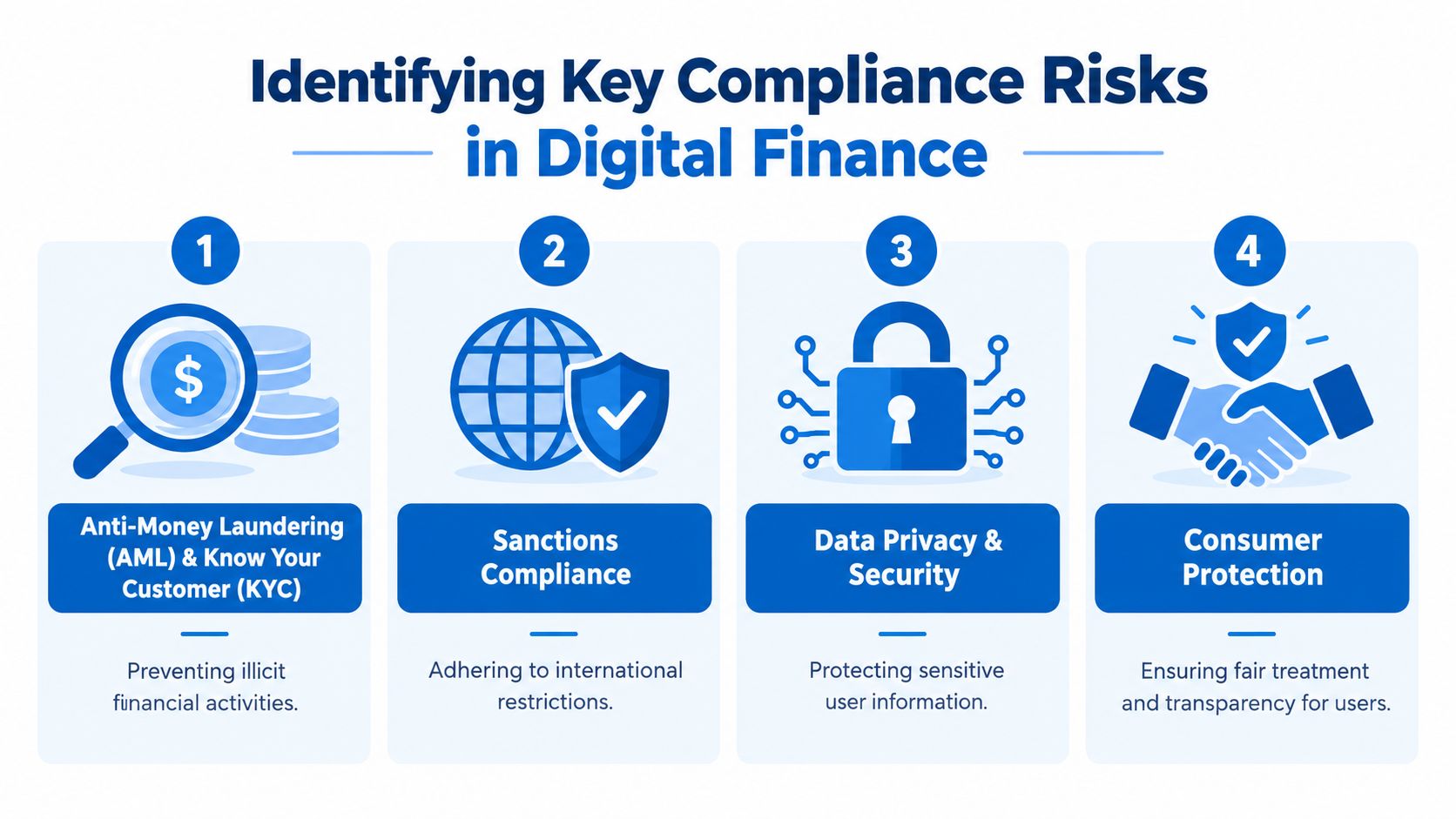
AML and KYC or KYB
The first exposure is accepting a customer or business you don't understand. KYC and KYB should establish identity, ownership, business purpose, expected activity, and relevant geography. For a DAO or crypto-native company, that may require additional work to understand signers, governance arrangements, treasury control, contributors, and the relationship between an entity and its wallets.
A failure can look simple. A company approves a business using incomplete ownership information, then processes a series of transactions that don't match the stated business model. If the onboarding record doesn't capture the original rationale, investigators have little context for deciding whether the activity is explainable or suspicious.
Use a risk-based process. Apply more scrutiny where the customer, product, jurisdiction, transaction pattern, or ownership structure creates greater exposure. A practical AML and KYC procedures guide can help teams translate onboarding principles into repeatable operational steps.
Sanctions screening
Sanctions controls must cover more than names in a customer database. Screen relevant customers, beneficial owners, counterparties, payment beneficiaries, and, where appropriate, wallet exposure. Define what happens when an alert is generated, including who can release a false positive and who can approve a restricted transaction.
A DAO might send a grant or vendor payment to a wallet whose activity creates a sanctions concern. If the organization checks only the recipient's name and ignores wallet intelligence, transaction context, and geographic indicators, the control may give false comfort.
Digital asset custody and security
Custody risk combines financial crime, technology, access management, and operational resilience. Separate initiation from approval, protect signing authority, enforce MFA, review privileged access, and maintain recovery procedures. The goal isn't merely to keep a private key secret. It's to ensure that no individual or compromised credential can move treasury assets without appropriate authorization and evidence.
For every wallet, document its purpose, owner, permitted assets, signing policy, transfer limits, monitoring approach, and reconciliation process. Treat hot wallets, operational wallets, and treasury storage differently rather than applying one generic rule.
FX and cross-border transactions
Cross-border operations create exposure through currency conversion, settlement timing, intermediary banks, beneficiary information, and local restrictions. An SME can receive revenue in one currency, pay contractors in another, and convert through a crypto or fiat route without a clear record of the rate, approval, or business purpose.
Review the transaction chain end to end. Record the originating account, beneficiary, currency, conversion event, applicable rate, fee, approver, and final settlement. Reconcile what the platform says happened with bank and blockchain records. Recent financial-crime guidance emphasizes data lineage, periodic reconciliations, and risk-based control testing across BSA/AML and OFAC systems, treating poor data quality as a direct threat to screening and risk scoring (financial-crime data management guidance).
Building Your Compliance Risk Management Framework
A lean company doesn't need a large department to create accountability. It does need clear ownership, documented decisions, reliable evidence, and enough independence to challenge commercial pressure. The adapted Three Lines of Defense model provides a practical division of responsibilities.
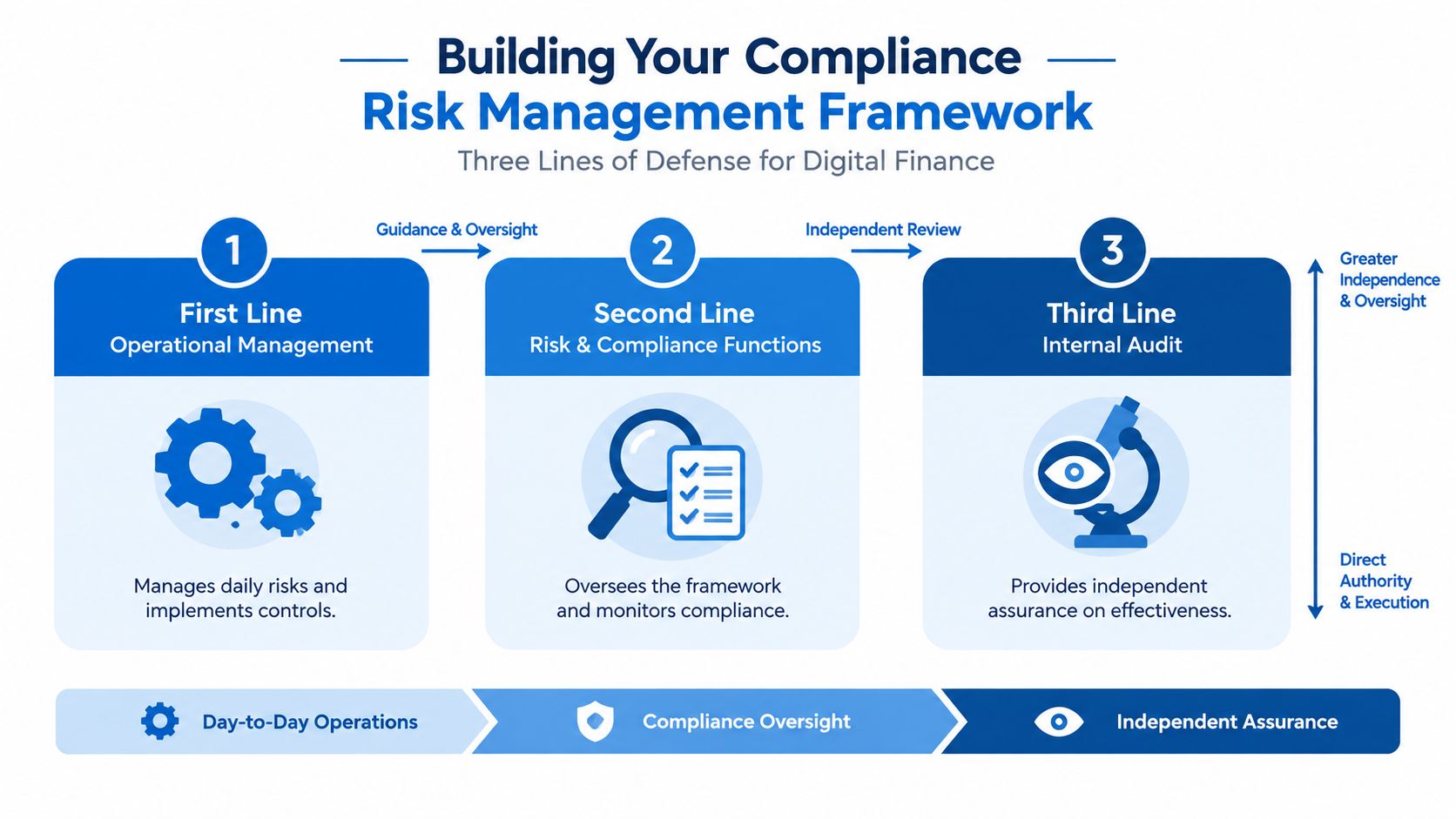
First line operations own the activity
Product, finance, customer operations, treasury, and engineering teams run the processes where risk occurs. They should follow approval rules, capture required evidence, resolve alerts, and report exceptions. Compliance can't be the only function responsible for a customer record that operations created or a payment that finance approved.
Start with a risk assessment that maps products, customers, jurisdictions, transaction flows, vendors, data, and access privileges. Rate each exposure qualitatively by impact and likelihood, then identify the control that prevents, detects, or corrects it. Revisit the assessment when the company launches a product, changes a provider, enters a market, or introduces a new asset flow.
Second line sets standards and challenges decisions
The compliance and risk function translates obligations into procedures. It defines onboarding requirements, sanctions rules, monitoring scenarios, escalation thresholds, training expectations, testing plans, and reporting formats. It should also challenge first-line decisions without taking over the underlying process.
Policies need operational detail. Instead of saying “monitor transactions,” specify which data is reviewed, how often alerts are assessed, what evidence investigators retain, and who can close a case. Training should follow roles, so a treasury employee learns payment and wallet controls while a product manager learns launch gates and data-handling requirements.
Third line tests independently
Internal audit, whether in-house or appropriately independent, evaluates whether controls are designed well and operating as intended. It should sample onboarding files, inspect approval trails, test access removal, review alert handling, trace data from source to report, and confirm that remediation closed the underlying issue.
Continuous monitoring matters because a quarterly policy review won't reveal a broken data feed today. A 2025 global compliance benchmarking survey describes the shift toward continuous monitoring of technology-enabled controls, with attention to third-party risk, employee conduct, and cyber or ESG-linked obligations.
Use a compact governance rhythm:
- Risk register: Record the exposure, owner, control, evidence, residual risk, and due date.
- Control calendar: Schedule monitoring, reconciliations, access reviews, training, and testing.
- Incident log: Capture the event, decision, rationale, customer impact, root cause, and corrective action.
- Management reporting: Escalate material exceptions, overdue remediation, recurring alerts, and risk acceptance decisions.
For adjacent regulated sectors, a specialized guide for iGaming operators offers a useful reminder that payment, customer, fraud, and operational controls must work together rather than sit in separate policy folders.
Using Platform Controls to Automate and Mitigate Risk
Technology helps when it places the right control directly inside the workflow. It fails when it creates a dashboard that nobody owns, automates a weak decision rule, or hides an incomplete data feed behind a clean interface.
A practical platform should connect identity, account, payment, card, wallet, and approval data. During onboarding, KYB information should feed the customer record used by payment operations and monitoring. During a transaction, the workflow should apply beneficiary and sanctions checks, enforce permissions, preserve approval evidence, and make the resulting record available for investigation.
Automate decisions, not accountability
Useful automation includes:
- Access controls: Require MFA, use role-based permissions, and review privileged access regularly.
- Payment approvals: Route high-risk or unusual payments to a second approver instead of relying on informal chat confirmation.
- Card governance: Apply merchant restrictions, spend limits, team roles, and policy-based approvals before a transaction reaches settlement.
- Treasury visibility: Reconcile fiat balances, crypto movements, conversions, and outstanding obligations in one operating view.
- Evidence capture: Store the decision, approver, timestamp, source data, and exception rationale alongside the transaction.
A platform such as OneSafe provides multi-currency business accounts, global payment rails, corporate card controls, crypto-compatible transactions, web3 invoicing, and Fireblocks-based digital asset custody. Those capabilities can support a control design, but they don't replace the company's risk assessment, jurisdictional analysis, monitoring decisions, or incident response responsibilities. For a deeper look at automation in digital-asset operations, see automated compliance for crypto and digital assets.
The economics make workflow design important. A 2024 risk and compliance benchmarking report cites a 2022 U.S. regulatory compliance cost of $3.079 trillion, or about $13,000 per employee for a typical firm. The figure doesn't mean every company can automate its way out of compliance expense. It does show why repetitive reconciliation, evidence collection, access review, and approval work deserve deliberate process engineering.
This video provides another way to examine how financial technology can connect operational controls with daily money movement.
Test the system under pressure
Before relying on automation, run controlled scenarios. Use a false-positive sanctions alert, an incomplete KYB record, a changed beneficiary, a failed reconciliation, a compromised user account, and an urgent payment request. Confirm that the system blocks or routes the event correctly, that the responsible person receives the alert, and that the audit record contains enough detail for later review.
Don't measure success by the number of alerts generated. Measure whether the business can resolve alerts consistently, explain decisions, identify control failures, and prevent the same issue from recurring. Automation should reduce manual friction while making accountability more visible.
Turning Compliance from a Cost Center to a Strategic Advantage
Compliance creates strategic value when it gives leadership a reliable view of where the business can operate and how safely it can scale. The work starts with a jurisdiction-aware risk assessment, continues through clear ownership and testing, and becomes durable when technology embeds controls into onboarding, payments, custody, cards, and reporting.
That approach helps a web3 company speak credibly with banks, payment partners, investors, enterprise customers, and regulators. It also gives finance and operations teams a common record of what happened, why it happened, and who approved it. Strong controls won't guarantee approval from every provider, but they make the business easier to understand and easier to govern.
AI and automation require the same discipline. Industry data cited in the Gartner compliance risk management outlook says 71% of respondents believe AI will have a positive overall impact, while 82% plan to invest more in automation. That optimism should be paired with validation. An automated system can process bad data faster, so teams must test lineage, model outputs, permissions, and escalation paths before treating efficiency as lower risk.
For smaller European businesses assessing digital-asset obligations, this overview of crypto compliance benefits for European SMEs provides a useful perspective on why compliance belongs in the operating model rather than at the end of a product launch.
OneSafe brings multi-currency accounts, cross-border payments, corporate cards with spending controls, crypto and fiat workflows, web3 invoicing, and digital-asset custody into one interface for global and web3 businesses. Review your highest-risk payment and treasury workflows, then visit OneSafe to see whether its platform controls fit your compliance risk management program.