HSBC’s October 2026 launch of RedCoin, a Hong Kong dollar-backed stablecoin now live for 3.3 million PayMe users, forces every startup to confront a sharper question: does a bank-issued token actually simplify your treasury, or just make legacy infrastructure look modern?
Table of Contents
- What Just Happened
- Why This Matters for Crypto Banking
- The Background: Crypto Banking Before RedCoin
- Where Traditional Banks Still Fall Short for Web3 Companies
- What This Means for Your Day-to-Day Operations
- What does the HSBC RedCoin launch mean for my startup’s banking stack?
- Is crypto banking finally safe and regulated for businesses?
- How can DAOs use bank-issued stablecoins without giving up on-chain governance?
- Should I move my company’s treasury to a bank that offers its own token?
- Five steps to future-proof your fiat-crypto operations
- Key Takeaways
What Just Happened
On October 25, 2026, HSBC flipped the switch on RedCoin, a HKD-denominated stablecoin, making it available to 3.3 million PayMe users. The bank’s HSBC RedCoin launches today - HSBC Hong Kong press release confirmed the token is fully backed by Hong Kong dollars and issued by HSBC. The South China Morning Post reported the launch the same day in “HSBC unveils RedCoin as name of Hong Kong stablecoin ...”, highlighting its immediate consumer reach.
RedCoin runs on a private, permissioned blockchain controlled by HSBC. That design choice gives the bank full compliance oversight but also walls the token off from public networks—and from business accounts. The bank’s Hong Kong Dollar Stablecoin | HSBC RedCoin product page describes the mechanics plainly: HKD-backed, redeemable at par, consumer-first.
Why This Matters for Crypto Banking
The significance of RedCoin isn’t in a new feature; it’s in who built it. A globally systemically important bank issuing its own stablecoin normalizes tokenized money for procurement teams, auditors, and compliance officers who previously blocked any mention of crypto in treasury policy. The next time you propose paying an overseas contractor in a dollar-equivalent token, the conversation shifts from “banks don’t do this” to “HSBC just did.”
Cross-border payments and FX will eventually get cheaper. A bank-issued stablecoin settles in seconds versus days for correspondent banking, and the cost of moving tokenized value is a fraction of traditional wires. But RedCoin is domestic-only today, and its private chain doesn’t interoperate with public blockchains. For startups and Web3 companies that need crypto-friendly business accounts this month, the fiat-to-crypto bridge matters more than the bank token itself.
The Background: Crypto Banking Before RedCoin
Crypto banking has matured fast. Standard Chartered absorbed Zodia Custody, while regulatory frameworks from Singapore to the EU shifted to binding rules. Meanwhile, crypto-native platforms built for multi-currency, multi-chain operations quietly grew to serve the businesses legacy banks couldn’t onboard.
At its core, crypto banking unifies fiat and digital assets under one account structure: hold USD, EUR, and USDC together, convert between them, pay vendors on either rail, and maintain compliance records—all without stitching together four platforms. The stablecoin leg is payment plumbing, not an investment thesis.
A broader context from Yahoo Finance illustrates how the launch fits into a wider geopolitical moment: “China Wants $5.1B in Bitcoin, Now HSBC Is Launching ...”, reinforcing that bank-issued stablecoins are now part of a larger strategic conversation.
Where Traditional Banks Still Fall Short for Web3 Companies
Onboarding That Takes Weeks Instead of Days
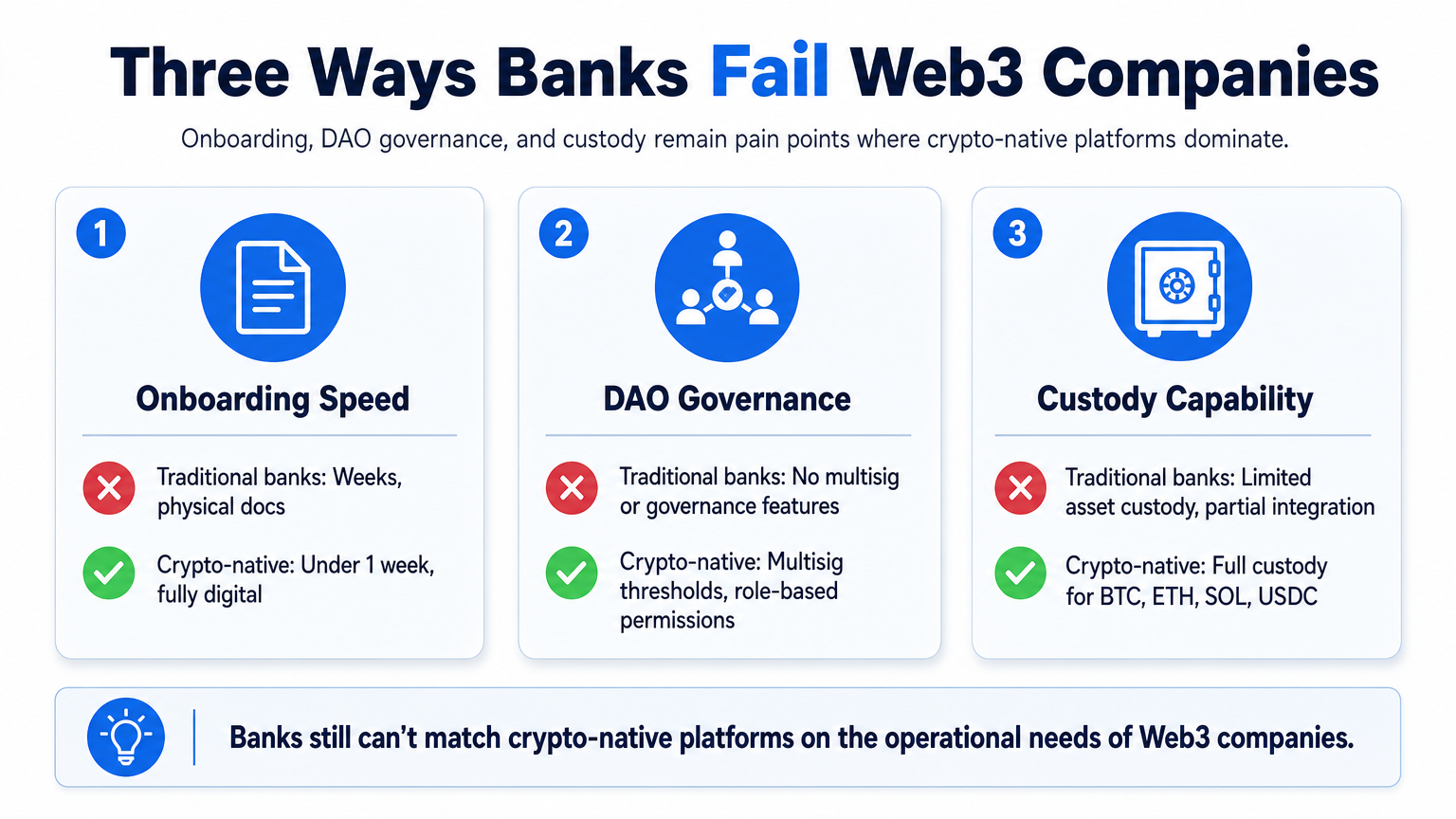
HSBC’s RedCoin materials emphasize consumer reach; there’s no evidence of a streamlined business onboarding path for crypto-native firms. Traditional corporate KYC still demands physical documents, multi-week compliance reviews, and manual touches. Purpose-built platforms typically complete business onboarding in under a week with fully digital verification.
No Multisig Governance for DAOs
DAO banking requires governance-aware infrastructure: multisig thresholds, role-based transaction permissions, audit trails that map to on-chain voting. RedCoin’s private chain doesn’t interact with smart contract wallets or governance modules. A DAO moving treasury to a private bank chain trades decentralized oversight for bank custody—a trade most DAOs will refuse.
Custody That Isn’t Crypto-Native
Bank custody for digital assets is often a wrapper around institutional-grade infrastructure. But can the bank custody Bitcoin, Ethereum, or Solana tokens with the same fluency as a crypto-first platform? The Zodia Custody precedent offers a partial yes for certain assets, but operational integration—paying a vendor in USDC from the same dashboard where you hold fiat—hasn’t been demonstrated.
What This Means for Your Day-to-Day Operations
Audit your current stack. Map every fiat and crypto rail your business touches: which accounts hold which currencies, where bottlenecks sit, what you pay in fees. Most teams find redundant, fragmented accounts across three or more providers.
Treat stablecoin integration as a treasury mandate. If you pay cross-border, routing one recurring payment through a regulated stablecoin can cut costs from 2–4% to sub-1%. Document the policy and run a live test. (An external primer on what RedCoin actually is, from Eco’s support page, “What Is HSBC RedCoin? | Support - Eco”, can serve as a non-technical reference for your team.)
Ask any banking partner six hard questions:
- Business onboarding time and exact document requirements.
- Multi-currency fiat accounts alongside stablecoin balances in one interface.
- Actual fees for fiat-to-crypto conversion, wires, and card FX.
- How they custody digital assets—and the custody infrastructure provider.
- Role-based permissions, multisig thresholds, or DAO-specific features.
- How fiat holdings are protected, and what is not covered by deposit insurance.
The sixth point is critical. Bank-issued stablecoins are not deposits and carry no equivalent of FDIC or Deposit Protection Scheme coverage. If a provider can’t explain the distinction clearly, that’s a red flag.
What does the HSBC RedCoin launch mean for my startup’s banking stack?
Operationall
y, practically nothing today: RedCoin is consumer-only, HKD-denominated, and on a private chain. In the medium term, it pressures every banking provider to compete on stablecoin rails or lose cross-border volume. Use the launch as a forcing function to consolidate your fiat and crypto accounts into a single operational layer now, so that when bank stablecoins and public chains converge, you can route payments through whichever rail is cheapest and fastest that week.
Is crypto banking finally safe and regulated for businesses?
Regulation has matured in 2026, and HSBC’s token under Hong Kong supervision proves bank-grade compliance extends to tokenized money. But safe and regulated are not synonyms. Fiat deposits at insured institutions enjoy deposit insurance; stablecoin balances—even bank-issued—do not. Understand exactly what happens in a custody failure, smart contract exploit, or issuer insolvency. Get the resolution plan in writing.
How can DAOs use bank-issued stablecoins without giving up on-chain governance?
As of now, they cannot—directly. RedCoin’s private chain can’t interact with multisig wallets, timelocks, or on-chain voting. The practical default is a split architecture: keep governance-critical treasury decisions on public chains with USDC, and maintain a fiat operational account for payroll, taxes, and vendor payments that can’t be settled in crypto. Purpose-built platforms that offer DAO-friendly features (role-based permissions, multisig-aware custody) bridge the gap without sacrificing governance.
Should I move my company’s treasury to a bank that offers its own token?
Not on the strength of the token alone. Evaluate the whole package: onboarding speed, multi-currency fiat support, crypto custody infrastructure, fee transparency, and whether the platform handles your actual workflows—invoicing, payroll, vendor payments, on/off-ramping. A bank-issued stablecoin signals maturity, not operational competence. If the platform forces you to run fiat and crypto through disconnected systems, you haven’t consolidated; you’ve added complexity.
Five steps to future-proof your fiat-crypto operations
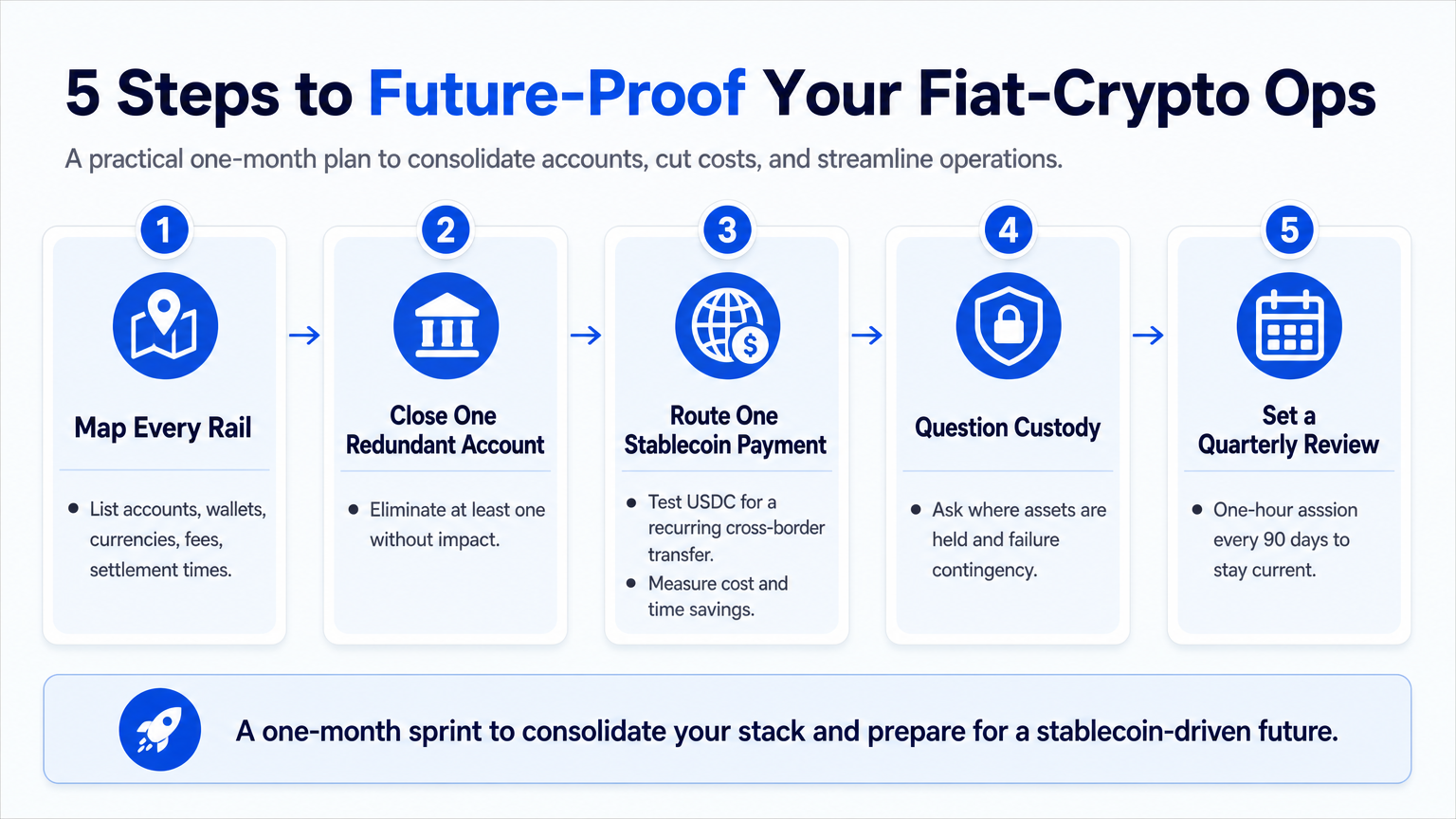
- Map every rail. List every account, wallet, and provider, along with currencies, fees, and settlement time.
- Close one redundant account. Most businesses can eliminate at least one without impact.
- Route one stablecoin payment. Pick USDC for a recurring cross-border transfer this month, then measure the cost and time delta.
- Question custody in every vendor review. Ask where digital assets are held, by whom, and what happens in a failure.
- Set a quarterly review. A one-hour session every 90 days keeps your stack current and creates decision logs for auditors. If you document those reviews publicly, a tool like Joyrise — your blog, written and published every day helps your team stay disciplined, but the review cadence matters more than the tool.
| Question | HSBC RedCoin (as reported) | Crypto-native business platforms |
|---|---|---|
| Stablecoin availability | HKD-backed, consumers only | Multi-currency stablecoins for business |
| Onboarding | Traditional corporate (weeks) | Under a week, fully digital |
| DAO support | Not announced | Role-based permissions, multisig-compatible |
| Chain interoperability | Private, permissioned chain | Public chain native (Ethereum, Solana) |
| Deposit insurance | Not applicable to stablecoins | Not applicable to crypto; fiat varies |
| Corporate FX cost | Not disclosed | 0.25% or prevailing FX, varies |
Key Takeaways
- RedCoin validates stablecoin banking as mainstream, but it’s consumer-focused, HKD-only, and unavailable to businesses today.
- Bank-issued stablecoins are not insured like bank deposits; keep that distinction explicit in treasury policy.
- DAOs cannot integrate with RedCoin’s private chain without losing on-chain governance. A split architecture remains the practical default.
- Your next 30 days should focus on consolidating fragmented accounts and running one stablecoin-based cross-border payment to measure the savings yourself.
- RedCoin pressures banks to compete on stablecoin rails by 2027—lowering cross-border costs for businesses that can switch rails quickly.
Ready to unify your fiat and crypto operations in a single, crypto-native account? Explore how OneSafe helps global businesses, startups, and DAOs manage both rails without the legacy overhead.