On October 25, 2026, the European Banking Authority (EBA) classified Circle’s USD Coin (USDC) as a significant stablecoin under the EU’s Markets in Crypto-Assets (MiCA) framework, a move that reshapes the stablecoin regulation 2026 landscape for any business touching the eurozone. Direct EU supervisory oversight begins in November 2026, triggering capital, reserve, and operational requirements for the dollar-pegged token that processes trillions in on-chain volume. For fintech treasuries, cross-border payroll, and DAO governance, this isn’t a distant policy shift—it’s an immediate compliance reality.
Table of Contents
- What just happened: USDC is now an EU ‘significant’ stablecoin
- Why this matters right now for global businesses and DAOs
- The regulatory background you need in 90 seconds
- Concrete implications for crypto-friendly business banking and neo-banking platforms
- Adjudicated disagreement: the CFTC stablecoin letter doesn’t give stablecoins a free pass
- What is a ‘significant’ stablecoin under MiCA and how does it differ from other e-money tokens?
- How does the EBA’s USDC classification affect businesses that use USDC for payments or treasury?
- How does US stablecoin regulation compare to the EU’s approach after this EBA decision?
- Recommended actions: an operational checklist for finance leads
- What to watch next
- Key Takeaways
- Sources
- Further reading
What just happened: USDC is now an EU ‘significant’ stablecoin
The European Banking Authority classified Circle’s USDC as a significant stablecoin, bringing it under direct EU supervisory oversight starting November 2026 (Tekedia, ‘European Banking Authority Classifies Circle’s USDC as a Significant Stablecoin’, October 25, 2026). The EBA also published final technical standards on September 15, 2026, specifying that the minimum own-funds floor for significant e-money tokens is 2% of average reserve assets (EBA, ‘Final Report on Technical Standards for Significant E-money Tokens’, September 15, 2026). Together, these decisions mean Circle, already authorised as an e-money institution in France, must now meet heightened standards that go far beyond a standard e-money token license.
What ‘significant’ means under MiCA: capital, reserves, and supervisory thresholds
MiCA stablecoin regulation creates a two-tier structure for fiat-pegged tokens called e-money tokens (EMTs). Once designated significant, the issuer faces:
- Higher own-funds requirements: minimum 2% of average reserve assets, with the EBA able to raise this.
- Stricter reserve management: reserves in high-quality liquid assets, fully segregated and redeemable at par at any time.
- Direct EBA supervision and enhanced governance, risk management, and transaction monitoring.
Circle’s new obligations and compliance timeline
Circle must demonstrate USDC compliance EU across all operations. Reporting changes land in November, with full alignment expected during a transitional period. For businesses holding or using USDC, tighter custody and off-ramp scrutiny starts now.
Why this matters right now for global businesses and DAOs
USDC liquidity and stablecoin off-ramp channels after the designation
The classification doesn’t ban USDC, but it compresses the set of compliant off-ramp partners. Payment processors and exchanges operating USDC-to-EUR conversions must meet significant-EMT standards, temporarily raising friction. Corridor providers now need a higher compliance bar.
Treasury management for Web3 startups: holding, paying, and converting USDC legally
Web3 startups using USDC for payroll must confirm each conversion step respects MiCA’s redemption and reserve rules. This demands a crypto-friendly business banking platform that can document issuer compliance and segregate client assets to EU standards.
DAO treasury compliance with EU-based contributors
DAOs paying members in USDC face DAO treasury compliance challenges. If the token is a significant EMT, the DAO needs to show its operations don’t circumvent EU law. A platform with customisable roles and jurisdiction-aware drawdowns, like OneSafe, embeds this into contributor payments.
The regulatory background you need in 90 seconds
MiCA’s two-tier stablecoin system: e-money tokens vs significant EMTs
MiCA defines EMTs as stablecoins pegged to a single fiat currency. The “significant stablecoin EBA” tag triggers the most stringent rules: higher capital, mandatory redemption, and direct oversight. Circle’s own MiCA-aligned framework now operates at the highest tier.
The US patchwork: state money-transmitter licenses, the GENIUS Act, and the CFTC stablecoin letter
The U.S. relies on state money-transmitter licences, while the proposed GENIUS Act would create a federal pathway. A CFTC staff advisory letter suggested certain stablecoins may be commodities, but it provides no safe harbour from issuer licensing—the CFTC stablecoin letter confirms anti-fraud jurisdiction, not a pass for unlicensed distribution.
How USDC already straddled these regimes—and what really changes now
Circle already held US and EU licences. What changes is the supervisory intensity and direct EBA leash. Routine oversight becomes proactive, and the heightened monitoring trickles into banking partners’ risk assessments.
Concrete implications for crypto-friendly business banking and neo-banking platforms
What an EU-regulated stablecoin demands of fiat-crypto bridges
A neo-banking crypto platform sitting between fiat and crypto must show MiCA-compliant handling of significant EMTs: segregated client accounts, clear chain-of-title records, and redemption-at-par mechanics. OneSafe’s architecture, with multi-currency accounts and crypto-to-fiat conversions, aligns with these demands by design.
Due-diligence shifts: custodians, Fireblocks integration, and reserve attestations
Businesses must demand proof of reserve segregation and heightened attestations. OneSafe uses Fireblocks for custody, giving institutional-grade security that reduces the counterparty risk a significant-EMT designation exposes. The due-diligence checklist expands to cover the full payment stack.
Corporate cards, cross-border wires, and FX under EU scrutiny
When USDC funds corporate cards or wires through a stablecoin rail, the significant-EMT status may trigger extra documentation. OneSafe’s platform, with corporate cards, international wires, and FX, bakes these compliance layers directly into card top-ups and conversion flows.
Adjudicated disagreement: the CFTC stablecoin letter doesn’t give stablecoins a free pass
What the CFTC letter actually said—and didn’t say
The CFTC staff advisory expressed the view that fully collateralized stablecoins could be “virtual commodities” under the Commodity Exchange Act. It did not pre-empt banking regulators, the SEC, or state money-transmitter requirements.
Why businesses still need issuer licensing, not just commodity classification comfort
The letter supplies no safe harbour for unlicensed distribution. A business converting USDC to fiat for U.S. customers still needs state money-transmitter licences. In the EU, MiCA applies regardless. Commodity classification simply confirms the CFTC’s anti-fraud role, leaving issuer licensing and reserve rules separate.
What is a ‘significant’ stablecoin under MiCA and how does it differ from other e-money tokens?

Under MiCA, a “significant” e-money token exceeds thresholds for holders, transaction volume, or interconnectedness with the EU financial system. The EBA assesses these factors and imposes enhanced obligations: at least 2% own funds, stricter reserve management (high-quality liquid assets, segregated, redeemable at par), direct EBA supervision, and potential usage limits. Ordinary e-money tokens face lighter requirements and remain at national level.
How does the EBA’s USDC classification affect businesses that use USDC for payments or treasury?
The classification alters the compliance pathway. Banking partners handling USDC conversions will perform heightened scrutiny. Companies may need to switch to EU-regulated off-ramps reflecting the significant-EMT standard. Custody and payment agreements must explicitly reference MiCA’s new requirements, making treasury management more documentation-intensive.
How does US stablecoin regulation compare to the EU’s approach after this EBA decision?
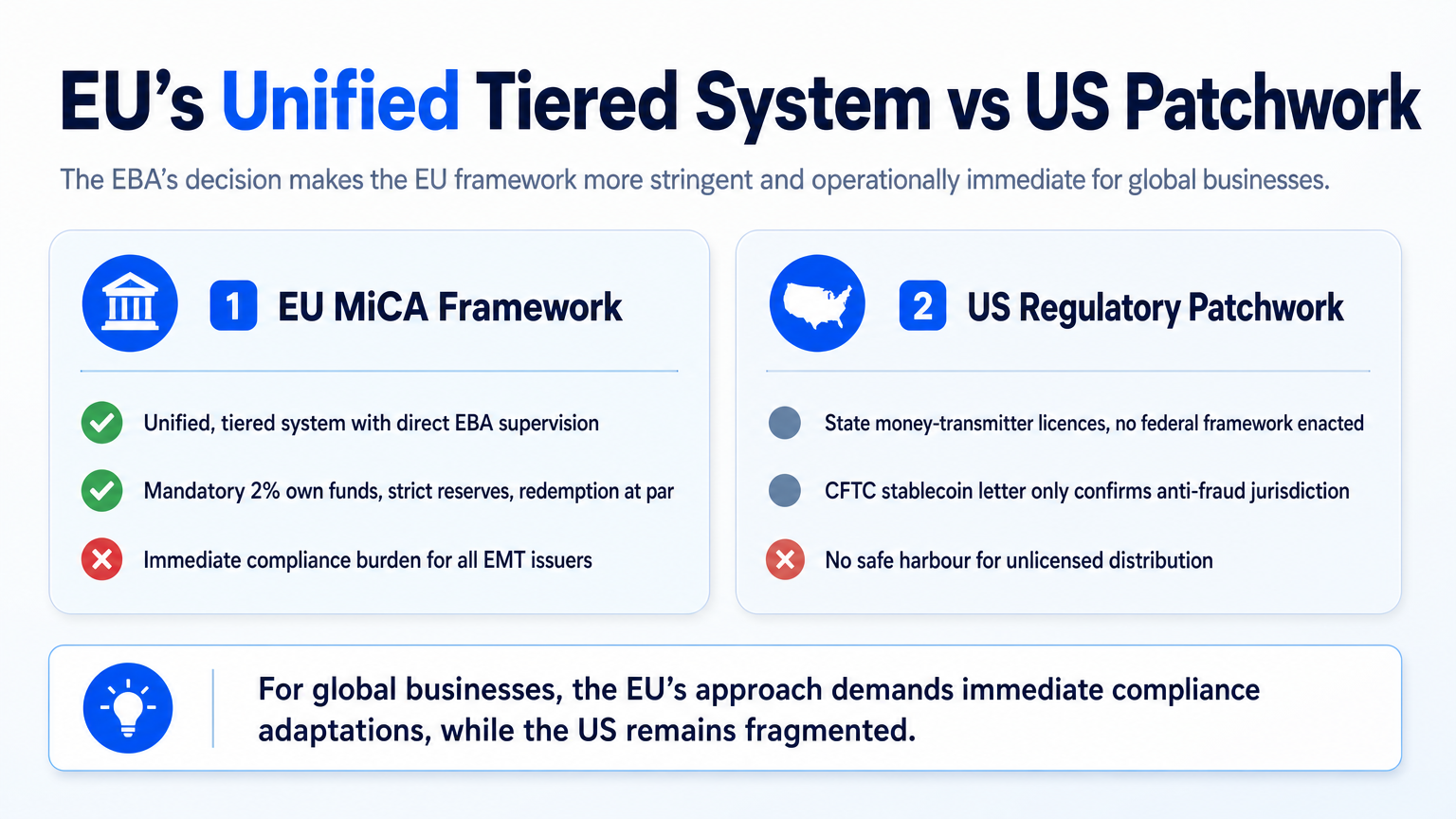
The EU now has a unified, tiered system with direct supervision of systemically important stablecoins. The U.S. still relies on a patchwork of state money-transmitter licences with no enacted federal framework, though the GENIUS Act could change that. The CFTC’s commodity letter adds a dimension but doesn’t replace issuer licensing. For global businesses, the EU’s approach is now the more stringent and operationally immediate.
Recommended actions: an operational checklist for finance leads
- Audit current USDC holdings and off-ramp partners for EU exposure, identifying any partner unable to demonstrate MiCA compliance.
- Update custodian and payment-provider agreements to include explicit MiCA significant-EMT representations on reserve segregation and redemption-at-par.
- Document a stablecoin usage policy for DAO contributors, with per-role limits and jurisdiction checks, enforced through a platform with customisable roles like OneSafe.
- Adopt a neo-banking platform built for multi-jurisdiction crypto compliance that offers multi-currency accounts, wires, corporate cards, and Fireblocks-grade custody without fragmenting compliance.
| Compliance Dimension | Pre-EBA (EMT) | Post-EBA (Significant EMT) |
|---|---|---|
| Supervisor | National authority | EBA + national authority |
| Own Funds | Standard e-money rules | Minimum 2% of reserve assets |
| Reserve Attestation | Monthly | Enhanced frequency/granularity |
| Redemption | Contractual at par | Mandatory right at any time |
| Off-Ramp Friction | Minimal | Tighter banking partner diligence |
| Custody Requirements | AML checks | Custodian must prove MiCA-compliance for significant EMT |
What to watch next
Will USDT or DAI receive the same classification?
Tether’s USDT could trigger thresholds if EU volumes climb; DAI’s multi-collateral structure may keep it outside EMT classification. USDC sets the precedent.
GENIUS Act momentum and a federal U.S. pathway
If enacted, the GENIUS Act could pre-empt state licences, reducing cross-border friction. The EBA’s move amplifies pressure on U.S. lawmakers.
How supervisors enforce significant-EMT rules
Early EBA enforcement actions—such as daily transaction limits or reserve composition orders—will set the tone. Finance teams should monitor EBA publications and issuer attestations for signs of tightening.
Key Takeaways
- USDC’s significant stablecoin EBA designation ushers in direct supervision, higher capital, and stricter reserve rules starting November 2026.
- Businesses and DAOs with EU exposure must audit USDC payment chains and adopt MiCA‑compliant stablecoin off-ramp partners.
- A neo-banking platform built for multi-jurisdiction compliance—like OneSafe—simplifies treasury management, custody, and cross-border payments under the new regime.
- The CFTC stablecoin letter does not replace issuer licensing; EU requirements add an enforceable, immediate compliance layer.
- The GENIUS Act and possible classifications of other stablecoins will define transatlantic stablecoin regulation, making adaptability a core treasury competency.
For teams that need to keep their audience informed without a dedicated writer, Joyrise plans, writes and publishes illustrated SEO articles to your Webflow blog every day—read your first article before you pay.
Sign up with OneSafe to manage fiat and crypto across jurisdictions with a platform built for the new stablecoin regulation reality.
Sources
- Regulating crypto-assets in Europe: Practical guide to MiCA
- What is MiCA Markets in Crypto Assets Regulation?
- Crypto regulation: the introduction of mica into the eu ...
Further reading