

On October 26, 2026, Canada’s Department of Finance published draft stablecoin regulations that will fundamentally reshape crypto banking for any business relying on stablecoins to settle cross‑border payments, manage treasury, or bridge fiat and digital assets. The rules, released in the Canada Gazette, mandate strict 1:1 reserve backing, a three‑business‑day redemption window, a 1% redemption fee cap, and a blanket prohibition on paying interest to token holders—directly or indirectly. For founders and finance leads running global operations, these guardrails directly alter the cost, speed, and risk of moving value between fiat and stablecoins.
Table of Contents
- What just happened: Canada proposes strict stablecoin rules
- Why it matters for crypto banking right now
- The background a newcomer needs to follow
- Concrete implications for global businesses and DAOs
- Recommended actions: what finance leads should do today
- What to watch next and open questions
- Your Questions About Canada's Stablecoin Rules Answered
- Key Takeaways
What just happened: Canada proposes strict stablecoin rules

Canada’s Department of Finance proposed the Draft Regulations Amending the Bank Act (Stablecoins) in the Canada Gazette on Saturday, October 26, 2026, as reported by Yahoo Finance. The proposal introduces hard consumer‑protection measures that would apply to any stablecoin issuer operating in Canada or targeting Canadian users.
The draft’s core requirements reshape the stablecoin operating model overnight:
- 1:1 reserve backing: Every token must be fully backed by high‑quality liquid assets—cash, government debt maturing in three months or less, and money‑market funds holding only such assets.
- Canadian custodian: Reserves must sit with a qualified Canadian custodian in segregated accounts that are bankruptcy‑remote from the issuer’s own assets.
- Redemption within three business days: Holders can demand redemption of any amount and must receive the par value within three business days.
- Redemption fee cap: Issuers can charge at most 1% of the redemption amount.
- Yield ban: Paying interest or any form of yield, directly or indirectly, is prohibited for simply holding the stablecoin.
For a deeper breakdown of these provisions, see our analysis of Canada’s new stablecoin rules.
Why it matters for crypto banking right now
In crypto banking—the set of services that let businesses hold, move, and convert both fiat and digital assets—stablecoins serve as the essential bridge. A Web3 startup paying a supplier in euros might convert USDC to EUR through a banking partner; a DAO treasury might park idle capital in stablecoins between grant rounds. The reliability of that bridge determines whether a cross‑border crypto payment settles in hours or remains stuck in a redemption queue. Canada’s draft reshapes that reliability at a fundamental level. For businesses trying to understand the full scope of crypto-fiat banking, resources like NerdWallet’s crypto bank and crypto banking 101 breakdown help clarify how these bridges function in practice.
The three‑business‑day redemption guarantee is a double‑edged tool. On one side, it gives treasury managers confidence they can exit a Canadian‑issued stablecoin quickly at par. On the other, if redemption volumes spike simultaneously, the mandatory timeline may strain issuers’ liquidity, potentially delaying actual cash delivery even if the rules are followed. For a CFO managing working capital across time zones, that uncertainty must now be priced into cash‑flow models.
The explicit yield ban eliminates the ability to earn a return on idle stablecoin balances—whether through direct interest or indirect arrangements. Any Canadian‑compliant stablecoin becomes a purely transactional instrument, not a store of value with a built‑in return. That shifts the calculus for DAOs accustomed to treating stablecoin holdings as a modest income generator, directly impacting DAO treasury management approaches.
The background a newcomer needs to follow
Stablecoins—tokens pegged 1:1 to a fiat currency, usually the U.S. dollar—are the settlement layer for crypto‑fiat banking. A business might receive a wire payment in fiat, convert it to USDC for near‑instant transfer to a crypto exchange, then swap back to fiat for payroll. Without stablecoins, the entire workflow reverts to slower, more expensive correspondent banking rails. This is why crypto banking relies on the coexistence of banks and startups that can provide both on‑ and off‑ramps. First Citizens Bank’s overview of banking built for crypto-native companies shows how traditional institutions are building these rails for digital asset firms.
Before Canada’s draft, the regulatory landscape was fragmented. The U.S. had the GENIUS Act working through Congress, which would set federal rules for payment stablecoin issuers (see the latest developments in the GENIUS Act update for October 2026). Meanwhile, the OCC took a different tack by encouraging community banks to issue stablecoins—a permissive signal detailed here. The European Union’s MiCA framework took effect, and Hong Kong advanced its own licensing regime. Against this scattered backdrop, Canada’s draft stands out for its specific, hard limits on redemption fees and yields.
Unlike many jurisdictions that have focused on issuer licensing and reserve transparency, Canada’s proposal specifies dollar figures (1% fee cap), timelines (three days), and structural prohibitions (yield ban). That clarity is rare and will force issuers—and the businesses that rely on them—to adapt with precision, rather than guess at crypto compliance boundaries.
Concrete implications for global businesses and DAOs
The 1% redemption fee cap sounds modest, but for a business sending $500,000 in international supplier payments, a 1% charge on exiting USDC means an extra $5,000 in cost, compared to near‑zero fees on some existing rails. Moreover, if a Canadian‑issued stablecoin becomes the default settlement token for a corridor, redemption delays during high‑volume periods could add unpredictable lags. Crypto banking for cross-border crypto payments now requires factoring in both the explicit cap and the tail risk of delayed access. This is especially acute for Web3 projects that depend on instant on‑chain settlement. The whole point of using stablecoins for cross-border crypto payments is to remove friction—these rules add some back.
With yield banned on compliant stablecoins, treasury managers lose the ability to generate even a modest return on idle digital dollars. A DAO holding $2M in a Canadian‑issued stablecoin would forfeit roughly $60,000–$100,000 annually in potential yield (assuming a 3–5% reference rate). Alternatives include parking working capital in non‑Canadian stablecoins that permit yield or converting idle balances into fiat deposits where interest might still be accessible. For teams building DAO treasury management processes, this is a new variable that directly impacts runway calculations.
Platforms that integrate fiat and crypto will have to decide whether to support Canadian‑issued stablecoins at all. If they do, they must build fee‑disclosure mechanisms and redemption‑risk warnings into their UIs. If they don’t, they fragment liquidity. Understanding the regulatory environment is part of any solid crypto compliance program. Milk Road’s guide on crypto banks, regulations, safety, benefits, and risks is a practical reference for navigating these decisions.
OneSafe, a financial technology company that provides neo‑banking services for global businesses and DAOs, illustrates how a unified platform can absorb regulatory shocks. Because it offers multi‑currency accounts alongside free USDC deposits and withdrawals, treasury managers are not locked into any one stablecoin. That structural flexibility means a business can hold fiat in segregated accounts, sweep funds into USDC only when needed for an on‑chain payment, and route around any emerging fee or delay. Assets in fiat are held with banking partners, while digital assets are secured on Fireblocks—a setup that separates jurisdictional risk at the digital asset custody level. This kind of architecture doesn’t eliminate the impact of Canada’s rules, but it reduces the concentration risk that a single‑coin treasury would face.
Recommended actions: what finance leads should do today
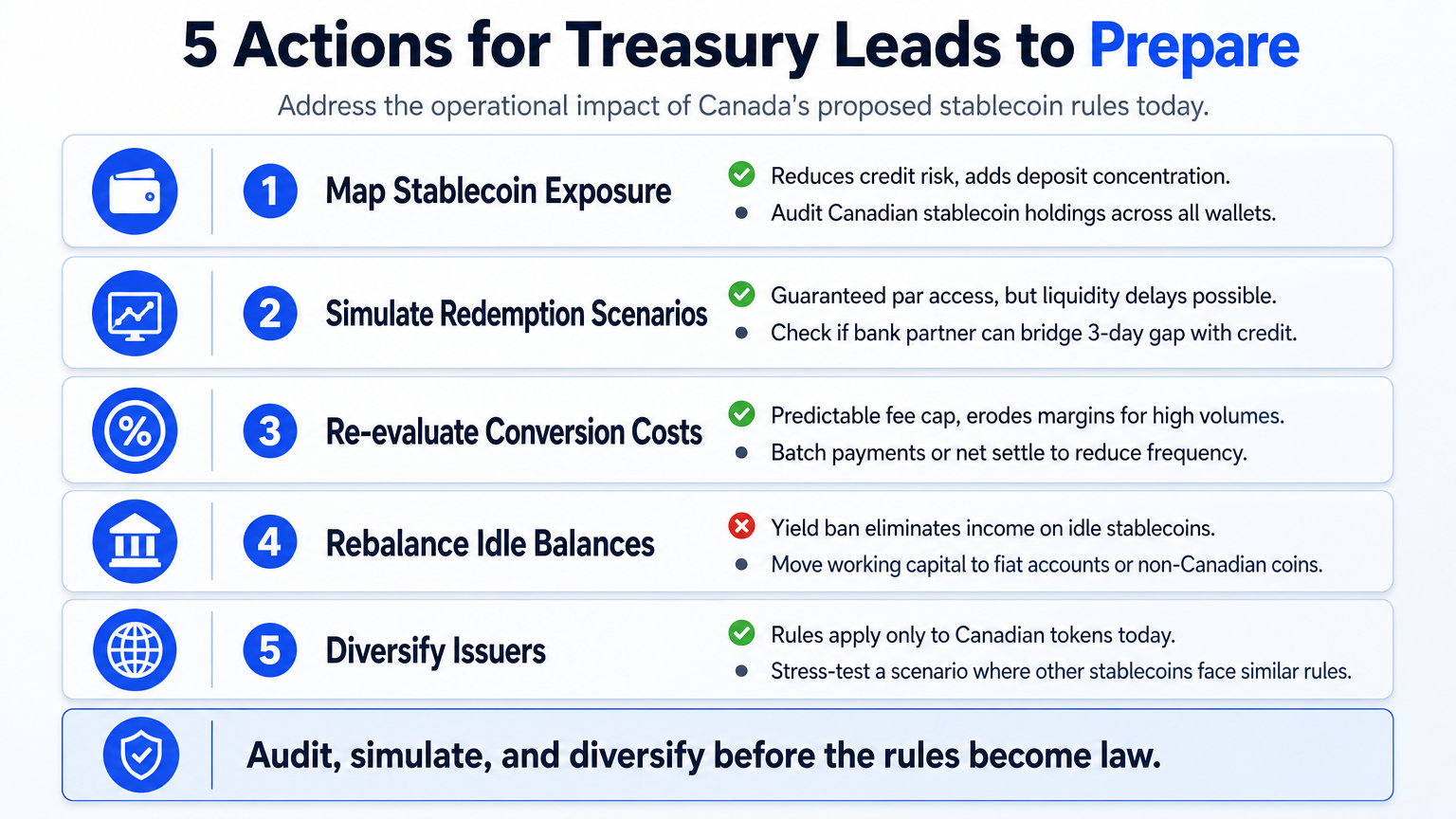
| Provision | Operational Impact | Action for Treasury Leads |
|---|---|---|
| 1:1 backing & segregated Canadian custodian | Reduces credit risk but adds deposit concentration in one jurisdiction. | Map total exposure to Canadian‑issued stablecoins across all wallets and bank partners. |
| Redemption within 3 business days | Guarantees near‑par access, but liquidity demand could delay payouts at scale. | Simulate a large redemption scenario; check if your current banking partner can bridge the 3‑day gap with fiat credit. |
| 1% redemption fee cap | Predictable costs, but still erodes margins for high‑volume payables. | Re‑evaluate the economics of frequent crypto‑fiat swaps; consider net settlement to reduce conversion frequency. |
| Yield ban (direct & indirect) | Eliminates income on idle balances. | Rebalance working capital into fiat accounts that may still earn interest, or use non‑Canadian stablecoins with caution. |
| Rules apply only to Canadian‑issued tokens | Non‑Canadian stablecoins remain unaffected today, but other jurisdictions may follow. | Stress‑test a scenario where a key non‑Canadian stablecoin adopts similar rules; diversify holdings across issuers and geographies. |
Identify exactly which stablecoins you hold, the issuer, and the jurisdiction under which the issuance is regulated. For any coin that could be classified as a Canadian stablecoin, map the contractual redemption process—this is foundational crypto compliance hygiene.
If your payment flows involve churning through Canadian‑issued stablecoins multiple times per month, the 1% fee per conversion adds up. Look at whether you can batch payments or settle in fiat where possible, using a platform that supports instant crypto‑to‑fiat conversion without locking you into a single token.
Ask your banking or payments partner: What percentage of our holdings is in Canadian‑issued stablecoins? What happens to our fiat access if that coin faces a redemption surge? The three‑day window is only as good as the issuer’s ability to liquidate reserves.
A platform that natively supports multi‑currency fiat accounts and multiple stablecoins—like OneSafe, with free USDC transfers and access to Euro, CAD, and USD accounts—gives you the ability to pivot swiftly. If a particular stablecoin becomes expensive or slow to redeem, you can shift balances to another stablecoin or into fiat without changing providers. For those exploring personal options, FV Bank’s personal banking for managing crypto and USD in one place shows how unified interfaces are becoming the norm, and Regions Bank’s intro to cryptocurrencies helps individuals understand the underlying assets. On the content side, teams scaling their crypto banking content can use Joyrise to plan, write, and publish illustrated SEO articles to their Webflow blog daily, receiving a first article before paying—useful when regulatory moves demand rapid educational output.
What to watch next and open questions
Canada’s hard numerical limits are novel. If they survive the consultation period and become law, expect G7 finance ministries to study them as a template. Japan and the U.K., both considering stablecoin legislation, may incorporate fee caps or redemption timelines.
A 1% fee cap is consumer‑friendly for small holders, but for wholesale cross-border crypto payments, it reintroduces a friction that stablecoins were meant to eliminate. The market will test whether a compliant stablecoin can offer near‑zero fees by cross‑subsidizing, or whether the cap becomes a floor for all issuers.
Some issuers may re‑domicile to avoid the yield ban and fee cap while maintaining Canadian user access through subsidiaries. The rules’ reach will hinge on whether “targeting Canadian users” triggers compliance, even if the issuer is offshore.
If fee caps spread, the “free” movement of stablecoins—a key advantage in crypto banking—will erode. The result could be a bifurcation: premium stablecoins with full backing and low caps, versus cheaper but riskier alternatives. For companies that rely on seamless global business banking, this shift will influence which neo-banking for Web3 partners survive regulatory scrutiny.
Your Questions About Canada's Stablecoin Rules Answered
What are Canada’s new stablecoin rules?
Published on October 26, 2026, the draft regulations require stablecoin issuers to hold 1:1 reserves in cash or short‑term government debt with a Canadian custodian, allow redemption within three business days for no more than a 1% fee, and forbid any form of yield—direct or indirect—to token holders.
How will these rules affect businesses using crypto banking for international payments?
Businesses that rely on Canadian‑issued stablecoins for cross-border crypto payments will face a predictable but non‑zero redemption cost (up to 1%) and a potential three‑day wait for large withdrawals. This adds a time and cost element that previously didn’t exist, requiring treasury leads to either absorb the cost or switch to alternative stablecoins or fiat rails.
What does a 1% redemption fee cap mean for my stablecoin strategy?
For a treasury that holds millions and converts frequently, a 1% loss on every redemption through the issuer is a material drag. Optimize your conversion cadence and consider using non‑Canadian stablecoins for working balances, keeping only what you intend to redeem soon in the Canadian token.
Should I move my stablecoin holdings out of Canadian‑issued coins?
If your primary use is transactional and you can accept the redemption friction, no immediate move is required. But if you hold large balances for yield or as a long‑term store of value, diversify into non‑Canadian stablecoins or fiat accounts where interest may be available.
How can a crypto‑fiat banking platform help me navigate regulatory shifts?
A well‑built crypto-fiat banking platform aggregates multiple currencies and stablecoins under one roof, so you aren’t locked into a single token. It can provide real‑time fee transparency, automate conversions, and offer segregated accounts that separate jurisdictional risks, letting you respond to rule changes without rebuilding your payments stack.
What does the yield ban mean for earning on idle digital dollars?
You cannot earn any interest from simply holding a Canadian‑compliant stablecoin. Shift those funds into non‑Canadian instruments or fiat accounts that may still generate returns.
What other regulatory changes in crypto banking should I watch for?
Monitor the U.S. GENIUS Act, the OCC’s encouragement of bank‑issued stablecoins, and any quantitative limits from EU MiCA regulators. Also watch for major stablecoin issuers redomiciling in response to this draft, as that will reshape market liquidity.
Key Takeaways
- Canada’s draft stablecoin rules introduce concrete operational limits—1% redemption fee cap, three‑day redemption, yield ban—that directly change the cost and speed of crypto banking.
- Businesses using Canadian‑issued stablecoins for cross‑border crypto payments must now factor in a 1% fee and potential redemption delays, eroding the efficiency advantage.
- The yield prohibition eliminates the ability to earn on idle stablecoin balances, forcing DAO treasury management to choose between safety and opportunity cost.
- Platforms that combine fiat and crypto multi‑currency accounts with free stablecoin transfers reduce concentration risk and offer the agility to pivot around new rules.
- Finance leads should audit exposure, stress‑test redemption paths, and diversify their stablecoin holdings immediately—before the rules move from draft to law.
For businesses that need to manage fiat and crypto in one interface without betting on a single stablecoin, explore OneSafe’s unified platform.



