On October 21, 2026, the U.S. Commodity Futures Trading Commission (CFTC) published an advance notice of proposed rulemaking (ANPRM) that directly redefines what crypto banking means for businesses holding digital assets. The proposed framework—Regulation Crypto Asset Transactions (CTX) and Regulation Crypto Asset Markets (CAM)—marks a deliberate shift from enforcement-by-settlement to explicit, fit-for-purpose crypto banking rules for retail commodity transactions involving crypto assets. For founders, finance leads, and DAO treasuries, this is not a distant policy paper; it is a compliance trigger that touches how you hold stablecoin working capital, how you pay vendors in USDC, and which platforms you trust for crypto-to-fiat conversion.
Table of Contents
- What just happened: CFTC crypto regulation 2026
- Why it matters now for businesses and DAOs
- Background: crypto banking before this moment
- Concrete implications and what to do now
- What to watch next
- Key Questions for Businesses
- Key Takeaways
What just happened: CFTC crypto regulation 2026
The ANPRM at a glance: Regulation CTX and CAM, dated October 21, 2026
On October 21, 2026, the CFTC formally released an ANPRM for two proposed regulations (CFTC Press Release 9307-26). Regulation CTX would govern retail commodity transactions where crypto assets are offered on a leveraged, margined, or financed basis to non-eligible contract participants. Regulation CAM would create an optional federal registration pathway for exchanges that want to offer leveraged crypto trading to retail customers under a single, comprehensive regime. The ANPRM asks 87 questions spanning capital requirements, crypto asset custody, disclosure, and market structure, effectively pulling large segments of crypto trading into a federal framework that the CFTC can oversee directly.
This is the first time a U.S. federal regulator has proposed a dedicated, complete rule set for the mechanics of retail crypto commodity transactions, rather than relying on ad hoc enforcement actions. The notice is open for public comment for 60 days from publication in the Federal Register, placing the comment deadline around late December 2026.
Selig's Fordham remarks: enforcement to fit-for-purpose rules
Chairman Michael S. Selig previewed the framework on October 5, 2026, at the Fordham Law Blockchain Regulatory Symposium. In his remarks, he argued that the CFTC’s existing enforcement-driven approach leaves firms guessing about what is permissible, while a clear registration pathway would lower barriers, improve investor protection, and attract responsible innovation. Steptoe LLP’s analysis of the ANPRM, published on October 21, 2026, notes that the proposal represents “a shift from enforcement-based oversight to comprehensive fit-for-purpose rules” (Mondaq / Steptoe LLP, October 21, 2026). This pivot matters because it moves crypto banking platforms and their business clients from a posture of uncertainty to one where compliance is structured, yet demands due diligence from the user side.
Separately, CFTC crypto regulation 2026 does not stand alone. Stablecoin oversight is also tightening. The GENIUS Act, which would create a federal framework for payment stablecoins, cleared the Senate Banking Committee on March 13, 2025, advancing the U.S. toward explicit crypto banking rules for dollar-pegged instruments (Reuters, "US Senate panel advances stablecoin bill," March 13, 2025).
Why it matters now for businesses and DAOs
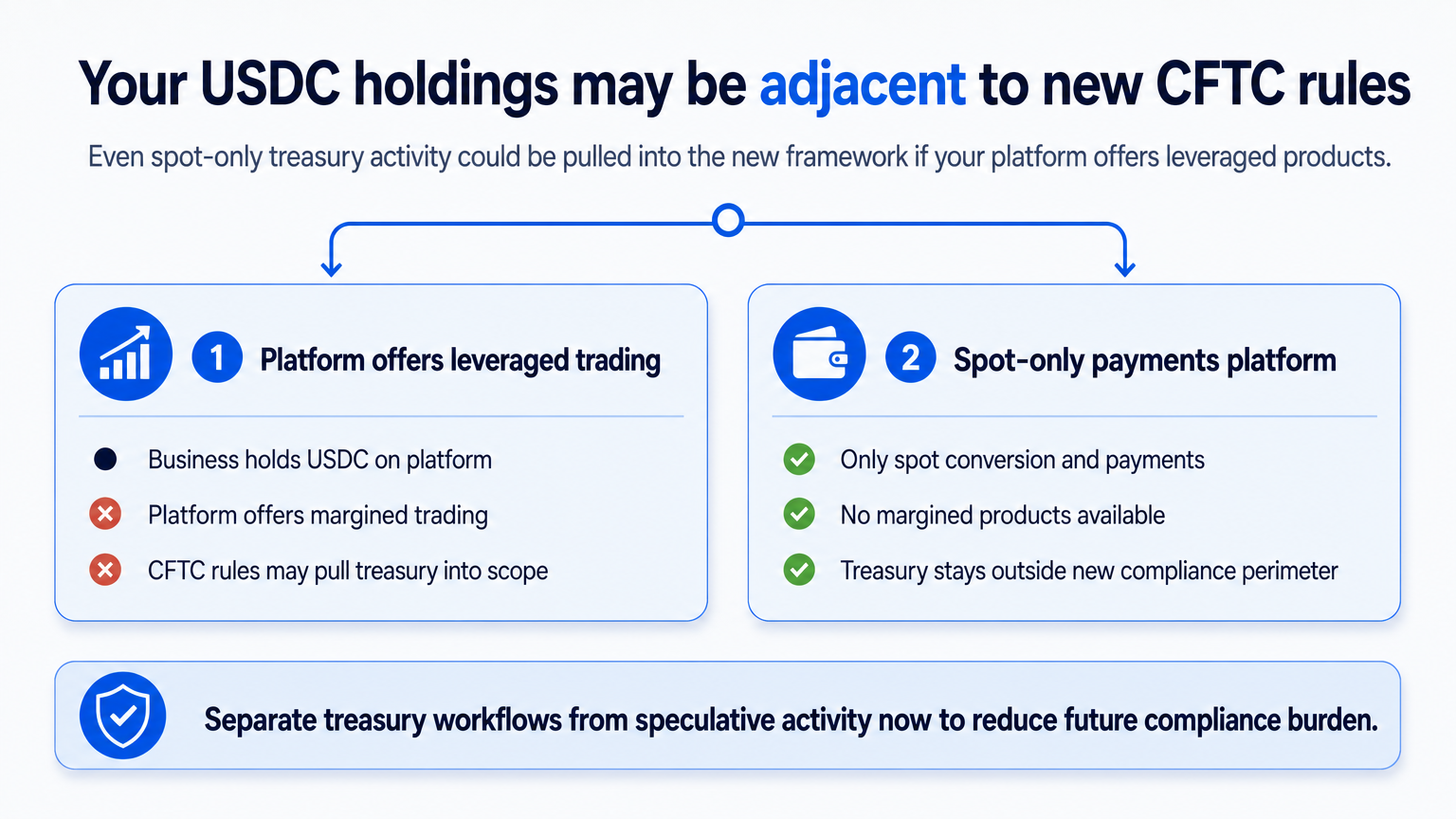
If you hold USDC or pay vendors in stablecoins, you are adjacent to the rulemaking
The ANPRM focuses on leveraged retail trading, but its perimeter question—“what is a retail commodity transaction involving crypto?”—ripples outward. If a business holds USDC on a platform that also offers leveraged products, or if it uses an on-ramp/off-ramp that directs stablecoin conversions through a partner exchange with margined trading, the proposed rules could indirectly pull those flows into a new compliance framework. Even companies that never touch leverage could see their custodial and recordkeeping obligations shift as platforms implement new controls. For DAOs that routinely make stablecoin business payments to contributors or service providers, DAO treasury compliance may depend on whether the platform segregates retail-trading activity from treasury services.
The conversation moves from 'is crypto safe?' to 'here are the rules for operating'
Most top-ranking pages for “crypto banking” still frame regulation as either hypothetical or future risk. None mention the October 2026 ANPRM. Regulation is no longer a thought experiment. The question for businesses is whether their current banking and custody stack meets the operational obligations that the CFTC and other regulators are beginning to codify.
Background: crypto banking before this moment
The existing content landscape treats crypto banking as the fusion of fiat checking accounts, multi-currency wallets, corporate cards, and crypto asset custody in a single digital interface. Multi-currency capabilities and cross-border payment speed are uniformly cited as the main business advantages. That baseline is accurate but incomplete; it omits the regulatory floor now emerging beneath those features.
The bank-vs-fintech distinction is the most material due-diligence question for business crypto accounts. A chartered digital asset bank such as Sygnum holds a banking license, operates under prudential supervision, and may provide deposit insurance, depending on the jurisdiction. A fintech company like OneSafe—which explicitly states it is a technology firm, not a bank, and that banking services are provided by its partners—offers segregated accounts, custody through Fireblocks, and mandatory MFA, but does not provide FDIC insurance. That distinction is not a weakness, but it is a material fact that must be checked at the point of onboarding.
For neo-banking for startups, this distinction is especially acute because many platforms are software layers over partner banks, not chartered institutions. A comparison tool like Spark.money’s crypto-friendly bank list can help teams see which providers carry a chartered-bank status versus which are software layers, while First Citizens Bank’s crypto-native banking division illustrates that traditional banks are also building crypto-capable rails, often with direct FDIC coverage for fiat balances.
Concrete implications and what to do now
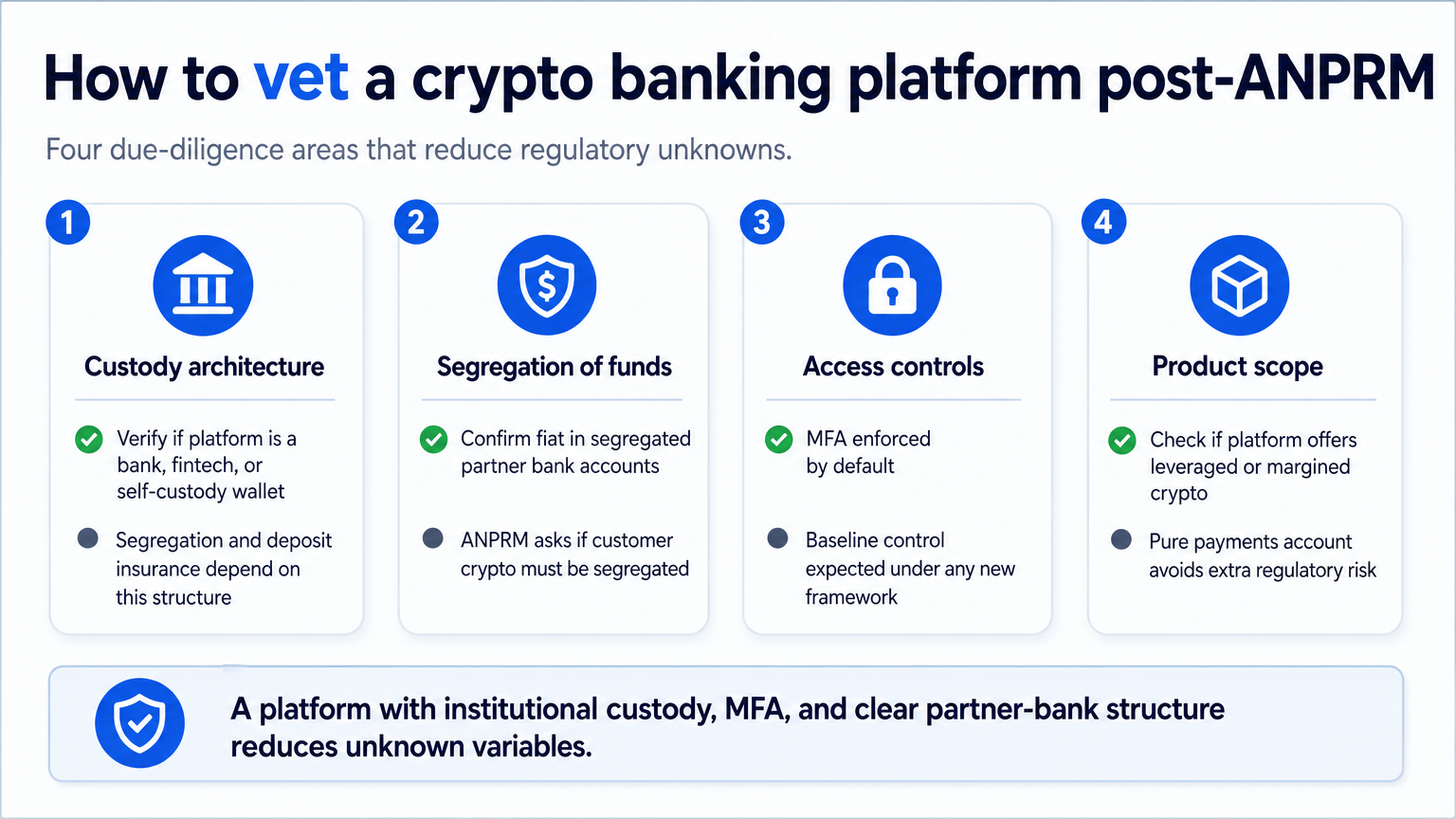
The ANPRM does not impose immediate requirements on businesses that simply hold or convert digital assets on a spot basis. But platforms that handle crypto transactions will be forced to erect clearer compliance walls between retail leveraged activity and other services. Businesses that rely on a single platform for both speculative trading and treasury management may find themselves pulled into a compliance regime not designed for them. The practical response is to harden your operational posture now.
| Due diligence area | What to verify | Why it matters post‑ANPRM |
|---|---|---|
| Custody architecture | Is the platform a regulated bank, a fintech with partner banks, or a self-custody wallet? Does it use a qualified custodian like Fireblocks? | Segregation of assets and clarity on deposit insurance change with the structure. A registered exchange may face new CFTC segregation rules. |
| Segregation of funds | Are fiat balances held in segregated accounts at partner banks? Are digital assets held 1:1 and verifiable on-chain? | The ANPRM asks whether customer crypto assets must be segregated from exchange assets. Platforms that already segregate proactively reduce contagion risk. |
| Access controls | Is MFA enforced by default? Are role-based permissions available for treasury teams? | Robust access controls are a baseline control expected under any new framework, and they limit insider-threat exposure. |
| Product scope | Does the platform offer leveraged or margined crypto products, or only spot conversion and payments? | Even if you don’t use leverage, being on a platform that offers it may subject your account to a different regulatory risk profile. A pure payments and treasury account is cleaner. |
A platform that uses institutional-grade custody, enforces MFA by default, and clearly discloses its partner-bank structure reduces unknown variables. OneSafe, for example, holds digital assets via Fireblocks and mandates MFA at signup, while fiat balances sit in segregated accounts at partner banks. Treat conversions and on/off-ramps as operational treasury, not speculation: separating treasury workflows from speculative activity is now a prudent structural choice. This means using a crypto to fiat conversion service purpose-built for business cash management, rather than a general-purpose exchange account that commingles trading and payments.
Revisit onboarding and KYC/KYB documentation now, not after rules harden. Getting onboarded with a fully documented entity avoids the queue later. The stablecoin regulation landscape is already tightening around identity and wallet screening requirements, and the CTX/CAM framework will add another layer.
What to watch next
Who counts as a 'retail commodity transaction' under CTX/CAM?
The ANPRM targets leveraged, margined, or financed transactions offered to non-eligible contract participants. But the draft asks for comment on whether spot transactions that are offered alongside leveraged products should be included. A business that merely holds USDC and converts it to fiat may not be engaging in a commodity transaction at all—but if the CFTC ultimately defines a “retail commodity transaction” to include any crypto asset sale that involves a platform holding customer funds, the reach could extend far beyond margin trading. The answer will determine whether a simple on-ramp/off-ramp provider is brought inside the regulatory perimeter.
Will DAO treasuries get explicit treatment?
The ANPRM asks about “decentralized organizations” but does not yet propose specific rules for how DAOs should register or be treated. A DAO using a crypto banking platform for contributor payments and treasury management may face a mismatch: the platform’s compliance framework is built around traditional corporate identities, while the DAO itself often lacks a legal entity. The comment period is an opportunity for DAO treasuries to push for tailored DAO treasury compliance.
Comment period and timeline
The CFTC’s formal comment period runs for 60 days after Federal Register publication, which is expected in late October or early November 2026, placing the deadline in late December 2026. Final rules are unlikely before mid‑2027 at the earliest. Still, platform-level compliance changes often start well before a rule’s effective date, so treat mid‑2026 as the inflection point when the direction of travel became unmistakable.
Key Questions for Businesses
Is my money safe with crypto banking?
Safety depends on the platform’s structure. If a platform is a chartered bank, fiat deposits may be insured. With a fintech that partners with banks, fiat funds are typically held in segregated accounts at partner banks, while digital assets are secured by a qualified custodian and protected by protocols like MFA. OneSafe, for instance, keeps digital assets on Fireblocks and mandates MFA, but does not offer FDIC insurance. Verify custody arrangements and insurance coverage before depositing.
Who can open a crypto banking account?
Generally, businesses—including startups, Web3 companies, and DAOs—can open a business crypto account if they provide formation documents, a government-issued photo ID, and, for U.S. entities, an EIN. Platforms vary in acceptance of DAOs and international clients. OneSafe, for example, serves businesses in 30+ countries (excluding OFAC-sanctioned nations and certain U.S. states).
How quickly can I open an account?
The best platforms complete onboarding in under a week, assuming the business provides complete documentation. OneSafe’s digital process typically finishes within a week and often takes 10 minutes or less to start. Rising compliance scrutiny may lengthen timelines as rules harden.
How does conversion work?
Platforms partner with exchange networks to provide crypto-to-fiat and fiat-to-crypto conversions at competitive rates. Fees are either a fixed percentage or a spread. Near-instantaneous conversion and transparent fees are key advantages over traditional bank forex desks.
What transactions can I perform?
A comprehensive crypto banking platform supports ACH, domestic and international wires, bill payments, corporate cards, crypto payments, and on/off-ramps between fiat and stablecoins. OneSafe adds automated payroll, invoicing, and DAO-specific role-based permissions.
What’s the strategic advantage of a unified platform?
A single interface that handles both fiat and crypto eliminates multiple banking relationships and manual reconciliation. It gives treasury managers real-time visibility into global cash positions. For Web3 startups and DAOs, it bridges traditional vendor payments and stablecoin business payments.
Key Takeaways
- The October 2026 CFTC ANPRM for Regulation CTX and CAM is the first explicit federal rulemaking for retail crypto commodity transactions, shifting the conversation from “what if” to “what’s required.”
- Crypto asset custody and bank-vs-fintech structure are the most material due-diligence variables for business crypto accounts, especially for neo-banking for startups.
- Separating treasury from speculative workflows is now a prudent structural move.
- Onboarding with complete KYB documentation now prevents delays when compliance requirements harden.
- DAO treasuries remain in a regulatory gray zone, but the comment period offers a window to shape DAO treasury compliance.
Ready to bring your business’s crypto treasury into alignment with the new regulatory direction? Get started with OneSafe today.