On October 21, 2026, Finextra reported that new BIS research finds cross-border payments remain expensive — but fintech firms and stablecoins now top the cost‑efficiency leaderboard, leaving traditional retail bank wires significantly more expensive (Finextra). The study accounted for FX spreads, speed, and hidden intermediary charges — the same factors a treasury team sees on real wire receipts. For corporate finance leads, that makes stablecoin payment rails a viable, measurable cost‑cutting operating line, not an experiment.
The BIS didn’t just compare sticker fees; it considered the full delivered cost. The method gives the finding operational weight: a SWIFT wire can be replaced by a stablecoin flow and deliver a meaningfully lower total cost, especially where fiat on/off‑ramps are efficient. The IMF has already observed that stablecoins can improve payments when infrastructure and oversight mature, and the BIS has published its own considerations for stablecoin cross‑border payments. While the full corridor‑level dataset is due later in 2026, the cost‑advantage signal is already actionable.
Table of Contents
- Why this matters now for finance leads
- The background you need
- Making stablecoin payments operational (without building an API)
- Where the sources disagree — and how to think about it
- Concrete actions this quarter
- What to watch next
- Key Takeaways
Why this matters now for finance leads
Cross‑border cost is a direct line item for any business paying remote contributors, vendors, or DAO contributors in different currencies. The BIS finding lets a treasury team treat stablecoin settlement as a financially defensible default for transactions in the $5,000–$50,000 range, where correspondent bank fees frequently eat 2–5% of the value. A quarter spent moving a portion of those flows to stablecoins can improve gross margin as tangibly as renegotiating a major SaaS contract.
The background you need

A stablecoin payment uses a blockchain‑based token pegged to fiat — commonly USDC. The sender converts fiat to the stablecoin, transfers it on‑chain (often settling in under a minute on networks like Solana or Ethereum L2s), and the recipient converts it back to local currency. This bypasses the correspondent banking chain entirely (see Mastercard’s stablecoins explained).
Current rails:
- Bank wires (SWIFT): 2–5% total cost including FX; settlement 1–5 business days.
- Fintech corridors (Wise): Near mid‑market rates, fees ~0.5–1%; still reliant on local banking partners.
- Stablecoin on‑chain settlement: Nearly free when both sides hold USDC. Even in the more common hybrid scenario, ramping costs (e.g., 0.25% FX plus a free deposit) undercut traditional wires. Fireblocks notes these flows are now integrating into institutional treasury operations.
Regulatory layer: In the US, the GENIUS Act distinguishes “payment stablecoins” — designed for transactions, not yield — and creates a federal framework for issuers. The yield‑fight debate over whether such tokens can pass on reserve‑asset yield will shape compliance obligations. Meanwhile, USDC has been tagged as a “significant” e‑money token under evolving global standards (details).
Making stablecoin payments operational (without building an API)
Most implementation content assumes you’ll integrate a crypto payments processor via API. That’s the right path for high‑volume platforms, but for a mid‑size finance team the faster route is to open a fiat‑crypto operating account with free USDC deposits and withdrawals and a bank‑like dashboard. For example, a platform such as OneSafe lets a business accept USDC, auto‑convert to USD or EUR, and pay vendors by domestic wire — no smart‑contract coding required.
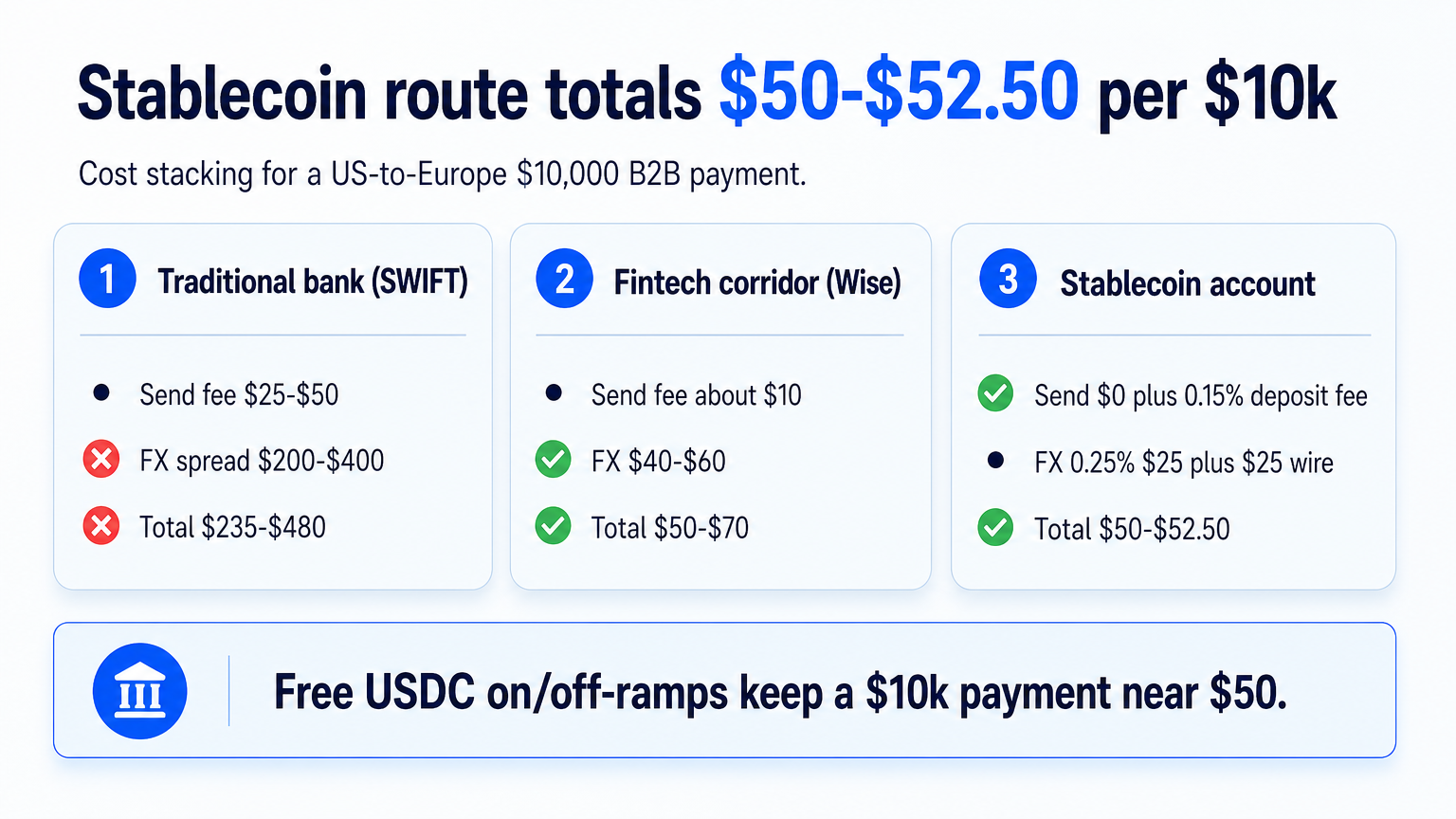
The table below breaks down the total cost for a typical $10,000 B2B payment from a US entity to a European vendor. It stacks fiat deposit fees, FX conversion, on‑chain gas (negligible here), off‑ramp spread, and any follow‑on wire.
| Cost element | Traditional bank (SWIFT) | Fintech corridor (Wise) | Stablecoin via fiat‑crypto account (OneSafe) |
|---|---|---|---|
| Send fee | $25–$50 (wire) | ~$10 (ACH) | $0 (ACH deposit, 0.15% fiat deposit fee) |
| FX spread | 2–4% ($200–$400) | 0.4–0.6% ($40–$60) | 0.25% FX ($25) |
| Additional intermediary | $10–$30 | $0 | $0 (USDC on‑ramp free) |
| Receive fee | $0 (depends on bank) | $0 | $25 (wire withdrawal if sending EUR) |
| Total estimated | $235–$480 | $50–$70 | $50–$52.50 (0.15% + 0.25% FX + $25 wire) |
Numbers assume USDC deposits and withdrawals are free (true for OneSafe), and the recipient’s bank doesn’t charge an incoming wire fee. For SWIFT, add SWIFT surcharge.
For DAOs and Web3 payroll, a platform with role‑based permissions, automated payment scheduling, and secure custody (e.g., Fireblocks) can bridge on‑chain treasuries with real‑world obligations. A core team can approve a batch USDC payment, convert it to fiat for a non‑crypto vendor, and keep a full audit trail without touching a command line.
Where the sources disagree — and how to think about it
Commercial stablecoin pages present the rails as enterprise‑ready. Central bank communications emphasise potential disruption. The practical truth: stablecoin settlement is operationally ready for many B2B flows, but the regulatory perimeter is still being drawn. Finance leads should distinguish technical readiness from legal readiness by running small‑volume pilots before replacing a primary bank pipeline.
Disputes illustrate the gap. Vendor content sometimes suggests reversals are simple, but stablecoin transactions are final by design. Stripe’s own stablecoin guide warns that refunds require the recipient’s cooperation — there is no automatic chargeback. Clear.bank reinforces this finality. The safe approach: treat stablecoin payments like wire transfers, with contractual controls upfront. Keep a fiat or card rail for consumer refunds until on‑chain dispute‑resolution protocols mature.
Concrete actions this quarter
1. Run a five‑line cost check Pick your most expensive regular corridor (e.g., USD→EUR). Model the total cost using your bank’s fee schedule and a fiat‑crypto provider’s published pricing. If the stablecoin path saves more than 50% — which it often will — you have a business case for a treasury pilot.
2. Pick a route that matches your team’s operating reality
- Crypto‑native team: Multi‑sig wallet + DeFi on/off‑ramp aggregator.
- Finance‑native team: A fiat‑crypto business account (like OneSafe) that handles USDC on/off‑ramps, multi‑currency accounts, and accounting integration through a standard interface.
3. Document compliance and custody controls Before sending stablecoins, document how private keys are managed (e.g., Fireblocks custody), who can authorise payments, and how you’ll handle a counterparty’s claim of non‑receipt. Attach this to your existing payment policy so auditors see a risk‑controlled approach. For DAOs, map stablecoin compliance steps to your governance framework.
What to watch next
The full BIS dataset will add corridor‑level detail, revealing exactly how on‑chain gas costs, exchange spreads, and local rail efficiency combine. That will let finance teams model per‑currency landing zones.
US payment stablecoin regulation under the GENIUS Act is still being defined. Final Treasury guidance and moves by large custodians — such as Lead Bank’s stablecoin API announcement — will shape bank participation. Once legal treatment of on‑chain settlement is unambiguous, the cost advantage may narrow, but early adopters can lock in better operating margins now.
Key Takeaways
- BIS research confirms stablecoin payments are materially cheaper than traditional bank wires for cross‑border transfers, alongside fintech corridors.
- A fiat‑crypto account with free USDC on/off‑ramps lets you run stablecoin payments without APIs or private‑key management.
- Total cost stacking shows typical savings of 70–80% versus SWIFT; a simple five‑line table quantifies it for any corridor.
- Stablecoin transactions are final — treat them like wire transfers, not card payments — so contractual controls are essential.
- For DAOs, stablecoin workflows can bridge on‑chain treasuries with real‑world vendor runs through role‑based platforms that handle custody and compliance.
Start simplifying your cross‑border payments today — open an account with OneSafe and experience unified fiat and stablecoin operations built for global businesses.