
You're probably here because payouts have started to break your normal finance stack.
A few contractors want USDC instead of wires. A vendor in another region can receive stablecoins today but can't reliably receive a bank transfer without delays. Your payroll team can send money, but they can't always prove who approved a wallet change, which exchange rate was used for reporting, or whether a transfer settled on-chain.
That's the difference between sending tokens and running crypto payouts as an operating system. The hard part isn't the first transfer. The hard part is making recurring payroll, contractor runs, and vendor disbursements work with controls that finance, compliance, and auditors can live with.
Table of Contents
- The move from transfers to controlled disbursements
- Where stablecoins fit
- What teams actually gain, and what they still have to build
- Start with stablecoins, then narrow by recipient reality
- Chain choice is an access problem first
- Segment payouts instead of forcing one universal rail
- Build custody around approvals, not convenience
- Wallet binding matters more than people think
- A workable control stack
- KYC and KYB need to connect the person, entity, and wallet
- Payroll taxes still run on fiat logic
- Controls that hold up in an audit
- A unified payout run
- Two common operating patterns
- Keep payment operations and spend controls connected
- What reliable reconciliation looks like
- A short troubleshooting checklist
- Reporting that survives audit
Why Teams Are Switching to Crypto Payouts Now
Monday morning, payroll is due in six countries. Two contractors want USDC, one vendor can only settle through a local exchange on a specific network, and a bank transfer to another region is still pending review. Finance can get money out, but the problem is proving who approved each payout method, which wallet belongs to which payee, and what fiat value should hit the ledger and tax reports.
That is why teams are adopting crypto payouts now. The pressure is operational.
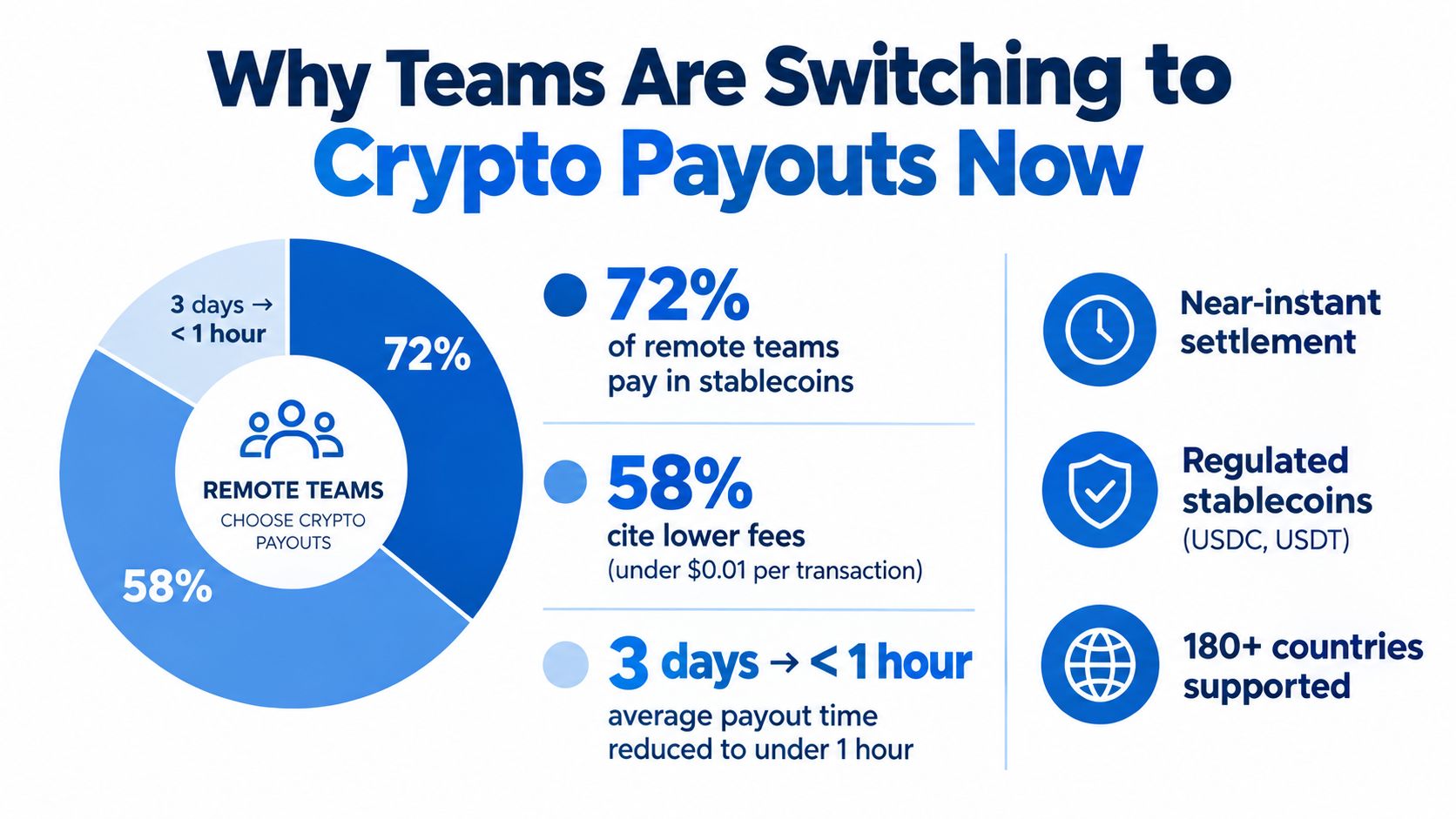
Crypto works well for companies with distributed workers, contractors, and suppliers because it removes part of the cross-border banking mess. A wallet can receive funds directly, settlement is visible on-chain, and recipients who already use stablecoins often get paid faster than they would through intermediary banks. The gain is not just speed. It is a payout rail that behaves more consistently across countries.
The move from transfers to controlled disbursements
What has changed is not simple token sending. It is the use of crypto for repeatable settlement workflows. CoinGate's H1 2026 crypto payments data report says the company processed 644,578 crypto payments in H1 2025, and by H1 2026 it reported 8,155 payouts, up from 3,887 in H2 2025 and 957 a year earlier. The same report says cryptocurrency settlements rose from 27% to 37.5% of all settlements in 2025, while fiat settlements fell from 73% to 62.5%. That pattern matters because it points to teams using crypto in actual finance operations, including disbursements and supplier settlement, not only customer payment acceptance.
From an ops standpoint, that distinction matters a lot. A one-off transfer proves a wallet can receive funds. A payout program has to stand up to month-end close, approval reviews, tax reporting, and audit questions six months later.
Where stablecoins fit
Payroll data points the same way. Rise's 2025 crypto payroll report found that 25% of businesses worldwide used cryptocurrency for payroll in 2025, up from 15% in 2023, while individual crypto-pay adoption rose from 3% in 2023 to 9.6% by the end of 2024. The report also says USDC accounted for 63% of crypto salary payments and USDT for 28.6%, so those two stablecoins represented 91.6% of the market.
That concentration is practical. Teams paying salaries, contractor invoices, or vendor bills usually need a payout asset with a stable fiat reference, broad exchange support, and fewer reconciliation headaches than a volatile token.
What teams actually gain, and what they still have to build
Crypto payouts help when the current process is full of exceptions:
- Cross-border delivery improves: recipients can receive funds without waiting on multiple banking intermediaries.
- Settlement evidence is clearer: finance can verify whether a transaction landed, when it landed, and to which wallet.
- One rail can cover more payout types: payroll, contractor pay, and vendor disbursements can run through a more uniform process.
The hard parts do not disappear:
- Wallet ownership has to be controlled: teams need wallet binding to a verified payee, plus a record of who approved any wallet change.
- Approvals need real separation of duties: maker-checker controls matter more when a wrong wallet cannot be reversed with a bank recall.
- Taxes still run in fiat terms: compensation may settle in stablecoins, but payroll records, withholding, and employer reporting still need fiat-denominated values at the right timestamp.
- Recipient usability still decides success: if the payee cannot access the chain you used or off-ramp locally, the payout is technically successful and operationally failed.
The teams making this switch successfully are not treating crypto as a shortcut around finance controls. They are using it as a payout rail, then adding the operating layer competitors usually skip: verified wallet records, approval logs, and reporting that maps every token movement back to fiat books and tax obligations.
Choosing Tokens Chains and Rails for Reliable Payouts
Choose the asset your recipients can use, on a chain they can realistically access, with a fiat backup when they can't.
That sounds obvious, but payout programs usually get messy. Finance picks a token for treasury convenience. Ops picks a chain because fees look low. Recipients then ask for a different network, or discover their exchange doesn't support deposits on the one you used.
Start with stablecoins, then narrow by recipient reality
For recurring compensation, stablecoins are the practical default. The strongest evidence sits in payroll behavior, where USDC and USDT dominate salary payments as noted earlier. That doesn't mean one is universally better. It means your choice should be driven by recipient access, treasury preference, and local off-ramp support.
A good first pass is simple:
| Option | Best For | Watch Out For |
|---|---|---|
| USDC | Teams that want a widely used stablecoin for payroll, contractor pay, and treasury workflows | Recipient exchange or wallet support can vary by region and chain |
| USDT | Markets where recipients already hold and off-ramp USDT | Internal policy teams may prefer a different stablecoin standard |
| Fiat rail | Staff or vendors who need direct bank receipt and no wallet handling | Slower cross-border processing and less direct settlement visibility |
If you're comparing stablecoin reliability for compensation policy, this breakdown of whether stablecoins are reliable for payroll is a useful framing tool because it looks at payroll from an employer operations angle rather than a trading angle.
Chain choice is an access problem first
People often reduce chain selection to fees. That's too narrow.
The better lens is this:
- Recipient off-ramp access: Can the payee receive that token on that chain and convert it locally if needed?
- Operational support: Can your team monitor confirmations and handle exceptions on that chain without confusion?
- Liquidity path: If you need to convert in or out around payroll day, is that route straightforward?
The broader settlement trend supports paying attention to chain behavior. One industry study estimated about $94.2 billion in stablecoin settlement across payment types from January 2023 to February 2025, and about $72.3 billion in monthly known stablecoin-based payments by February 2025, while also noting that most of the value was settling directly on-chain and that chain selection and confirmation latency matter in practice, according to this stablecoin settlement study summary.
That same research also warned that researchers could only aggregate roughly 1% of total nominal stablecoin settlement activity, which is a useful caution. Headline volume is not the same thing as payout usability. Treasury flows, exchange activity, and internal wallet movement can distort what looks like “payments” at the surface level.
Practical rule: Pick the rail your recipient can receive without opening a support ticket.
Segment payouts instead of forcing one universal rail
A payout program gets more reliable when you segment instead of standardize too aggressively.
Use one group for employees or contractors who want stablecoins and already maintain compatible wallets. Keep another group on bank rails because their compliance, reporting, or local cash needs make fiat cleaner. For vendors, let invoice terms drive the rail. Some should be paid on-chain. Others should stay on SWIFT or domestic transfer.
The mistake is trying to prove a point with crypto. Finance should be trying to close payout runs cleanly, not convert every payee into a crypto user.
Setting Up Custody Security and Wallet Controls
The fastest way to lose confidence in crypto payouts is weak wallet governance.
Most payout failures that hurt teams aren't exotic blockchain events. They're ordinary control failures. The wrong wallet gets approved. A contractor updates an address over email and nobody verifies it. Treasury can send funds, but nobody can later show who reviewed the destination or why an exception was allowed.
Build custody around approvals, not convenience
If you're operating at team level, custody has to support separation of duties. That usually means a business-controlled environment with role-based permissions, mandatory multi-factor authentication, and approval thresholds that match payout risk.
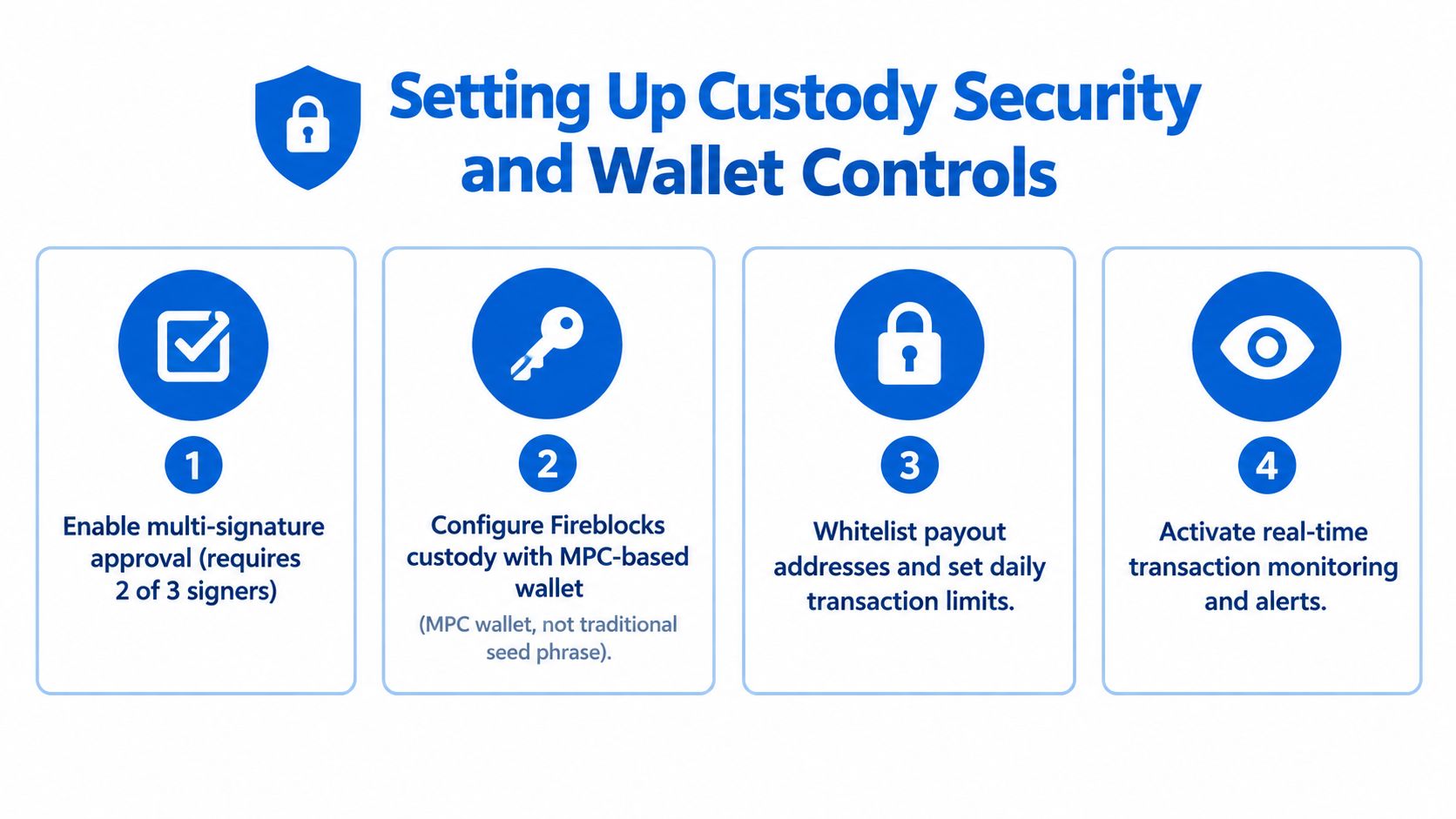
A platform like Fireblocks is commonly used because it supports institutional custody patterns that are better suited to business disbursements than ad hoc team wallets. If your team is weighing custody models, this review of the benefits and risks of self-custody wallets in crypto is worth reading before you let operational payouts live in a founder-controlled wallet.
The control pattern that works looks like this:
- Treasury funds the payout environment. Keep inbound funding and outbound payout authority visible to finance.
- Ops prepares the batch. They should be able to assemble payouts without having unilateral send authority.
- Approvers review before release. This is your maker-checker layer.
- Finance retains evidence. Approval logs, wallet records, and settlement records need to survive after the run closes.
Wallet binding matters more than people think
A wallet address isn't an identity. It's just a destination.
That's why wallet-to-person binding matters. Each payout wallet should be tied to a verified person or legal entity in your internal records, along with chain, asset, effective date, and who approved the setup. If the wallet changes, treat it like a bank detail change. Freeze use of the old record, trigger fresh review, and document the reason for the update.
Recent compliance-focused guidance for stablecoin payroll stresses wallet-to-person binding, maker-checker approvals, sanctions screening, and complete evidence retention as the controls that make payouts audit-ready, with weak wallet-change controls and incomplete approval logs listed among the biggest risks in Stablecoin Insider's coverage of stablecoin payroll controls.
A business can recover from a delayed payout more easily than from an ungoverned one sent to the wrong destination.
A workable control stack
For many teams, a practical setup includes:
- Address verification before first use: Validate wallet format, correct chain, and intended asset before a live payout.
- Approved recipient records: Keep a controlled list of wallets that have passed review.
- Maker-checker release: One person prepares. Another approves.
- Change controls: Any wallet update gets fresh verification and approval.
- Evidence retention: Save approvals, transaction hashes, payout instructions, and recipient acknowledgments where appropriate.
If you're paying both in fiat and crypto, structure your operating accounts to support that split cleanly. Treasury should be able to hold working balances, convert when needed, and keep crypto payout flows separate from ordinary card spend or reimbursement activity. The cleaner that architecture is, the less painful your month-end close becomes.
Handling KYC KYB Compliance and Payroll Taxes Correctly
Payroll closes on Friday. Someone updates a contractor wallet in chat an hour before release, finance exports the batch, and no one can show who approved the change or how the payout amount was valued in fiat. That is how a routine crypto payroll run turns into a control failure.
Crypto payouts become audit problems long before they become technical problems. The hard part is proving who you paid, why you paid them, which wallet was approved, what the fiat value was at release, and how tax and reporting records were produced from the same run.
KYC and KYB need to connect the person, entity, and wallet
Before the first recurring payout, confirm the legal identity of the payee and the role they play in your books. Employee, contractor, and vendor records should not sit in a shared bucket with only a wallet address and a display name.
For vendors and other entities, KYB should verify registration details, beneficial ownership where required, and whether the counterparty fits your risk policy. For individuals, KYC should verify identity and tie that identity to the approved payout destination. In practice, that means the wallet is an attribute of the payee record, not the record itself.

Sanctions screening belongs inside the payout workflow, alongside onboarding and release approvals. It should run before funds go out, and again if a wallet or legal entity record changes. Teams that need a starting point can use this guide to AML and KYC procedures to structure the onboarding side correctly.
Payroll taxes still run on fiat logic
Stablecoins change the rail. They do not change payroll tax treatment.
Employers still need a defensible fiat value on the payment date, payroll withholding still needs to be calculated under normal rules, reporting still needs to land on fiat-denominated forms such as W-2s or 1099-NECs, and tax deposits still need to be funded in dollars. Deel's employer guide to stablecoin regulations also notes a gap between crypto withdrawals and deposits on its platform, which points to a pattern many finance teams already follow. They keep payroll liabilities in fiat terms and convert close to payout time instead of warehousing large crypto balances all month, according to Deel's employer guide to stablecoin regulations.
That distinction matters in operations. If HR approves compensation in USD, treasury converts to stablecoins, and finance reports wages in USD, those records have to reconcile to one another without manual patching at month end.
Controls that hold up in an audit
A workable process needs more than identity checks. It needs evidence that the approved payee, approved wallet, approved amount, and approved fiat valuation all came together in one controlled run.
Use a checklist finance can enforce:
- Classify the payee correctly: Employee, contractor, and vendor treatment drives tax handling and documentation.
- Bind the wallet to the payee record: Keep the legal name, tax form, contract status, and approved destination in one controlled record.
- Require review for wallet changes: A new address should trigger fresh verification, not a silent overwrite.
- Record fiat value at release: Save the exchange rate or valuation method used on the payment date.
- Separate approval from execution: The person preparing the batch should not be the only person able to release it.
- Retain evidence: Keep approval logs, payout files, transaction hashes, and the supporting tax records together.
- Fund statutory obligations in fiat: Crypto payroll does not remove dollar-based remittance requirements.
Teams that are still tightening the reporting side can use this resource on dealing with crypto tax compliance because it focuses on the accounting and filing issues that often get missed during rollout.
If the payout clears onchain but the wallet owner, approval trail, and fiat tax records do not line up in your ledger, the run is not finished.
Running Payroll Contractor and Vendor Payouts in OneSafe
The cleanest payout setups use one operating workflow for all three categories: payroll, contractors, and vendors. The details differ, but the discipline doesn't. You fund the account, convert when needed, stage the batch, route approvals, execute the run, and archive evidence.
Here's what that looks like in practice when you want fiat and crypto in the same system.
A unified payout run
A platform such as OneSafe can be used for this because it combines multi-currency business accounts, ACH, wires, SWIFT, crypto payments, web3 invoicing, corporate cards with spend controls, and near-instant fiat-to-crypto or crypto-to-fiat conversion in one interface, with stated foreign exchange pricing of 0.25% for FX and business controls such as approvals, limits, and Fireblocks-based custody in the publisher information provided above.
That matters operationally because payout teams rarely live in a crypto-only world. They need to pay one contractor in stablecoins, settle another vendor by wire, issue an invoice in crypto, and keep internal spend controls active for the broader business.
A common workflow looks like this:
- Fund in fiat. Treasury receives operating cash into a business account.
- Convert only what's needed. If part of the run goes out in USDC or USDT, convert close to release time to reduce exposure.
- Stage payee groups separately. Payroll, contractors, and vendors should not share the same approval logic by default.
- Run approvals. Finance signs off on amount, recipient, and route.
- Execute and capture evidence. Store transfer details, confirmations, invoices, and approval logs together.
Two common operating patterns
A DAO treasury usually cares about governance first. It needs committee approvals, wallet controls, evidence retention, and a clean line between treasury holdings and operating payouts.
A tech firm paying global contractors usually cares about consistency. It wants to fund in fiat, convert selected amounts into stablecoins, pay recipients who requested crypto, and leave everyone else on bank rails without juggling separate tools.
The useful part is not the crypto feature by itself. It's the fact that treasury, payouts, and records can sit in one controlled workflow.
Here's a quick product walkthrough for teams evaluating that model:
Keep payment operations and spend controls connected
Don't overlook corporate cards and team spend just because the main problem is payouts.
If your vendor base, team reimbursements, and contractor payments all feed into the same finance close, policy controls need to connect. Spend limits, merchant controls, and approval policies reduce the chance that crypto disbursements become a side channel outside normal finance oversight.
That's the practical standard to aim for. Crypto payouts should fit into the business payment stack you already govern, not create a separate shadow process.
Reconciling Reporting and Fixing Failed Payouts
If you only track whether a payment was submitted, your payout reporting is incomplete.
For crypto payouts, the useful reliability benchmark is whether the payment was confirmed on-chain, not merely handed off to a bank, processor, or queue. That distinction matters because finance needs to know when a payout settled, while support needs to know why an exception happened.
What reliable reconciliation looks like
The strongest operating guidance here comes from payout failure handling. One operational benchmark says blockchain-native workflows can reduce failed payout rates from a traditional 3% to 7% range to under 0.3% when the system uses address validation, automated routing, and payout monitoring, according to Speed's guidance on global payouts using crypto.
The same guidance points to a simple method that works in practice:
- Pre-validate recipient wallets: Catch destination issues before release.
- Segment by chain and asset liquidity: Don't force every payout down one route.
- Classify failures before retrying: Wrong address, compliance hold, and transfer-state ambiguity need different responses.
That last point matters most. Blind retries create duplicate work and sometimes duplicate risk.
A short troubleshooting checklist
Use a triage flow that finance and ops can both understand.
- Destination error: The wallet or chain doesn't match the intended route. Stop and verify with the approved recipient record.
- Compliance hold: The payout is paused for screening or review. Keep the case documented and don't reroute casually.
- State ambiguity: The transfer was initiated but the team can't confirm final status from internal tools alone. Check on-chain confirmation before escalating.
- Funding mismatch: Fiat was available, but the crypto conversion or allocation for the run wasn't completed cleanly.
If your recipients are deciding between crypto and traditional payout methods, guidance on choosing the right withdrawal route can help frame the user-side trade-offs, especially when support teams need to explain why one route fits a given payee better than another.
Reporting that survives audit
A workable reporting pack usually includes the internal payout instruction, approval record, recipient identity record, wallet binding, fiat value used for accounting, and on-chain settlement evidence. Keep those together. Don't spread them across chat logs, browser histories, and separate spreadsheets.
The teams that scale crypto payouts well aren't the ones sending the fastest transactions. They're the ones that can answer basic finance questions without reconstructing the story afterward.
If you need crypto payouts to work like real finance operations, OneSafe offers multi-currency business accounts, fiat rails, crypto payments, approvals, and custody-related controls in one workflow. That makes it easier to run payroll, contractor, and vendor disbursements without splitting your process across separate banking, wallet, and treasury tools.