Table of Contents
- description: "The Ripple OCC charter and upcoming FSOC stablecoin custody designation make qualified custody the new baseline for crypto payroll. How to evaluate providers and stay compliant."
- What Just Happened: The Ripple OCC Charter
- Why This Matters for Crypto Payroll Right Now
- Crypto Payroll 101: What Every Operator Needs to Know
- The New Rules of Engagement for Crypto Payroll
- Implications for Companies Paying Teams in Crypto
- Open Questions and What to Watch Next
- Key Takeaways
description: "The Ripple OCC charter and upcoming FSOC stablecoin custody designation make qualified custody the new baseline for crypto payroll. How to evaluate providers and stay compliant."
Crypto Payroll After Ripple’s OCC Charter: Analysis
What Just Happened: The Ripple OCC Charter
On October 30, 2026, the Office of the Comptroller of the Currency (OCC) awarded Ripple a federal trust bank charter—the first such grant for a stablecoin issuer. The Financial Stability Oversight Council (FSOC) is expected to designate stablecoin custody as a systemically important activity as early as November 2, 2026, according to the OneSafe blog's October 31, 2026 analysis. For anyone running crypto payroll, the ground just shifted.
A federal trust bank charter—first for a stablecoin issuer
The OCC's interagency charter application for Ripple National Trust Bank confirms the institutional architecture: a federally chartered trust bank authorized to issue stablecoins and hold reserves under federal supervision. Ripple announced the final approval on October 30, 2026. Banking Dive's coverage of the unconditional approval notes the charter arrived without conditions—a departure from the conditional approvals earlier digital-asset applicants received.
Why does a bank charter for Ripple matter to a payroll manager? Because it establishes that stablecoin issuance and custody are now firmly inside the federal banking perimeter. That precedent, not the charter itself, is what cascades into payroll compliance.
FSOC’s expected designation: stablecoin custody as systemically important
The FSOC is expected to designate stablecoin custody as a systemically important activity on November 2, 2026, per the same OneSafe analysis. A systemically important designation triggers heightened supervision, capital requirements, and operational standards for custodians—standards that flow downstream to every service that touches stablecoins on behalf of customers, including payroll providers.
Why This Matters for Crypto Payroll Right Now
The twin developments convert what was previously a best-practice debate into a compliance requirement. Crypto payroll no longer sits in a gray zone where self-custody and unregulated providers can plausibly claim equivalence to bank-grade infrastructure.
Qualified custody becomes the compliance baseline
The charter plus the FSOC designation create, in effect, a federal preference cascade: regulated banks and trust companies hold stablecoin reserves and keys; payroll providers that integrate with those custodians inherit the compliance posture; providers that don't are now visibly outside the line. The Paxos analysis of how banks should manage stablecoin custody articulates the control environment expected of institutional custodians—segregation of duties, independent verification, and audit trails that self-custody setups rarely match.
The end of self-custody and unregulated payroll providers
Here's the blunt implication: self-custody and unregulated payroll providers are now a demonstrable compliance liability. A provider whose custody model is a smart contract controlled by the employer's own keys, or a pool wallet at an unlicensed exchange, sits squarely outside the regulatory structure federal agencies are actively building. For a company processing payroll across borders, that exposure is now defensible only if you're willing to argue with the federal government's direction of travel.
Crypto Payroll 101: What Every Operator Needs to Know

Before assessing the new rules, a quick grounding for operators new to the mechanics.
What is crypto payroll?
Crypto payroll is the payment of employee wages in cryptocurrency, most commonly stablecoins to avoid volatility. Employers typically contract with a provider that handles fiat-to-crypto conversion, employee onboarding, and distribution. The employer can denominate salaries in fiat and let the provider handle the rest, or denominate in crypto directly.
Benefits and trade-offs
The advantages: faster cross-border settlement, lower fees than traditional correspondent banking on international wires, the ability to pay a globally distributed team without maintaining local bank accounts in each jurisdiction, and an employee-value proposition that appeals to talent already living in digital assets.
The trade-offs: tax treatment remains jurisdiction-specific and in flux; employees bear price risk if paid in volatile assets; and payroll errors are harder to reverse on-chain. Smart operators mitigate most of this by using stablecoins and a provider with proper reconciliation.
Why stablecoins dominate—and which ones matter
Stablecoins dominate crypto payroll because they maintain a peg to fiat currency and reduce price risk. USDC is the workhorse for institutional-grade payroll due to its regulated issuer, monthly attestations, and deep integration with custodial infrastructure. USDT still moves significant volume but carries opacity concerns. DAI, while decentralized in ethos, is increasingly collateralized by USDC, which makes its "decentralized" label more complicated than it appears.
The New Rules of Engagement for Crypto Payroll
Here is where the October 30 charter and the imminent FSOC designation actually change decision-making.
How the charter and FSOC redefine custody requirements
The Ripple charter confirms that federal regulators view stablecoin issuance and custody as banking activities. The FSOC designation extends that logic to custody specifically. Together they establish a two-layer requirement for anyone handling stablecoin payroll at scale: assets should sit with a qualified custodian—a federally chartered trust bank, a state-licensed trust company, or an institution using custodial infrastructure auditable to that standard—and the payroll provider should have a documented, reviewable path from employer funds to employee wallets.
What 'qualified custody' means in practice (Fireblocks, trust charters)
Qualified custody, in practical terms, means the private keys that control payroll funds are held by an entity that meets regulatory standards for safekeeping—segregated accounts, independent technology, audit trails, and insurance or equivalent protections. The Fireblocks digital asset custody guide breaks down the technical implementation: MPC-based key management, policy engines that enforce transaction thresholds, and hardware isolation that prevents any single party from moving funds unilaterally. That infrastructure is materially different from a hot wallet or a shared seed phrase.
OneSafe, for example, secures digital assets with Fireblocks custody and mandatory multi-factor authentication—architecture aligned with the qualified custody direction federal regulators are now formalizing.
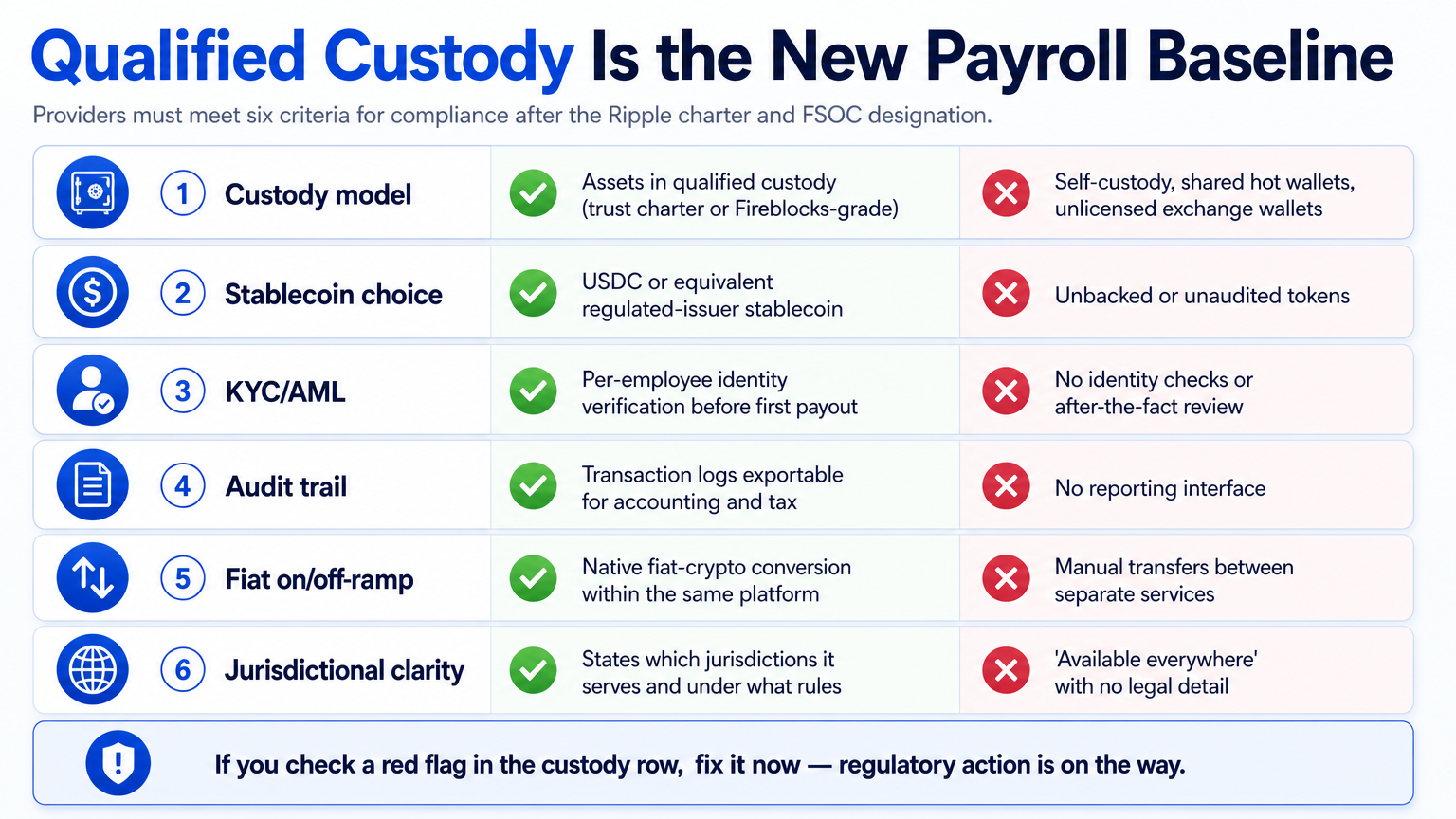
A checklist for evaluating providers post-October 30
| Evaluation Criterion | What "Compliant" Looks Like After October 30, 2026 | Red Flag |
|---|---|---|
| Custody model | Assets held in qualified custody (trust charter or Fireblocks-grade infrastructure) | Self-custody, shared hot wallets, unlicensed exchange wallets |
| Stablecoin choice | USDC or equivalent regulated-issuer stablecoin | Unbacked or unaudited tokens |
| KYC/AML | Per-employee identity verification before first payout | No identity checks or after-the-fact review |
| Audit trail | Transaction logs exportable for accounting and tax | No reporting interface |
| Fiat on/off-ramp | Native fiat-crypto conversion within the same platform | Manual transfers between separate services |
| Jurisdictional clarity | Provider states which jurisdictions it serves and under what rules | "Available everywhere" with no legal detail |
Run your current provider through this table. If you check a red flag in the custody row, the regulatory shift says: fix it now, not after the first enforcement action.
Implications for Companies Paying Teams in Crypto
From self-custody to institutional-grade security
The operational takeaway: move payroll custody to institutional-grade infrastructure now. Companies that hold payroll funds in a team wallet or a multi-sig controlled entirely by founders are running a structure regulators have signaled they will not accept. The OneSafe analysis of crypto treasury management shifts after the Ripple charter details why the same logic applies to treasury as payroll: qualified custody is becoming the floor, not the ceiling.
Impact on DAOs and Web3 startups—segments OneSafe serves daily
DAOs face the sharpest adjustment. Many paid contributors through self-custodied multi-sigs precisely because those structures avoided traditional banking. That rationale is now inverted: a DAO with a 5-of-9 multi-sig is not "more decentralized" in any sense regulators care about—it is simply unqualified custody. OneSafe serves DAOs and Web3 startups with customizable roles and permissions, secure custody via Fireblocks, and automated payment workflows, which lets a DAO preserve on-chain governance while moving the custody layer to infrastructure that meets the new standard. For more on how the Ripple charter reshapes crypto treasury management for these organizations, see What Ripple's OCC Charter Means for Crypto Treasury Management.
Why a unified fiat-crypto platform is no longer optional
Fragmentation is a compliance risk under the new regime. If an employer moves fiat through a bank, converts on an exchange, holds crypto in a self-custody wallet, and pays from a separate payroll tool, no single party can produce a complete compliance record. A unified platform that handles fiat and crypto natively—onboarding, conversion, custody, distribution, and reporting in one system—produces the auditability that the federal direction demands. OneSafe's platform combines multi-currency fiat accounts with crypto on/off-ramps and Fireblocks-secured custody, removing the seams where compliance falls through.
Fee structures and operational efficiency under the new regime
Compliance has a cost, but it need not be punitive. Qualified custody infrastructure tends to be cheaper than the operational overhead of maintaining in-house custody—hardware wallets, key ceremony logistics, recovery planning, and insurance are each expensive line items when internalized. A platform with transparent pricing (for context, OneSafe charges 0.15% on fiat deposits and withdrawals and nothing on USDC crypto deposits and withdrawals) converts fixed compliance overhead into a predictable marginal cost.
Open Questions and What to Watch Next
FSOC’s November 2 designation and the enforcement timeline
The designation itself is expected November 2, 2026, but the enforcement timeline is unknown. Regulators typically allow a transition period for new designations, but the buffer could be months, not years. Watch for interagency guidance that specifies compliance deadlines for non-bank custodians.
Tax reporting and accounting standards in flux
Crypto payroll generates reportable income in most jurisdictions, but the reporting mechanics remain inconsistent. The IRS has not issued payroll-specific stablecoin guidance; companies currently default to fiat-valuation-at-payment-date treatment. Expect new guidance as stablecoin custody formalizes—and budget for retroactive reporting risk if your current approach is undocumented.
How state-level regulators may react
State money transmitter licensing intersects with federal trust charters in ways that are not yet resolved. A federally chartered custodian may preempt some state requirements, but payroll providers that are not chartered at either level face a patchwork. Companies operating in multiple states should confirm their provider's licensing posture per state rather than assuming a federal seal covers everything.
For teams wanting to document their compliance approach publicly, Joyrise plans, writes and publishes illustrated SEO articles to your Webflow blog every day—with the first article ready before payment.
Key Takeaways
- The Ripple OCC charter (October 30, 2026) and the expected FSOC stablecoin custody designation (November 2, 2026) make qualified custody the de facto compliance baseline for crypto payroll.
- Self-custody and unregulated payroll providers are now a demonstrable liability—run your provider through a custody, KYC, stablecoin, and audit-trail checklist immediately.
- A unified fiat-crypto platform with Fireblocks-grade custody aligns with the federal direction and eliminates the operational seams where compliance failures occur.
- DAOs and Web3 startups face the sharpest adjustment: on-chain governance can remain, but the custody layer must move to institutional-grade infrastructure.
- Watch the FSOC designation's enforcement timeline, IRS stablecoin payroll guidance, and state-level reactions before assuming your current setup is sufficient.
To run compliant crypto payroll on a unified fiat-crypto platform with qualified custody, open a OneSafe account today.