October 31, 2026
The landscape of crypto treasury management changed irreversibly on October 30, 2026, when the Office of the Comptroller of the Currency awarded Ripple a federal trust bank charter — the first such grant for a stablecoin issuer (OneSafe blog, “Crypto Treasury Management After the Ripple OCC Charter”, October 30, 2026). Days later, on November 2, the Financial Stability Oversight Council is expected to designate stablecoin custody as a systemically important activity (OneSafe blog, “Crypto Treasury Management After the Ripple OCC Charter”, November 2, 2026). These twin federal actions end the era in which startups and DAOs could rely on self-custody and still meet institutional standards. The new regulatory baseline is qualified custody, and the fastest way to align is a single platform that unifies fiat and crypto operations.
Table of Contents
- What Just Happened
- Why It Matters Now for Crypto Treasury Management
- Background: Crypto Treasury Management Before the Charter
- Concrete Implications and Recommended Actions
- What to Watch Next
- Key Takeaways
What Just Happened
The Ripple Trust Bank Charter
On October 30, 2026, the OCC granted final, unconditional approval for Ripple National Trust Bank, a milestone detailed in the interagency charter application and confirmed by Ripple’s press release. This is the first time a stablecoin-focused entity has received a federal trust bank charter, reported Banking Dive on the same day. The charter grants Ripple a national platform to custody digital assets, issue stablecoins, and provide payment services under direct federal supervision, shifting the stablecoin custody model from state-level trust structures to a uniform federal framework.
Stablecoin Custody Goes Systemic
A few days later, on November 2, the Financial Stability Oversight Council (FSOC) is expected to designate stablecoin custody as a systemically important activity, according to OneSafe’s November 2 analysis of the Crypto Treasury Management After the Ripple OCC Charter. That designation would bring stablecoin custodians under heightened regulatory oversight, akin to the treatment of critical financial market utilities. Combined, the charter and the FSOC move create a clear regulatory expectation: any organization holding digital asset reserves — especially stablecoin reserves — must use a qualified custodian that meets federal standards.
Why It Matters Now for Crypto Treasury Management
Why did Ripple’s OCC charter change custody requirements?
The charter establishes a precedent that federal banking regulators will treat large-scale stablecoin custody as a supervised activity. By granting a national trust bank license specifically to a stablecoin issuer, the OCC signaled that self-custody or unregulated multi-signature setups are insufficient for organizations that hold assets on behalf of a treasury, a protocol, or a community. The FSOC’s pending systemically-important designation entrenches this view, making it highly likely that auditors, counterparties, and eventually regulators will demand that crypto-native treasuries move assets to qualified custodians — entities that meet federal capital, audit, and security requirements. This isn’t a suggestion; it’s the new baseline for compliant Ripple’s OCC Charter: Crypto Treasury Management Shift.
The End of Self-Custody for Compliant Treasuries
For years, the crypto industry debated whether self-custody via multi-signature wallets or MPC (multi-party computation) could equal the safety of a qualified custodian. The Ripple charter and FSOC ruling adjudicate that debate in favor of qualified custody as the regulatory baseline. A DAO or startup that continues to rely on a self-managed Gnosis Safe or a raw MPC setup will face growing friction: banks may refuse to on‑board, auditors will flag control deficiencies, and institutional partners will demand segregation of duties that only a licensed custodian can provide. The Ripple Charter Reshapes Crypto Treasury Management is clear: the cost of non‑compliance now outweighs the philosophical preference for self-custody.
New Demands on Startup and DAO Treasuries
Beyond custody, the new regime demands integrated fiat-crypto workflows. A startup treasury that holds USDC for payroll and vendor payments, and a DAO treasury that funds grants on‑chain, must now demonstrate that both fiat and crypto assets sit inside a governed, auditable perimeter. That means moving beyond the fragmentation of a separate bank account plus a self-custody wallet. The quickest path is a platform that offers qualified custody alongside fiat accounts, instant on/off‑ramps, and controls tailored to decentralized organizations — exactly the kind of unified infrastructure that the Ripple OCC Charter Reshapes Crypto Treasury Management blog post identifies as the key operational response.
Background: Crypto Treasury Management Before the Charter

What is a crypto treasury?
A crypto treasury is the collection of digital assets — stablecoins, native protocol tokens, and liquid cryptocurrencies — that an organization holds as working capital, reserves, or strategic investments. It includes on‑chain wallets, smart contract accounts, and any off‑chain holdings held with custodians. The treasury’s role is to ensure liquidity, fund operations, and manage risk, just like a traditional treasury, but with assets that exist on a blockchain.
What is crypto treasury management?
Crypto treasury management is the practice of overseeing the custody, allocation, risk exposure, and operational use of those digital assets. It covers decisions about where to hold assets (self‑custody vs. qualified custody), how to execute payments in crypto and fiat, how to handle volatility, and how to maintain compliance with tax and regulatory obligations. As the What Ripple's OCC Charter Means for Crypto Treasury Management analysis notes, the discipline now also encompasses alignment with federal custody standards.
How is treasury management for crypto different from traditional treasury management?
Four differences stand out. First, markets run 24/7, so risk management must be continuous. Second, volatility in non‑stablecoin assets can erode working capital quickly, demanding dynamic hedging or rebalancing. Third, the custody model — who holds the private keys — carries both operational and regulatory weight, a topic without a parallel in fiat treasury (where custody is assumed to be bank‑based). Fourth, fiat integration is a constant bottleneck; moving value between crypto on‑ramps and bank accounts is slow, expensive, and error‑prone unless the treasury stack is unified.
What does secure treasury management look like for crypto?
Secure crypto treasury management rests on three pillars: qualified custody (assets held by a regulated, insured custodian with segregated accounts), operational security (multisig governance, role‑based permissions, mandatory MFA), and comprehensive reporting that gives treasurers and auditors a single source of truth across all assets. Pre‑charter, many teams argued that a well‑constructed multisig on Fireblocks or a similar MPC provider met the bar. Post‑charter, regulators are demanding that the custodian itself be a chartered entity with oversight, not just the technology provider.
Concrete Implications and Recommended Actions
How should startups and DAOs adapt their treasury workflows now?
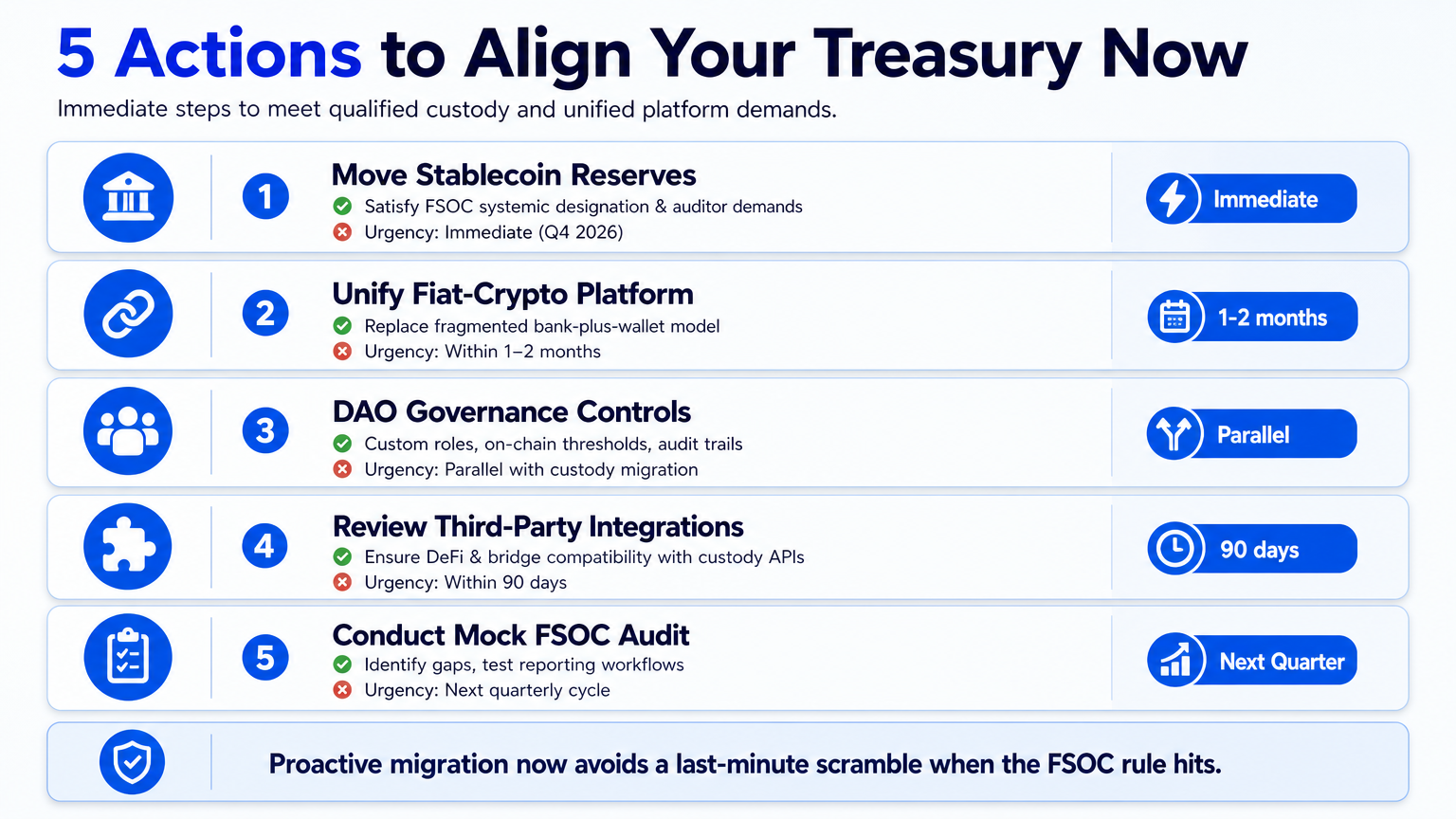
The most urgent step is to migrate all material crypto holdings to a qualified custodian and to connect that custody environment to a fiat operating account. The checklist below compresses the necessary actions into a single‑view table.
| Action | Why now | Urgency |
|---|---|---|
| Move stablecoin reserves to a qualified custodian | Meets expected FSOC systemic designation; satisfies auditor and partner expectations | Immediate (within Q4 2026) |
| Deploy a unified fiat-crypto platform | Replaces the fragmented bank‑plus‑wallet model, reducing reconciliation errors and compliance gaps | Within 1–2 months |
| Implement DAO‑specific governance controls | Customizable roles, on‑chain voting thresholds for large transactions, and automated audit trails | Parallel with custody migration |
| Review all third‑party integrations | Ensure any DeFi protocol or payment bridge used is compatible with qualified custody APIs | Within 90 days |
| Conduct a mock FSOC‑style audit | Identify gaps before regulators or partners do; test reporting workflows | Next quarterly cycle |
Below, the most critical moves in detail.
Migrate to Qualified Custody — Now
The first action is unambiguous: move all stablecoin and high‑value crypto holdings to a qualified custodian. This is not about abandoning crypto‑native principles; it’s about satisfying a regulatory requirement that is already shaping bank partnerships and audit standards. A qualified custodian that holds assets in segregated accounts with institutional‑grade security (e.g., Fireblocks‑backed infrastructure) provides the necessary segregation of duties and reporting. Procrastination will create a compliance debt that compounds when the FSOC designation becomes final.
Unify Fiat and Crypto Operations
The new requirements expose a classic pain point: startups and DAOs often maintain a business bank account for payroll and vendor payments separately from a crypto wallet for token holdings and grants. That split forces manual sweeps, duplicated KYC/KYB processes, and reconciliation nightmares. A platform that integrates fiat accounts, corporate cards, and on‑chain custody — a neo-banking for crypto model — slashes that operational load. When a DAO can pay a grant partly in USDC and partly in USD from a single interface, with roles and permissions that reflect its governance, compliance becomes a feature of the workflow, not a bolt‑on. OneSafe, for instance, offers a unified environment where multi‑currency fiat accounts and crypto custody sit under the same login, with segregated accounts and user‑specific permissioning — directly mapping to the needs described here.
Overhaul Your Risk and Governance Frameworks
DAOs face a unique challenge: the community must retain oversight while the assets sit with a qualified custodian. The solution is to encode governance into the treasury operations themselves. Start by defining on‑chain voting thresholds that must be met before the custodian can move funds, and establish role‑based access so that multisig signers in the DAO map to specific transaction limits. Pair this with automated reporting that publishes proof‑of‑reserves and transaction logs to the community. This approach preserves decentralization of decision‑making while centralizing the secure custody of assets — the only path that aligns with both the spirit of a DAO and the letter of the new rules.
What to Watch Next
The FSOC Timeline
The FSOC’s expected designation on November 2, 2026, is only the start. Within weeks, we will see the specific prudential standards the council intends to impose on stablecoin custodians. These could include capital requirements, liquidity buffers, and mandatory stress tests. Every treasury operator should monitor the FSOC’s public releases and model how those standards would affect the cost and availability of custody services. A proactive shift to qualified custody now positions a treasury ahead of any scramble when the final rule hits.
Global Regulatory Dominoes
The U.S. actions will inevitably influence regulators in the EU, UK, Singapore, and the UAE. The EU’s MiCA framework already mandates reserve custody requirements; the Ripple charter may accelerate stricter interpretations. Treasuries with cross‑border operations should watch for reciprocity agreements and the potential requirement to use custodians regulated in multiple jurisdictions. The trend is clear: fiat-crypto integration under a unified compliance umbrella will become the global norm, and platforms that already bridge that gap will be the hubs of treasury activity.
Key Takeaways
- The Ripple OCC charter and the pending FSOC designation have made qualified custody the regulatory floor for any startup or DAO holding stablecoins or digital asset reserves.
- Self‑custody via multisig alone is no longer a defensible position; auditors and bank partners will increasingly demand a chartered custodian.
- A unified fiat-crypto platform — not a patchwork of separate banking and custody stacks — is the fastest way to meet new compliance demands while reducing operational overhead.
- DAOs can preserve community governance by embedding on‑chain voting and role‑based permissions on top of a qualified custody layer, rather than sacrificing control.
- The window for voluntary migration is closing; the FSOC’s rulemaking and global regulatory mimicry will soon make proactive steps mandatory.
Open an account at OneSafe to unify your fiat and crypto treasury operations on a single platform built for the new regulatory reality.
For daily illustrated coverage of crypto treasury management shifts, Joyrise: your blog, written and published every day: Joyrise plans, writes and publishes illustrated SEO articles to your Webflow blog every day. Read your first article before you pay.