On October 8, 2026, Bitcoin businesses across Europe got a concrete upgrade for crypto payroll: a named euro IBAN that doesn’t flinch at digital assets. Bringin opened an invite-only beta of business accounts that let companies hold, accept, and pay in Bitcoin and stablecoins from a virtual IBAN held in the company’s own name – and route those funds through SEPA as easily as any traditional euro account. For payroll teams that have wrestled with frozen accounts and blocked wires, the release removes a long-standing bottleneck.
Table of Contents
- What just happened with Bringin?
- Why are European banks freezing Bitcoin companies?
- Why it matters for crypto payroll
- The background you need
- What crypto payroll platforms must do now
- Open questions and what to watch next
- Key Takeaways
What just happened with Bringin?
As reported by Bitcoin Magazine on October 8, 2026, Bringin launched euro business accounts built specifically for Bitcoin and stablecoin operations.¹ The invite-only beta lets companies open a vIBAN in the company’s own name – not a pooled or third-party label – and then hold Bitcoin, stablecoins, and euros under one roof. SEPA payments run directly from that IBAN. The account sits on Bringin’s existing consumer platform, which has processed more than €15 million in transactions.¹ The beta covers 30 European countries, giving Bitcoin-first startups a compliant, SEPA-connected home for the fiat leg of their payroll.
Why are European banks freezing Bitcoin companies?
As of today, traditional European banks are still freezing or rejecting accounts for companies that touch Bitcoin.¹ A business that receives stablecoin revenue or pays contributors in crypto often sees its bank account suspended with little explanation. Banks cite risk appetite or AML policy, but the practical result is frozen salaries and blocked payroll cycles. This has forced Web3 teams into unstable workarounds: peer-to-peer fiat off-ramps, multiple EMIs, or holding stablecoins indefinitely because converting to euro triggers a compliance review. With Bringin’s named euro IBAN, those teams can keep a fiat buffer inside an institution that explicitly supports Bitcoin, so conversion and payout steps no longer hit a hostile third-party wall.
Why it matters for crypto payroll
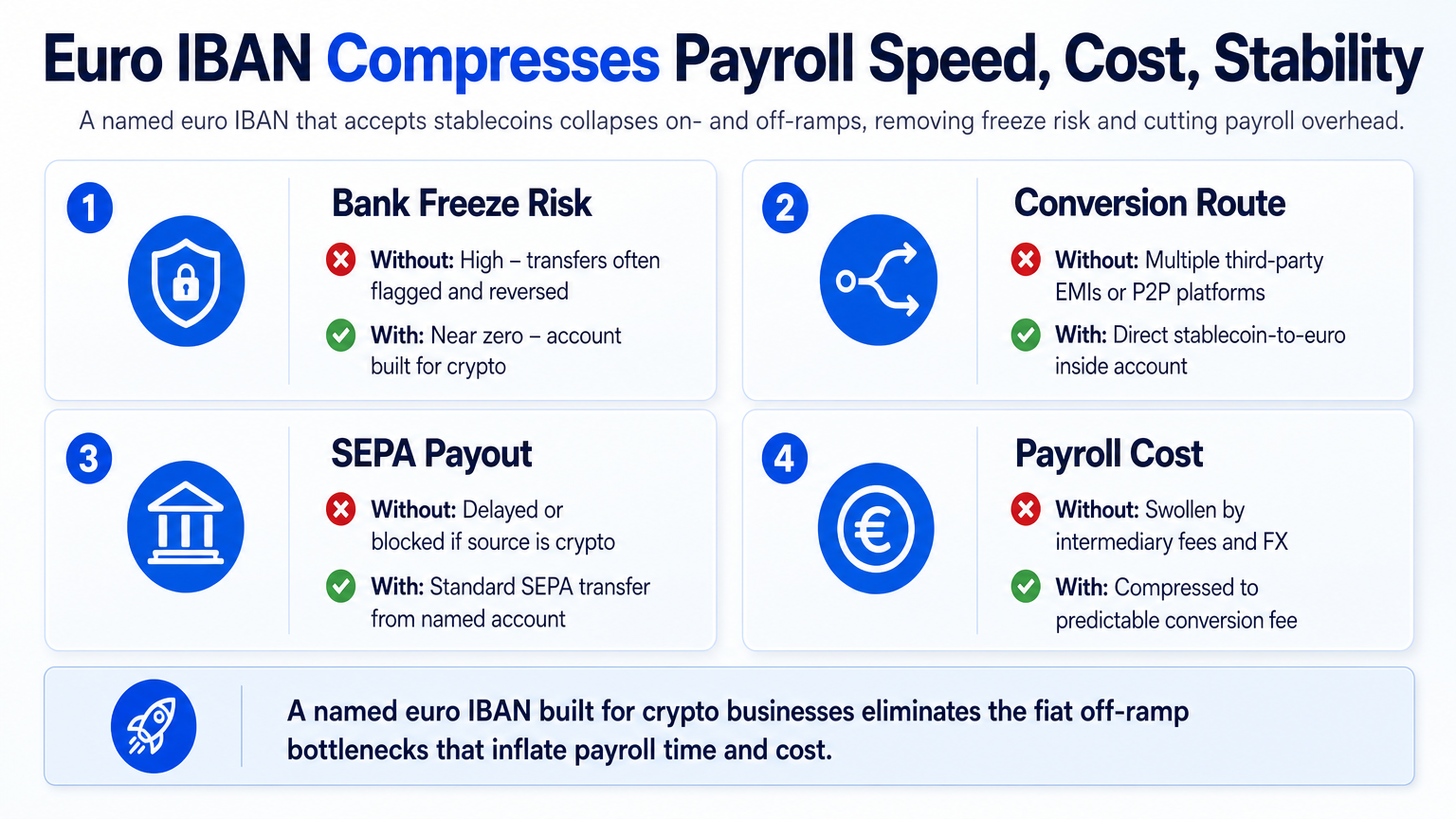
A crypto payroll process can break if an intermediary bank flags a transaction. Bringin’s euro IBAN removes that friction, letting payroll managers run SEPA credit transfers from a named account even when the source is a stablecoin conversion. Receive stablecoins → convert to euros → pay employee via SEPA, all inside one compliant environment with no freeze risk.
Most payroll cycles end in fiat. A named euro IBAN that accepts stablecoin deposits and allows instant SEPA transfers collapses the on- and off-ramps. A DAO can hold its treasury in USDC, move a month’s payroll to Bringin, convert to euros, and push salaries across the SEPA zone – no high-street bank blocking. That’s fiat-crypto payroll unification backed by an account in the business’s own name.
The beta’s 30-country reach means one IBAN covers payroll in most of the EU and EEA, eliminating a patchwork of local banks that traditional banks either won’t approve for a crypto business or will price at a premium. This drastically lowers the cost and complexity of global workforce payments for startups that live on digital-asset balance sheets.
Compressing the consensus: speed, cost, and stability
| Factor | Without a crypto-friendly euro IBAN | With a Bringin euro IBAN |
|---|---|---|
| Bank freeze risk | High – transfers often flagged and reversed | Near zero – account built for crypto businesses |
| Conversion route | Multiple third-party EMIs or P2P platforms | Direct stablecoin-to-euro conversion inside the account |
| SEPA payout | Delayed or blocked if source is crypto-related | Standard SEPA credit transfer from a named account |
| Compliance posture | Fragmented KYC and Travel Rule records across providers | Single point of KYC with Travel Rule integration |
| Payroll cost per cycle | Swollen by intermediary fees and emergency FX | Compressed to a predictable conversion fee |
The background you need
How traditional banks block crypto-related payroll
European banks classify any business that touches “virtual assets” as high-risk, even if payroll is entirely fiat. That means refusal to onboard, sudden terminations, or blocked SEPA transfers. Getting approved for a business bank account remains a top headache for Web3 founders.²
The rise of stablecoin payroll
Over the past two years, stablecoin payroll has become operational reality via platforms like Toku, Acctual, and Crossmint.³ The fiat off-ramp – converting stablecoins to euros without facing a bank freeze – remained the weakest link. A named euro IBAN that doesn’t penalize crypto revenue finally strengthens that link.
Benefits of crypto payroll
Settlement finality (seconds vs. days), borderless reach, and programmability (automated vesting, salary streaming) are the hard gains.⁴ These advantages are why adoption has grown despite headwinds.
Disadvantages of crypto payroll
Tax complexity is the largest hurdle – employees must track and report crypto income, and employers face uncertain withholding. Volatility risk exists even for stablecoins, UX friction requires wallets and exchange accounts, and custody risk means a compromised wallet can wipe out salaries with no recourse.⁵ Because of these drawbacks, most payroll managers treat stablecoin payroll as a complement to fiat salaries, not a full replacement.
Is crypto payroll legal in Europe?
Yes, mostly. MiCA provides a framework; paying in a regulated stablecoin is permissible. National tax treatments vary, and employment contracts must spell out the terms. The missing piece has been the banking layer – a compliant rail that doesn’t discriminate. Bringin’s IBAN closes that gap.
What’s still missing from the SERP
Most ranking pages skip the fiat banking prerequisite and how to integrate a named euro IBAN into a payroll stack. This analysis fills that gap by showing exactly how Bringin unblocks the last mile of stablecoin salary payouts and what steps payroll managers should take.
What crypto payroll platforms must do now
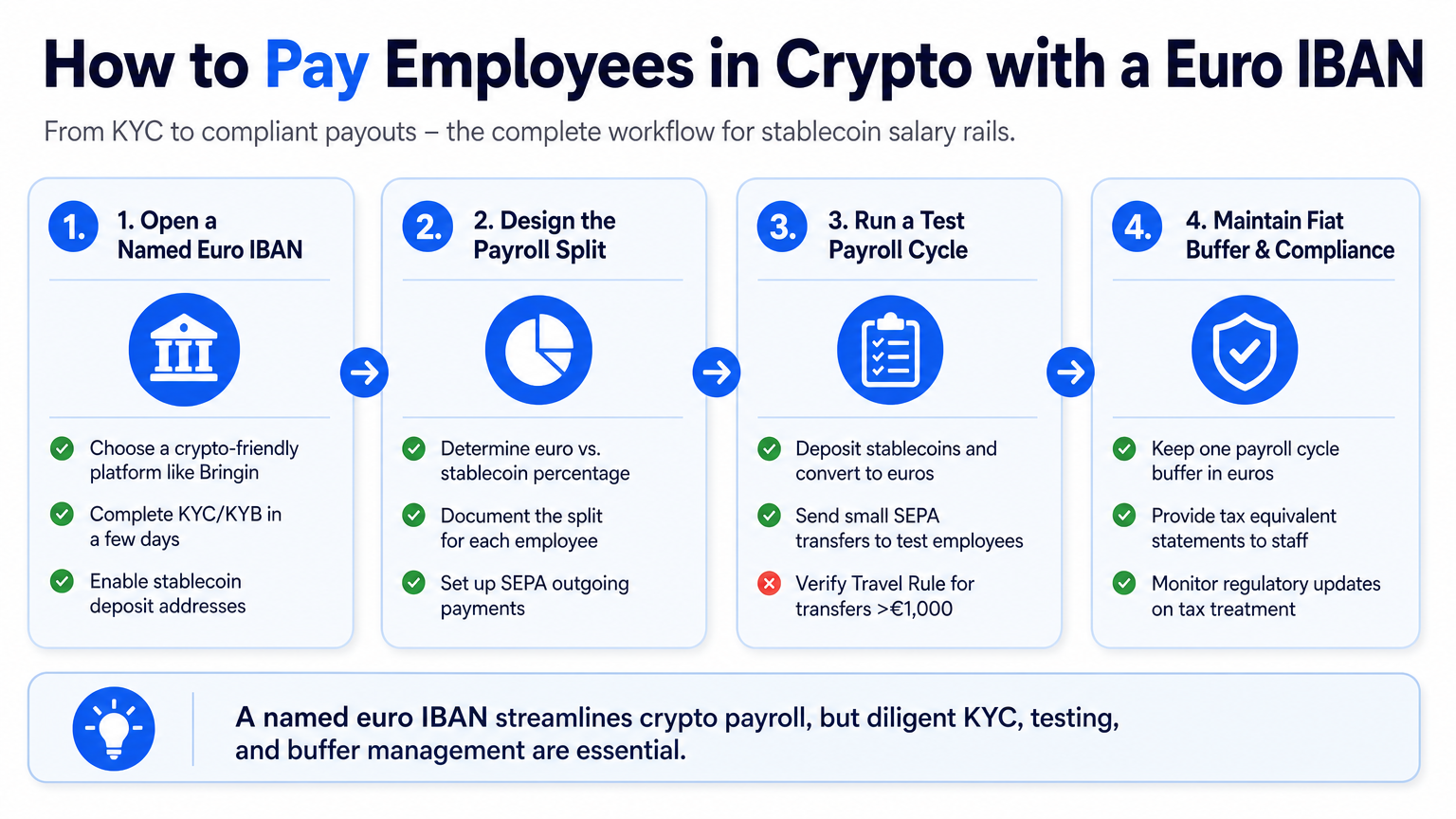
How businesses can pay employees in crypto using a euro IBAN
- Open a named euro IBAN with a platform that explicitly supports Bitcoin and stablecoin business accounts (e.g., Bringin’s beta).
- Complete the platform’s KYC/KYB; this typically takes a few days.
- Enable stablecoin deposit addresses and confirm internal conversion to euros.
- Design the payroll split (euro vs. stablecoin percentage) and document it.
- Activate SEPA outgoing payments and test with a small transaction.
- Set up Travel Rule compliance for all crypto transfers above €1,000.
- Run a sample payroll cycle end-to-end: deposit stablecoins → convert → send SEPA transfers to test employees.
- Provide employees with a tax equivalent statement at the time of payment.
- Keep a fiat buffer equal to at least one payroll cycle in euros inside the account.
- Monitor regulatory updates and adapt the split if tax treatment changes.
Integrating with SEPA-friendly banking like Bringin
For payroll providers, integrating with a SEPA-friendly partner like Bringin means connecting a euro liquidity pool to on-chain payroll rails. The IBAN becomes the fiat gateway; stablecoin transfers handle the crypto portion. Crucially, the IBAN is held in the business’s own name, preserving clear ownership and avoiding pooled-account risk.
Ensuring compliance and Travel Rule requirements
Using an independent IBAN for blockchain-based payroll concentrates compliance obligations. The EU Travel Rule requires sharing sender/recipient information for transfers above €1,000. A business must verify that every stablecoin-to-euro conversion is linked to the corresponding SEPA payment, creating an unbroken audit trail, and retain records for 5–7 years. Payroll compliance means mapping each conversion to a specific salary record.
What role does OneSafe play in crypto payroll?
OneSafe is a financial technology company (not a bank; banking services are by partners) that provides a unified fiat and crypto dashboard.⁶ For crypto payroll, it offers multi-currency accounts, instant crypto-to-fiat conversions, and zero-cost USDC transfers. With a named euro IBAN from a partner like Bringin, OneSafe can orchestrate the full payroll cycle using that IBAN as the settlement rail – automating payment rules, issuing corporate cards, and tracking crypto-to-fiat wage splits while custody sits on Fireblocks.
Open questions and what to watch next
Will other banks follow Bringin’s model?
Bringin proves demand exists. If a major B2B fintech copies the model, expansion would accelerate but also invite sharper regulatory scrutiny. For now, the invitation-only beta suggests measured growth; payroll managers should watch for public launch dates and any transaction-volume restrictions.
Regulatory clarity still missing
MiCA clarifies e-money tokens, but national labor codes still don’t address crypto-denominated wages uniformly. Until the European Banking Authority issues detailed guidance, companies running crypto payroll should structure agreements as a base euro salary with an optional stablecoin component. The fiat bridge Bringin provides makes that approach feasible for the first time at scale.
Key Takeaways
- Bringin’s named euro IBAN removes the bank-freeze risk that has blocked stablecoin salary payouts across 30 European countries, creating a viable fiat leg for crypto payroll.
- Payroll managers can now run a complete cycle – stablecoin receipt, euro conversion, and SEPA salary payments – inside a single compliant environment, cutting costs and delays.
- Stablecoin payroll offers speed and borderless reach, but tax complexity and custody risks remain; the fiat buffer approach balances innovation with employee protection.
- Businesses should integrate such an IBAN into a unified neo-banking platform to ensure Travel Rule compliance and a clear audit trail for every transaction.
- Regulatory clarity is still evolving; companies should structure crypto wages as a supplement to a base euro salary until national guidelines solidify.
Ready to simplify your global payroll with a single platform that handles fiat and crypto in one place? Open a OneSafe account today and build your payroll stack around a banking experience that works for Web3.
¹ Bitcoin Magazine, “Bringin Opens Euro Business Accounts for Bitcoin Companies Across 30 European Countries,” October 8, 2026.
² For more on banking hostility to crypto, see Is It Hard to Get Approved for a Business Bank Account?.
³ Stablecoin payroll platforms are catalogued in resources like Gloroots’ Top 6 Crypto Payroll Software for Global Teams [2026] and Eco’s Best Crypto Payroll Platforms 2026: Compared.
⁴ Mechanics and advantages are covered by Multiplier’s Crypto Payroll Explained.
⁵ Security and custody concerns are a central theme in Crossmint’s Stablecoin Payroll Infrastructure for Global Teams.
⁶ OneSafe is a financial technology company. Banking services are provided by its partners. See platform details at https://onesafe.io.