Circle’s SAP integration puts USDC and EURC into corporate treasuries, raising the bar for crypto treasury management.
On October 7, 2026, stablecoin issuer Circle partnered with Tereina to embed USDC and EURC into SAP’s payment environment, as reported by Cointelegraph. The integration targets the largest enterprises—and raises urgent questions for every business holding digital assets without an ERP backbone.
Table of Contents
- What Just Happened: Circle Targets SAP’s Treasury Ecosystem
- Why This Matters Now for Crypto Treasury Management
- Background: From Wallets to Integrated Treasury
- Concrete Implications for Businesses Holding Crypto
- Adjudicating the Divide: Can Blockchains and ERPs Coexist in Treasury?
- What This Means for Startups, DAOs, and Non-Enterprise Companies
- Recommended Actions for Finance Leaders
- What to Watch Next
- What is crypto treasury management?
- How is crypto treasury management different from traditional treasury management?
- What does secure treasury management look like for crypto?
- How can finance leaders build controls for crypto treasuries?
- How will Circle’s SAP integration affect crypto treasury management?
- Key Takeaways
What Just Happened: Circle Targets SAP’s Treasury Ecosystem
The Tereina Partnership and How It Works
Circle and Tereina, an SAP-backed financial services firm, are connecting stablecoin settlement directly into SAP’s Central Finance and Treasury and Risk Management modules. For a treasury team, stablecoin payments become a native option alongside SWIFT and ACH—no external wallet, no separate reconciliation.
Why 84% of Global Commerce Matters
Circle highlighted that the SAP ecosystem touches 84% of global commerce. When one integration can reach that much volume, regulatory and accounting infrastructure tends to follow, and corporate crypto treasury stops being a special project.
Why This Matters Now for Crypto Treasury Management
Embedding USDC and EURC as native instruments inserts stablecoin rails into the machinery that already handles cash positioning, bank connectivity, and compliance checks. The result: USDC treasury management inside a system with audit trails, FX exposure tracking, and a drastically shorter path to adoption than asking corporates to adopt a separate crypto platform.
Timing aligns with broader shifts. In March 2026, the U.S. Treasury Department dropped a controversial rule that would have classified certain crypto mixers as primary money-laundering concerns, easing compliance fears for treasuries holding transparent on-chain assets (Crypto Treasury Management Shifts as Treasury Drops Rule). Circle’s move lands in a year when regulated stablecoins are increasingly seen as payment infrastructure, directly affecting how auditors and risk committees evaluate crypto treasury risk.
Background: From Wallets to Integrated Treasury
Crypto Treasury Management in a Nutshell
Crypto treasury management handles digital assets alongside fiat for liquidity, payments, and short-term investments—covering custody, signing policies, sweeps, and audit-ready reporting. Until recently, the toolset was split.
The Gap Between Crypto-Native Startups and Enterprise Systems
Web3 startups and DAOs often use a mix of Gnosis Safe, on-chain tools, and crypto-friendly banks. Large corporations rely on Gartner-listed Treasury Management Systems (Best Treasury Management Systems Reviews 2026) that historically ignored crypto. That meant a DeFi protocol could deploy $50 million in stablecoins instantly but couldn’t automate a vendor payment in SAP’s format—and a multinational could do the reverse but had no way to hold USDC on its balance sheet without a special-purpose account.
Concrete Implications for Businesses Holding Crypto
New Options for Liquidity and Payment Efficiency
For SAP users, the integration could cut cross-border settlement from days to minutes, remove correspondent bank fees, and simplify intercompany netting. Circle’s internal treasury case study shows USDC dramatically reduced settlement time and cost (Intercompany Treasury Management with USDC - Circle). The real unlock is holding a single pool of USDC and routing it to subsidiaries, suppliers, and exchanges without leaving the primary system.
Rethinking Security and Custody in a Multi-System World
ERP integration doesn’t eliminate the need for proper key management. Multi-party computation (MPC) and hardware security modules remain baseline requirements (Crypto Treasury Management: Enterprise Guide 2026). The custody backend still matters, just layered under a familiar UI.
The Compliance and Reporting Puzzle
Stablecoin payment integration inside an ERP can improve audit trail data capture but sharpens the need for transaction monitoring and sanctions screening. The combination of on-chain traceability and SAP’s compliance modules could create a stronger control environment than many standalone crypto platforms—if implemented correctly.
Adjudicating the Divide: Can Blockchains and ERPs Coexist in Treasury?
The Case for Native Crypto Platforms
Crypto-native treasury tools—from on-chain multi-sigs to institutional platforms like BitGo (Crypto Treasury Management)—provide direct settlement, composable smart contracts, and complete key policy control. For DAOs and crypto-first startups, that flexibility is critical.
The Case for SAP Integration
SAP integration gives corporate treasurers something native tools lack: seamless connection to the general ledger, procurement, and bank relationships. For a multinational, it means USDC operates alongside 50 fiat currencies in the same cash pool without retraining staff or ripping out the ERP.
A Hybrid Future—and Where That Leaves Everyone Else
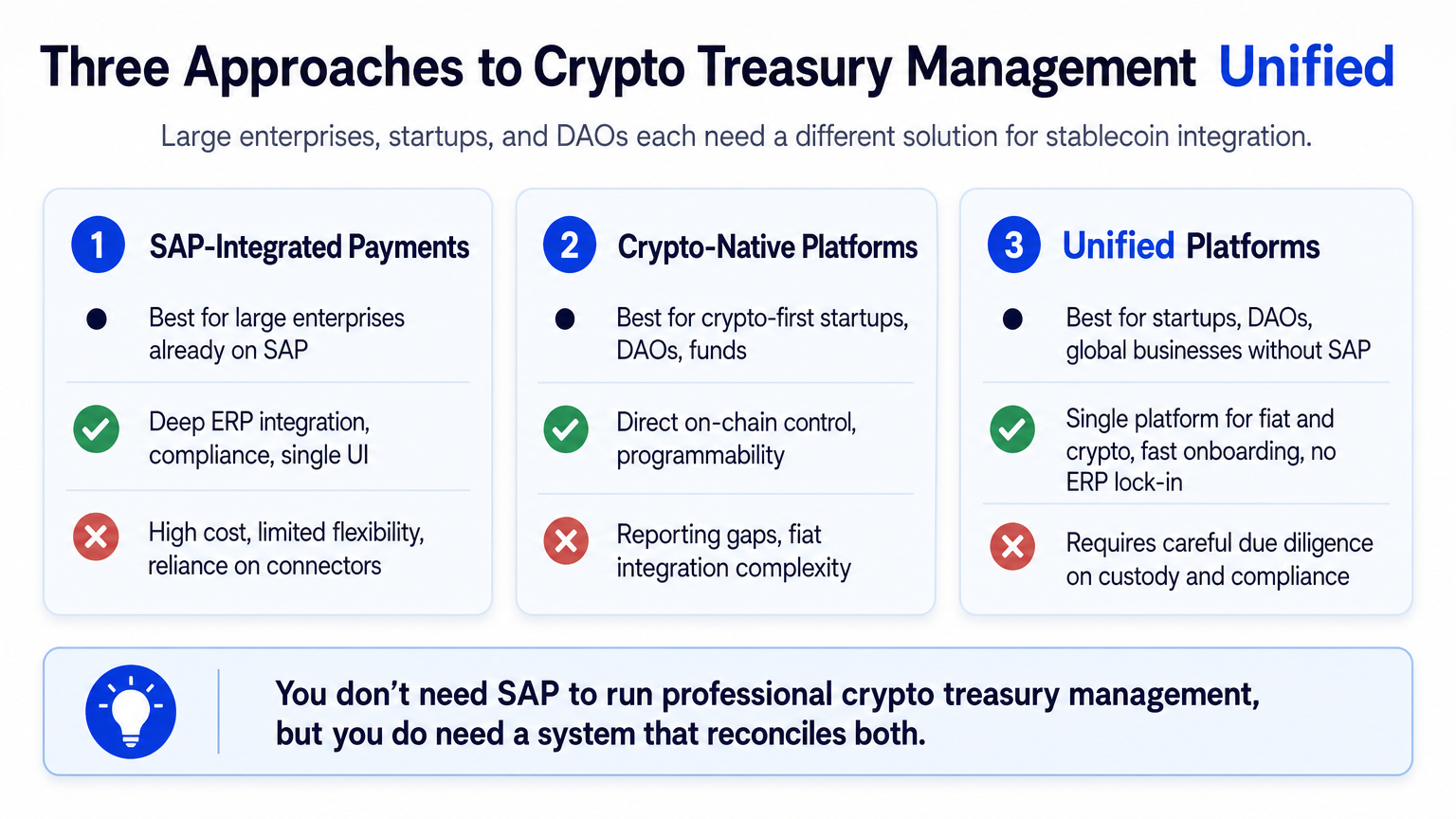
Both approaches have merit. Large enterprises will keep their ERPs and plug in stablecoin modules. Others—especially startups, DAOs, and mid-market firms without an SAP license—need a different path. Unified platforms that provide fiat and crypto accounts, corporate cards, and automated treasury workflows can bridge the two worlds. You don’t need SAP to run professional crypto treasury management, but you do need a system that reconciles both.
| Approach | Best for | Strengths | Watch out for |
|---|---|---|---|
| SAP-integrated stablecoin payments | Large enterprises already on SAP | Deep ERP integration, compliance, single UI | High cost, limited flexibility, reliance on connectors |
| Crypto-native treasury platforms | Crypto-first startups, DAOs, funds | Direct on-chain control, programmability | Reporting gaps, fiat integration complexity |
| Unified neo-banking / treasury platforms | Startups, DAOs, global businesses without SAP | Single platform for fiat and crypto, fast onboarding, no ERP lock-in | Varies; requires careful due diligence on custody and compliance |
What This Means for Startups, DAOs, and Non-Enterprise Companies
The Growing Divide Between SAP Users and the Rest
Circle’s SAP move risks widening the infrastructure gap. SAP customers will soon access native stablecoin rails inside their core financial system. Companies outside that ecosystem—bootstrapped startups, DAOs, Web3-native teams—could be locked out of that efficiency unless they have an alternative stack that delivers comparable operational control. Corporate treasury standards are being rewritten; inaction leaves a gap that auditors and counterparties will notice.
How Platforms Like OneSafe Bridge the Gap
For businesses that can’t—or won’t—deploy an SAP module, a neo-banking platform that handles fiat and crypto in one place becomes the pragmatic bridge. OneSafe, for example, provides multi-currency accounts, zero-cost USDC deposits and withdrawals, instant crypto-to-fiat conversions, and automated payment workflows through a single interface that can serve as a lightweight treasury command center. The platform’s Fireblocks-backed custody, role-based permissions, and built-in compliance mirror the control layers SAP treasurers expect, without demanding an ERP migration. This model delivers USDC treasury management operationally comparable to the Circle-SAP integration, just on different infrastructure.
Recommended Actions for Finance Leaders
Assess Your Current Treasury Stack
Map every tool you use for fiat and crypto and ask: would a large USDC payment or an audit request break your process? List every manual step between payment initiation and final settlement.
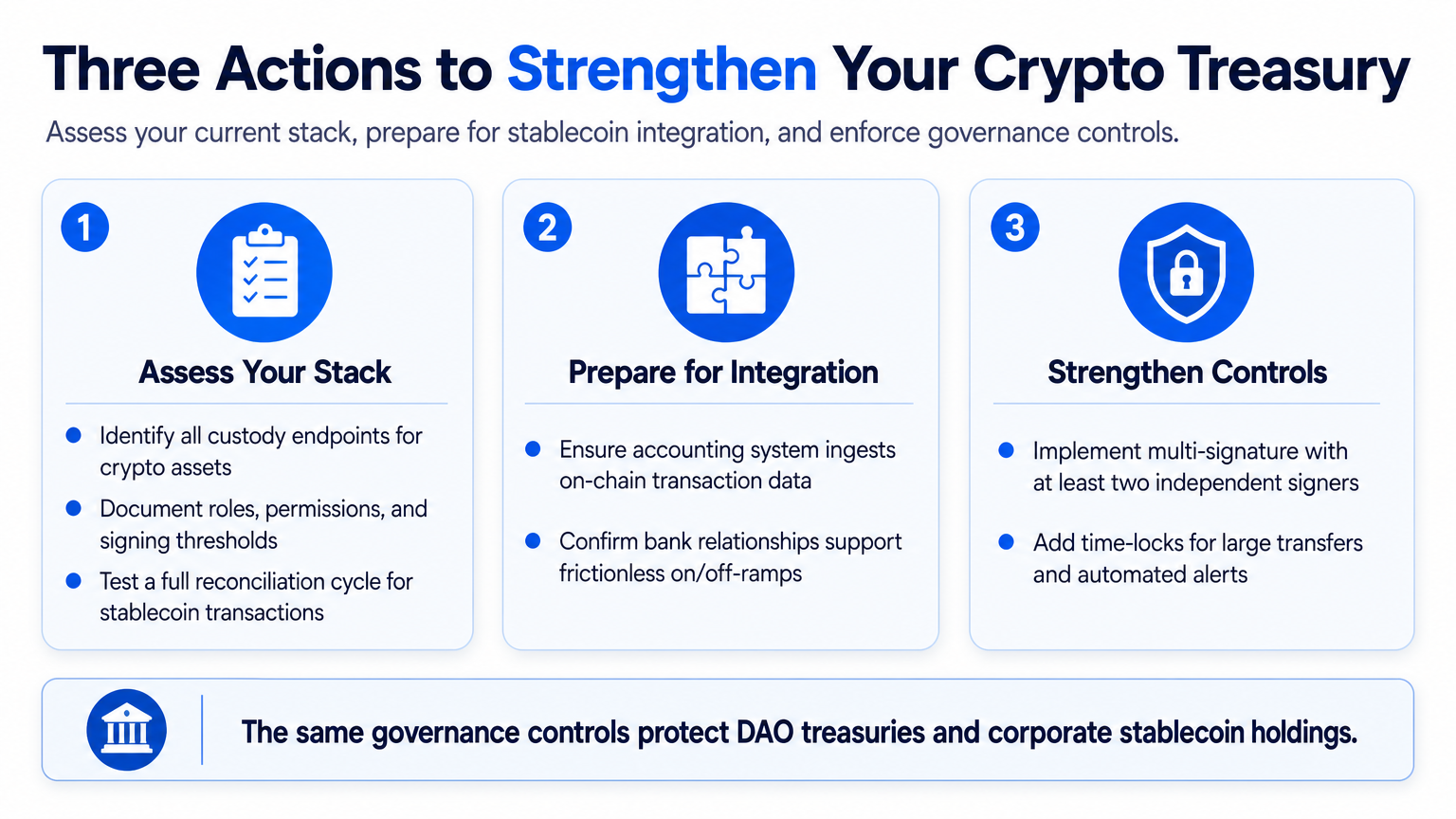
- Identify all custody endpoints for crypto assets
- Document roles, permissions, and signing thresholds for every wallet
- Map how fiat and crypto accounts are funded and swept
- Test a full reconciliation cycle for a stablecoin transaction
- Note which systems lack real-time data feeds
Prepare for Stablecoin Integration in Your Toolchain
Even without SAP, the market is moving toward ERP-embedded and platform-level stablecoin rails. Ensure your accounting system can ingest on-chain transaction data and that your bank relationships support on/off-ramps without friction. For a detailed technical breakdown, see Stablecoin Payments Come to SAP: What Circle’s Deal Means.
Strengthen Governance and Controls Regardless of Platform
High-profile governance votes like Compound’s treasury allocation highlight what happens when governance and execution diverge (Crypto Treasury Management: Lessons from Compound's Vote). Implement best practices: multi-signature authorization with at least two independent signers, time-locks for large transfers, and automated alerts for out-of-policy movements. The same controls protect a DAO treasury and a corporate stablecoin holding.
What to Watch Next
Circle hasn’t announced a go-live date; hurdles like SAP S/4HANA compatibility and bank-partner approvals remain. The real test is whether USDC volumes migrate onto SAP rails. Watch for other stablecoin issuers and TMS vendors like Kyriba or FIS adding native stablecoin support. Regulation remains the wildcard—the U.S. stablecoin bill debate could reshape the compliance landscape overnight.
What is crypto treasury management?
Crypto treasury management covers the processes, tools, and controls to hold, move, and account for digital assets—especially stablecoins—alongside fiat. It spans custody, payment execution, liquidity management, and financial reporting, requiring crypto treasury management software or integrated platforms that unify on-chain and banking data.
How is crypto treasury management different from traditional treasury management?
Traditional treasury management operates entirely within the banking system and ERPs, managing cash, debt, and FX through fiat rails. Crypto treasury management adds blockchain-native settlement, digital asset custody, and real-time on-chain positions, demanding new risk frameworks for smart contract risk, key compromise, and regulatory uncertainty.
What does secure treasury management look like for crypto?
Secure crypto treasury management rests on (1) qualified custody or institutional MPC/HSM key storage, (2) policy-driven transaction authorization with multi-signature and spending limits, (3) independent reconciliation between on-chain data and internal books, and (4) continuous monitoring for anomalies.
How can finance leaders build controls for crypto treasuries?
Start with role-based access and segregation of duties. Enforce transaction limits, require multi-party approval for high-value transfers, and maintain an immutable log. Integrate on-chain data into financial reporting so every movement ties to a business purpose. For DAOs, customizable roles can encode governance votes directly into treasury execution.
How will Circle’s SAP integration affect crypto treasury management?
It accelerates enterprise crypto treasury by placing stablecoin rails inside the dominant ERP system, reducing friction for SAP customers. It validates stablecoin payment integration as a serious corporate capability and will likely push regulatory clarity. Non-SAP businesses will feel pressure to adopt comparable integration, whether through SAP alternatives or unified platforms.
Key Takeaways
- Circle’s October 7, 2026 Tereina partnership embeds USDC and EURC into SAP, turning stablecoins into native ERP instruments and upgrading enterprise crypto treasury.
- The integration serves large SAP-using corporations but creates a divide that startups, DAOs, and mid-market firms must bridge through unified platforms.
- Secure crypto treasury management still depends on MPC-grade custody, policy-based approvals, and rigorous reconciliation—no ERP changes that.
- Finance leaders should immediately map their current treasury stack, test reconciliation cycles, and confirm their platform can handle stablecoin flows natively.
- The Circle-SAP move signals USDC treasury management becoming a baseline expectation, not a competitive advantage.
Start building a treasury stack that handles fiat and crypto together, with no ERP required—explore the OneSafe platform.